

Memoirs of the Life of Agrippina
- London: Printed by R. Cruttwell for G. and J. Robinson, 1804
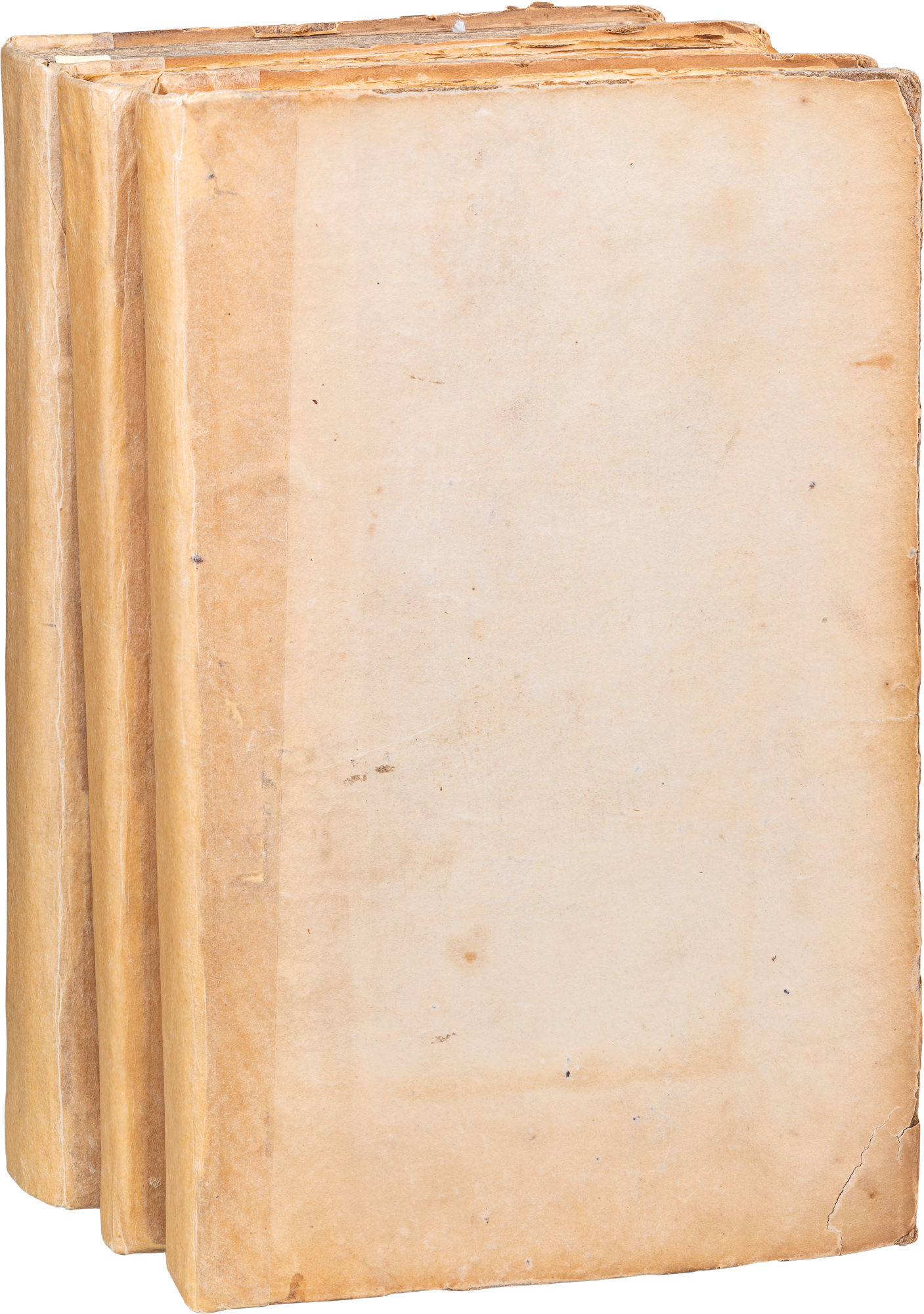
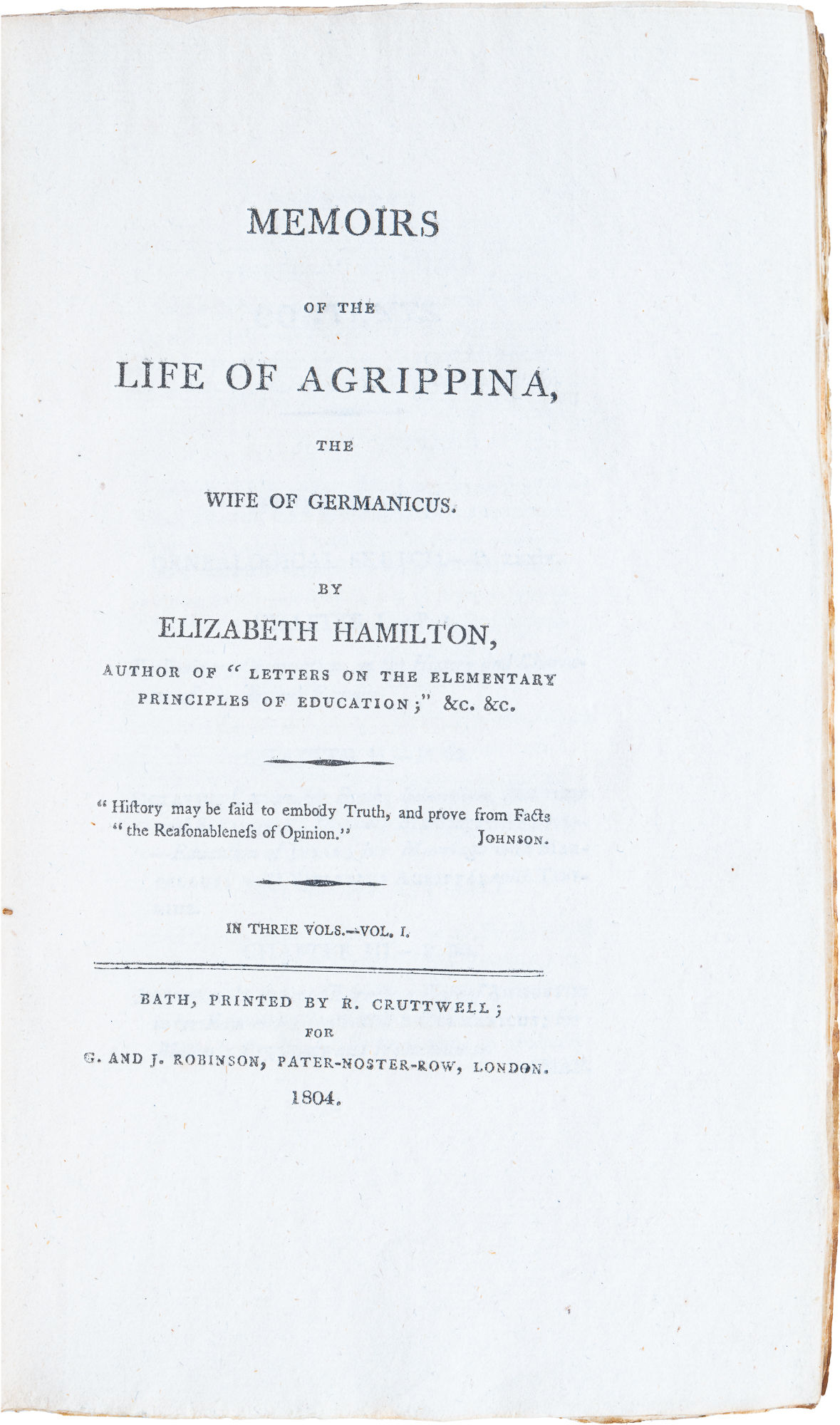
London: Printed by R. Cruttwell for G. and J. Robinson, 1804. First Edition. 3 vols., 8 vo (214 x 133mm), pp. [ii], xxxviii, 319, [1]; [ii], v, [i], 340; [ii], viii, 352. Original buff-white boards, uncut, neatly rebacked with matching paper, with the half titles. There's a mend to the upper corner of vol. 1, light soiling to the boards, rubbing to the extremities, internally clean and beautiful with only a few spots of foxing throughout. Not in Sadleir, Block or Wolff. Summers (p. 59) records only a later, 1811 edition in 2 volumes. An interesting transitional effort between biography and the emerging historical romance. CBEL, III, page 398. Not quite biography and not quite historical novel, the work straddles both: an advance on what came before it and a forerunner of what was to come. The historical novel was still in its infancy in 1804. The early and immature but invaluable attempts began with Leland's national novel Longsword (1762), Reeve's The Champion of Virtue (1782), Lee's The Recess (1785), and Edgeworth's Castle Rackrent (1800), but the formula had not yet been fully realized. By 1810, Jane Porter, likely inspired by Lady Morgan's The Wild Irish Girl (1806), produced The Scottish Chiefs, and in 1814 Walter Scott published Waverley (PMM 273), which is commonly credited as the origin of the form. That credit is somewhat specious: because Scott established the historical romance as the dominant mode of long fiction in the first half of the nineteenth century, he received recognition as its originator rather than as the figure who popularized something that already existed. The line of descent from there is long and distinguished: Scott's own Ivanhoe (1820), Cooper's Last of the Mohicans (1826), Hugo's Notre Dame (1831), Dumas's Three Musketeers (1844), Hawthorne's Scarlet Letter (1850), Melville's Israel Potter (1855), Dickens's Tale of Two Cities (1859), Tolstoy's War and Peace (1869), Wallace's Ben-Hur (1880), Hardy's Trumpet-Major (1880), Stevenson's Kidnapped (1885), Crane's Red Badge of Courage (1895), and Mitchell's Gone With the Wind (1936), among many others. Tucked chronologically between Edgeworth and Morgan is this triple-decker, centered on Agrippina (13 B.C.–33 A.D.), granddaughter of Octavian Augustus and wife of Germanicus. Outwardly the book presents itself as an amplified biography, but the incidents, conversations, and inner thoughts for which there is no historical record, and which can be traced back no further than the pen of Elizabeth Hamilton, occur with such frequency as to constitute not the occasional embellishment of a biographical narrative but rather an almost fully realized historical novel. Something else here is equally significant. The text is preceded by a lengthy preface, replicating the function of Leland's preface ("advertisement") in Longsword, which contains an extended theoretical defense of what might now be called "faction" and the earliest systematic definition of the concept that I have been able to trace. It surely furthered, among readers of the period, the debate over the boundaries of fact and fiction, an omen of a tipping point in the emerging supremacy of the form.
Details
Title
Memoirs of the Life of Agrippina
Author
Hamilton, Elizabeth
Condition
Unknown
Publisher
Printed by R. Cruttwell for G. and J. Robinson: London
Date
1804
Edition
First Edition