

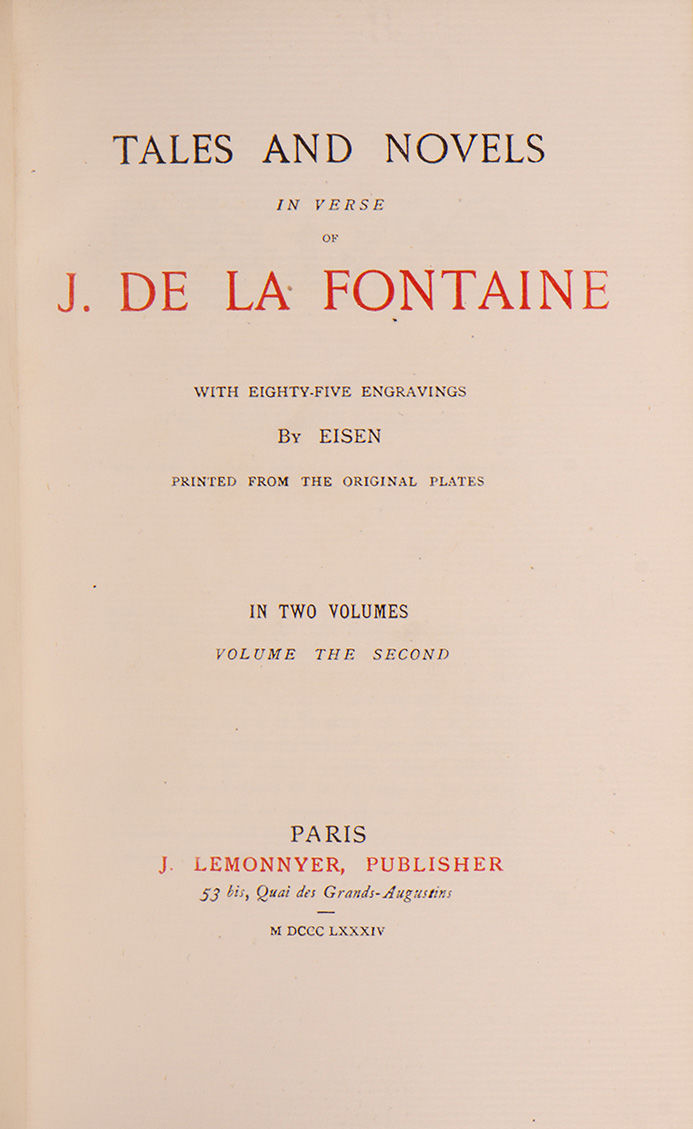
Tales and Novels in Verse of J. De La Fontaine (in 2 vols.)

- Paris: J. Lemonnyer, 1884
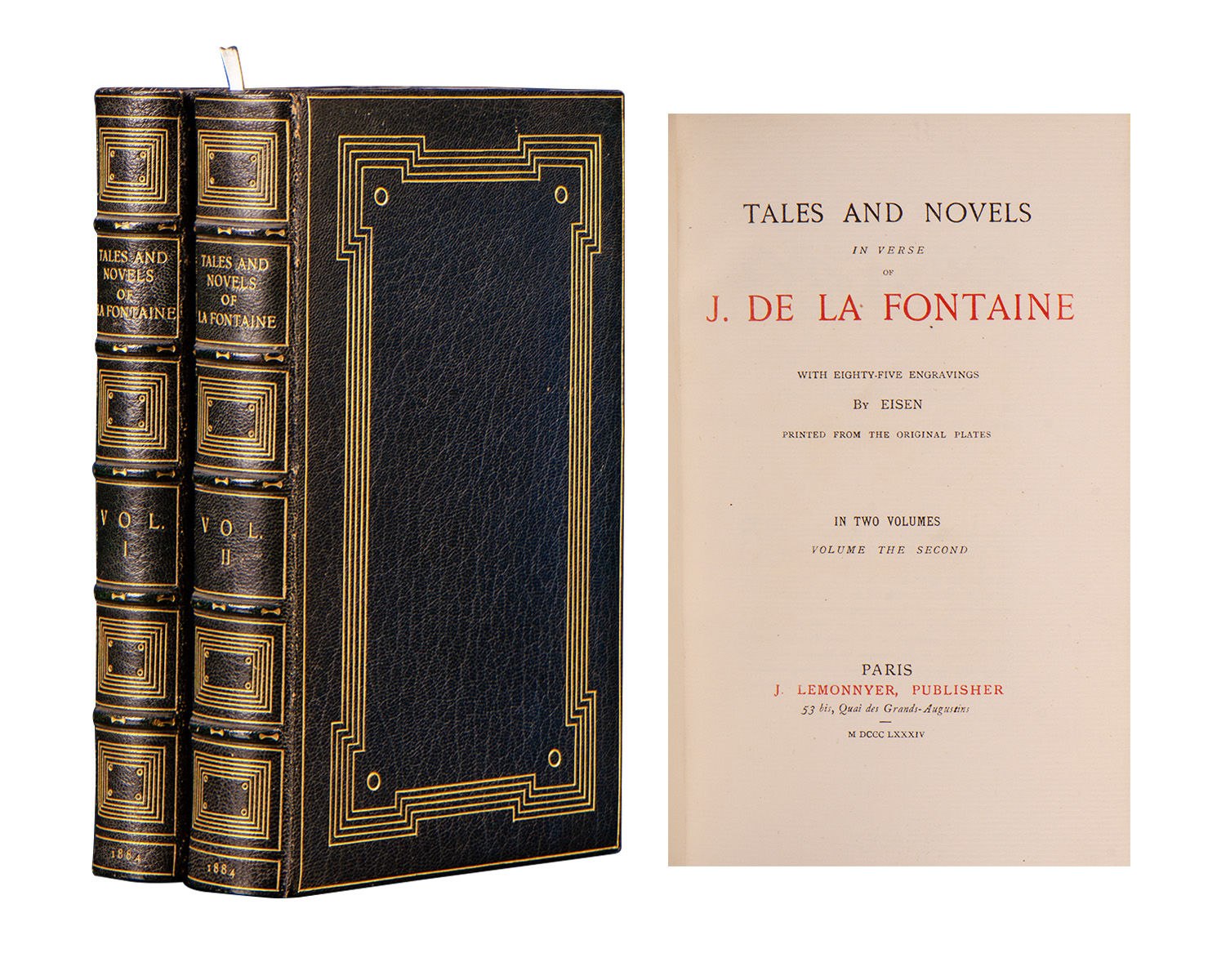
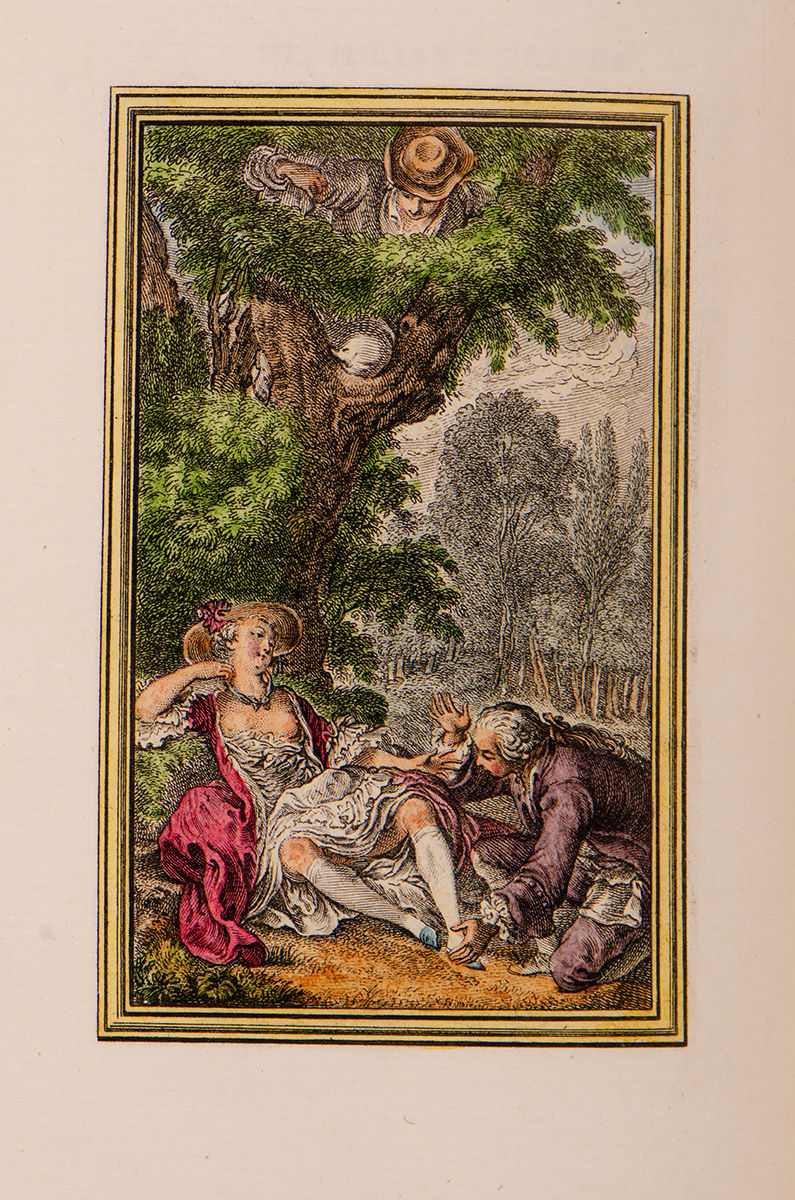
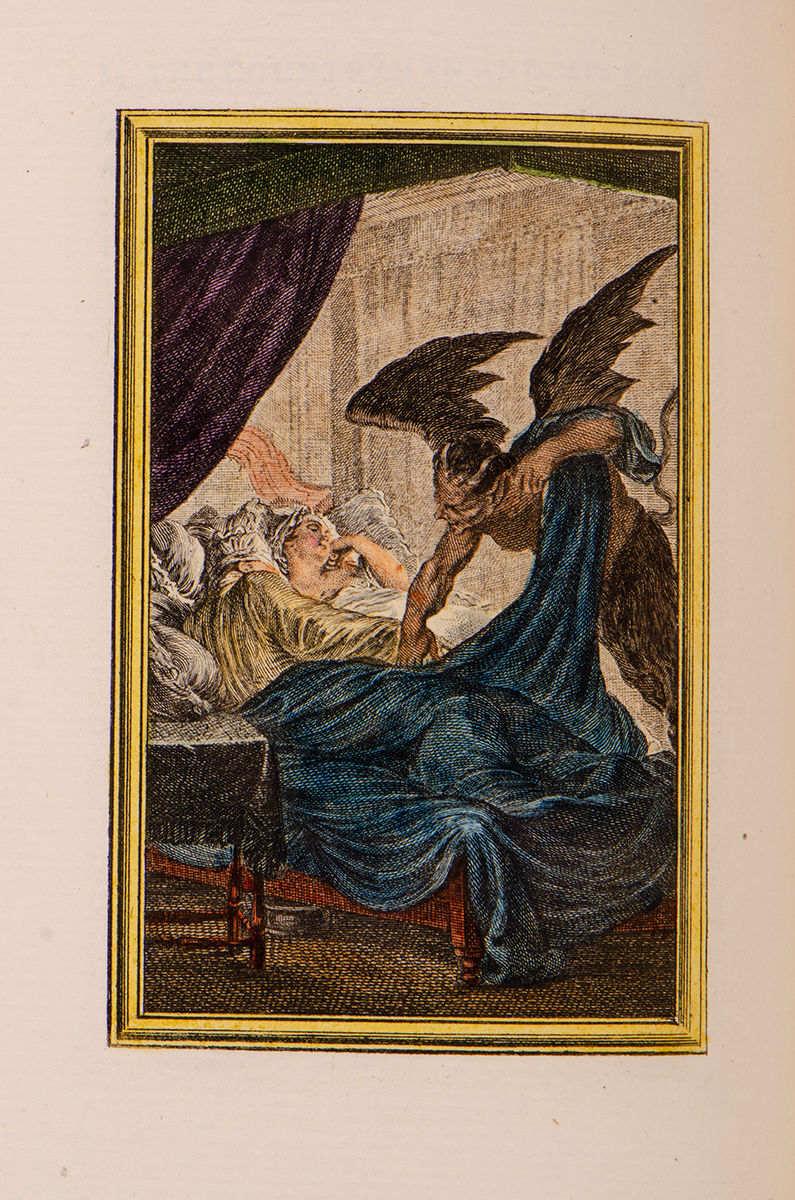
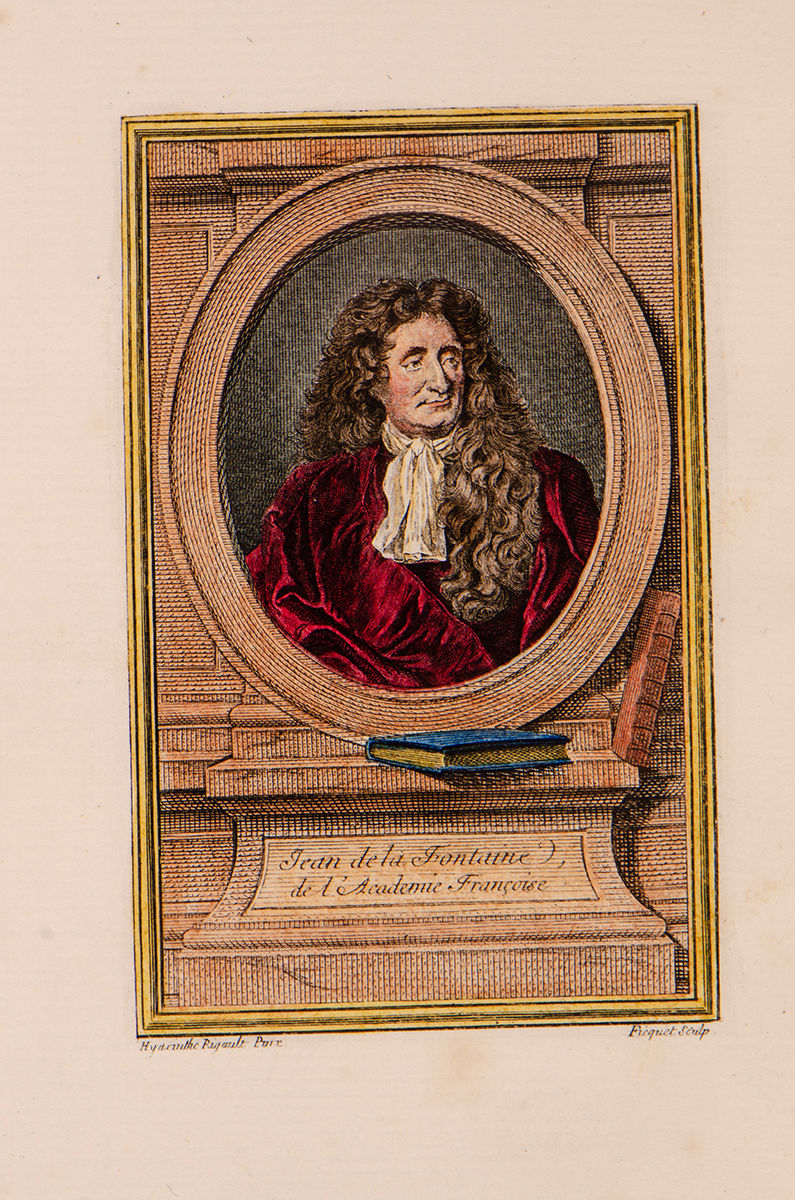
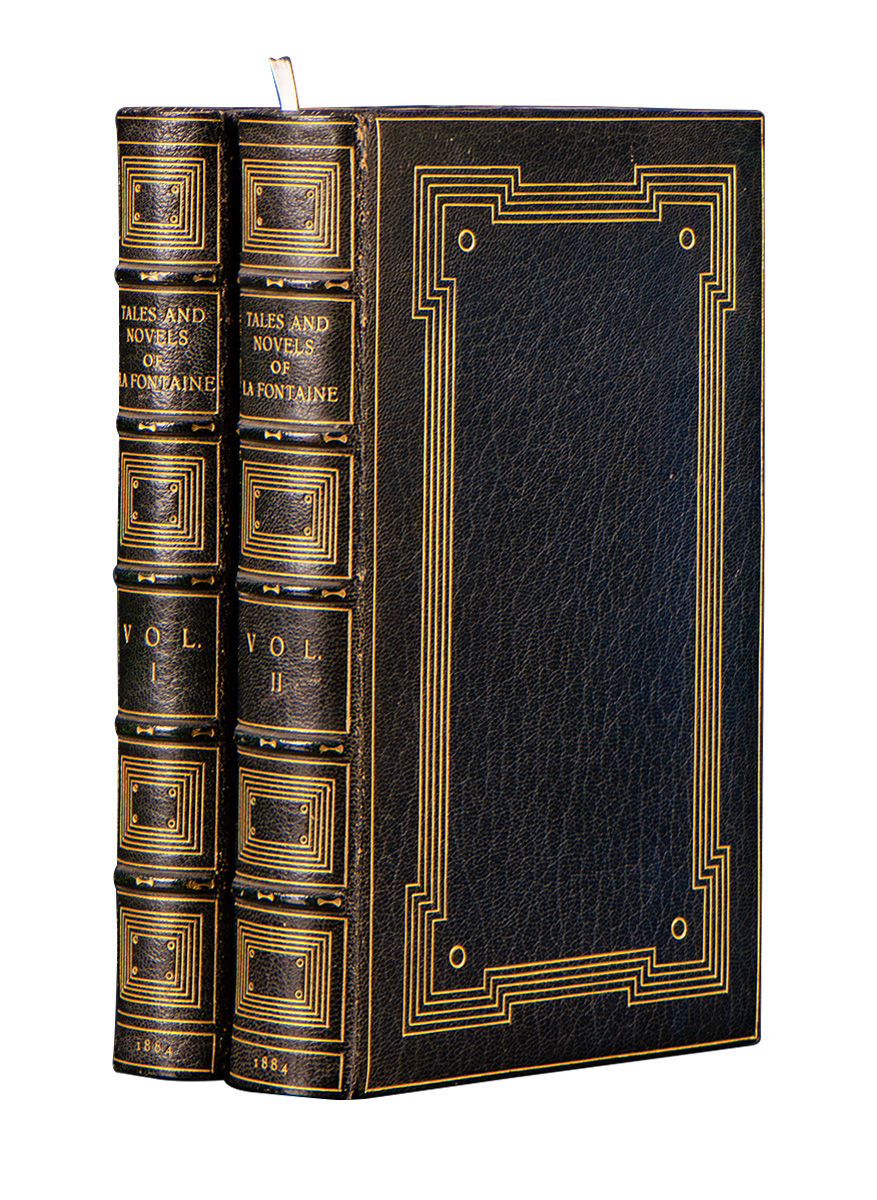
Paris: J. Lemonnyer, 1884. Later edition. Two octavo volumes. xi, 252; x, 334, [1] pp. Eighty-five hand-colored stipple and line engravings. Bound by Bayntun of Bath for Brentano's of New York in early twentieth century full midnight blue crushed morocco with gilt-ruled border and four-fillet geometric frame with open dots at corners. Gilt tooled raised bands, gilt ruled compartments. All edges gilt. Blue silk endleaves. A fine copy.
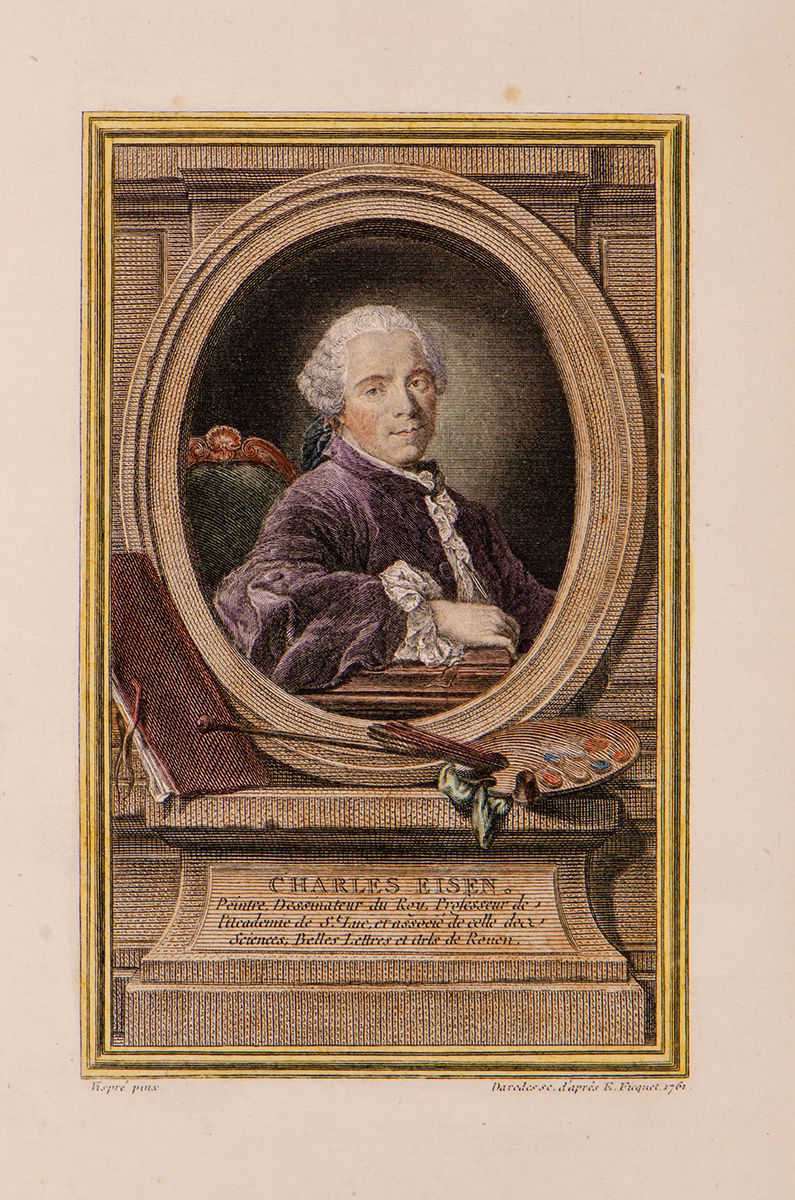
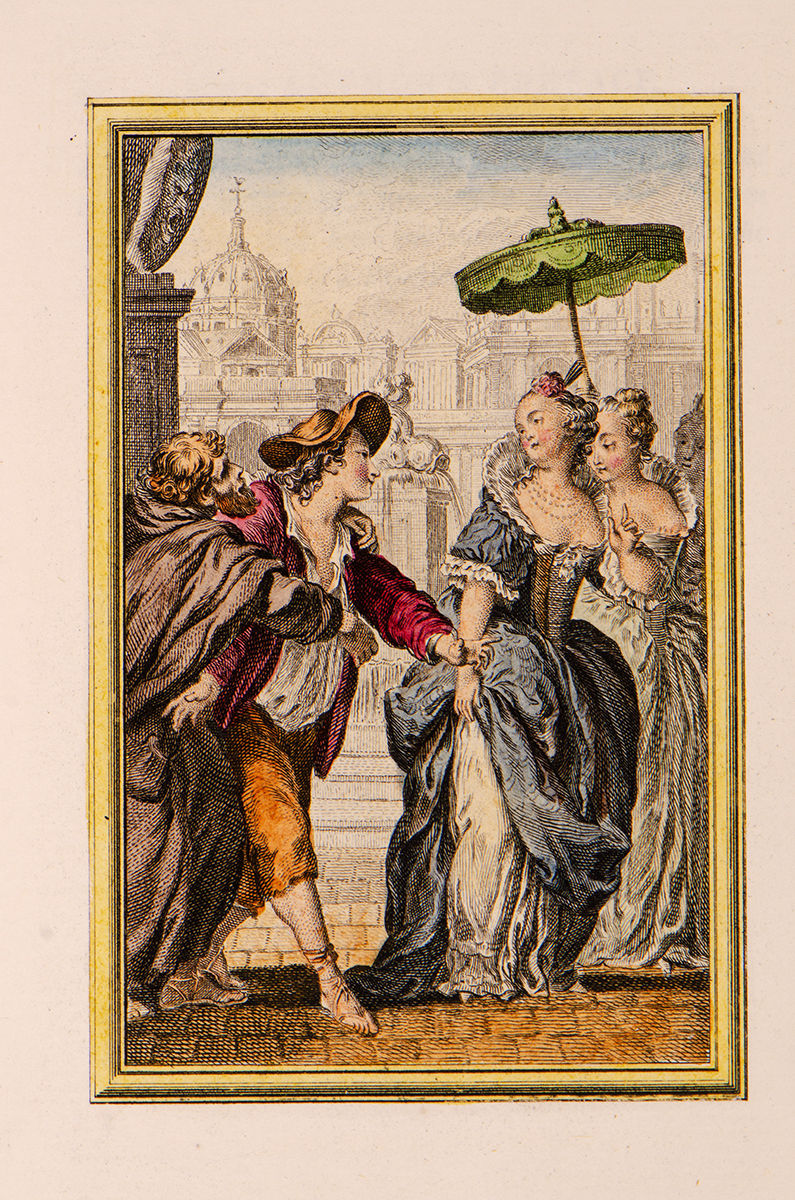
A fine reprint of the first edition in English of Charles-Dominique-Joseph Eisen's (1720-1778) richly illustrated edition of La Fontaine's Contes et nouvelles en vers (1762). "Eisen's...designs for La Fontaine are the liveliest and most adroit that he ever drew. Thoroughly at home with the varied action of these lusty stories - their love passages, their intrigues, their practical jokes - he is also expert in choosing the moment in each that will best serve his purpose as an illustrator...The detailed meaning of his concentrated compositions is to be grasped only after prolonged examination. The world that they depict is that of the homme moyen sensuel, where beauty exists only to satisfy desire and youth has its way over age, where cynicism is the common coin and virtue the calculated means to an end. But before the force and vitality of Eisen's scenes, normal scruples dissolve in admiration" (The Art of the French Illustrated Book).
French author Jean de La Fontaine (1621-1695) was most famous for his Fables. A towering classic of French literature, these moralizing stories inspired fabulists across Europe and inspired numerous translations, projects, and adaptations. "Like his miscellaneous works, La Fontaine's Contes et nouvelles en vers (Tales and Novels in Verse) considerably exceed the Fables in bulk. The first of them was published in 1664, the last posthumously. He borrowed them mostly from Italian sources, in particular Giovanni Boccaccio, but he preserved none of the 14th-century poet's rich sense of reality. The essence of nearly all his Contes lies in their licentiousness, which is not presented with frank Rabelaisian verve but is transparently and flippantly disguised. Characters and situations are not meant to be taken seriously; they are meant to amuse and are too monotonous to amuse for long. The Contes are the work far less of a poet than of an ingenious stylist and versifier. The accent of La Fontaine the narrator enlivens the story with playfully capricious comments, explanations, and digressions" (Enclyclopedia Britannica).
George Bayntun (1873-1940) was the founder of Bayntun Bindery. Trained by apprenticeship with the Taylor family, Bayntun opened his own book bindery in 1894 dedicated to using traditional hand-crafted techniques and high-quality materials. The Bath-based firm acquired the Rivière Bindery (also based in Bath) in 1939, transforming into the "Bayntun-Riviere bindery," which is still in existence and family owned.
A fine reprint of the first edition in English of Charles-Dominique-Joseph Eisen's (1720-1778) richly illustrated edition of La Fontaine's Contes et nouvelles en vers (1762). "Eisen's...designs for La Fontaine are the liveliest and most adroit that he ever drew. Thoroughly at home with the varied action of these lusty stories - their love passages, their intrigues, their practical jokes - he is also expert in choosing the moment in each that will best serve his purpose as an illustrator...The detailed meaning of his concentrated compositions is to be grasped only after prolonged examination. The world that they depict is that of the homme moyen sensuel, where beauty exists only to satisfy desire and youth has its way over age, where cynicism is the common coin and virtue the calculated means to an end. But before the force and vitality of Eisen's scenes, normal scruples dissolve in admiration" (The Art of the French Illustrated Book).
French author Jean de La Fontaine (1621-1695) was most famous for his Fables. A towering classic of French literature, these moralizing stories inspired fabulists across Europe and inspired numerous translations, projects, and adaptations. "Like his miscellaneous works, La Fontaine's Contes et nouvelles en vers (Tales and Novels in Verse) considerably exceed the Fables in bulk. The first of them was published in 1664, the last posthumously. He borrowed them mostly from Italian sources, in particular Giovanni Boccaccio, but he preserved none of the 14th-century poet's rich sense of reality. The essence of nearly all his Contes lies in their licentiousness, which is not presented with frank Rabelaisian verve but is transparently and flippantly disguised. Characters and situations are not meant to be taken seriously; they are meant to amuse and are too monotonous to amuse for long. The Contes are the work far less of a poet than of an ingenious stylist and versifier. The accent of La Fontaine the narrator enlivens the story with playfully capricious comments, explanations, and digressions" (Enclyclopedia Britannica).
George Bayntun (1873-1940) was the founder of Bayntun Bindery. Trained by apprenticeship with the Taylor family, Bayntun opened his own book bindery in 1894 dedicated to using traditional hand-crafted techniques and high-quality materials. The Bath-based firm acquired the Rivière Bindery (also based in Bath) in 1939, transforming into the "Bayntun-Riviere bindery," which is still in existence and family owned.
Details
Title
Tales and Novels in Verse of J. De La Fontaine (in 2 vols.)
Author
[Fine Binding - Bayntun] La Fontaine, [Jean de.]
Condition
Unknown
Publisher
J. Lemonnyer: Paris
Date
1884
Edition
Later edition