

J. Yōka shōchi junjō 幼科證治準繩; Ch. You ke zheng zhi zhun sheng [Standard for Diagnosis & Treatment in Pediatrics]
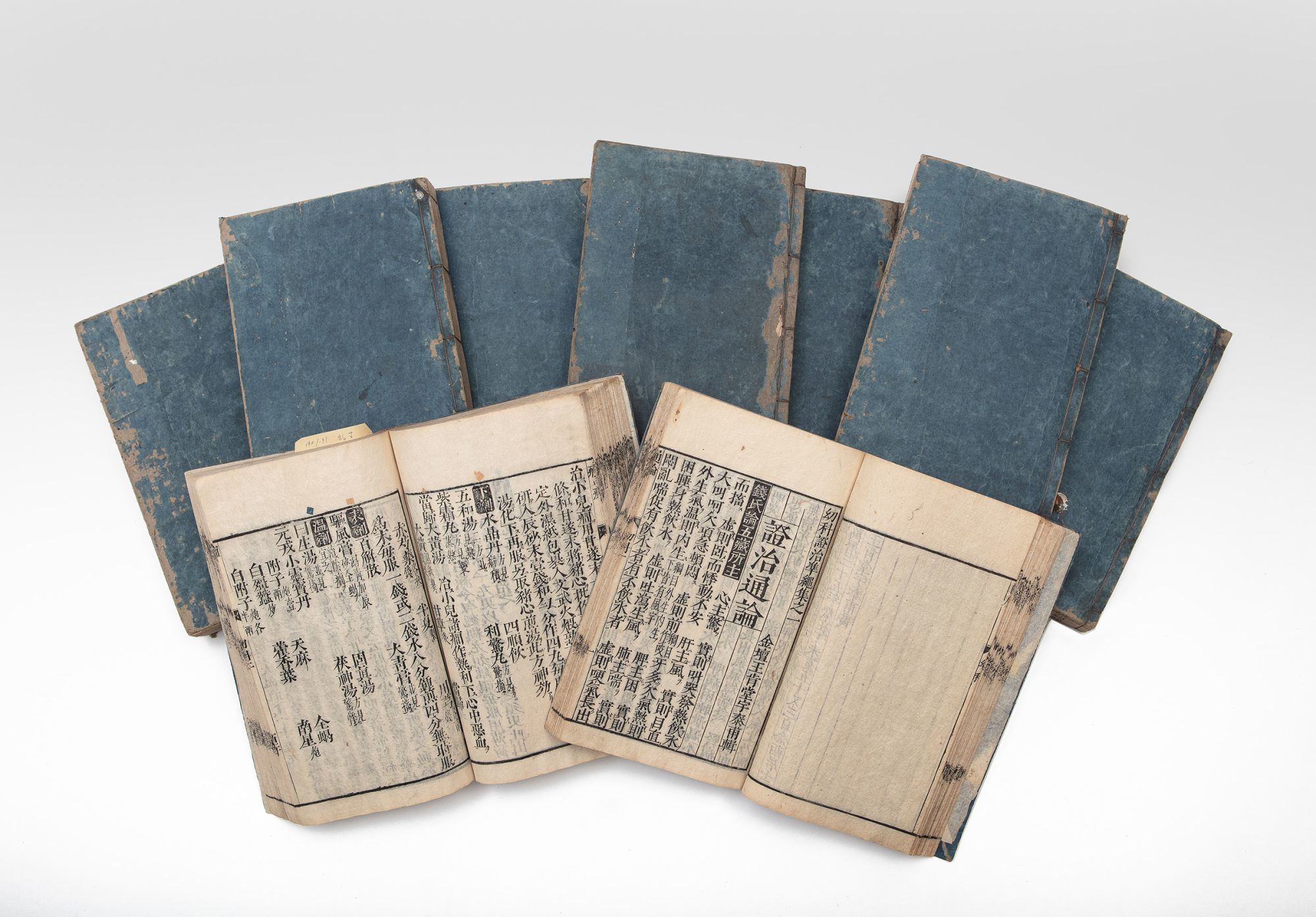
Nine juan (kan) in nine vols. 8vo, orig. semi-stiff wrappers (a little worn), old stitching. [Kyoto]: Murakami Heirakuji 村上平樂寺, 1673.
First edition to be printed in Japan of the section on pediatrics from the massive work Standard for Diagnosis & Treatment. Wang (ca. 1552-1638 or 1549-1631) wrote in the Preface to our book (dated 1607, Wanli 35; in trans.):
Physicians call pediatrics the “mute specialty” on account of its difficulty. They are referring to the fact that children cannot explain their own illness and suffering. They use the words of the Yellow Emperor to say, “I cannot examine them. Children are in a separate category. They are to be nursed at home.” I alone say that this is not the case. Now, small children have not experienced the shock of the seven emotions and six desires, their organs have not been soaked in the eight delicacies and five flavors. When you give them medicine, you can easily see its effect. It is like the fact that a stomach full of fat meat and fine grain is hard to exhaust, but one with an inferior meal in it is easy to get results. How can this be called hard?
However, books from past and present address this specialty cannot be taken as good. For example, the Mirror of [Preserving Life and] Mind [保生]心鑑 is overgrown with weeds, and Categorized Essentials [of the Pediatric Specialty] [幼科]類萃 is cursory, the New Book [?] 新書 contains ancient material but nothing modern, and [Yingtong] baiwen [嬰童]百問 [A Hundred Questions on the Infants and Children] leaves out 10,000 things for every one thing it contains. These books all circulate in our day, but none of them can serve as a standard for pediatrics. For that reason, I have edited the present compilation, placing special focus on clarifying the subject of smallpox [?].
The book is largely a formulary but also contains theoretical pieces, such as the initial essay, “Comprehensive discourse on diagnosis and treatment.” Topics covered are ailments afflicting newborns, problems of the liver, “vigilance,” “epilepsy,” “wind stroke,” “lolling of the head,” “clenched jaw,” “eyes,” “urinary blockage,” “diarrhea,” “residual urination,” “clear urine and turbid relief,” “hernia,” “yin swellings,” “yin ulcers,” “fever,” “slow speech,” “sweating,” “belching qi,” “sores,” and “smallpox” (underlined in the table of contents by a reader of our book), including “prevention,” “the great method,” “first fevers,” “emergence of the shape [of pox],” “when pox have broken out,” etc. There are many more categories besides these; the book is very comprehensive.
Wang Kentang was born into a family of officials, with his father at one time holding the post of Vice Minister of the Board of Punishments. Wang read widely, but after his mother fell ill, he began to study medicine. He passed the highest-level civil service examination in 1589 and was assigned to the Hanlin Academy. After he was demoted in a political incident, he retired on account of illness, and dedicated himself once more to medicine. He both authored books and practiced medicine, being credited with successfully surgically removing a tumor on the side of a patient’s eye socket. His book Standard for Diagnosis and Treatment included material from the great works of medicine from the Ming period and earlier.
Fine set; slightly worn wrappers.
First edition to be printed in Japan of the section on pediatrics from the massive work Standard for Diagnosis & Treatment. Wang (ca. 1552-1638 or 1549-1631) wrote in the Preface to our book (dated 1607, Wanli 35; in trans.):
Physicians call pediatrics the “mute specialty” on account of its difficulty. They are referring to the fact that children cannot explain their own illness and suffering. They use the words of the Yellow Emperor to say, “I cannot examine them. Children are in a separate category. They are to be nursed at home.” I alone say that this is not the case. Now, small children have not experienced the shock of the seven emotions and six desires, their organs have not been soaked in the eight delicacies and five flavors. When you give them medicine, you can easily see its effect. It is like the fact that a stomach full of fat meat and fine grain is hard to exhaust, but one with an inferior meal in it is easy to get results. How can this be called hard?
However, books from past and present address this specialty cannot be taken as good. For example, the Mirror of [Preserving Life and] Mind [保生]心鑑 is overgrown with weeds, and Categorized Essentials [of the Pediatric Specialty] [幼科]類萃 is cursory, the New Book [?] 新書 contains ancient material but nothing modern, and [Yingtong] baiwen [嬰童]百問 [A Hundred Questions on the Infants and Children] leaves out 10,000 things for every one thing it contains. These books all circulate in our day, but none of them can serve as a standard for pediatrics. For that reason, I have edited the present compilation, placing special focus on clarifying the subject of smallpox [?].
The book is largely a formulary but also contains theoretical pieces, such as the initial essay, “Comprehensive discourse on diagnosis and treatment.” Topics covered are ailments afflicting newborns, problems of the liver, “vigilance,” “epilepsy,” “wind stroke,” “lolling of the head,” “clenched jaw,” “eyes,” “urinary blockage,” “diarrhea,” “residual urination,” “clear urine and turbid relief,” “hernia,” “yin swellings,” “yin ulcers,” “fever,” “slow speech,” “sweating,” “belching qi,” “sores,” and “smallpox” (underlined in the table of contents by a reader of our book), including “prevention,” “the great method,” “first fevers,” “emergence of the shape [of pox],” “when pox have broken out,” etc. There are many more categories besides these; the book is very comprehensive.
Wang Kentang was born into a family of officials, with his father at one time holding the post of Vice Minister of the Board of Punishments. Wang read widely, but after his mother fell ill, he began to study medicine. He passed the highest-level civil service examination in 1589 and was assigned to the Hanlin Academy. After he was demoted in a political incident, he retired on account of illness, and dedicated himself once more to medicine. He both authored books and practiced medicine, being credited with successfully surgically removing a tumor on the side of a patient’s eye socket. His book Standard for Diagnosis and Treatment included material from the great works of medicine from the Ming period and earlier.
Fine set; slightly worn wrappers.
Details
Title
J. Yōka shōchi junjō 幼科證治準繩; Ch. You ke zheng zhi zhun sheng [Standard for Diagnosis & Treatment in Pediatrics]
Author
WANG, Kentang 王肯堂
Condition
Unknown