

J. Chūkei zensho; Ch. Zhongjing quan shu 仲景全書 [Complete Writings of (Zhang) Zhongjing]
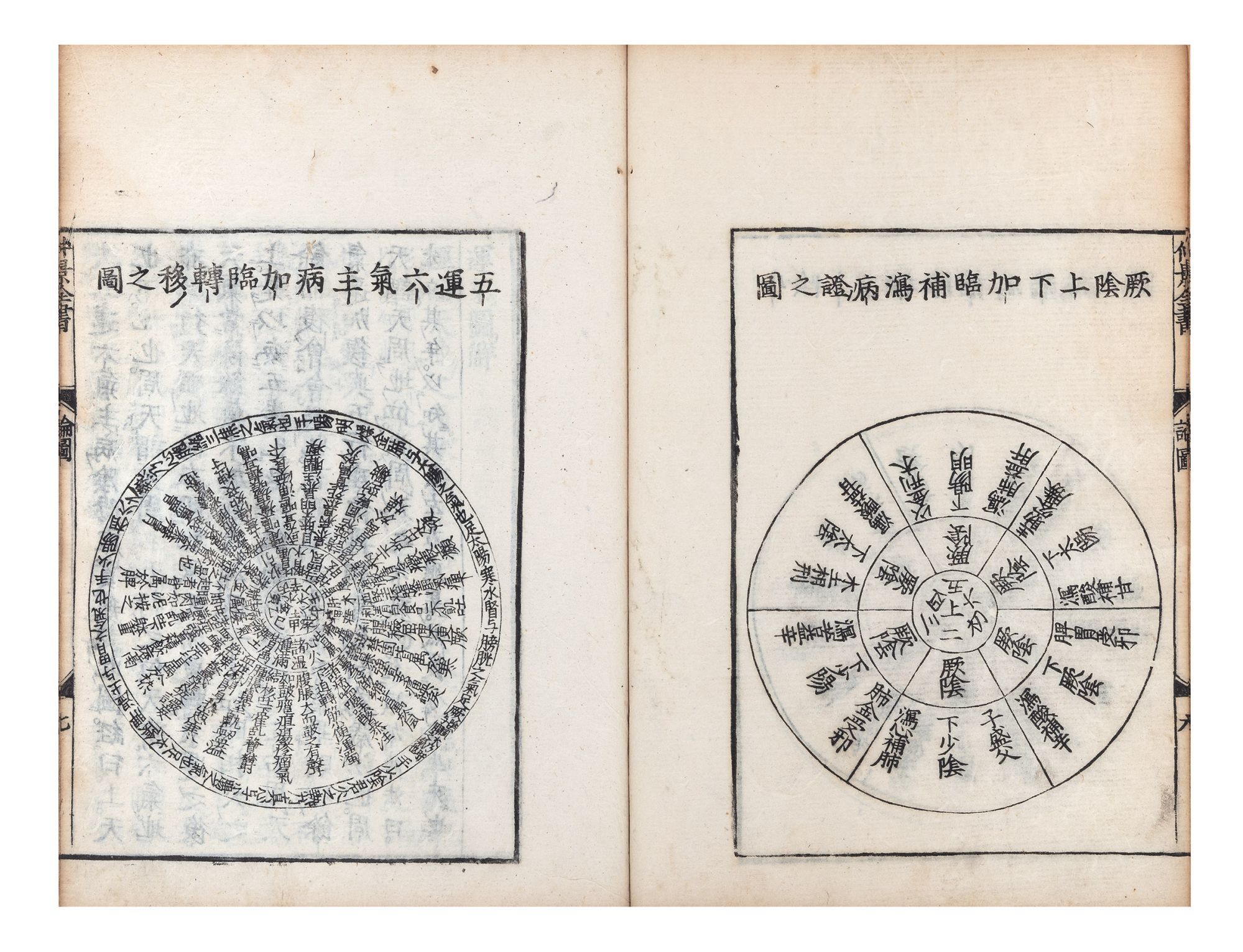
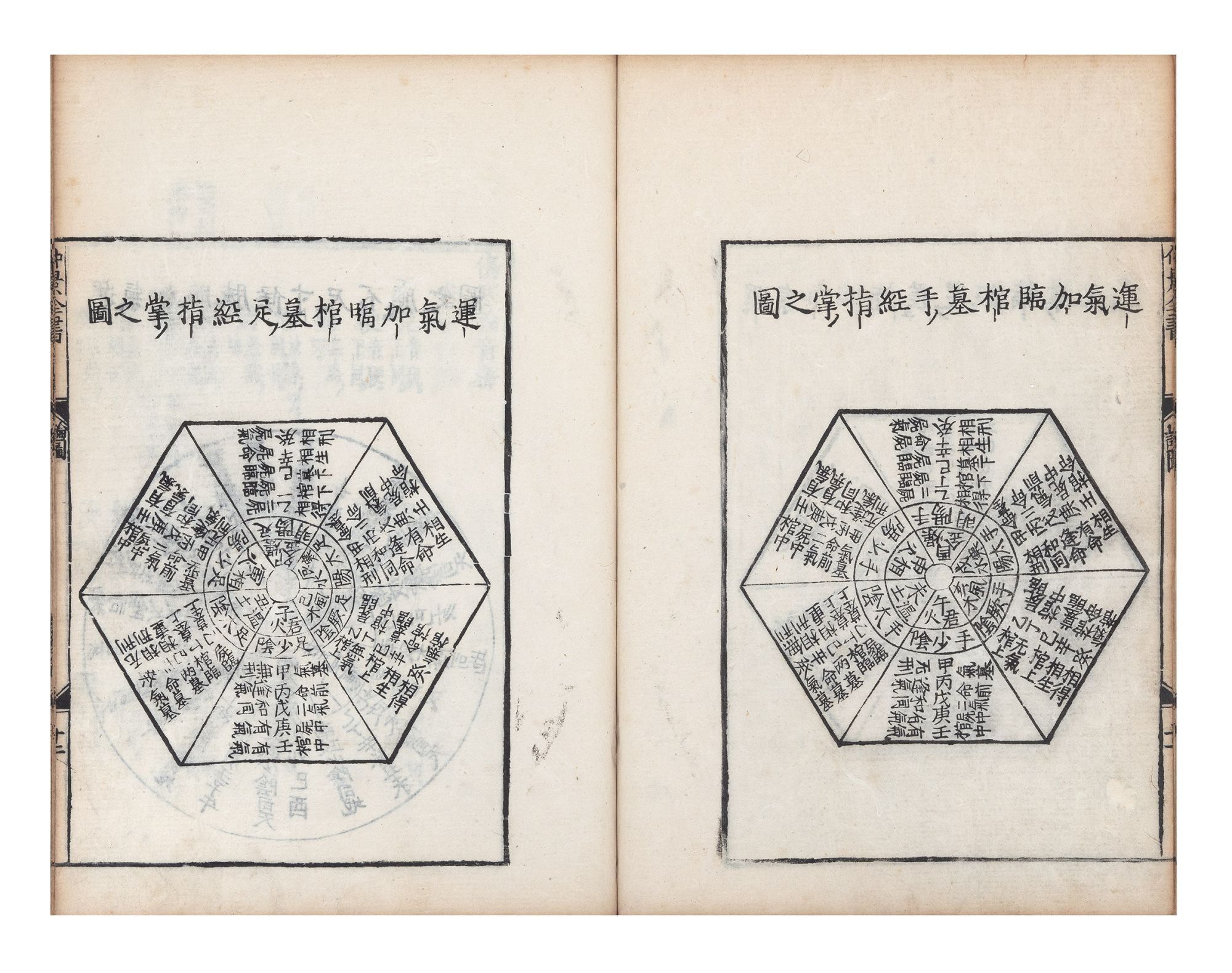
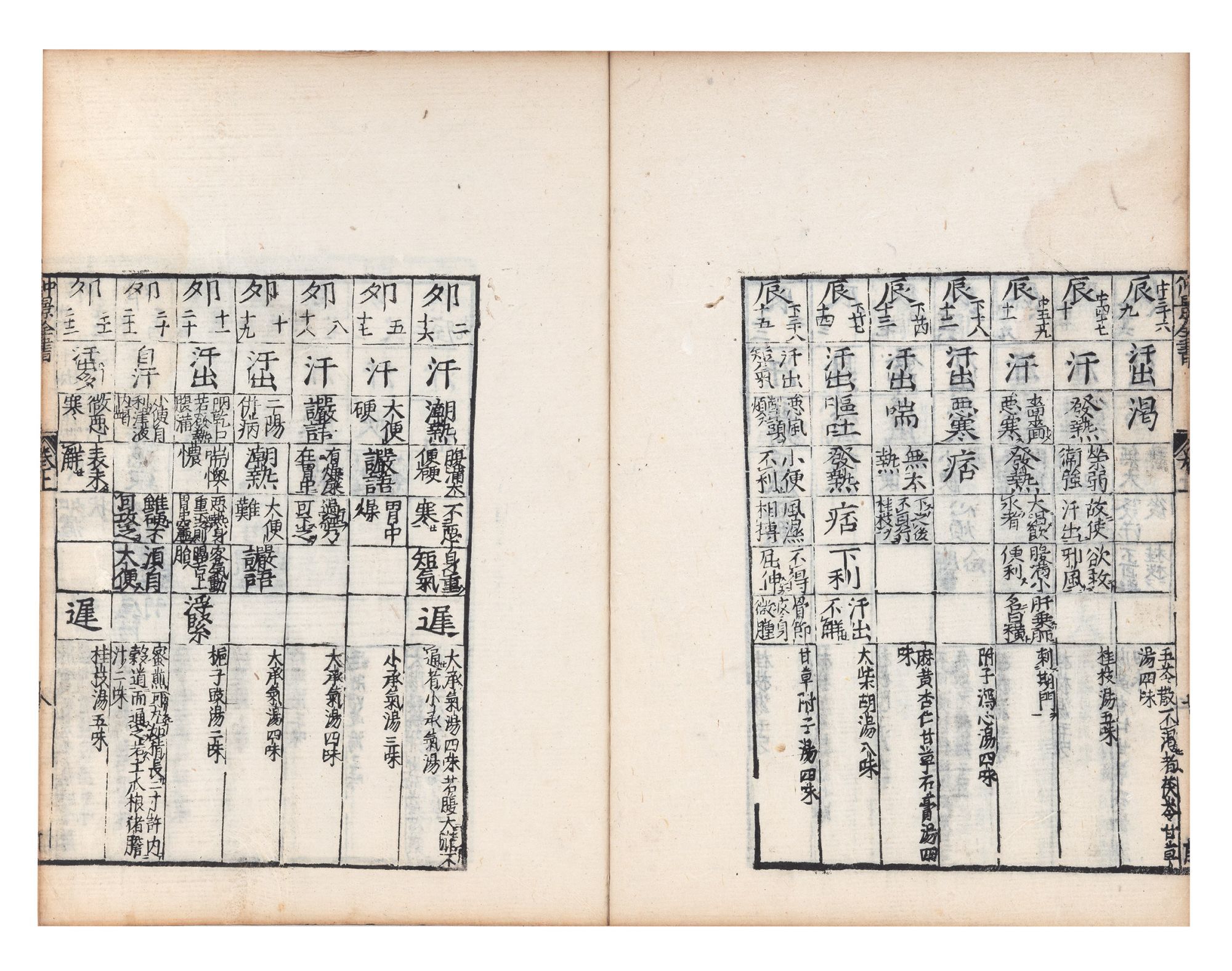
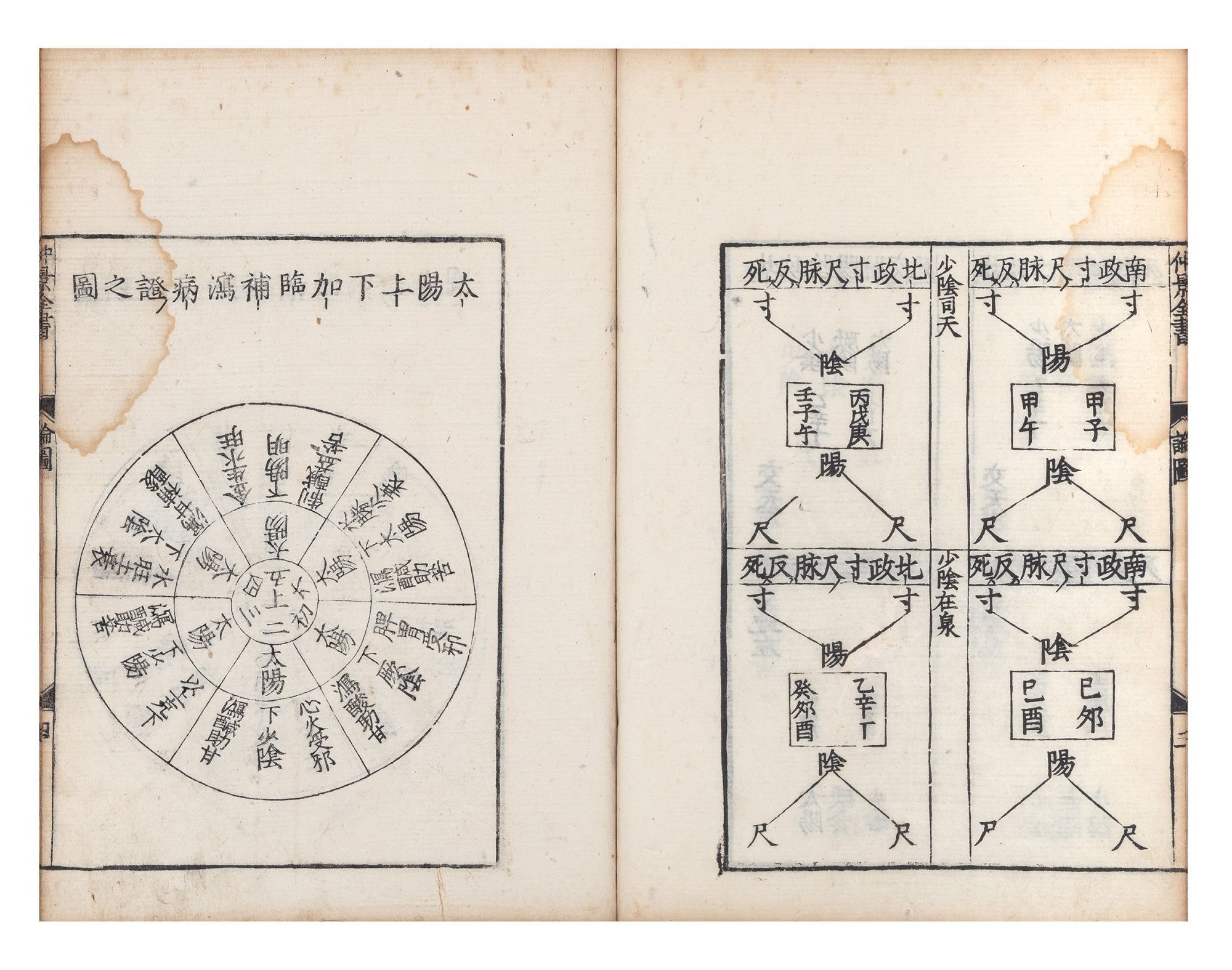
Eleven woodcut diagrams. Seven vols. 8vo, orig. semi-stiff wrappers (worn & a little wormed) with orig. title-slips, old stitching. Kyoto: Akitaya Sōbei 秋田屋総兵衛, [1668].
A rare and early Japanese edition of the collected works of Zhang. “Zhang Zhongjing (born c. 150 CE-died c. 219) was a Chinese physician who wrote in the early 3rd century CE Shang han za bing lun [Treatise on Febrile and Other Diseases], which greatly influenced the practice of traditional Chinese medicine. The original work was later edited and divided into two books, Shang han lun [Treatise on Febrile Diseases] and Jin gui yao lue [Jingui Collection of Prescriptions]. Today, Zhang’s work remains highly regarded and important in the practice of Chinese medicine, and he is often referred to as the Chinese Hippocrates.
“Zhang’s Treatise was an important book on dietetics and was especially influential for its information on typhoid and other fevers. Zhang’s work was revered in the East for as long a time as Greek physician Galen of Pergamum’s works were popular in the West. Zhang described typhoid clearly and recommended the use of only a few potent drugs in treating it. The drugs were to be used one at a time, a considerable advance from the shotgun prescriptions then common. Zhang stated that cool baths were also an important part of the treatment, an idea that remained unused for 1,700 years until Scottish physician James Currie promoted it in his famous treatise on fever therapy…
“Zhang paid close attention to the physical signs, symptoms, kind, and course of a disease, and he carefully recorded the results obtained from any drugs that he prescribed. He forthrightly stood for the dignity and responsibility of the medical profession, and this attitude, coupled with his close powers of observation, make it easy to understand why he has become known by the name of his Greek medical ancestor Hippocrates. In the 16th and 17th centuries there was a strong revival of his teachings and practices” (Britannica, online).
Zhang “ascribed a decisive significance to the pathogenic potential of climatic influences...Chang [Zhang] stressed the distinction between those influences normally present in the body and those that must be considered pathogenic...Chang’s approach diverged considerably from the belief of...other contemporary scholars” (Unschuld, p. 174).
Zhang’s Shanghan zabing lun 傷寒雜病論 [Treatise on Cold Damage and Miscellaneous Disorders] is “the earliest formulary not from archaeological excavations...This formulary brought forth a new system of diagnosis based on the six warps (or stages, liujing 六經) of disease as well as a well-developed taxonomy of diseases. In addition, each of the formulæ is given a name, and the dosage and method of preparation of the herbs are specifically described. In fact, this book provides by far the greatest single source of formulæ in traditional Chinese medicine. Zhang, who described himself primarily as a collector rather than as a composer of formulæ, was the first person we know of to identify the condition of a patient (the diagnosis) with a particular formula used to treat that condition” (Goldschmidt, p. 135).
A Preface by Zhao Kaimei (also known as Qimei 琦美; 1563-1624), dated 1599 (Wanli jihai), written for the book’s Chinese edition, is reproduced in our book with the addition of Japanese kunten reading marks. Zhao was a book collector and official, serving as Vice Minister of the Board of Personnel of Ming China.
Several circular and diamond-shaped diagrams illustrate ideas from the book.
Fine set; some dampstaining, thumbing, and insignificant worming. Our book contains marginal annotations by an earlier reader.
❧ Asaf Goldschmidt, “Pre-Standardised Pharmacology: Han through Song,” in The Routledge Handbook of Chinese Medicine (2022), pp. 133-45; Paul U. Unschuld, Medicine in China: A History of Ideas (California: 1985, 2010). See NIJL 4431715 for the date.
A rare and early Japanese edition of the collected works of Zhang. “Zhang Zhongjing (born c. 150 CE-died c. 219) was a Chinese physician who wrote in the early 3rd century CE Shang han za bing lun [Treatise on Febrile and Other Diseases], which greatly influenced the practice of traditional Chinese medicine. The original work was later edited and divided into two books, Shang han lun [Treatise on Febrile Diseases] and Jin gui yao lue [Jingui Collection of Prescriptions]. Today, Zhang’s work remains highly regarded and important in the practice of Chinese medicine, and he is often referred to as the Chinese Hippocrates.
“Zhang’s Treatise was an important book on dietetics and was especially influential for its information on typhoid and other fevers. Zhang’s work was revered in the East for as long a time as Greek physician Galen of Pergamum’s works were popular in the West. Zhang described typhoid clearly and recommended the use of only a few potent drugs in treating it. The drugs were to be used one at a time, a considerable advance from the shotgun prescriptions then common. Zhang stated that cool baths were also an important part of the treatment, an idea that remained unused for 1,700 years until Scottish physician James Currie promoted it in his famous treatise on fever therapy…
“Zhang paid close attention to the physical signs, symptoms, kind, and course of a disease, and he carefully recorded the results obtained from any drugs that he prescribed. He forthrightly stood for the dignity and responsibility of the medical profession, and this attitude, coupled with his close powers of observation, make it easy to understand why he has become known by the name of his Greek medical ancestor Hippocrates. In the 16th and 17th centuries there was a strong revival of his teachings and practices” (Britannica, online).
Zhang “ascribed a decisive significance to the pathogenic potential of climatic influences...Chang [Zhang] stressed the distinction between those influences normally present in the body and those that must be considered pathogenic...Chang’s approach diverged considerably from the belief of...other contemporary scholars” (Unschuld, p. 174).
Zhang’s Shanghan zabing lun 傷寒雜病論 [Treatise on Cold Damage and Miscellaneous Disorders] is “the earliest formulary not from archaeological excavations...This formulary brought forth a new system of diagnosis based on the six warps (or stages, liujing 六經) of disease as well as a well-developed taxonomy of diseases. In addition, each of the formulæ is given a name, and the dosage and method of preparation of the herbs are specifically described. In fact, this book provides by far the greatest single source of formulæ in traditional Chinese medicine. Zhang, who described himself primarily as a collector rather than as a composer of formulæ, was the first person we know of to identify the condition of a patient (the diagnosis) with a particular formula used to treat that condition” (Goldschmidt, p. 135).
A Preface by Zhao Kaimei (also known as Qimei 琦美; 1563-1624), dated 1599 (Wanli jihai), written for the book’s Chinese edition, is reproduced in our book with the addition of Japanese kunten reading marks. Zhao was a book collector and official, serving as Vice Minister of the Board of Personnel of Ming China.
Several circular and diamond-shaped diagrams illustrate ideas from the book.
Fine set; some dampstaining, thumbing, and insignificant worming. Our book contains marginal annotations by an earlier reader.
❧ Asaf Goldschmidt, “Pre-Standardised Pharmacology: Han through Song,” in The Routledge Handbook of Chinese Medicine (2022), pp. 133-45; Paul U. Unschuld, Medicine in China: A History of Ideas (California: 1985, 2010). See NIJL 4431715 for the date.
Details
Title
J. Chūkei zensho; Ch. Zhongjing quan shu 仲景全書 [Complete Writings of (Zhang) Zhongjing]
Author
ZHANG, Zhongjing 張仲景, author, & ZHAO, Kaimei 趙開美, editor
Condition
Unknown