

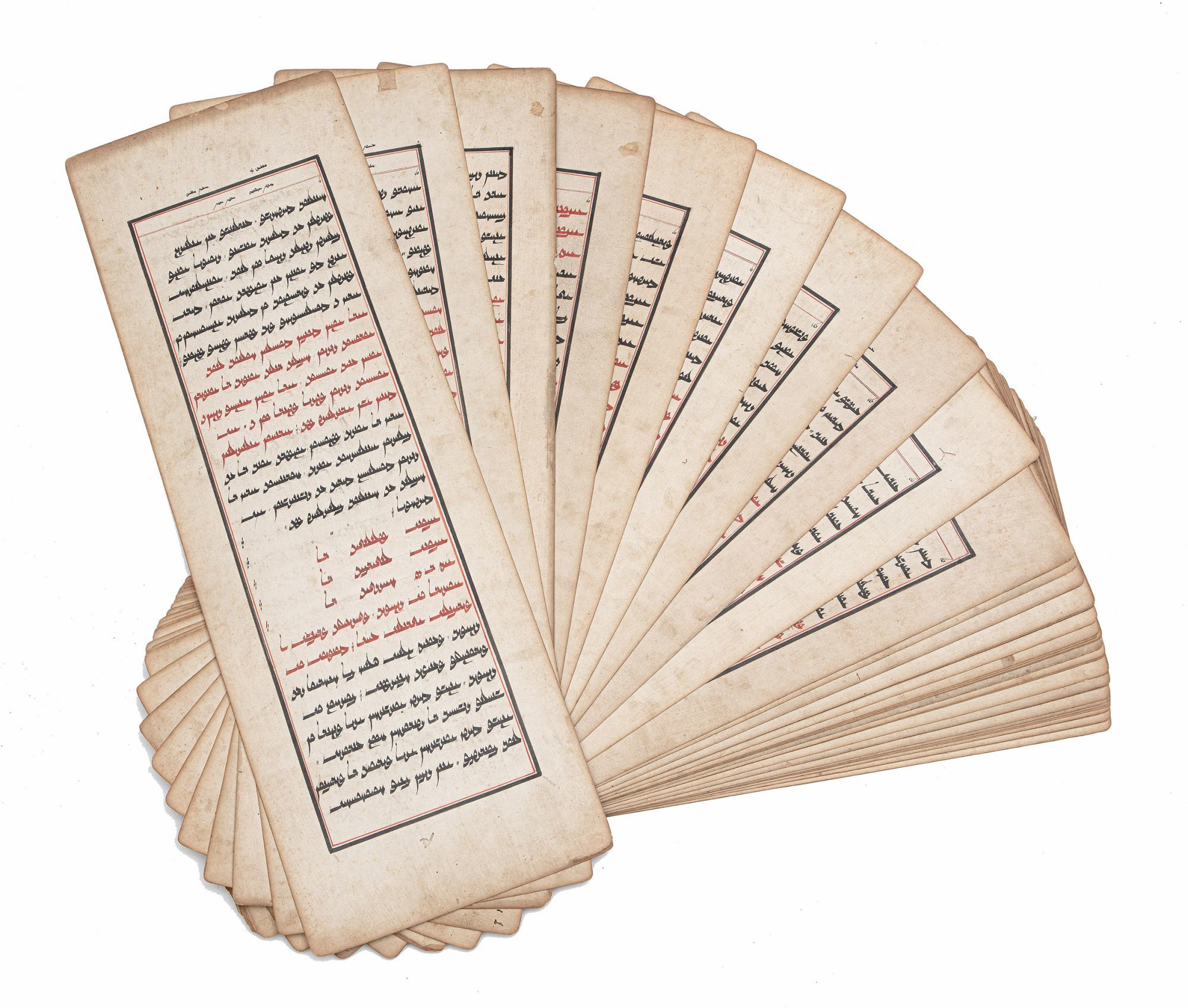
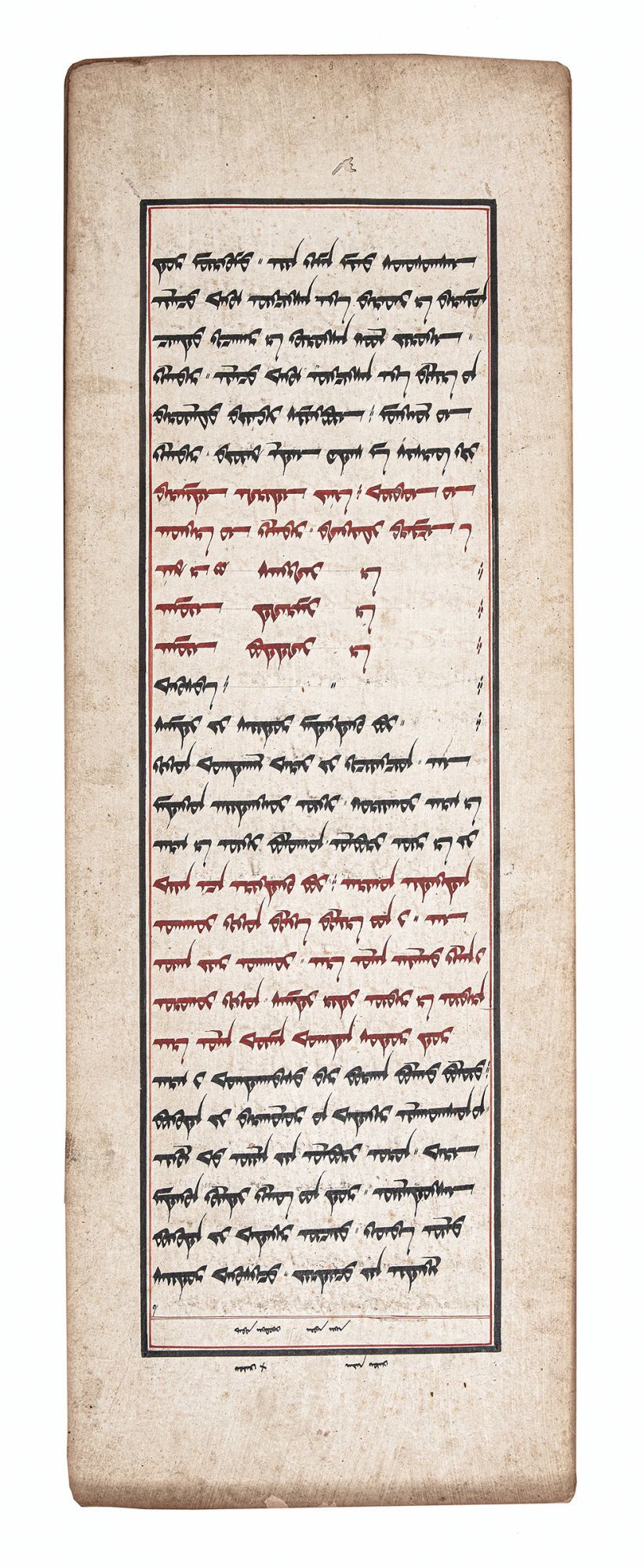
Manuscript on paper. 44 pothi-style oblong sheets (270 x 775 mm.), inscribed on both sides in red and black
[China]: [late 18th-century].
Several Buddhist sutras in Mongolian, probably including the Heart Sutra, in a beautifully executed two-color manuscript likely produced at the court of the Qianlong emperor.
Tibetan Buddhism spread among the Mongols in the 16th and 17th centuries. In the late 16th century, certain Buddhist scriptures were translated into Mongolian. The basis of the translations was the Kanjur, the Tibetan texts with sutras containing the sayings of the Buddha. Then, “from 1602 to 1607 a first, complete Kanjur translation into the Mongolian languages [was] prepared under the auspices of Namudai sečen qaγan, the ruler of the Tumed Mongols at the turn of the 17th century...This oldest known Kanjur translation has apparently not come down to us” (Kollmar-Paulenz, pp. 156-59).
In 1629, this first translation of the Kanjur influenced the first complete Kanjur still extant today. This translation project was undertaken by Liγdan qaγan (Ligdan Khan, 1588-1634), who attempted to unify the Mongols. This version of the Kanjur, in turn, heavily influenced the edition that was printed in Beijing in 1718-20 under Manchu auspices. The Manchu rulers of the Qing empire patronized Tibetan Buddhism in part because of its sway over the Mongols (their important allies) and in part, probably, out of personal belief. Beijing thus became an important site for Mongolian scholarship and publishing. As shown by our text, manuscripts continued to be produced at court alongside prints, which was also the case for other languages with which the court engaged, such as Chinese and Manchu.
Several of the sheets in our manuscript contain the titles of sutras. The text first gives the name of the sutra in Sanskrit, then in Tibetan, and then in Mongolian. Sanskrit and Tibetan are both transcribed in the Mongol script, but we are unable to identify these titles. In one instance, the Mongolian-language title is ilaǰu tegüs nögčigsen eke bilig-ün činadu kiǰaγar-a kürügsen γool [?] ǰirüken, which we believe is a version of the Heart Sutra, or the “The Heart of the Perfection of Wisdom.” The catalogue of the Mongolian Kanjur contains an entry for this title, minus the word γool, “center” (Vol. 2, p. 952, item 0162). The exact relationship between our sutra and the version in the Kanjur warrants closer study.
“The ‘Heart Sūtra’ is perhaps the most famous, and certainly the most widely recited, of all Buddhist sūtras across all Mahāyāna traditions. It is also one of the most commented upon” (The Princeton Dictionary of Buddhism, p. 657). “Its cryptic delineation of the meaning of emptiness and its radical economy of expression have exercised a fascination over the minds of Buddhist thinkers in India, China, Japan, Korea, Tibet, and Central Asia” (Lopez, p. 3). The sutra contains the famous statement “form is emptiness, emptiness is form.” “This is one of the most widely quoted and commented upon statements in the entire corpus of Mahāyāna sutras” (The Princeton Dictionary, loc. cit.).
In addition to the Heart Sutra, several other titles are found in our manuscript. Further research is needed in order to establish exactly what sutras are contained in it.
Our manuscript was featured in Sugimura Yūzō’s 杉村勇造 (1900-78) Kenryū kōtei 乾隆皇帝 [The Qianlong Emperor] among the color plates at the beginning of the book. Sugimura’s legend stated merely that it was a “Qianlong-period fair copy Buddhist sutra” 乾隆精寫本.
Very fine and fresh condition. Minor browning.
With thanks to Professor Lin Shih-Hsuan of National Taipei University.
❧ Mengguwen Ganzhuer, Danzhuer mulu 蒙古文甘珠爾、丹珠爾目錄 (Yuanfang chubanshe, 2002); Karénina Kollmar-Paulenz, “The Transmission of the Mongolian Kanjur: A Preliminary Report,” in The Many Canons of Tibetan Buddhism, ed. by Henk Blezer, Alex McKay, and Charles Ramble (Brill: 2002), pp. 151-76; The Princeton Dictionary of Buddhism, ed. by Robert E. Buswell Jr. & Donald S. Lopez, Jr. (Princeton: 2013); Donald S. Lopez, Jr. The Heart Sūtra Explained: Indian and Tibetan Commentaries (SUNY: 1988).
Several Buddhist sutras in Mongolian, probably including the Heart Sutra, in a beautifully executed two-color manuscript likely produced at the court of the Qianlong emperor.
Tibetan Buddhism spread among the Mongols in the 16th and 17th centuries. In the late 16th century, certain Buddhist scriptures were translated into Mongolian. The basis of the translations was the Kanjur, the Tibetan texts with sutras containing the sayings of the Buddha. Then, “from 1602 to 1607 a first, complete Kanjur translation into the Mongolian languages [was] prepared under the auspices of Namudai sečen qaγan, the ruler of the Tumed Mongols at the turn of the 17th century...This oldest known Kanjur translation has apparently not come down to us” (Kollmar-Paulenz, pp. 156-59).
In 1629, this first translation of the Kanjur influenced the first complete Kanjur still extant today. This translation project was undertaken by Liγdan qaγan (Ligdan Khan, 1588-1634), who attempted to unify the Mongols. This version of the Kanjur, in turn, heavily influenced the edition that was printed in Beijing in 1718-20 under Manchu auspices. The Manchu rulers of the Qing empire patronized Tibetan Buddhism in part because of its sway over the Mongols (their important allies) and in part, probably, out of personal belief. Beijing thus became an important site for Mongolian scholarship and publishing. As shown by our text, manuscripts continued to be produced at court alongside prints, which was also the case for other languages with which the court engaged, such as Chinese and Manchu.
Several of the sheets in our manuscript contain the titles of sutras. The text first gives the name of the sutra in Sanskrit, then in Tibetan, and then in Mongolian. Sanskrit and Tibetan are both transcribed in the Mongol script, but we are unable to identify these titles. In one instance, the Mongolian-language title is ilaǰu tegüs nögčigsen eke bilig-ün činadu kiǰaγar-a kürügsen γool [?] ǰirüken, which we believe is a version of the Heart Sutra, or the “The Heart of the Perfection of Wisdom.” The catalogue of the Mongolian Kanjur contains an entry for this title, minus the word γool, “center” (Vol. 2, p. 952, item 0162). The exact relationship between our sutra and the version in the Kanjur warrants closer study.
“The ‘Heart Sūtra’ is perhaps the most famous, and certainly the most widely recited, of all Buddhist sūtras across all Mahāyāna traditions. It is also one of the most commented upon” (The Princeton Dictionary of Buddhism, p. 657). “Its cryptic delineation of the meaning of emptiness and its radical economy of expression have exercised a fascination over the minds of Buddhist thinkers in India, China, Japan, Korea, Tibet, and Central Asia” (Lopez, p. 3). The sutra contains the famous statement “form is emptiness, emptiness is form.” “This is one of the most widely quoted and commented upon statements in the entire corpus of Mahāyāna sutras” (The Princeton Dictionary, loc. cit.).
In addition to the Heart Sutra, several other titles are found in our manuscript. Further research is needed in order to establish exactly what sutras are contained in it.
Our manuscript was featured in Sugimura Yūzō’s 杉村勇造 (1900-78) Kenryū kōtei 乾隆皇帝 [The Qianlong Emperor] among the color plates at the beginning of the book. Sugimura’s legend stated merely that it was a “Qianlong-period fair copy Buddhist sutra” 乾隆精寫本.
Very fine and fresh condition. Minor browning.
With thanks to Professor Lin Shih-Hsuan of National Taipei University.
❧ Mengguwen Ganzhuer, Danzhuer mulu 蒙古文甘珠爾、丹珠爾目錄 (Yuanfang chubanshe, 2002); Karénina Kollmar-Paulenz, “The Transmission of the Mongolian Kanjur: A Preliminary Report,” in The Many Canons of Tibetan Buddhism, ed. by Henk Blezer, Alex McKay, and Charles Ramble (Brill: 2002), pp. 151-76; The Princeton Dictionary of Buddhism, ed. by Robert E. Buswell Jr. & Donald S. Lopez, Jr. (Princeton: 2013); Donald S. Lopez, Jr. The Heart Sūtra Explained: Indian and Tibetan Commentaries (SUNY: 1988).
Details
Title
Manuscript on paper. 44 pothi-style oblong sheets (270 x 775 mm.), inscribed on both sides in red and black
Author
MONGOLIAN SUTRAS
Condition
Unknown