

T. Mi-vkhrugs-pavi vcho-ga dang-po bzhugs sto; Ch. Yu zhi yao shi tan ke yi 御製藥師壇科儀 [Ritual for the Altar of the Healing Buddha (trans. of Ch. title)]
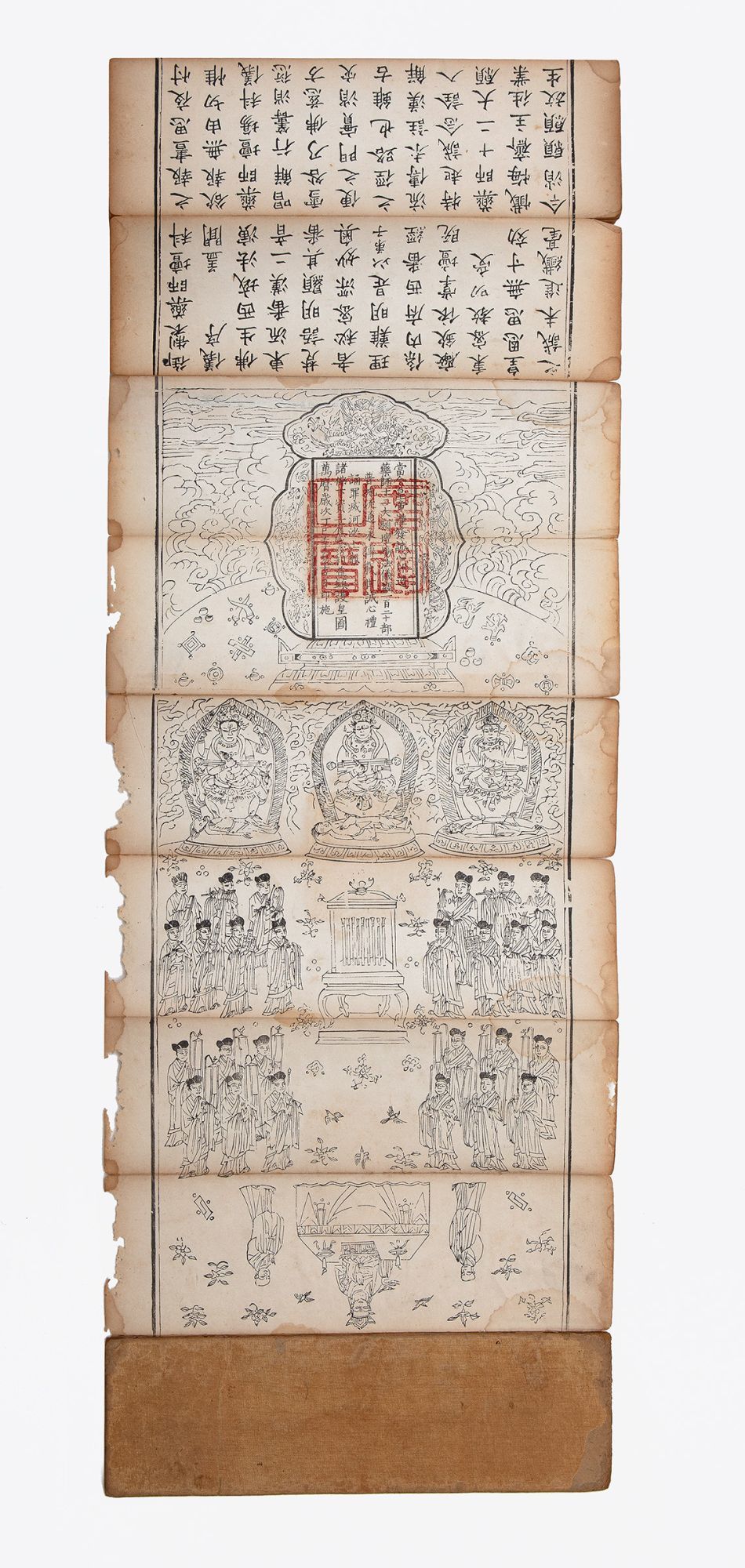
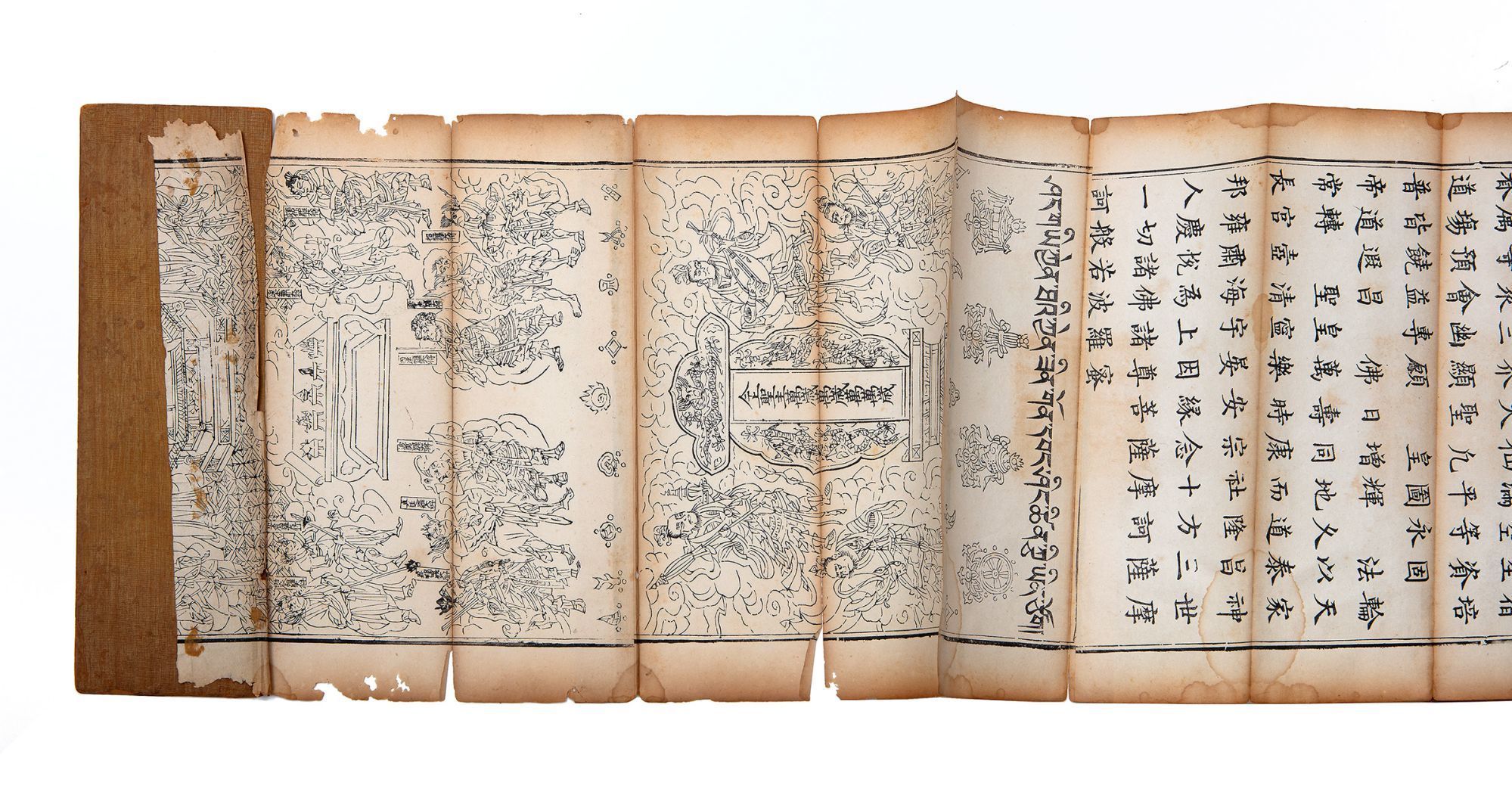
Two & one-half woodcut illus. 44 sheets, each folded into multiple pages. Oblong small 8vo (89 x 288 mm.), orig. stiff boards in concertina format (one loose). [Beijing]: [Nei fu 內府], 1617.
A very scarce bilingual — Tibetan and Chinese — Buddhist scripture published at the Ming Imperial Household in Beijing. Ours is one of two known copies, judging by WorldCat (1202247985). Our book is dedicated to Bhaiṣajyaguru, the healing Buddha. This Buddha “has a body more brilliant than the sun, which was the color of lapis lazuli (vaiḍūryamaṇi) and possessed the power to heal illness and physical deformities” (The Princeton Dictionary of Buddhism, pp. 108-09).
The Ming court periodically asserted sovereignty over Tibet, and several Ming emperors, Wanli among them, patronized Tibetan Buddhism by printing Tibetan-language scriptures in Beijing.
The title given in the Preface, authored by the palace eunuch Zheng Li 鄭利, is enigmatic. In the cartouche that follows the illustrations at the beginning of the book, the title is given as Yaoshi shier dayuan tanchang fayi 藥師十二大願壇場法儀 [Dharma Ritual for the Site of Enlightenment with the Twelve Vows of the Healing Buddha]. The twelve vows of Bhaiṣajyaguru invoked in the title are:
1. The vow to brightly illuminate his own body and the bodies of others;
2. The vow to use his power to quicken the enlightenment of sentient beings;
3. The vow to have sentient beings satisfy their wants and not suffer from poverty;
4. The vow to firmly establish all sentient beings in the course of the Great Vehicle;
5. The vow to have all sentient beings live morally, and to embrace the three sets of precepts;
6. The vow to fully enhance the spiritual capacities of those who are lacking them;
7. The vow to free all sentient beings from the myriad sicknesses, to make them at ease mentally and physically, and to have them experience peerless perfect enlightenment;
8. The vow to transform females into males;
9. The vow to liberate all sentient beings from the entrapments of Māra and mistaken non-Buddhist paths, and from the dense forest of incorrect thinking and evil views (arisen based on ignorance of cause-and-effect), to induce correct cognition;
10. The vow to liberate all sentient beings from the unexpected misfortune of robbery, evil rulers, and so forth;
11. The vow to have all hungry and thirsty human beings gain excellent nutrition;
12. The vow that the poor who lack clothing will be given fine garments (Digital Dictionary of Buddhism).
The Preface is dated 1599 (Wanli jihai), whereas the cartouche is dated 1617 (Wanli dingsi).
Our book appears to lack the final leaf of the illustration at the end. However, a comparison with the digitized copy originally held at the Berlin State Library, which is the only other copy that we know of, lacks even the first leaf of this illustration. Ours is thus the more complete copy. The Berlin copy was evacuated to Silesia during the Second World War, and was then taken to Krakow when that region became part of Poland. It is still in Krakow.
We believe that our book comes from the collection of Japanese sinologist Kanda Nobuo 神田信夫 (1921-2003).
Fine copy; some tears in the margins, with no loss of text, and some marginal dampstaining, as well as the aforementioned possible loss of half an illustration at the end. One board is loose. Preserved in a modern hantao.
A very scarce bilingual — Tibetan and Chinese — Buddhist scripture published at the Ming Imperial Household in Beijing. Ours is one of two known copies, judging by WorldCat (1202247985). Our book is dedicated to Bhaiṣajyaguru, the healing Buddha. This Buddha “has a body more brilliant than the sun, which was the color of lapis lazuli (vaiḍūryamaṇi) and possessed the power to heal illness and physical deformities” (The Princeton Dictionary of Buddhism, pp. 108-09).
The Ming court periodically asserted sovereignty over Tibet, and several Ming emperors, Wanli among them, patronized Tibetan Buddhism by printing Tibetan-language scriptures in Beijing.
The title given in the Preface, authored by the palace eunuch Zheng Li 鄭利, is enigmatic. In the cartouche that follows the illustrations at the beginning of the book, the title is given as Yaoshi shier dayuan tanchang fayi 藥師十二大願壇場法儀 [Dharma Ritual for the Site of Enlightenment with the Twelve Vows of the Healing Buddha]. The twelve vows of Bhaiṣajyaguru invoked in the title are:
1. The vow to brightly illuminate his own body and the bodies of others;
2. The vow to use his power to quicken the enlightenment of sentient beings;
3. The vow to have sentient beings satisfy their wants and not suffer from poverty;
4. The vow to firmly establish all sentient beings in the course of the Great Vehicle;
5. The vow to have all sentient beings live morally, and to embrace the three sets of precepts;
6. The vow to fully enhance the spiritual capacities of those who are lacking them;
7. The vow to free all sentient beings from the myriad sicknesses, to make them at ease mentally and physically, and to have them experience peerless perfect enlightenment;
8. The vow to transform females into males;
9. The vow to liberate all sentient beings from the entrapments of Māra and mistaken non-Buddhist paths, and from the dense forest of incorrect thinking and evil views (arisen based on ignorance of cause-and-effect), to induce correct cognition;
10. The vow to liberate all sentient beings from the unexpected misfortune of robbery, evil rulers, and so forth;
11. The vow to have all hungry and thirsty human beings gain excellent nutrition;
12. The vow that the poor who lack clothing will be given fine garments (Digital Dictionary of Buddhism).
The Preface is dated 1599 (Wanli jihai), whereas the cartouche is dated 1617 (Wanli dingsi).
Our book appears to lack the final leaf of the illustration at the end. However, a comparison with the digitized copy originally held at the Berlin State Library, which is the only other copy that we know of, lacks even the first leaf of this illustration. Ours is thus the more complete copy. The Berlin copy was evacuated to Silesia during the Second World War, and was then taken to Krakow when that region became part of Poland. It is still in Krakow.
We believe that our book comes from the collection of Japanese sinologist Kanda Nobuo 神田信夫 (1921-2003).
Fine copy; some tears in the margins, with no loss of text, and some marginal dampstaining, as well as the aforementioned possible loss of half an illustration at the end. One board is loose. Preserved in a modern hantao.
Details
Title
T. Mi-vkhrugs-pavi vcho-ga dang-po bzhugs sto; Ch. Yu zhi yao shi tan ke yi 御製藥師壇科儀 [Ritual for the Altar of the Healing Buddha (trans. of Ch. title)]
Author
WANLI EMPEROR OF THE MING (nominal author)
Condition
Unknown