

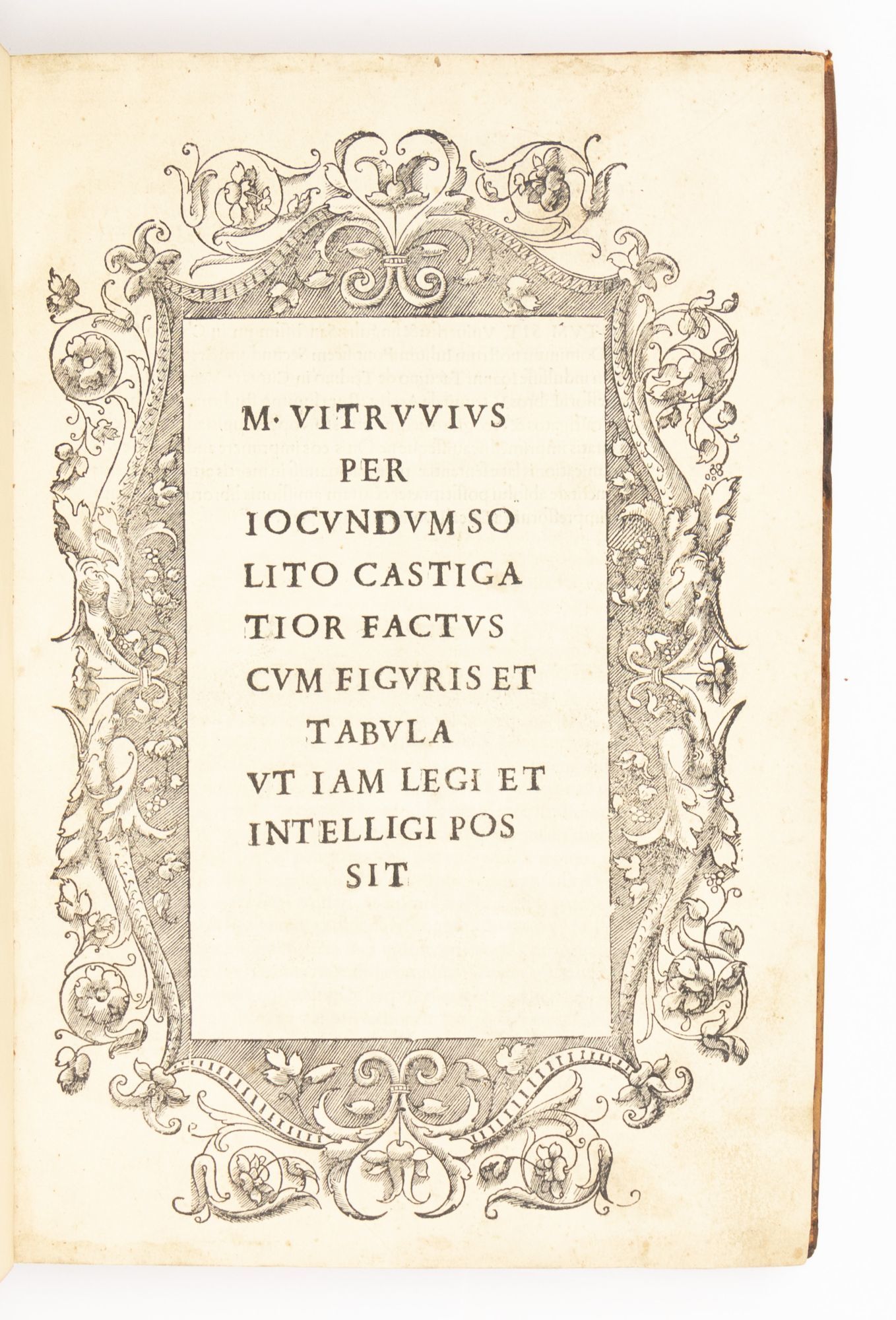
[De Architectura libri decem], M. Vitruuius per Iocundum solito castigatior factus cum figuris et tabula vt iam legi et intelligi possit
![[De Architectura libri decem], M. Vitruuius per Io](https://d3525k1ryd2155.cloudfront.net/h/983/744/1617744983.1.x.jpg)
- Hardcover
- Venice: Giovanni Tacuino da Trino, 1511
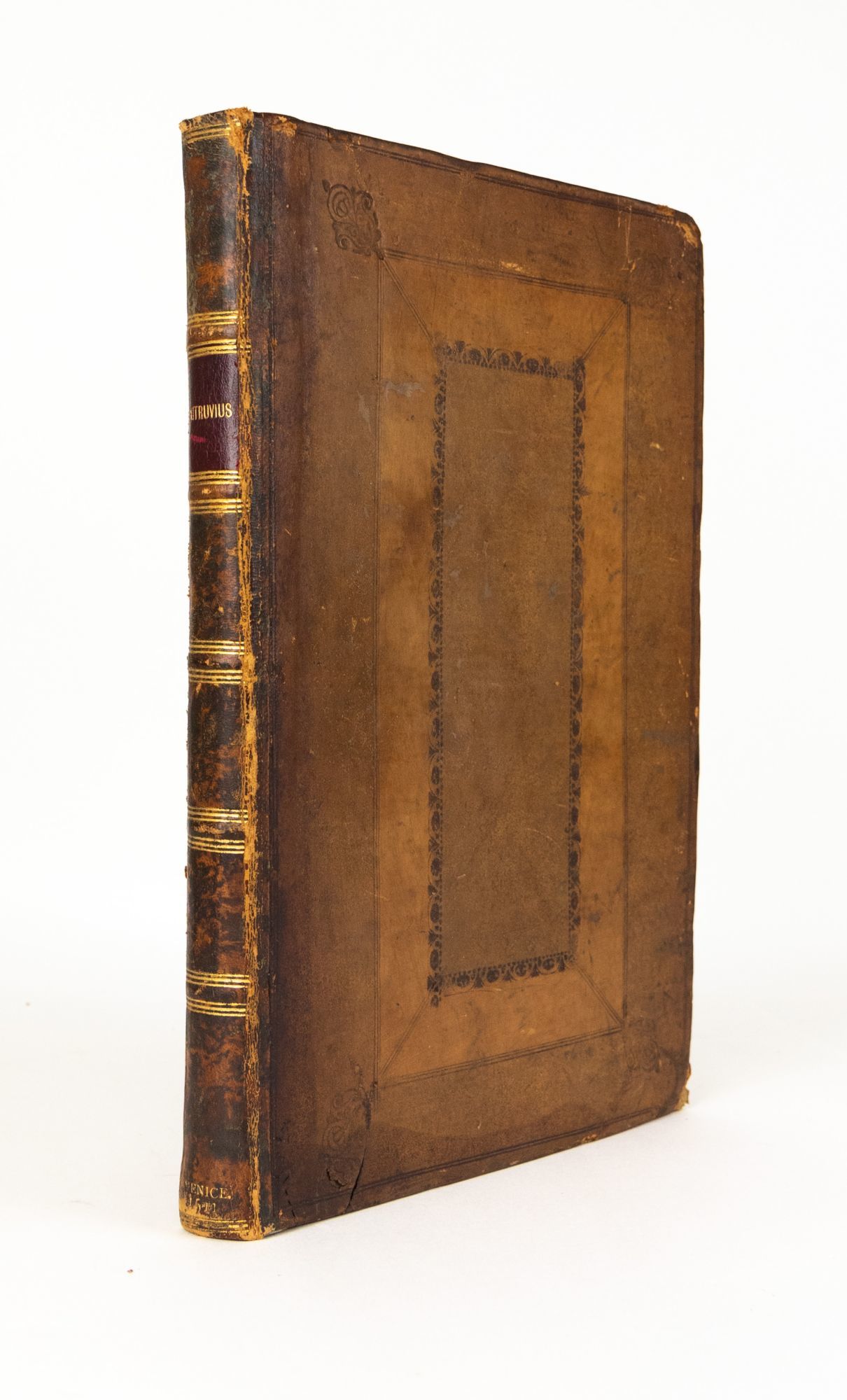
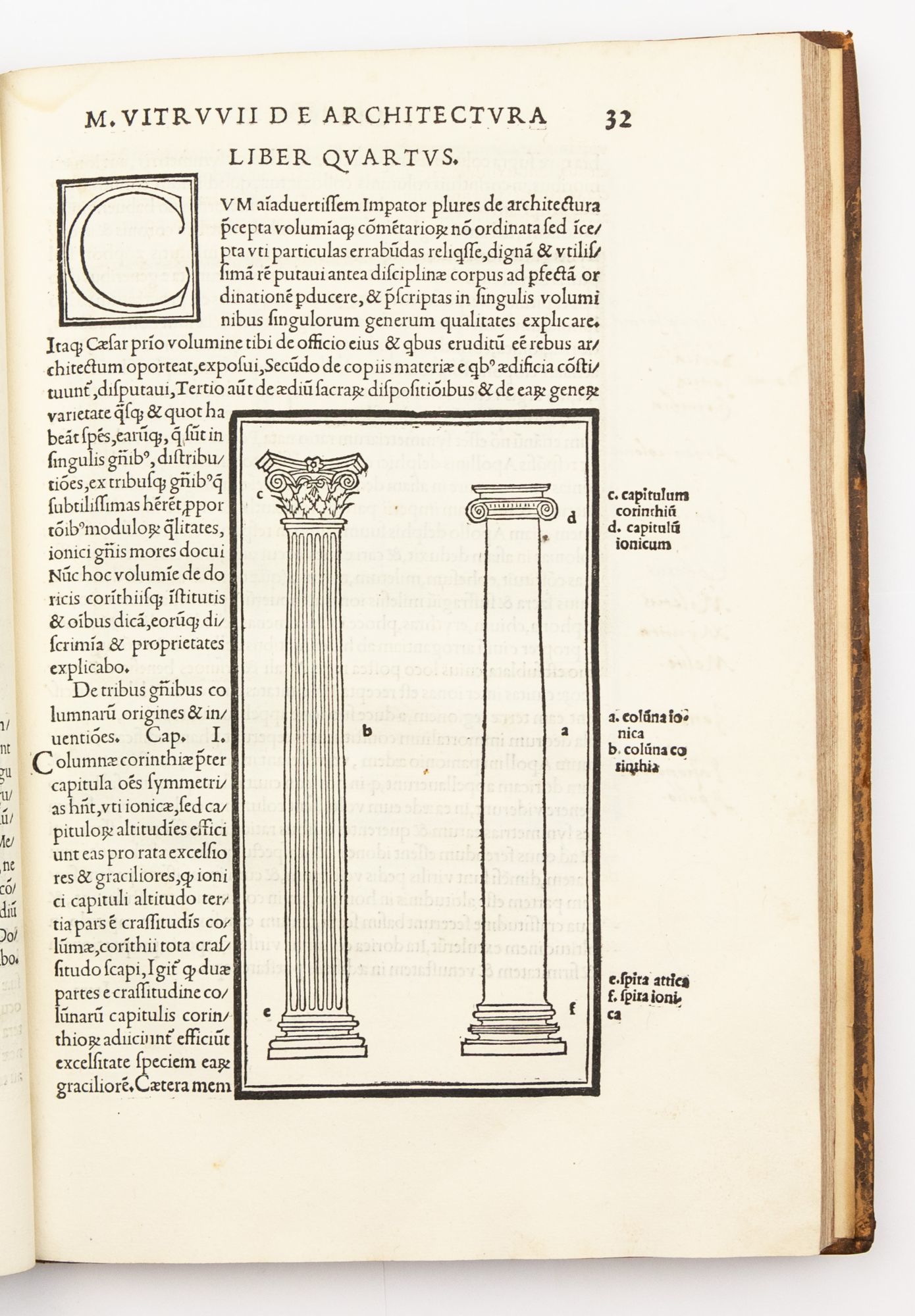
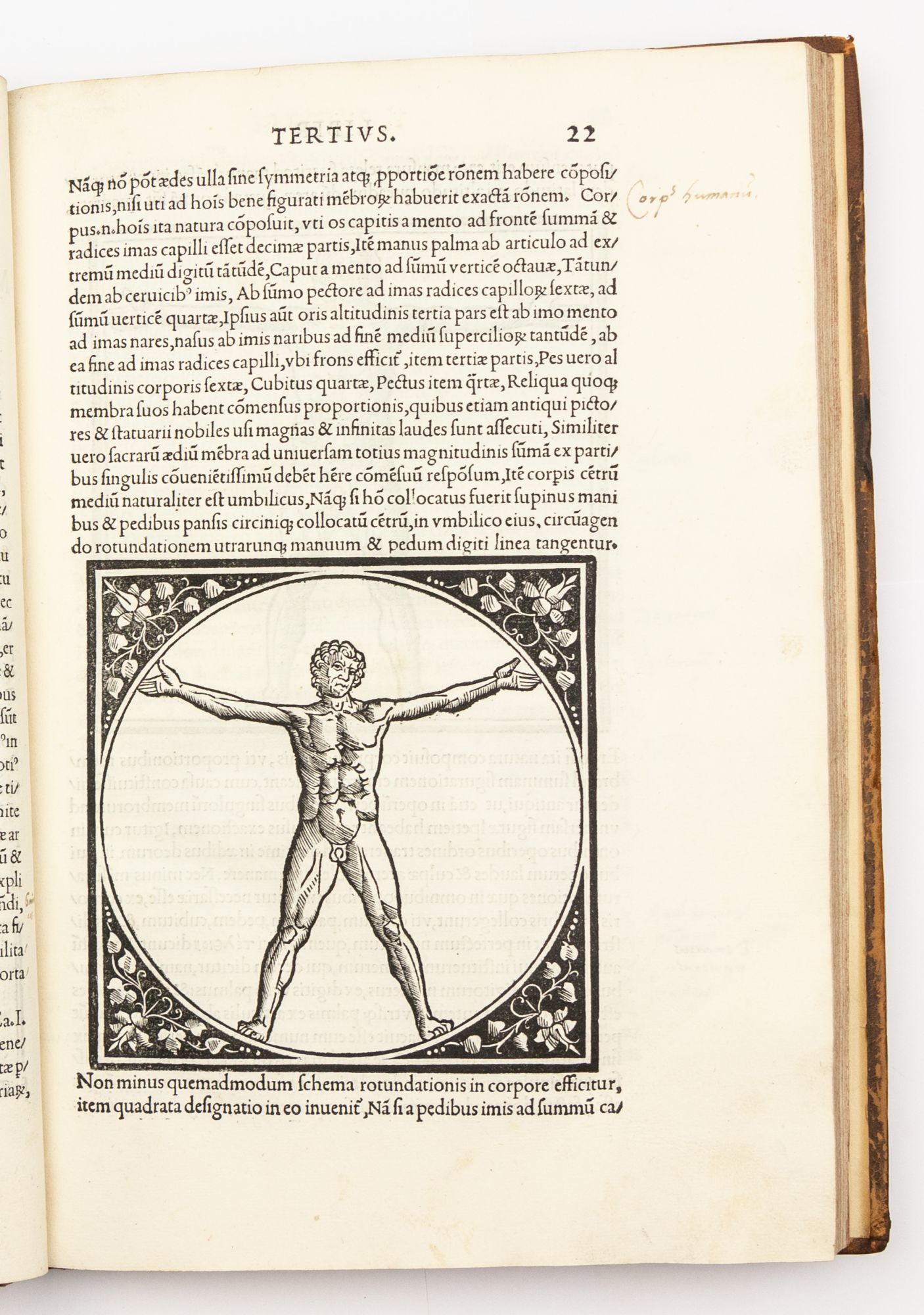
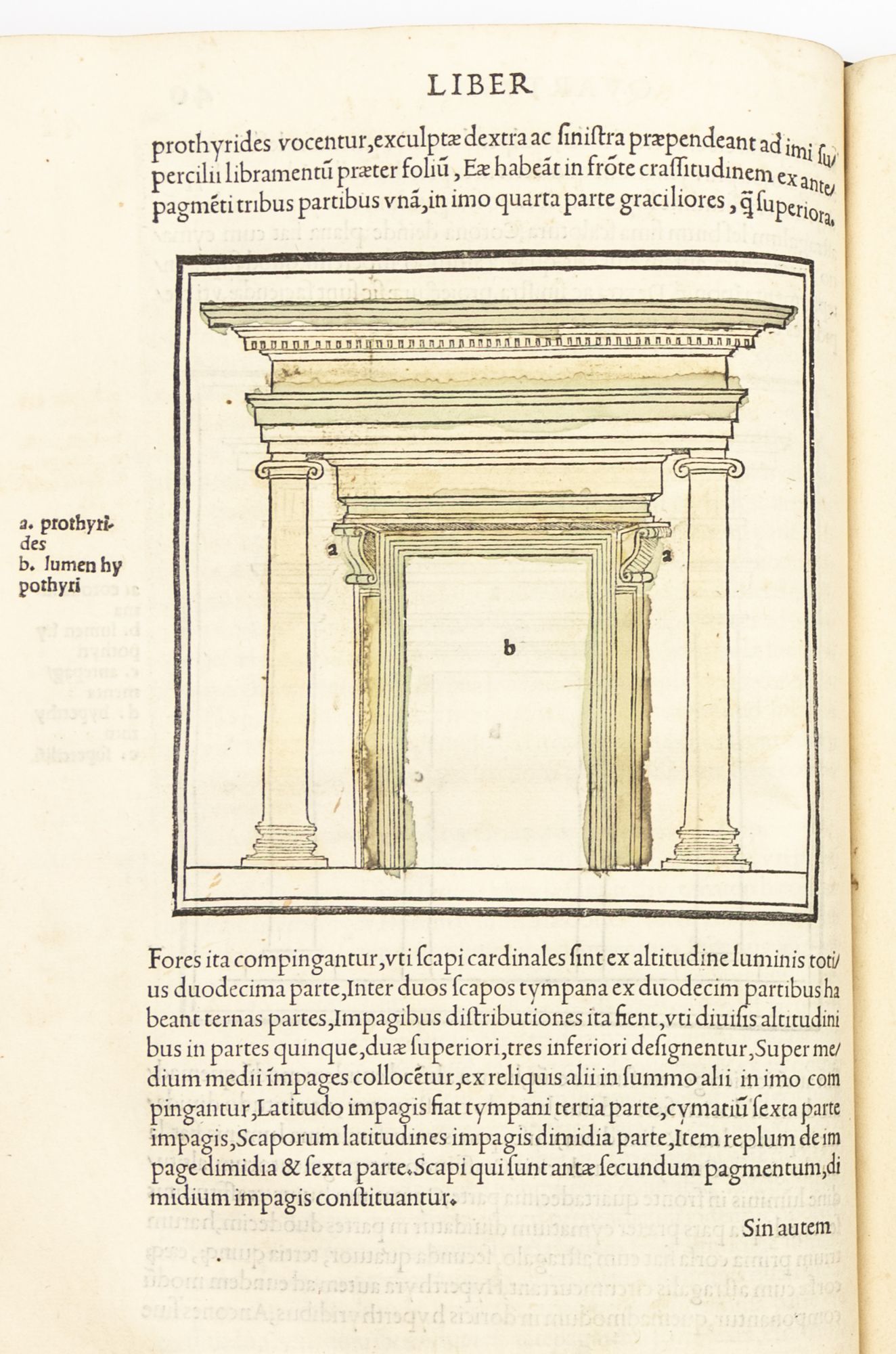
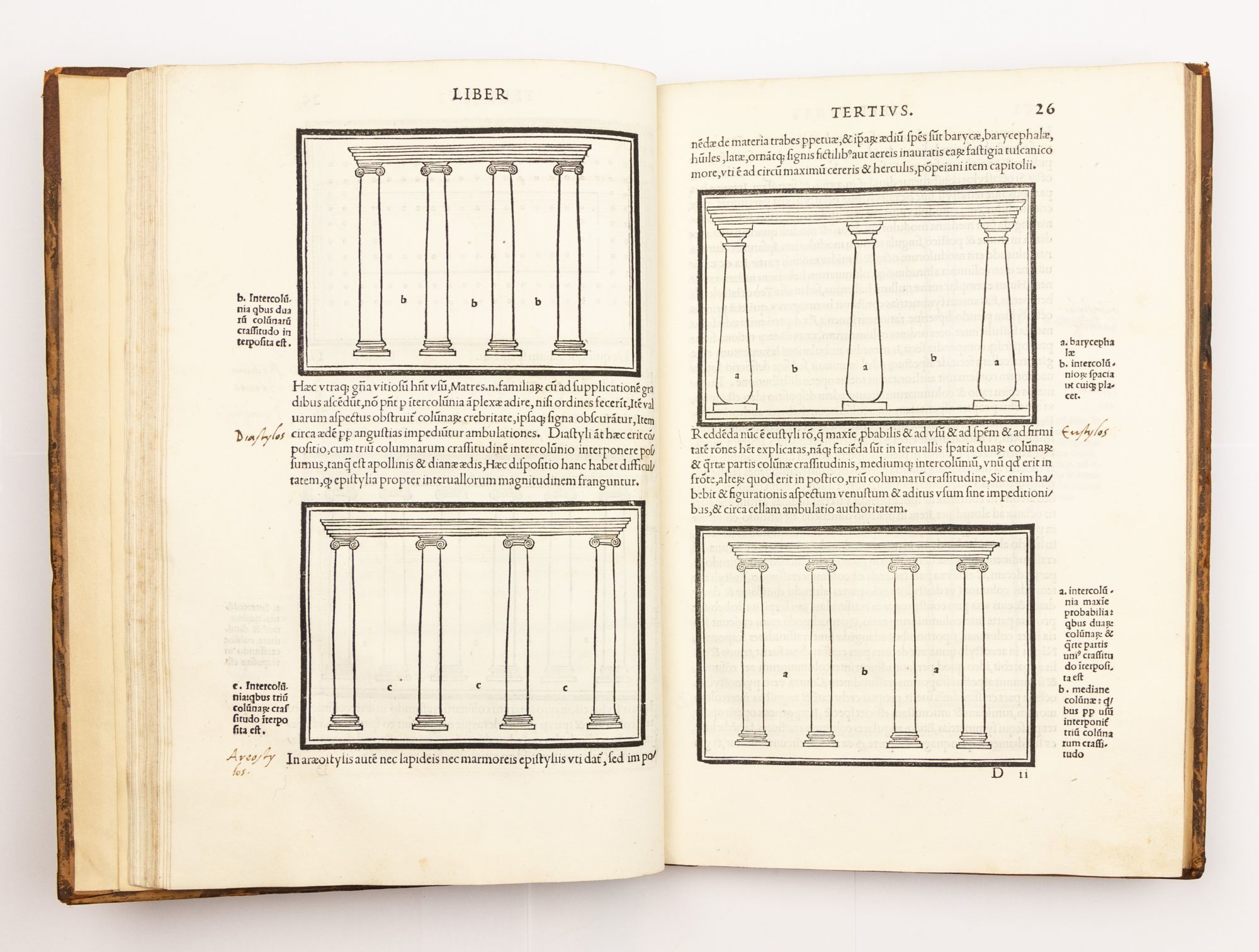
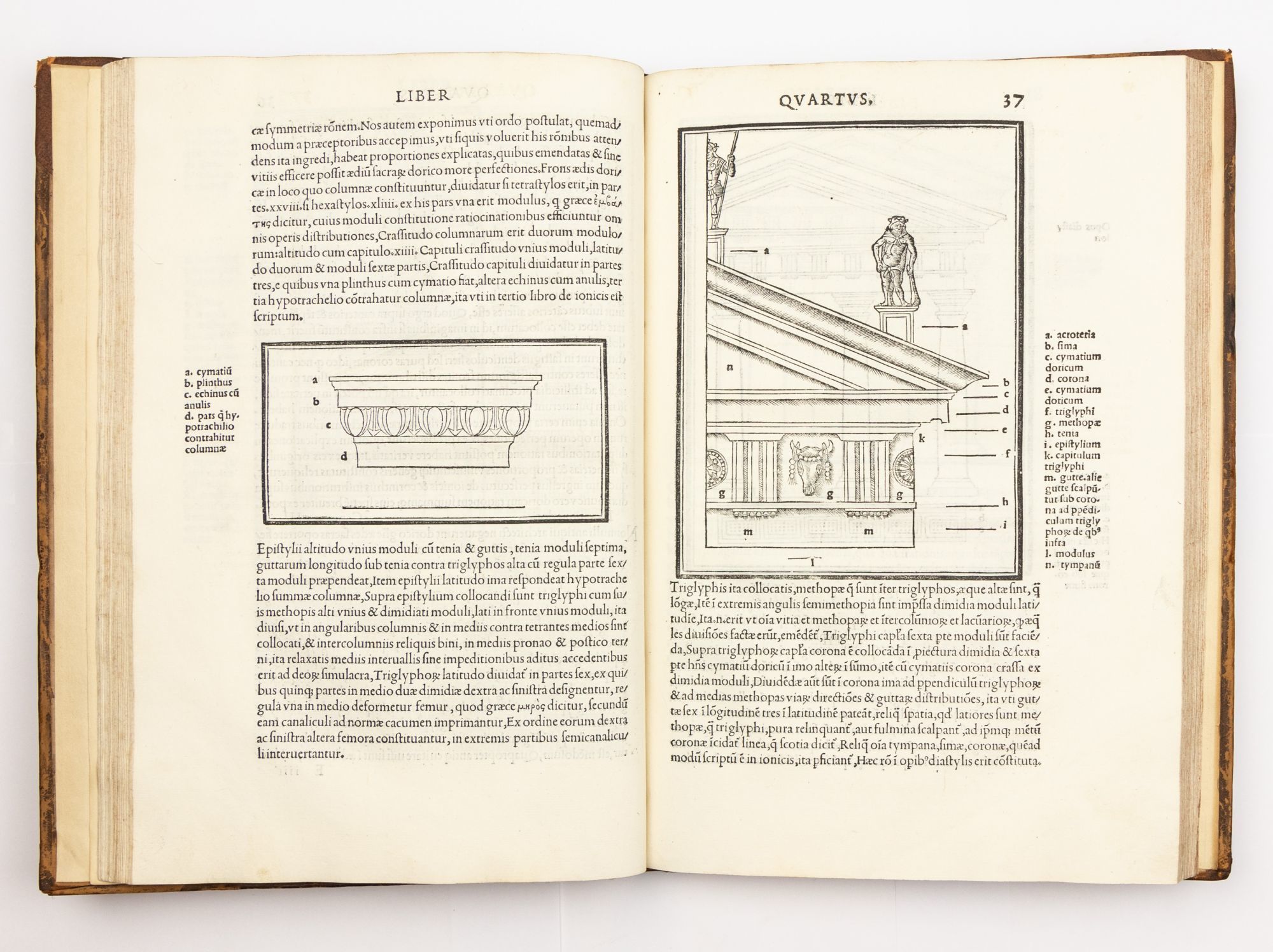
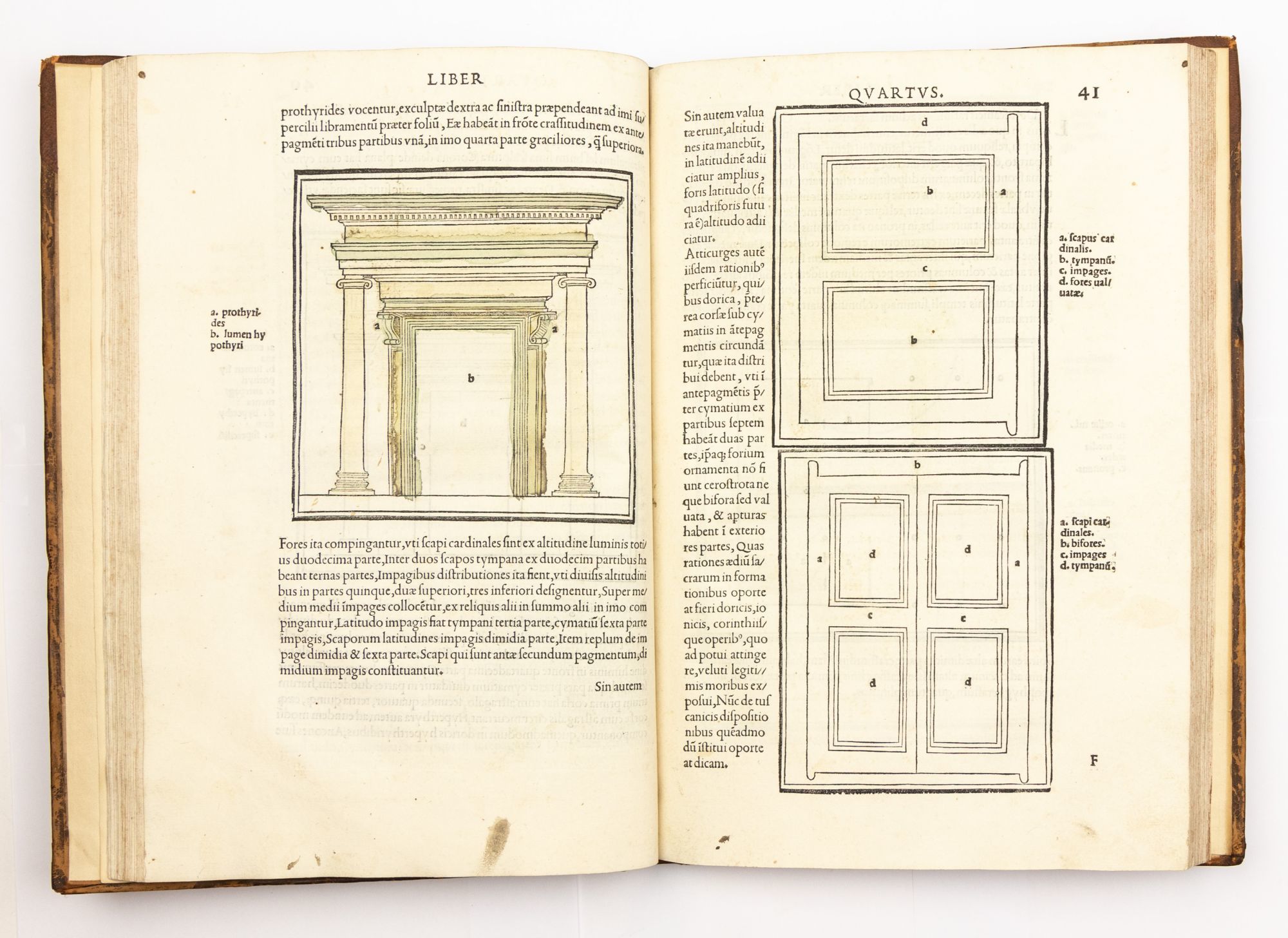
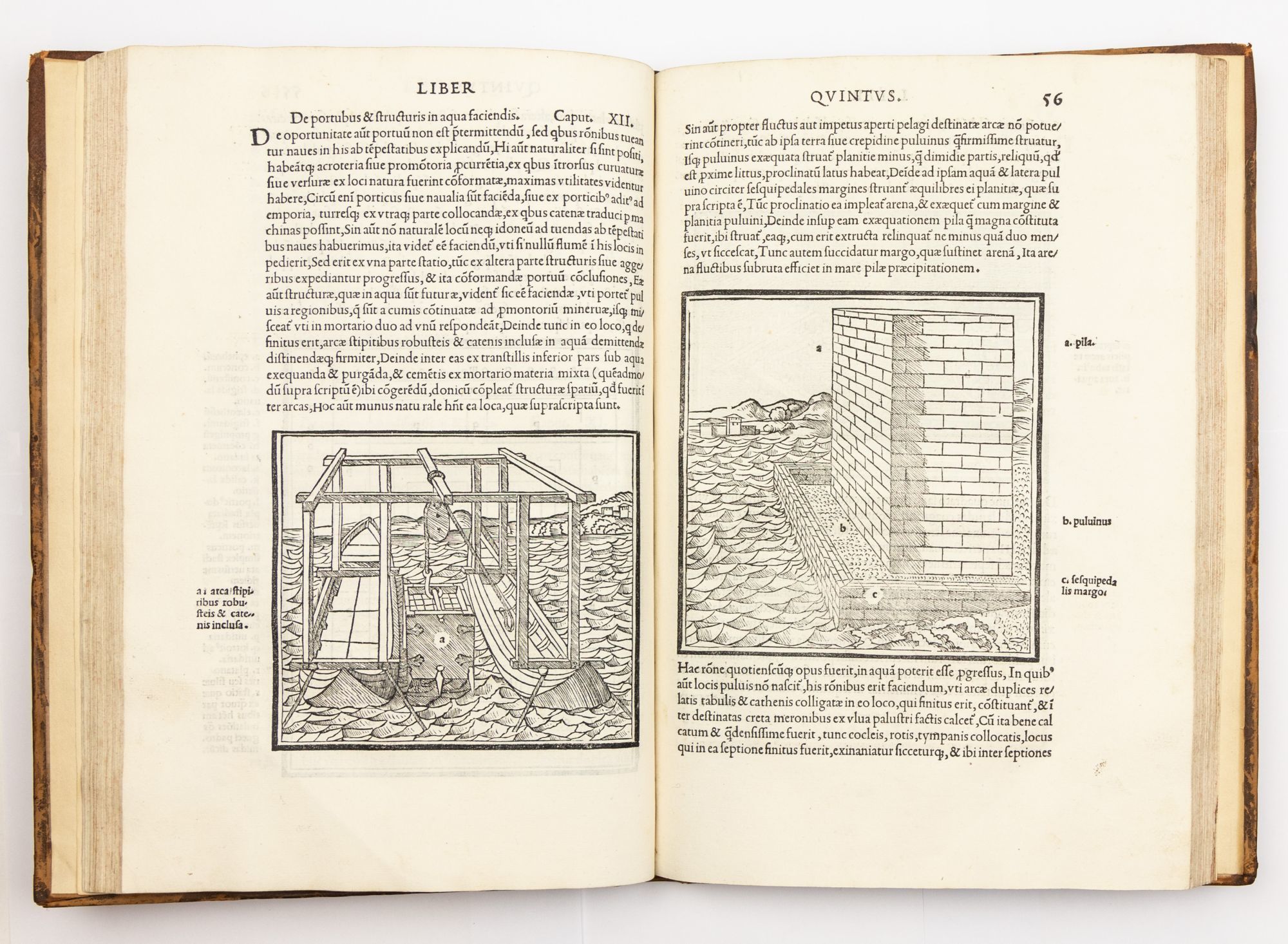
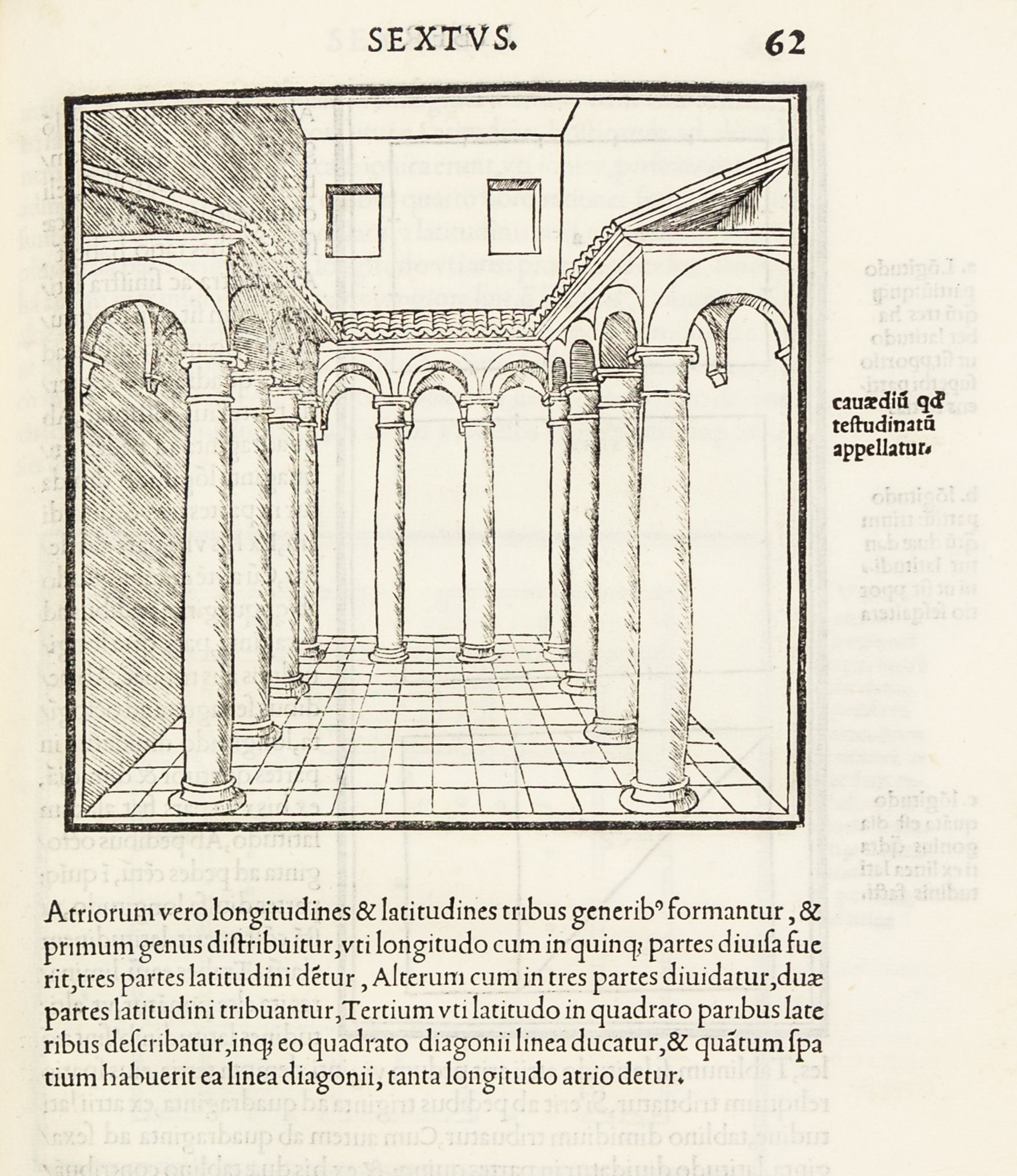
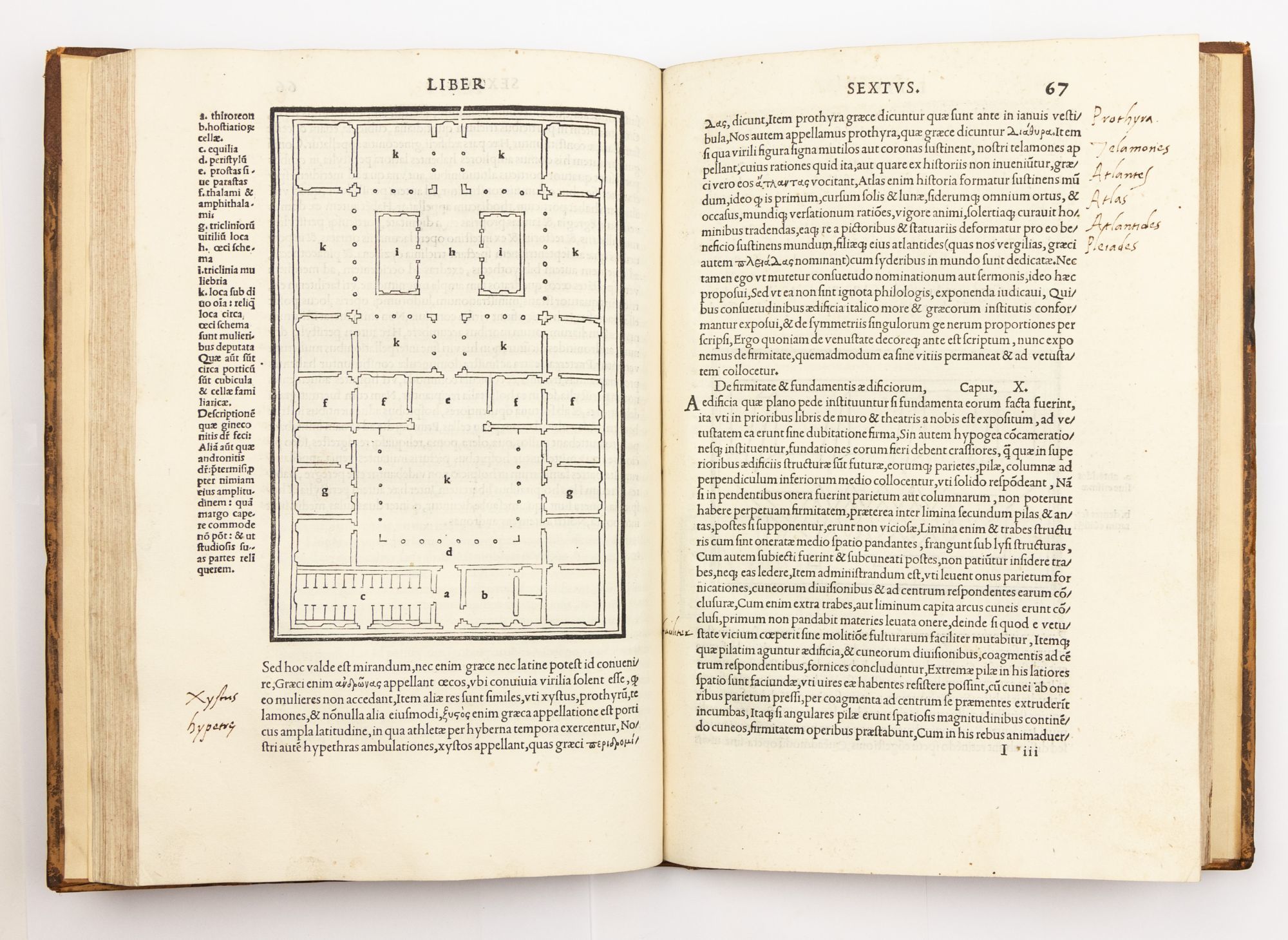
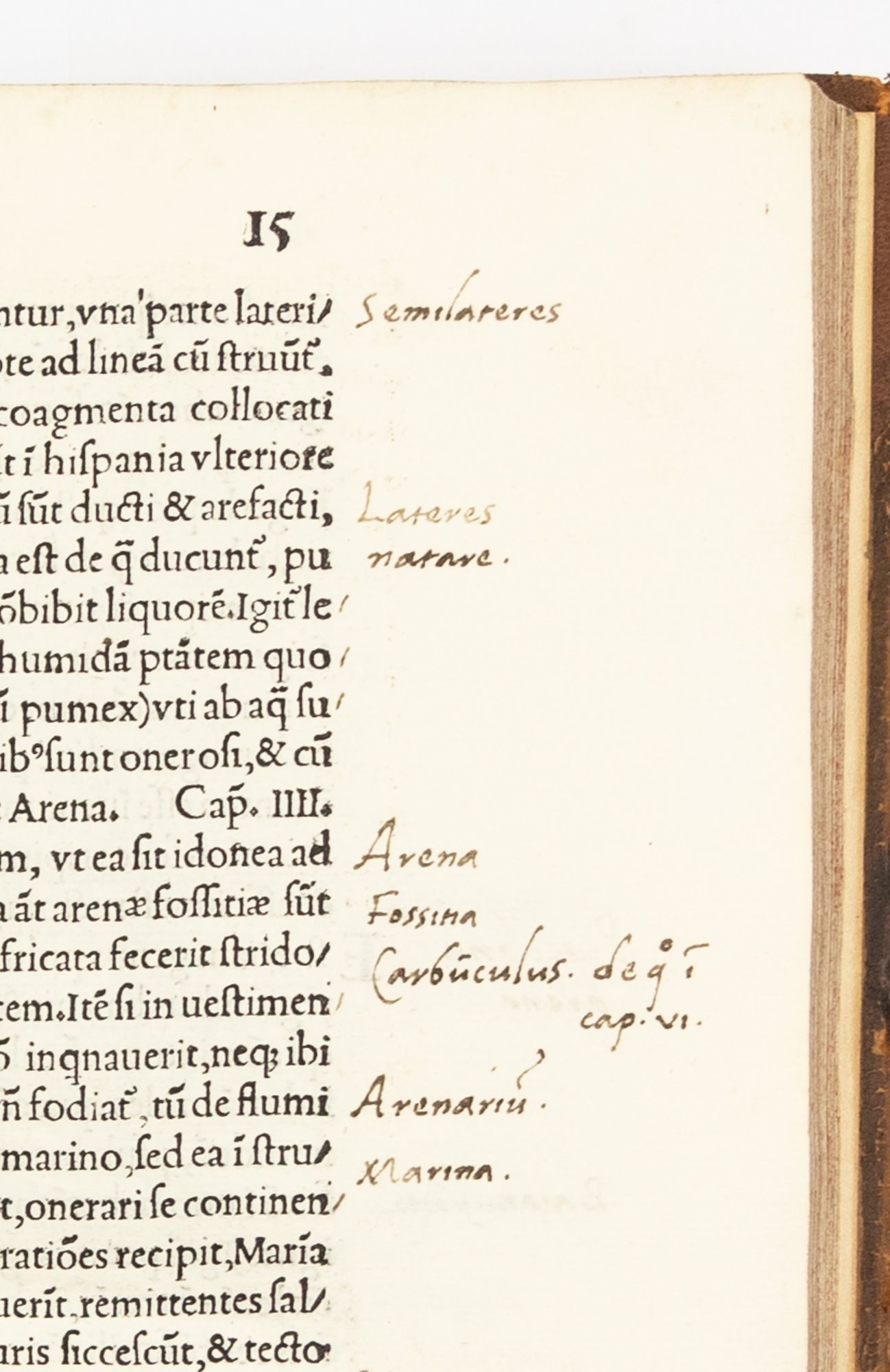
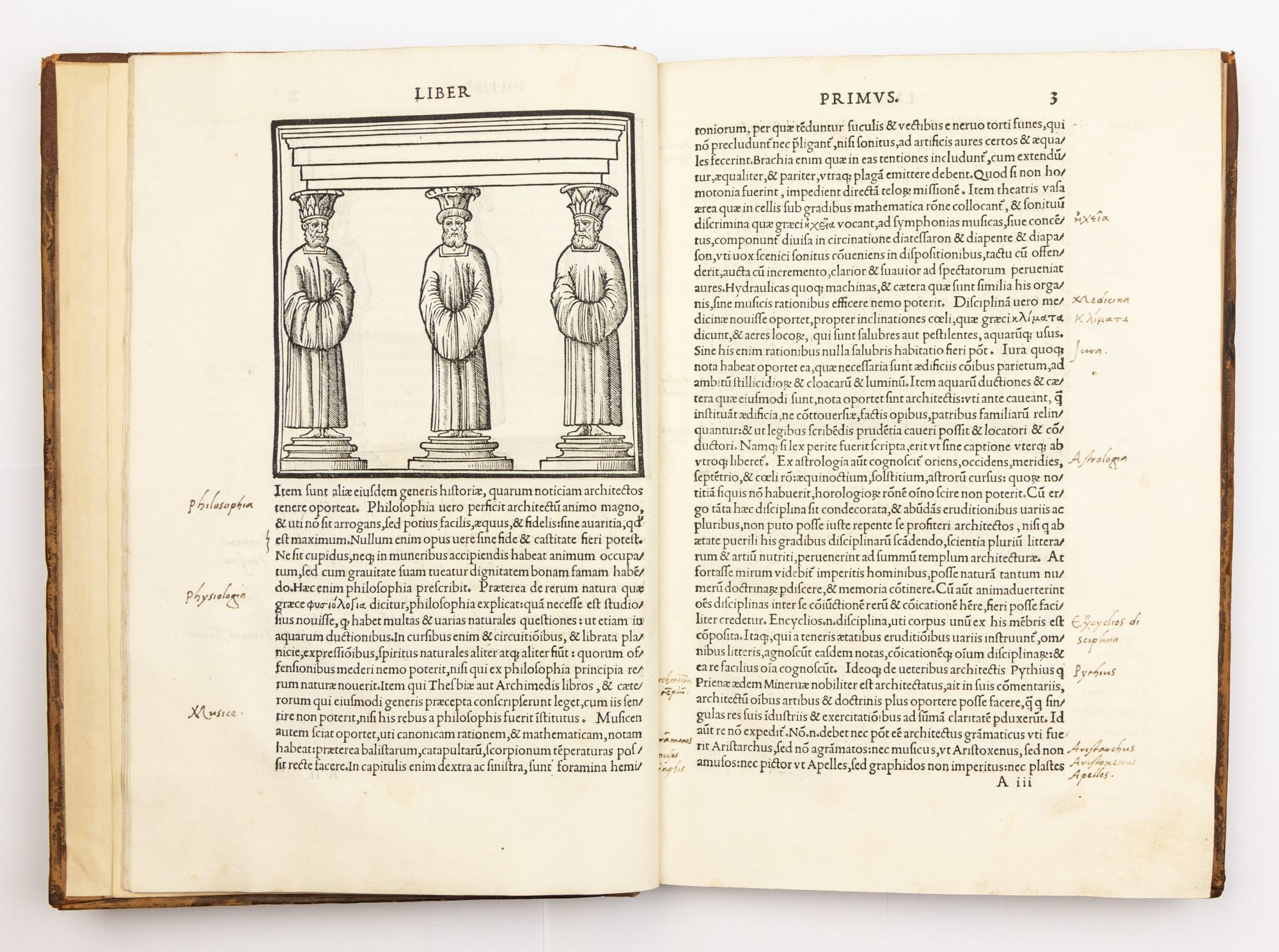
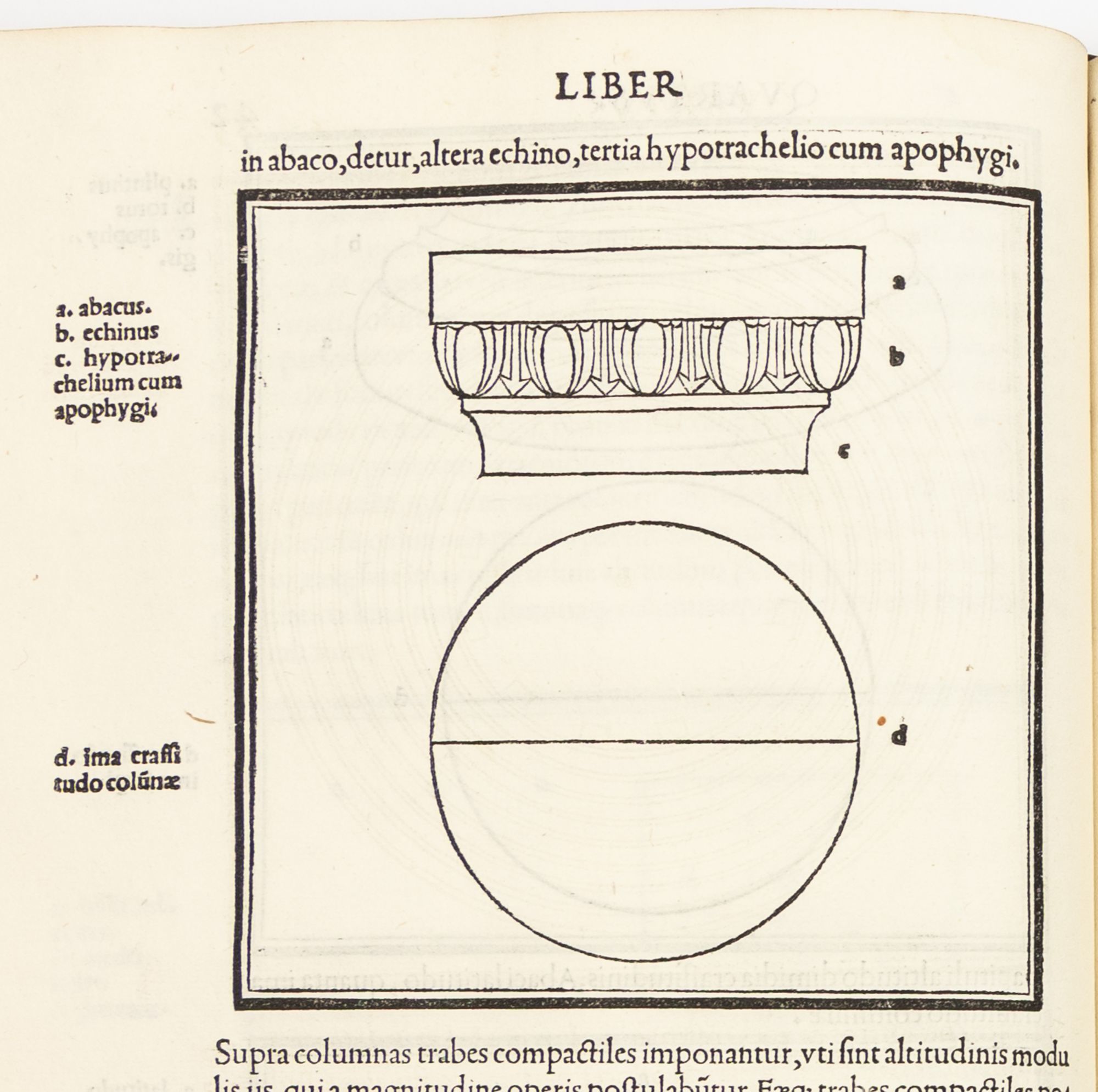
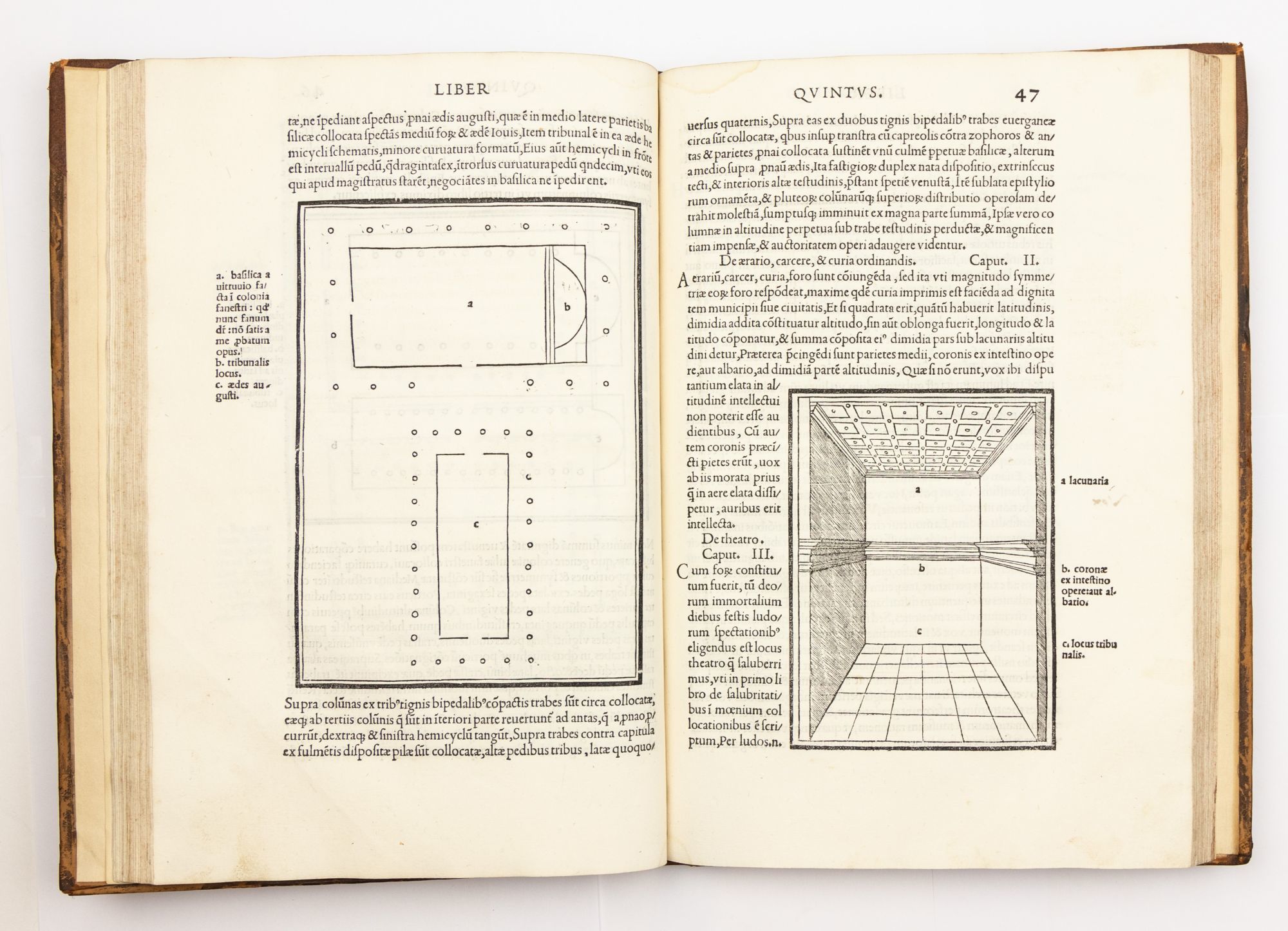
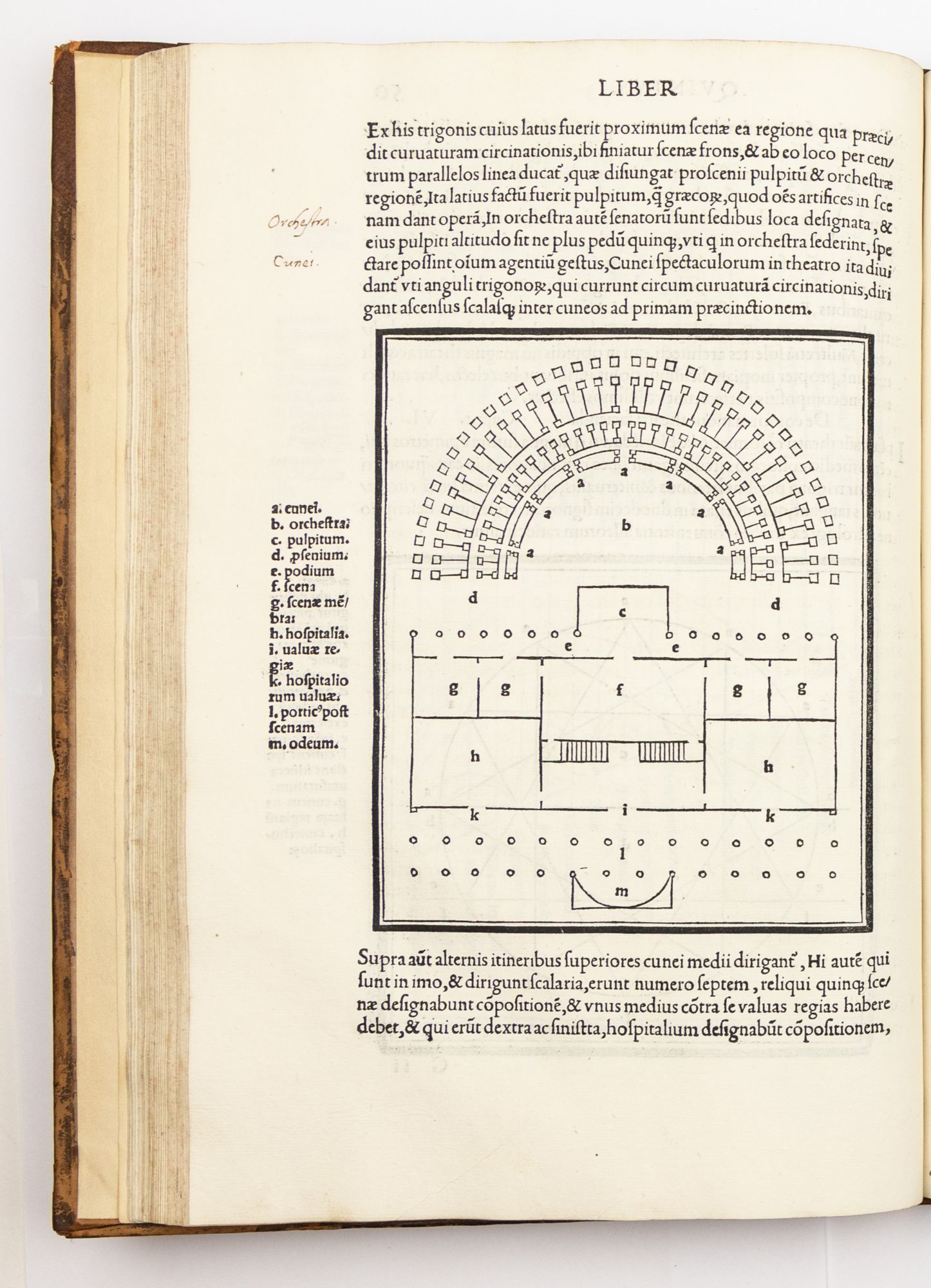
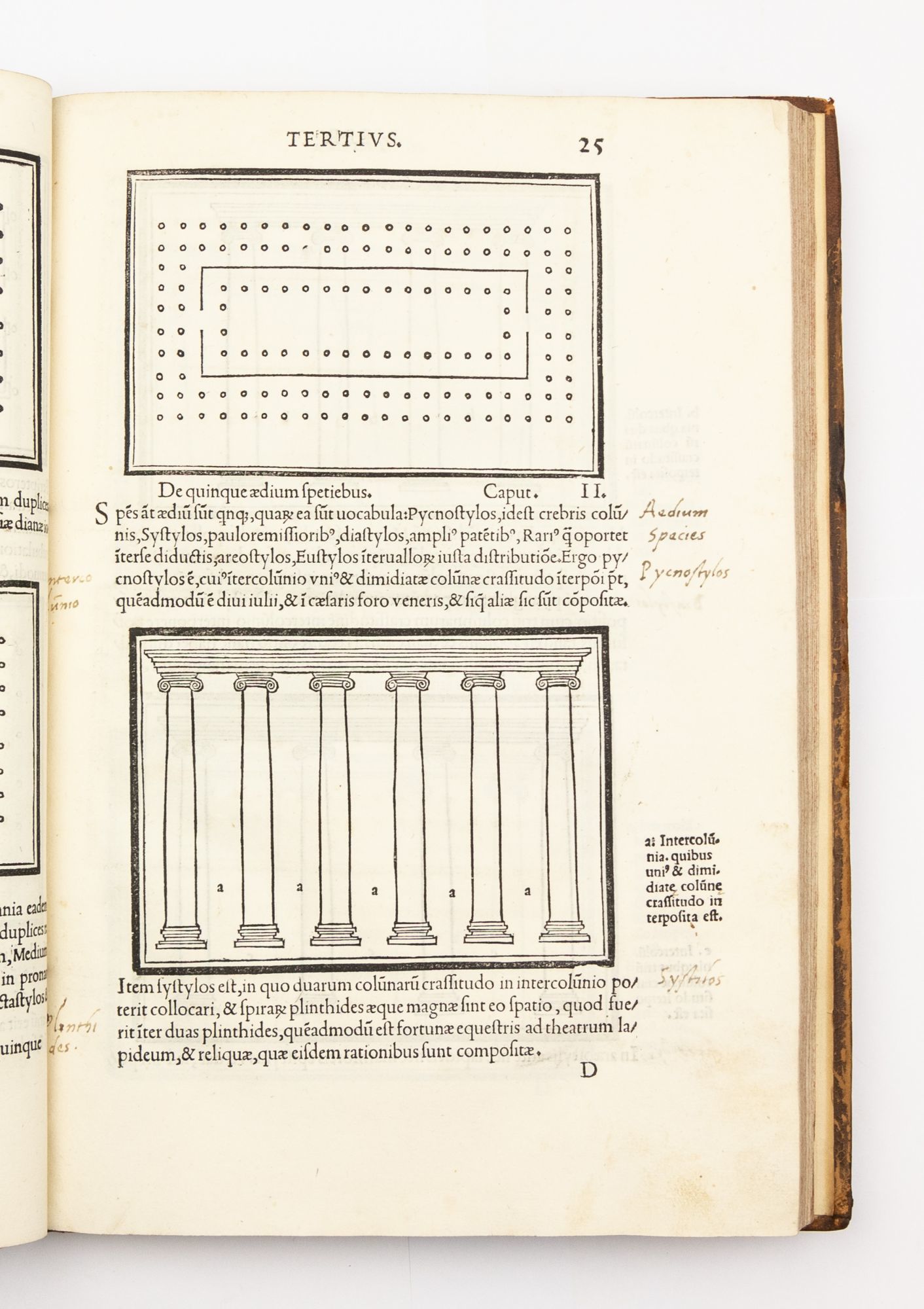
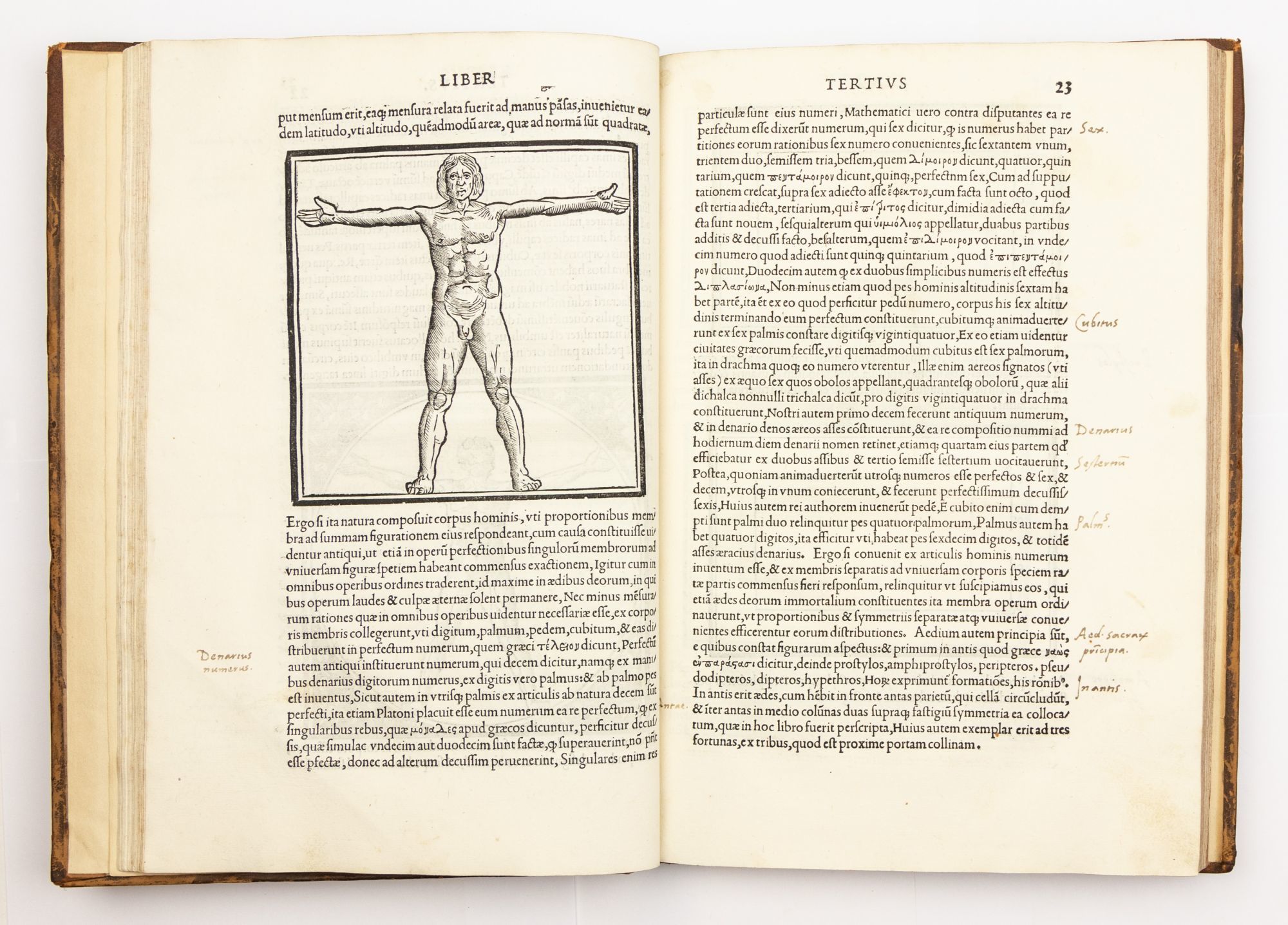
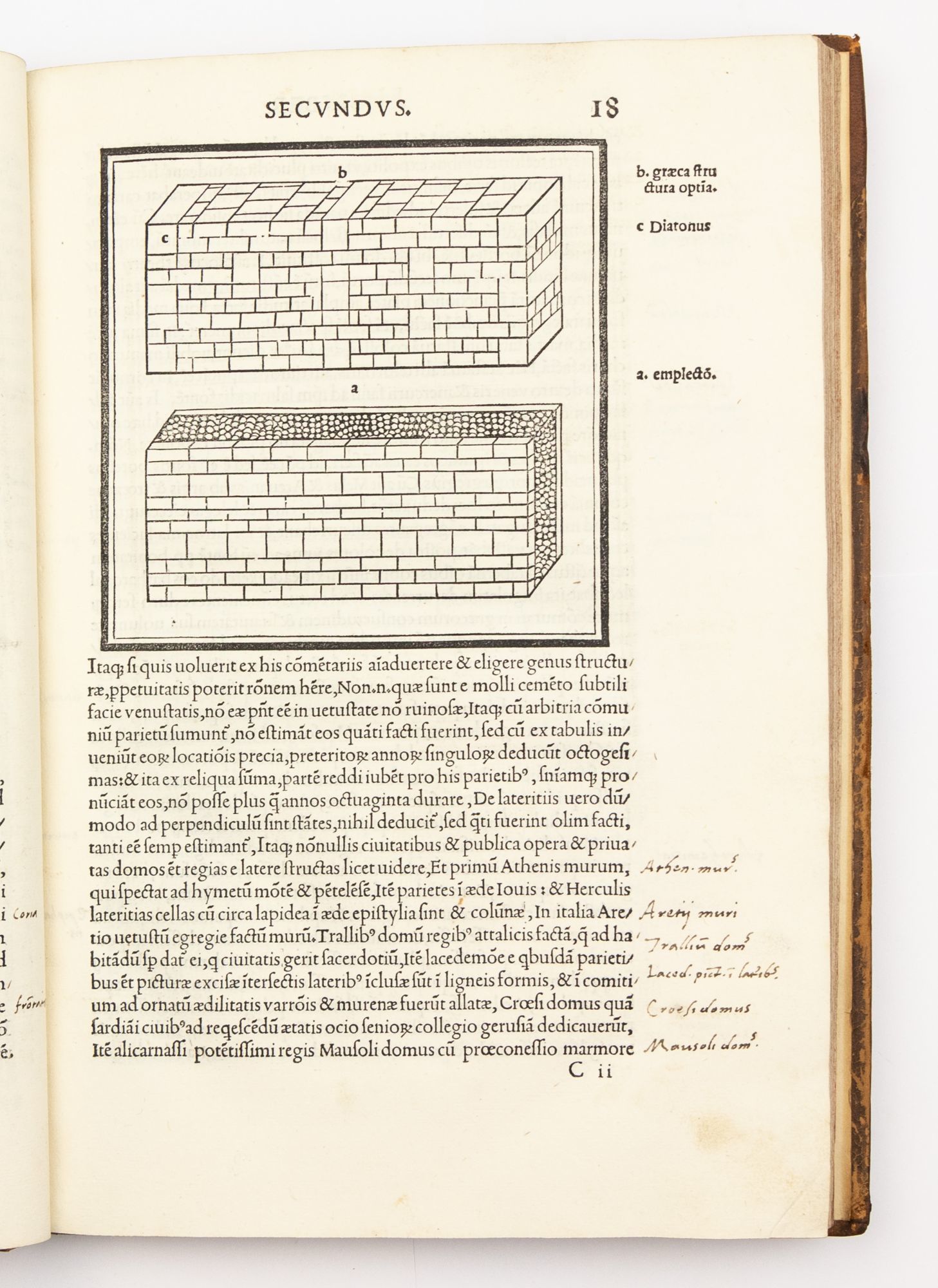
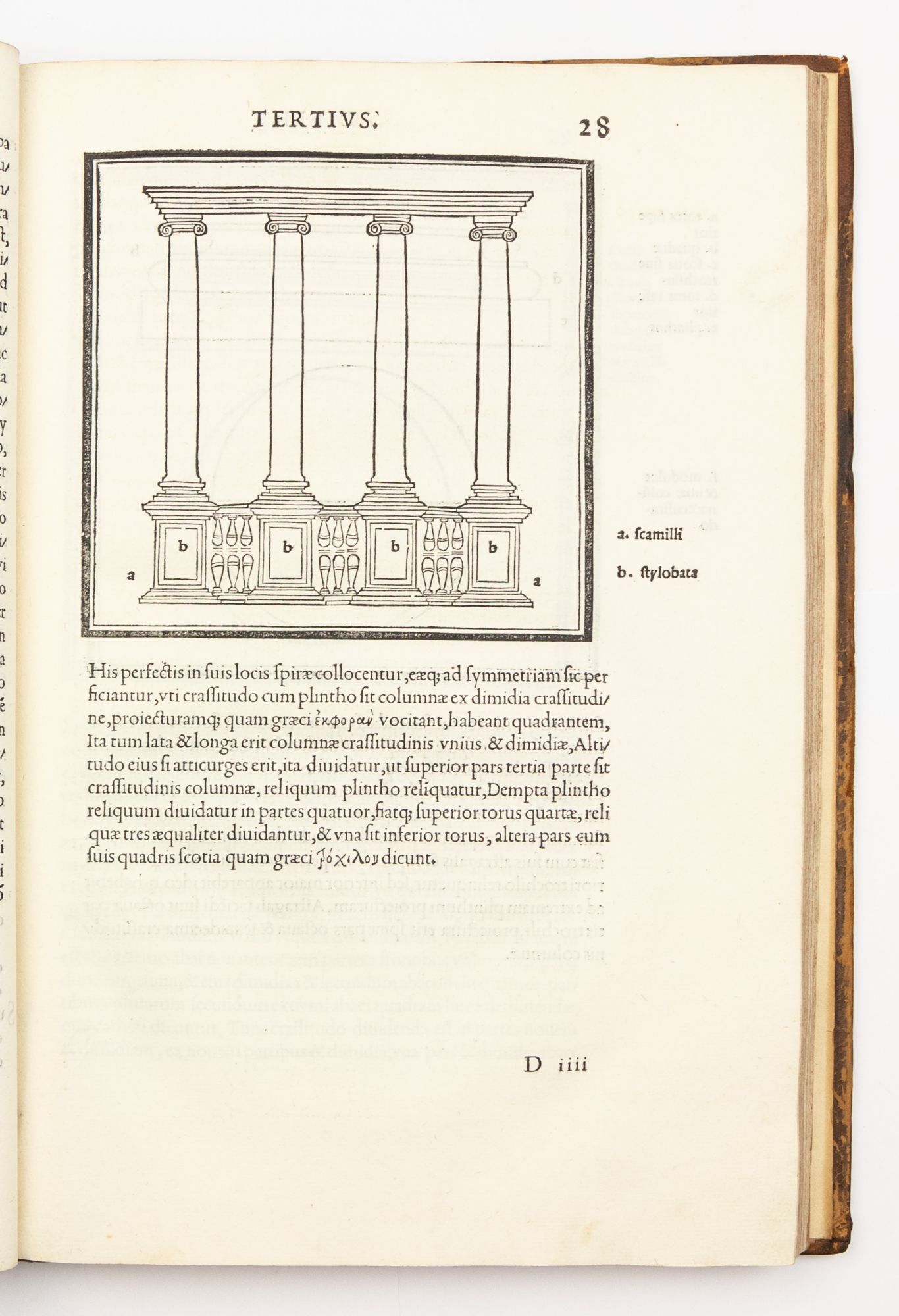
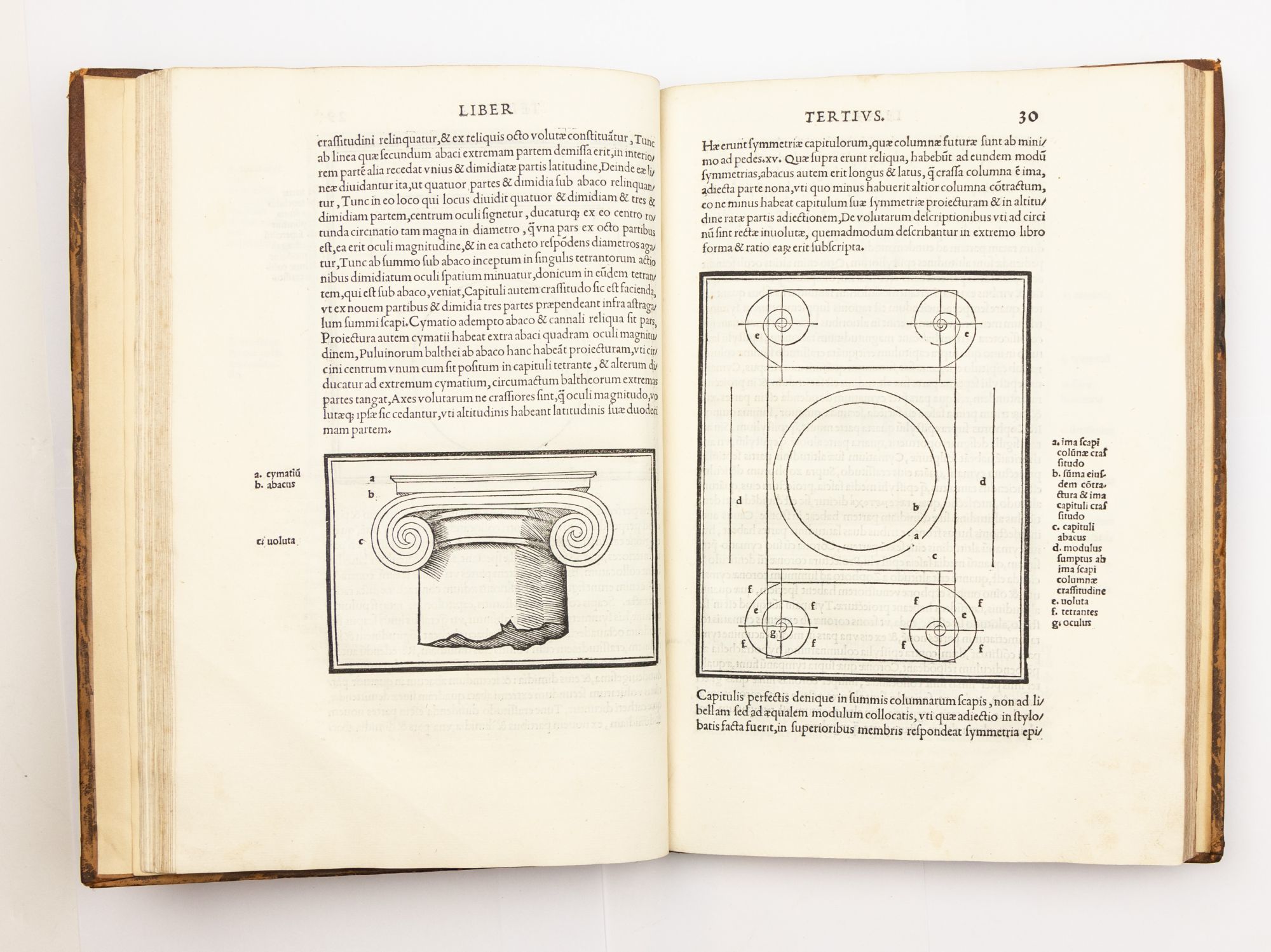
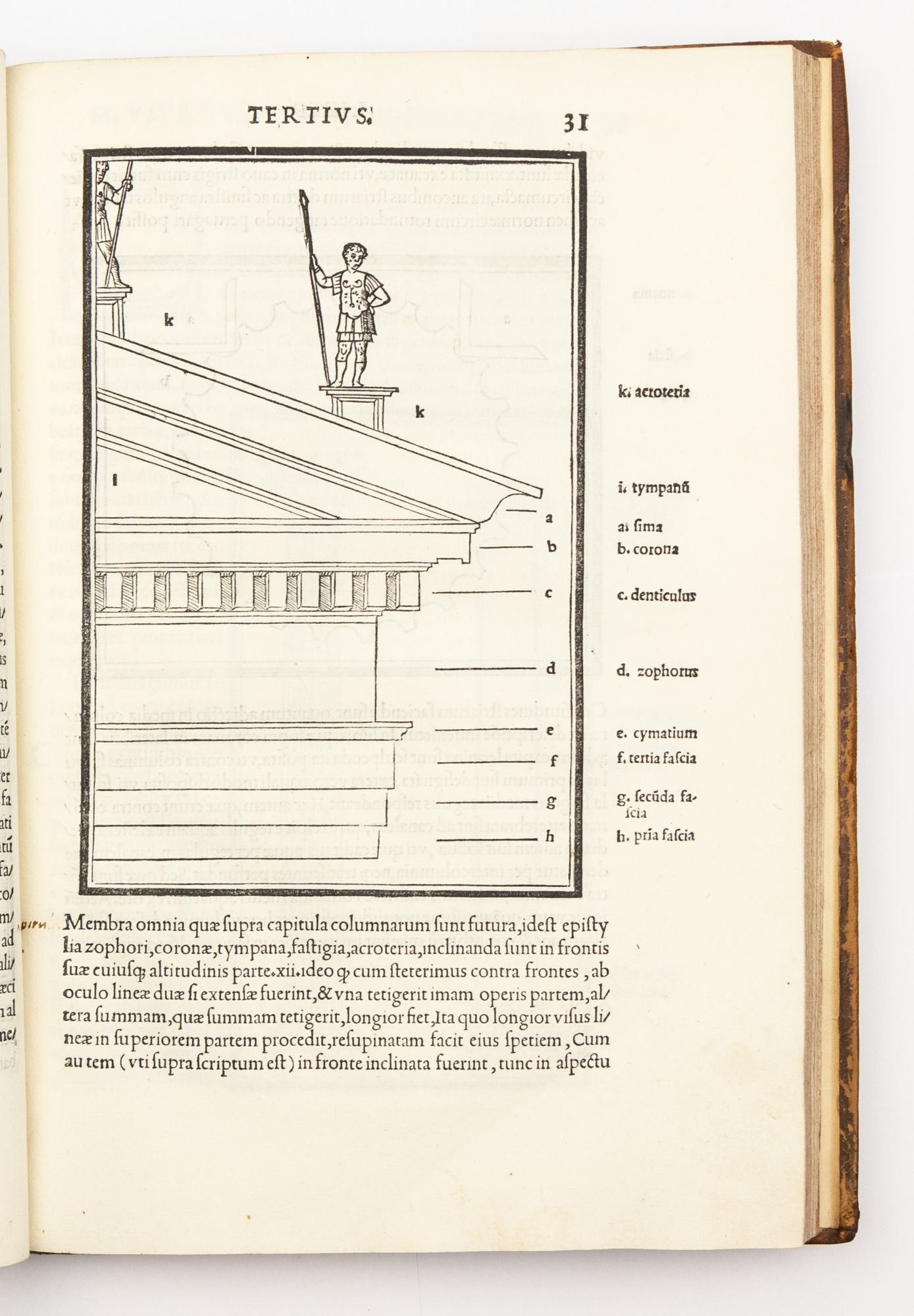
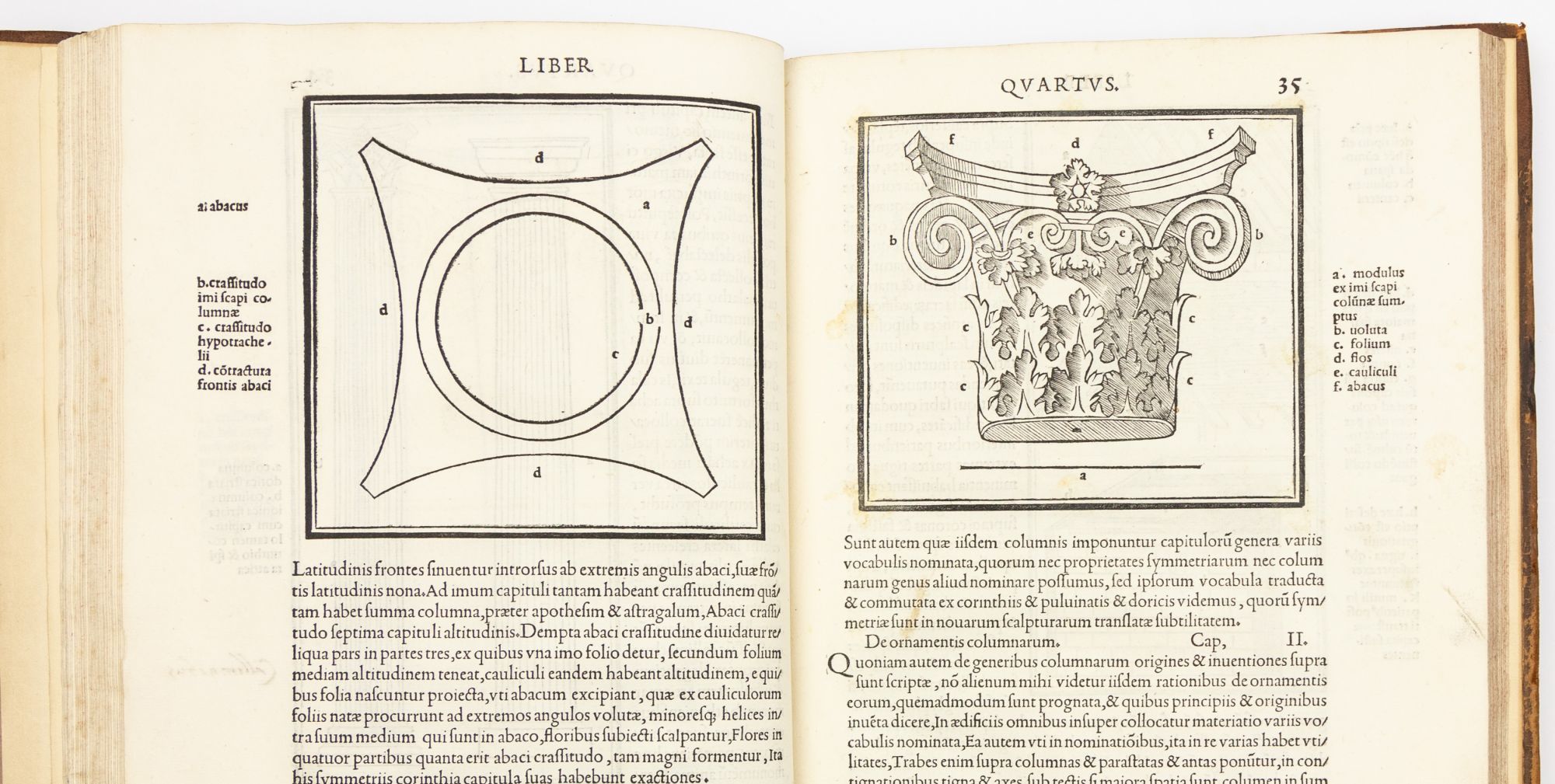
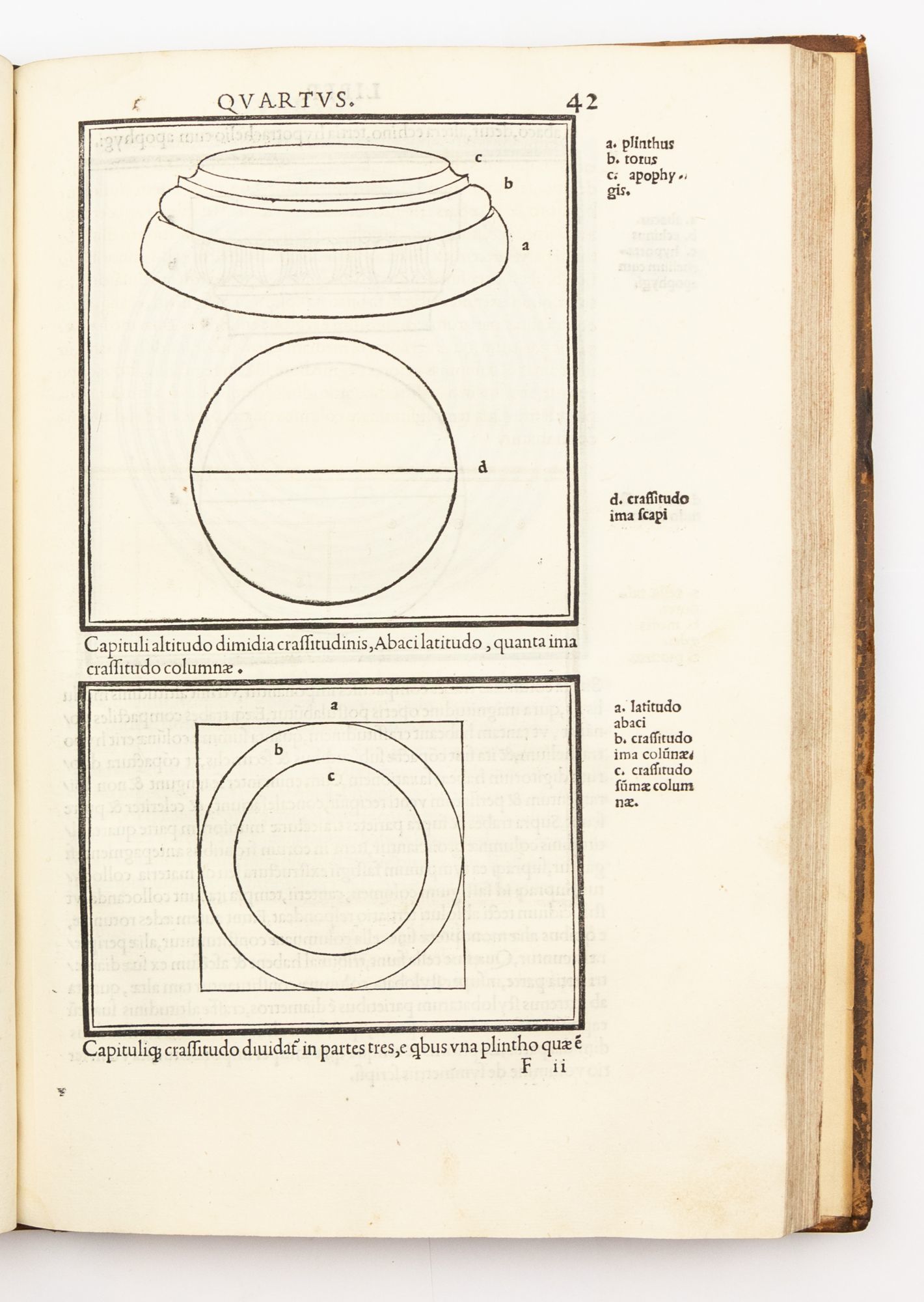
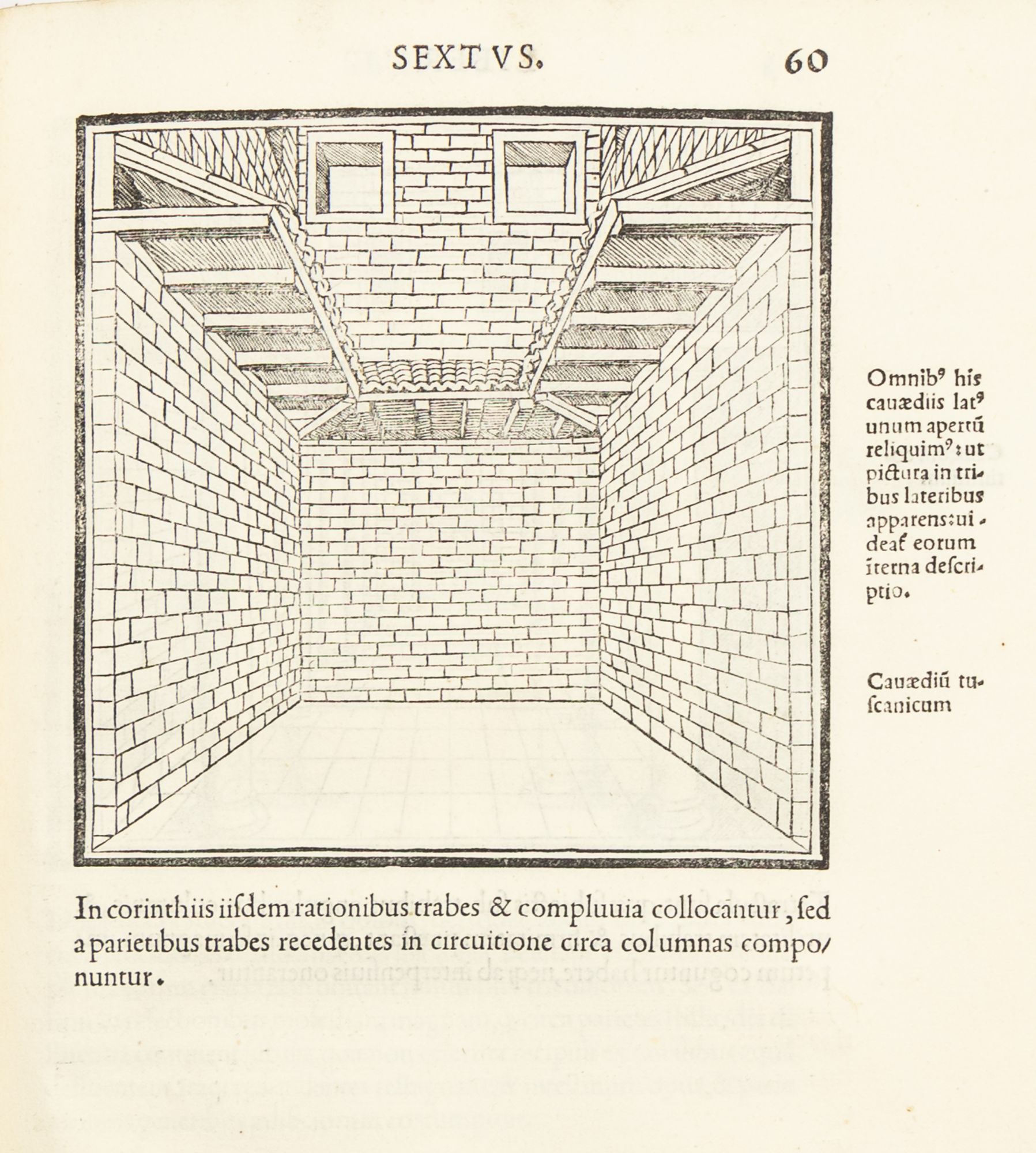
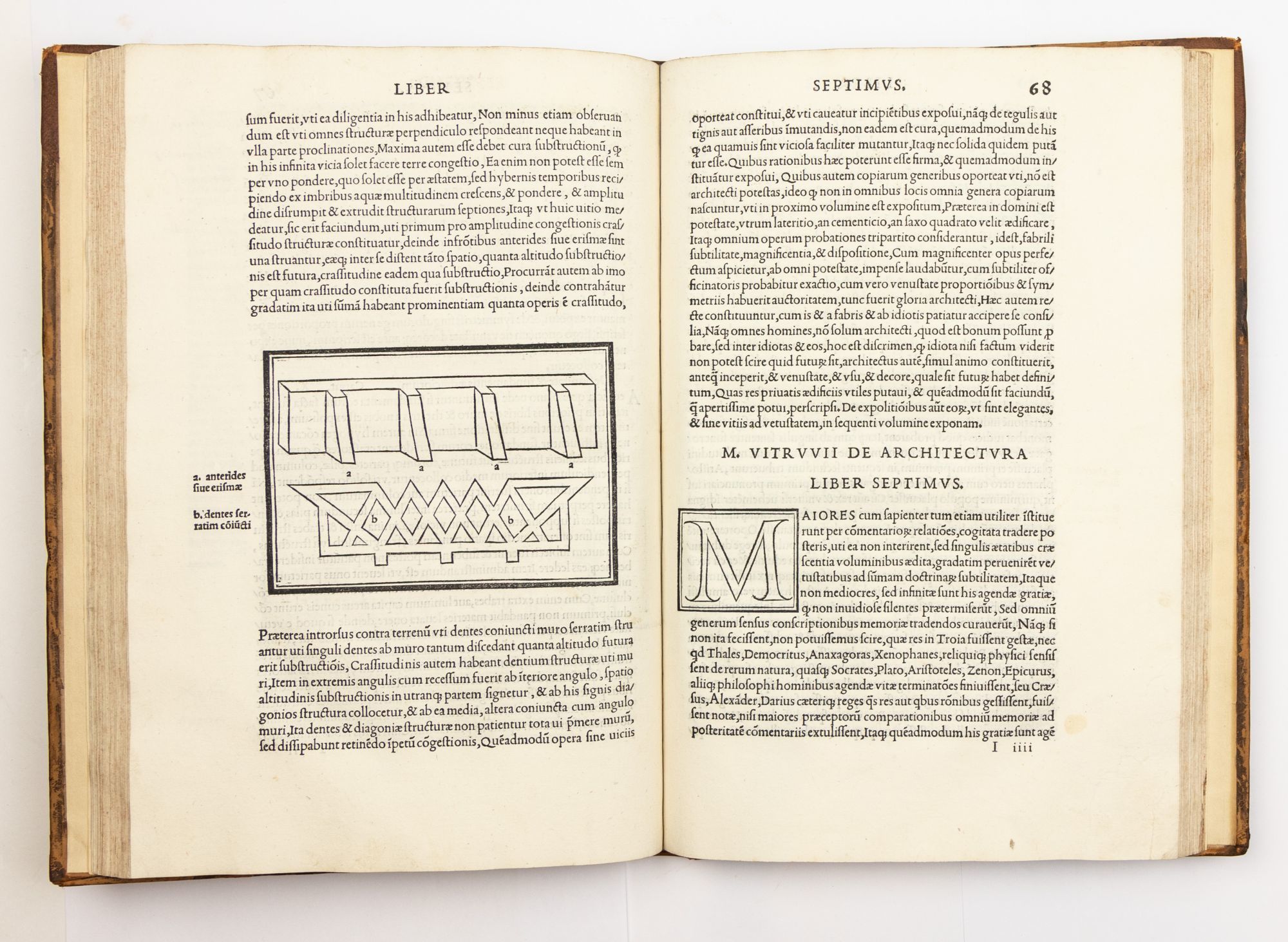
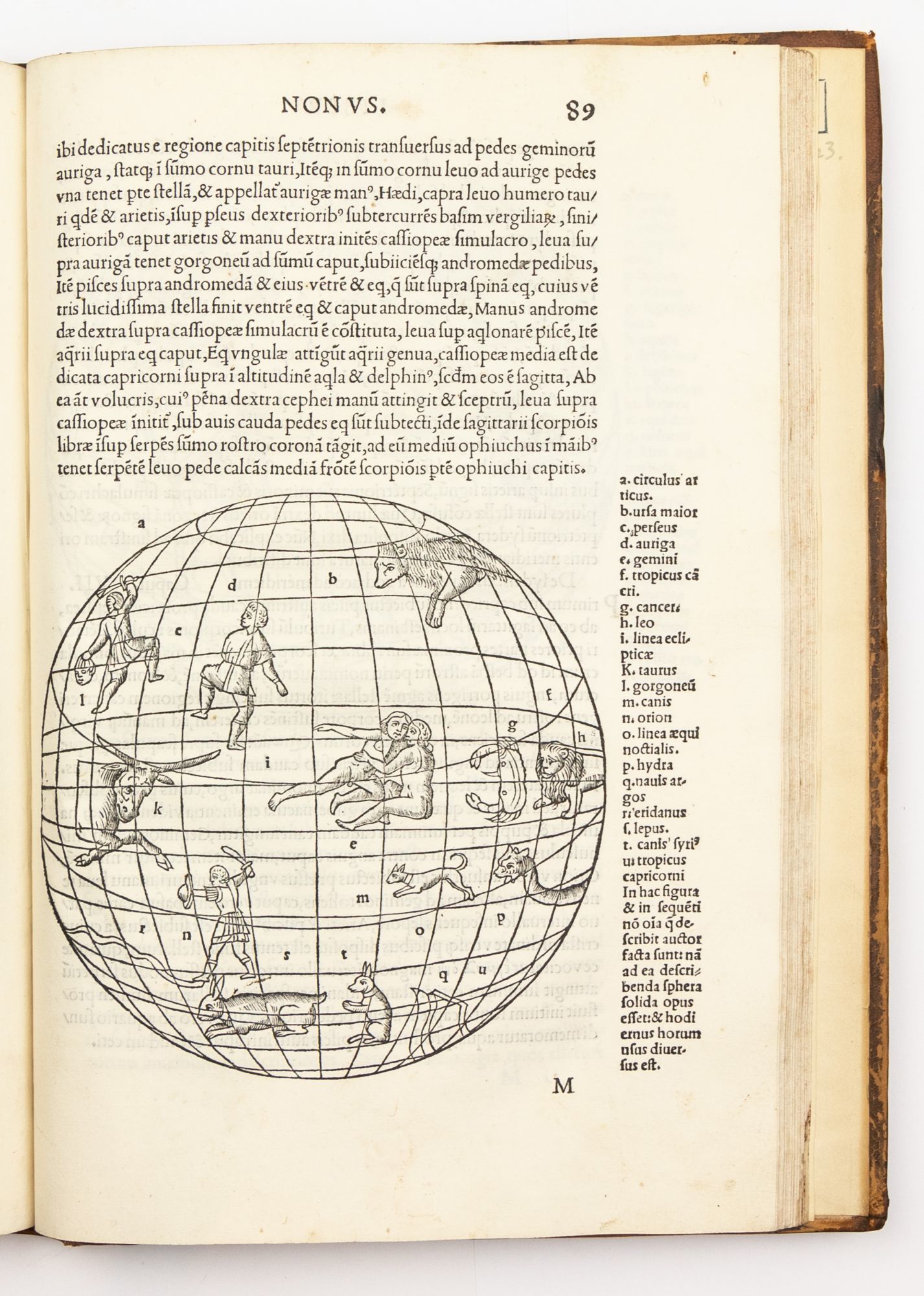
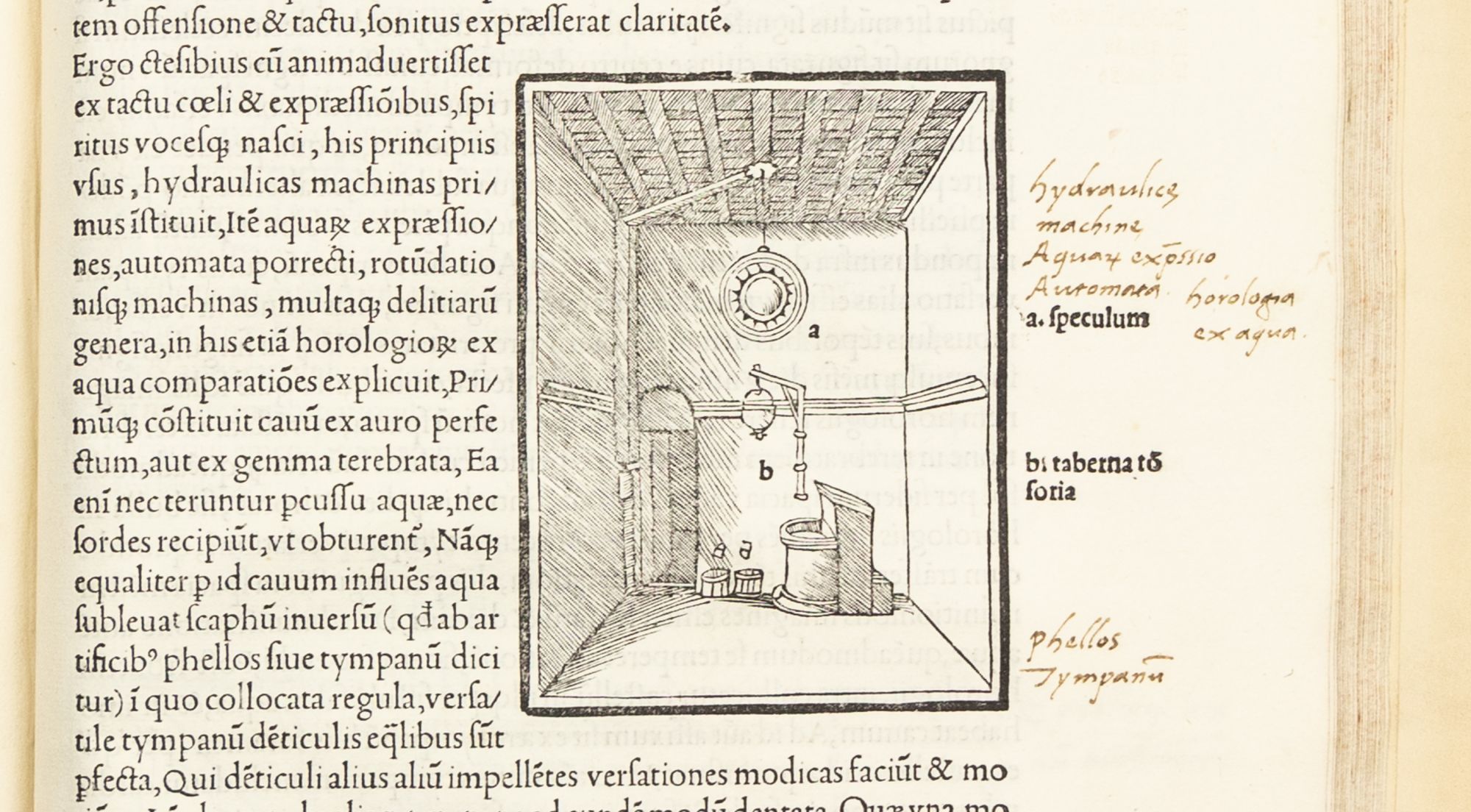
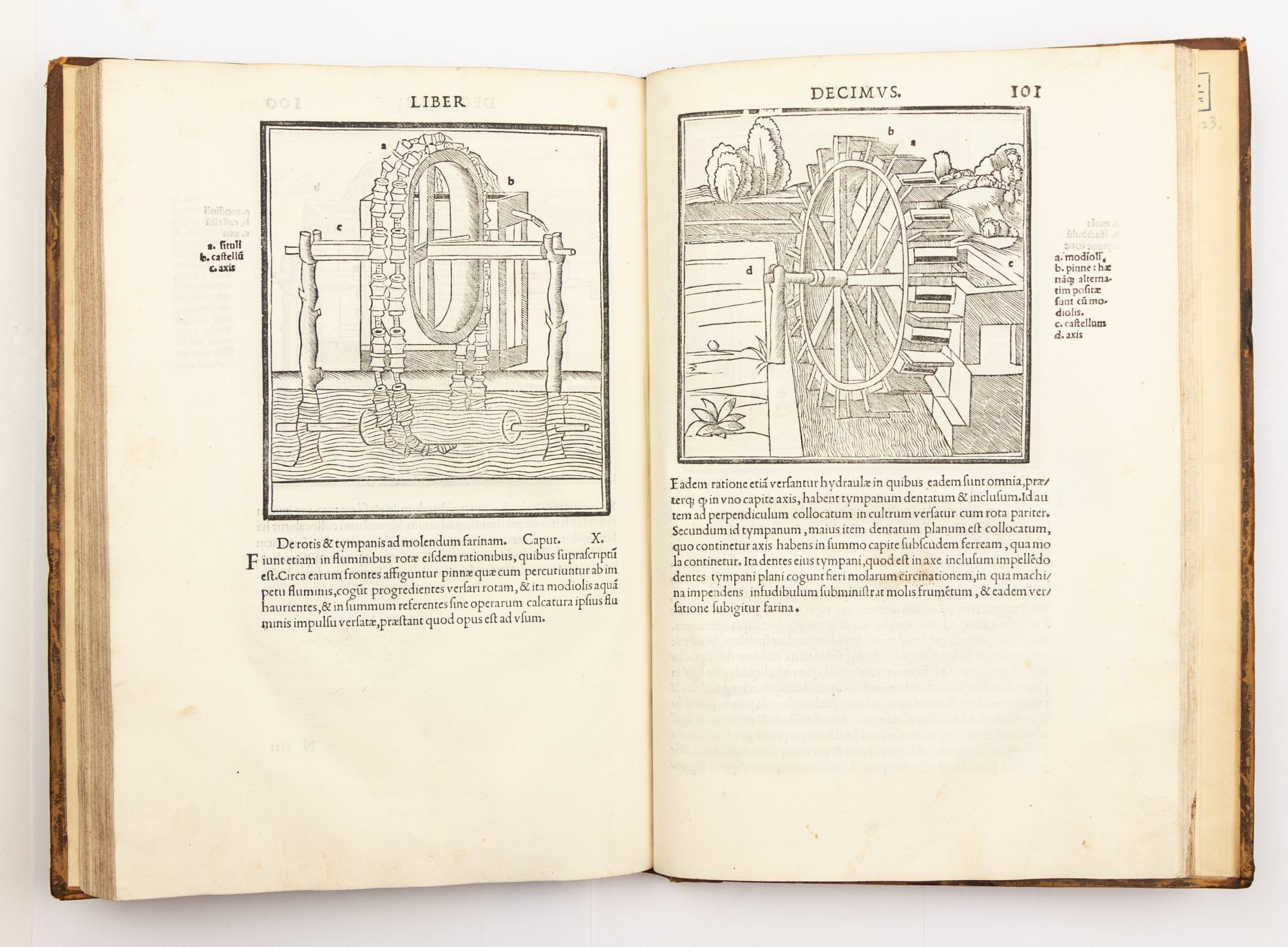
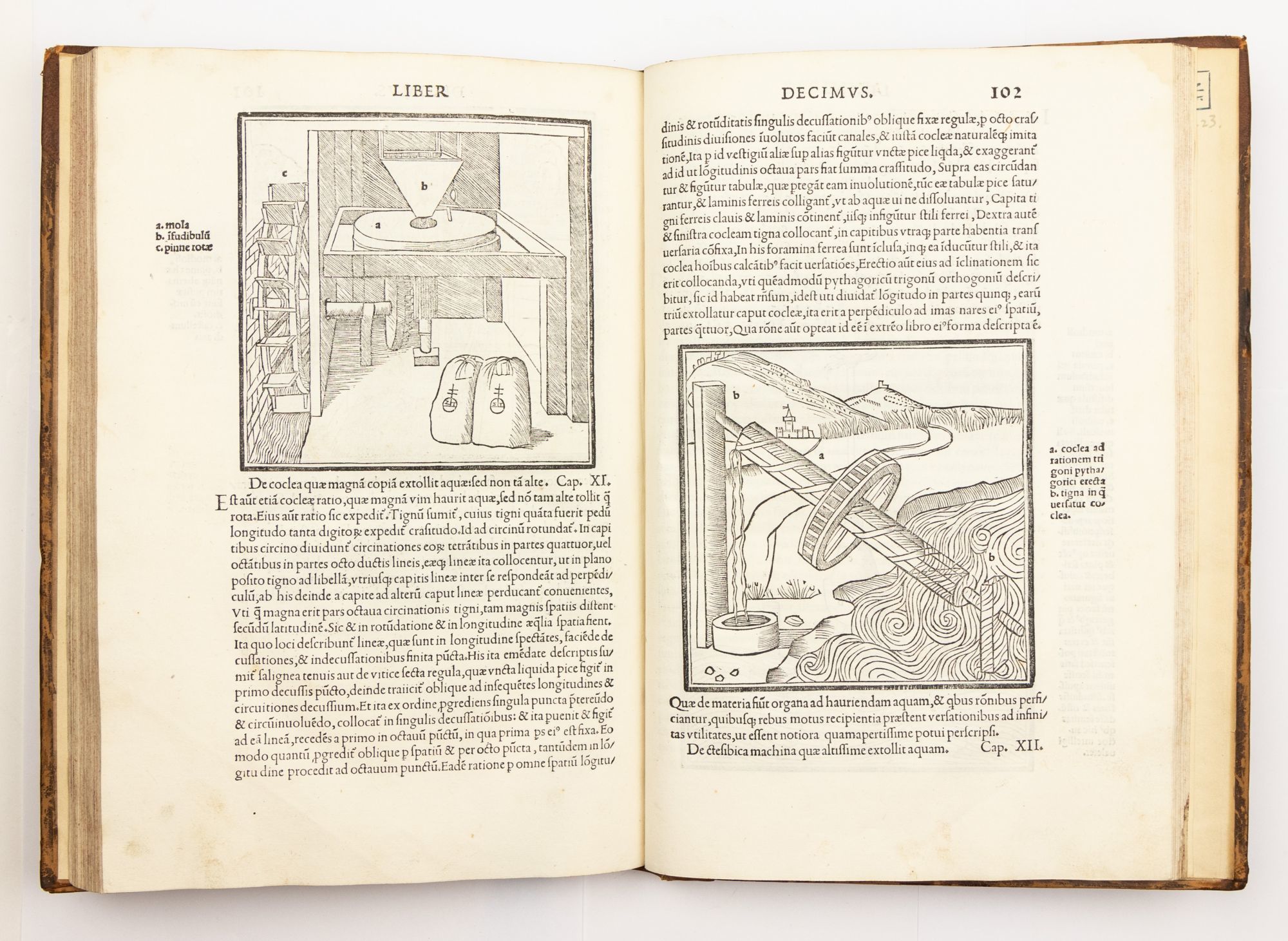
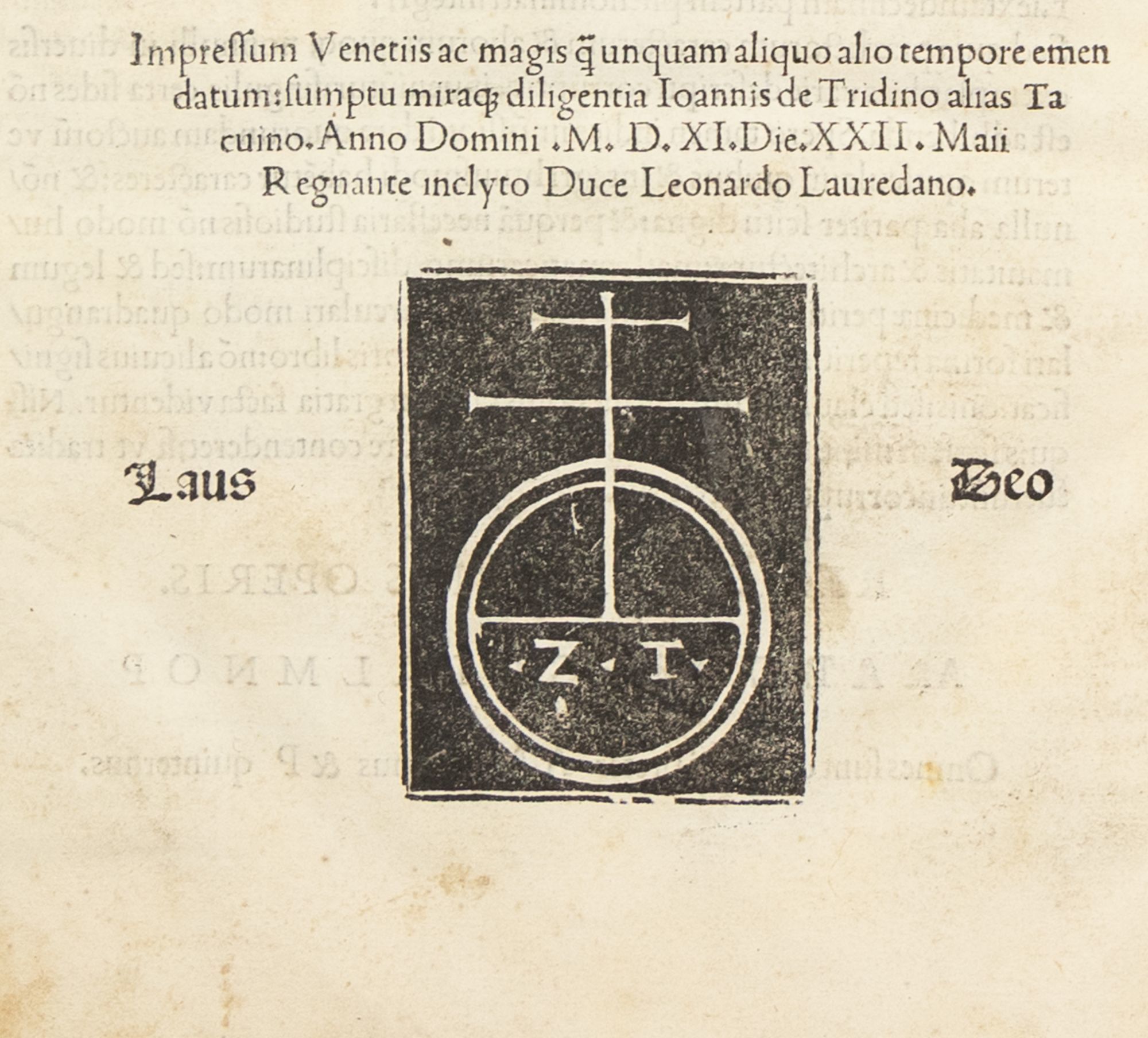
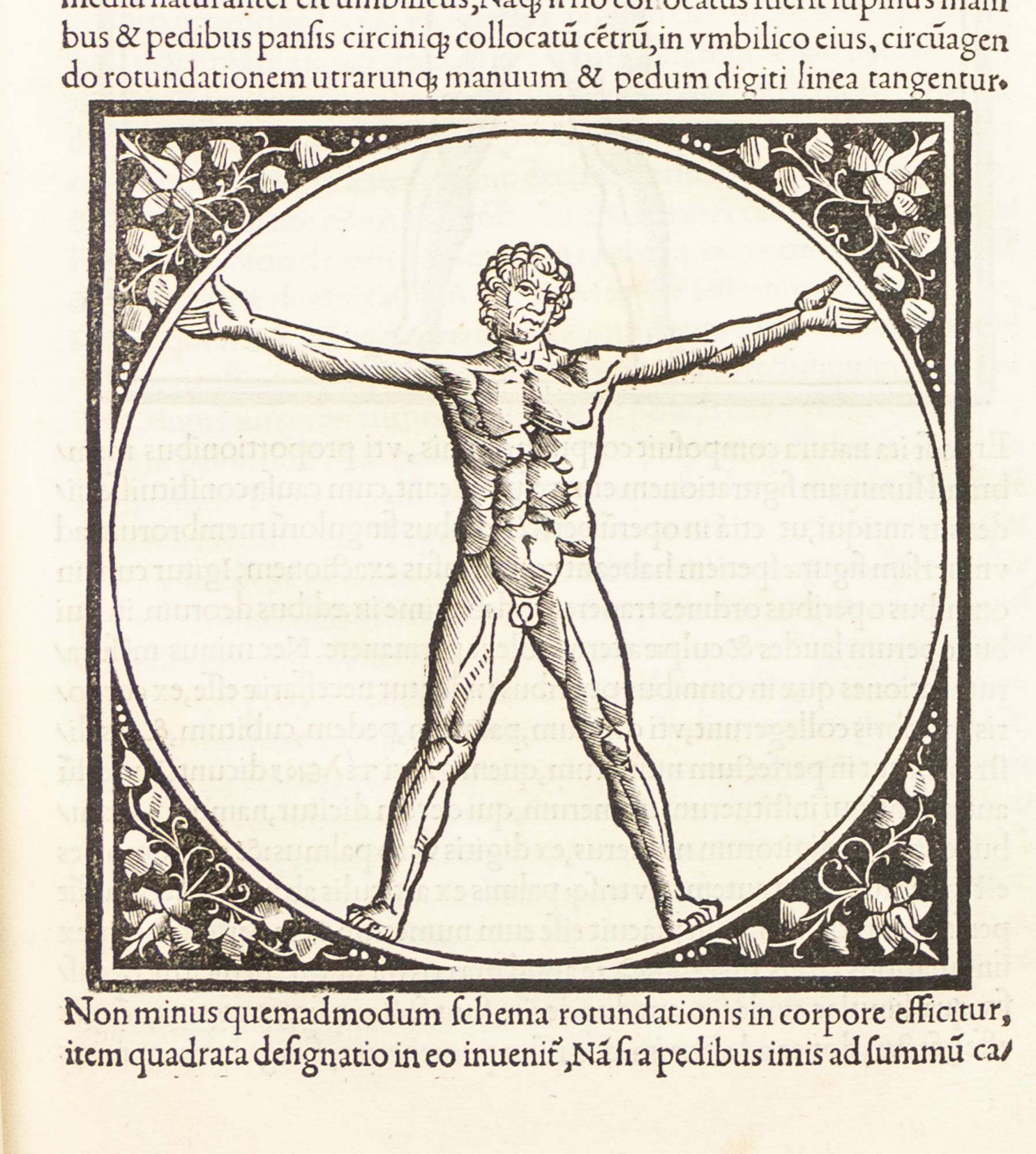
Venice: Giovanni Tacuino da Trino, 1511. THE FIRST ILLUSTRATED EDITION OF VITRUVIUS, edited by the architect Fra Giovanni Giocondo. Hardcover. Fine. Text printed in Roman type, with a few words in Greek. The publisher’s orb and cross device appears on the penultimate leaf and in the illustration on leaf H5 verso. The text is illustrated with 136 woodcuts measuring from 52 x 128 mm. to 230 x 132 mm. These are diagrams, plans, architectural details, and illustrations of engineering machinery in use. The block on leaf G8 verso is printed upside down. The title features an elaborate woodcut title border with dolphins. A very fine copy bound in 18th c. English paneled calf (rebacked, corners bumped, extremities worn, modern endpapers.) The leaves are very fine and unwashed, with numerous 16th c. marginal annotations in Books I-III and less frequently in Books 4, 8, and 10; the woodcut on leaf folio 41 verso colored at an early date. Minor cosmetic blemishes as follows; title v. lightly soiled, light oil stain to upper margin of folio 77; folio 97 recto dusty and with a few light stains; light marginal dampstain to lower outer corner of final gathering; last leaf soiled on verso, occ. marginal soiling.
The 1511 edition of Vitruvius’ “De architectura” marks a revolutionary development in the Renaissance reception of Vitruvius and the book’s influence on Renaissance architecture. It holds the distinction of being the first illustrated edition, with woodcuts based on drawings by the editor, the Veronese architect and engineer Fra Giovanni Giocondo, whose achievements include the construction of the bridge of Notre Dame in Paris and his appointment as architect of Saint Peter’s basilica in Rome.
The book, illustrated with 136 woodcuts (some inspired by illuminated drawings in the Vatican Library), was printed in Venice, where Fra Giocondo served as chief architect for Venice’s ruling Consiglio dei dieci (“Council of ten”). While beautiful, the woodcuts were not intended as merely decorative but rather as practical visual aids for architects, urban planners, and engineers. The title explains their function explicitly: “M. Vitruvius per Iocundum solito castigatior factus cum figuris et tabula ut iam legi et intelligi possit” (“M. Vitruvius, made more correct, with figures and tables to make it possible to read and understand the text”.)
The explanatory “tables” mentioned in the title are found at the end of the book, with the text printed in three columns. Also a learned humanist, Fra Giocondo improved the text, filling in lacunae using manuscripts unknown to earlier editors and providing shoulder notes in the margins. The book, therefore, served two audiences: the humanist theorists who influenced Renaissance culture; and the architects, craftsmen, and urban planners who realized these concepts in concrete form.
In his dual capacity as architect/engineer and humanist, Fra Giocondo was uniquely qualified to influence the shaping of Renaissance Venice. In his professional capacity, he was charged with the improvement of the city’s infrastructure, in particular the amelioration of the build-up of silt in the Venetian lagoon. As an intellectual, close to the future Doge Andrea Gritti, he helped realize the “Renovatio urbis” (the “renewal of the city”), satisfying the Venetians’ desire to see their city reflect principles of classical culture and design.
Fra Giocondo’s 1511 Vitruvius is a testament to the confluence of these two currents, the intellectual and the practical, which would raise Venice in a short time to a city that could compete with Renaissance Rome as a magnet for architects. Moreover, the book’s editorial and graphic excellence exerted a profound influence on later editions. The significance of Giocondo and his book in the development of Venice was succinctly stated by the 18th c. art historian Scipione Maffei, who wrote that Giocondo “could be called the second edificator of Venice” (“potea chiamarsi secondo edificator di Venezia”.)
“Fra (Frate) Giovanni Gioconda was one of the most distinguished architectural theorists and practitioners of his time. During his long career he served three kings -Ferrante of Naples, Charles VIII, and Louis XII of France- the Venetian republic, and the papacy.
“During his stay in Naples, Fra Gioconda met several distinguished Renaissance architects and humanists and began his work on Vitruvius. In c. 1489 he may have contributed to the engineering project to bring water to Poggio Reale and to the moats of Naples; he overlapped with Giuliano da Sangallo, whom he met again at the end of their lives in Rome at the construction site of Saint Peter's. In 1492 he is recorded as taking an apprentice in Naples for five years. That year he may also have worked with Francesco di Giorgio Martini on a translation and illustration of Vitruvius, which Francesco offered to the duke of Calabria…
“After the invasion of Naples by the French army, Fra Gioconda was invited back to France by Charles VIII; he is documented in France in 1498 and was there perhaps as early as 1495. In 1500 he built the bridge of Notre Dame in Paris, considered by Vincenzo Scamozzi as the first classical bridge of the Renaissance… Fra Giocondo's presence in Paris marks the beginning of Vitruvian studies in France; the public and private lectures that he offered are documented by the notes of his pupil Guillaume Budé…
“Fra Giocondo passed from French royal service into the service of the Venetian republic, where he worked as hydraulic and military engineer between 1506 and 1514. He worked on the improvements of the port of Venice, threatened by deposits of the Brenta river. In 1514 he made a design for the Rialto bridge and surrounding buildings in Venice in the form of a Roman forum…
“Fra Giocondo's publication of his edition of Vitruvius in 1511 is the best remembered of his Venetian projects. It was dedicated to Pope Julius II, at a time when Venice was making its peace with the papacy, and Fra Giocondo may have envisaged his own, eventually realized, move to Rome. Fra Giocondo's claim for his edition is that he reconciled the reconstituted Latin text with the extant ancient Roman ruins…
“Fra Giocondo had distinguished counselors in Venice, including Pietro Bembo, Giovanni Lascaris, and Giovanni Marco da Landinara, an expert in optics, who assisted him with the illustrations. The graphic segment is in fact the great breakthrough of Fra Giocondo's edition… The woodcut illustrations, based on drawings probably prepared by Fra Giocondo himself, are assumed to have been made by the publisher…
“Fra Giocondo's stellar career was crowned by appointment to papal service in 1513, when he was nominated architect of Saint Peter's upon the death of Donato Bramante. He occupied this position with Raphael and with Giuliano da Sangallo, with whom he also shared a great interest in architectural theory and archaeology. Lavishly salaried and provisioned by the pope, Fra Giocondo was encouraged to live well and remain in good physical condition; but he was already eighty. Raphael believed that Fra Giocondo was "given to him by the pope" to learn his architectural secrets; in fact they talked every day about the building of Saint Peter's, where they probably focused on stabilizing the foundations of the basilica.”(Millard Catalogue)
Vitruvius’ “On Architecture”:
“De architectura” is the only text of Greco-Roman architecture that has survived from antiquity. It’s importance in the history of Western architecture from the Renaissance to the nineteenth-century is immeasurable, and it remains, to this day, fundamental to the historical study of architecture. Though not quite forgotten in the Middle Ages, Vitruvius’ treatise experienced a revival in the fifteenth-century and soon became a central text for architects and architectural theorists…
“Based on Vitruvius' own experience and dedicated to the Emperor Augustus, the treatise was the result of two separate writing campaigns. Vitruvius affirms that he spent thirty-five to forty years on the composition of his treatise. There is a sixty-threeitem bibliography, which is the only reference we have to Vitruvius' ancient sources on architecture…
“In the first book, Vitruvius discusses the elements of architecture, the siting of the town, its fortifications, its streets, and the location of its principal buildings. Book 2 is devoted to building materials but also explores the origin of buildings and the characteristics of the four natural elements. Books 3 and 4 are concerned with temples; in an earlier version they probably formed one book. At the beginning of book 3, Vitruvius offers his fundamental anthropomorphic proportional system for architecture. He discusses temple types, columns and intercolumniations, foundations, and the Ionic order. The Corinthian order, the origin of orders, and the proportions of the Tuscan order are among the subjects of book 4. In books 5 and 6, Vitruvius shifts attention toward the interior of buildings, and from sacred to functional structures. Thus in book 5 he explores the major public buildings and spaces of the Roman city, which include the forum, the basilica, the curia, the baths and gymnasia, and harbors. He compares the Greek and Roman theaters in a passage that became invaluable for Renaissance readers. Book 6, on private dwellings, is a fundamental part of the treatise. Here Vitruvius examines Roman and Greek houses, setting out their principal rooms, their proportions, exposure, size, and embellishments. These six books may have formed the original treatise in its first arrangement, which Vitruvius offered to Julius Caesar. The remaining four books were composed subsequently.
“Book 7 deals with the cladding of buildings, the finishing materials for floors, walls, and ceilings, including a discussion of decorations appropriate to wall painting. The last three books deal with technical matters; concerned respectively with hydraulics, timepieces and machinery, they seem most distant from our own interpretation of the discipline of architecture. In book 8, Vitruvius displays his great practical experience in finding, conducting, and taming water. In book 9 -the least susceptible to updating of the entire treatise Vitruvius amplified his discussion of clocks extensively with lore concerning the planets and the phases of the moon, the constellations, complicated sundials, and water clocks. Frank Brown (1981) believes that books 8 and 9 were written last…
“Book 10 is the longest chapter, ‘crowded with Vitruvius' experience’ in engineering. This book is an essential textbook of contemporary technology, to be used in peace and war. Vitruvius first considers the principles and vocabulary of mechanics. He then examines various pieces of machinery such as pulleys for hoisting, wheels and bucket-chains for raising water, sluices and millstreams, the endless screw, the force-pump, the water organ, and the odometer for the measurement of land and sea travel. Among his war engines are catapults and ballistae, battering rams, towers, and armored sheds.
“The Vitruvian text became for Renaissance architecture what biblical studies had been for theology. It became the foundational Urtext of architectural theory and practice, with a huge afterlife. His precepts were examined as valuable instruction and dependable theory for architecture in the Renaissance, when -searching for an ancient Roman source humanists and architects became interested enough to sort out his text…
“Vitruvius' treatise was fundamental for the two main research interests in Roman architecture in the first decades of the sixteenth century: the archaeological verification of the Renaissance architectural style through the theory of the classical orders, and the elaboration or creation of new urban housing forms. Books 4 and 6 thus received particularly intense commentary. Other extensively studied passages in the text included the discussion of the modes of graphic representation of architecture, the origin of human shelter, the anthropomorphic proportional system of classical architecture, and the ideal planning of cities. Furthermore, each commentator on Vitruvius attempted to situate the text so as to verify current practices and architectural composition, thus using the authority of the text to justify personal or regional practices. Vitruvius became an important guide to the understanding of the archaeological remains of Rome, but a problematic one, since his descriptions often clashed with the reality of imperial Roman architectural ruins strewn about the Renaissance city.”(Millard Catalogue).
The 1511 edition of Vitruvius’ “De architectura” marks a revolutionary development in the Renaissance reception of Vitruvius and the book’s influence on Renaissance architecture. It holds the distinction of being the first illustrated edition, with woodcuts based on drawings by the editor, the Veronese architect and engineer Fra Giovanni Giocondo, whose achievements include the construction of the bridge of Notre Dame in Paris and his appointment as architect of Saint Peter’s basilica in Rome.
The book, illustrated with 136 woodcuts (some inspired by illuminated drawings in the Vatican Library), was printed in Venice, where Fra Giocondo served as chief architect for Venice’s ruling Consiglio dei dieci (“Council of ten”). While beautiful, the woodcuts were not intended as merely decorative but rather as practical visual aids for architects, urban planners, and engineers. The title explains their function explicitly: “M. Vitruvius per Iocundum solito castigatior factus cum figuris et tabula ut iam legi et intelligi possit” (“M. Vitruvius, made more correct, with figures and tables to make it possible to read and understand the text”.)
The explanatory “tables” mentioned in the title are found at the end of the book, with the text printed in three columns. Also a learned humanist, Fra Giocondo improved the text, filling in lacunae using manuscripts unknown to earlier editors and providing shoulder notes in the margins. The book, therefore, served two audiences: the humanist theorists who influenced Renaissance culture; and the architects, craftsmen, and urban planners who realized these concepts in concrete form.
In his dual capacity as architect/engineer and humanist, Fra Giocondo was uniquely qualified to influence the shaping of Renaissance Venice. In his professional capacity, he was charged with the improvement of the city’s infrastructure, in particular the amelioration of the build-up of silt in the Venetian lagoon. As an intellectual, close to the future Doge Andrea Gritti, he helped realize the “Renovatio urbis” (the “renewal of the city”), satisfying the Venetians’ desire to see their city reflect principles of classical culture and design.
Fra Giocondo’s 1511 Vitruvius is a testament to the confluence of these two currents, the intellectual and the practical, which would raise Venice in a short time to a city that could compete with Renaissance Rome as a magnet for architects. Moreover, the book’s editorial and graphic excellence exerted a profound influence on later editions. The significance of Giocondo and his book in the development of Venice was succinctly stated by the 18th c. art historian Scipione Maffei, who wrote that Giocondo “could be called the second edificator of Venice” (“potea chiamarsi secondo edificator di Venezia”.)
“Fra (Frate) Giovanni Gioconda was one of the most distinguished architectural theorists and practitioners of his time. During his long career he served three kings -Ferrante of Naples, Charles VIII, and Louis XII of France- the Venetian republic, and the papacy.
“During his stay in Naples, Fra Gioconda met several distinguished Renaissance architects and humanists and began his work on Vitruvius. In c. 1489 he may have contributed to the engineering project to bring water to Poggio Reale and to the moats of Naples; he overlapped with Giuliano da Sangallo, whom he met again at the end of their lives in Rome at the construction site of Saint Peter's. In 1492 he is recorded as taking an apprentice in Naples for five years. That year he may also have worked with Francesco di Giorgio Martini on a translation and illustration of Vitruvius, which Francesco offered to the duke of Calabria…
“After the invasion of Naples by the French army, Fra Gioconda was invited back to France by Charles VIII; he is documented in France in 1498 and was there perhaps as early as 1495. In 1500 he built the bridge of Notre Dame in Paris, considered by Vincenzo Scamozzi as the first classical bridge of the Renaissance… Fra Giocondo's presence in Paris marks the beginning of Vitruvian studies in France; the public and private lectures that he offered are documented by the notes of his pupil Guillaume Budé…
“Fra Giocondo passed from French royal service into the service of the Venetian republic, where he worked as hydraulic and military engineer between 1506 and 1514. He worked on the improvements of the port of Venice, threatened by deposits of the Brenta river. In 1514 he made a design for the Rialto bridge and surrounding buildings in Venice in the form of a Roman forum…
“Fra Giocondo's publication of his edition of Vitruvius in 1511 is the best remembered of his Venetian projects. It was dedicated to Pope Julius II, at a time when Venice was making its peace with the papacy, and Fra Giocondo may have envisaged his own, eventually realized, move to Rome. Fra Giocondo's claim for his edition is that he reconciled the reconstituted Latin text with the extant ancient Roman ruins…
“Fra Giocondo had distinguished counselors in Venice, including Pietro Bembo, Giovanni Lascaris, and Giovanni Marco da Landinara, an expert in optics, who assisted him with the illustrations. The graphic segment is in fact the great breakthrough of Fra Giocondo's edition… The woodcut illustrations, based on drawings probably prepared by Fra Giocondo himself, are assumed to have been made by the publisher…
“Fra Giocondo's stellar career was crowned by appointment to papal service in 1513, when he was nominated architect of Saint Peter's upon the death of Donato Bramante. He occupied this position with Raphael and with Giuliano da Sangallo, with whom he also shared a great interest in architectural theory and archaeology. Lavishly salaried and provisioned by the pope, Fra Giocondo was encouraged to live well and remain in good physical condition; but he was already eighty. Raphael believed that Fra Giocondo was "given to him by the pope" to learn his architectural secrets; in fact they talked every day about the building of Saint Peter's, where they probably focused on stabilizing the foundations of the basilica.”(Millard Catalogue)
Vitruvius’ “On Architecture”:
“De architectura” is the only text of Greco-Roman architecture that has survived from antiquity. It’s importance in the history of Western architecture from the Renaissance to the nineteenth-century is immeasurable, and it remains, to this day, fundamental to the historical study of architecture. Though not quite forgotten in the Middle Ages, Vitruvius’ treatise experienced a revival in the fifteenth-century and soon became a central text for architects and architectural theorists…
“Based on Vitruvius' own experience and dedicated to the Emperor Augustus, the treatise was the result of two separate writing campaigns. Vitruvius affirms that he spent thirty-five to forty years on the composition of his treatise. There is a sixty-threeitem bibliography, which is the only reference we have to Vitruvius' ancient sources on architecture…
“In the first book, Vitruvius discusses the elements of architecture, the siting of the town, its fortifications, its streets, and the location of its principal buildings. Book 2 is devoted to building materials but also explores the origin of buildings and the characteristics of the four natural elements. Books 3 and 4 are concerned with temples; in an earlier version they probably formed one book. At the beginning of book 3, Vitruvius offers his fundamental anthropomorphic proportional system for architecture. He discusses temple types, columns and intercolumniations, foundations, and the Ionic order. The Corinthian order, the origin of orders, and the proportions of the Tuscan order are among the subjects of book 4. In books 5 and 6, Vitruvius shifts attention toward the interior of buildings, and from sacred to functional structures. Thus in book 5 he explores the major public buildings and spaces of the Roman city, which include the forum, the basilica, the curia, the baths and gymnasia, and harbors. He compares the Greek and Roman theaters in a passage that became invaluable for Renaissance readers. Book 6, on private dwellings, is a fundamental part of the treatise. Here Vitruvius examines Roman and Greek houses, setting out their principal rooms, their proportions, exposure, size, and embellishments. These six books may have formed the original treatise in its first arrangement, which Vitruvius offered to Julius Caesar. The remaining four books were composed subsequently.
“Book 7 deals with the cladding of buildings, the finishing materials for floors, walls, and ceilings, including a discussion of decorations appropriate to wall painting. The last three books deal with technical matters; concerned respectively with hydraulics, timepieces and machinery, they seem most distant from our own interpretation of the discipline of architecture. In book 8, Vitruvius displays his great practical experience in finding, conducting, and taming water. In book 9 -the least susceptible to updating of the entire treatise Vitruvius amplified his discussion of clocks extensively with lore concerning the planets and the phases of the moon, the constellations, complicated sundials, and water clocks. Frank Brown (1981) believes that books 8 and 9 were written last…
“Book 10 is the longest chapter, ‘crowded with Vitruvius' experience’ in engineering. This book is an essential textbook of contemporary technology, to be used in peace and war. Vitruvius first considers the principles and vocabulary of mechanics. He then examines various pieces of machinery such as pulleys for hoisting, wheels and bucket-chains for raising water, sluices and millstreams, the endless screw, the force-pump, the water organ, and the odometer for the measurement of land and sea travel. Among his war engines are catapults and ballistae, battering rams, towers, and armored sheds.
“The Vitruvian text became for Renaissance architecture what biblical studies had been for theology. It became the foundational Urtext of architectural theory and practice, with a huge afterlife. His precepts were examined as valuable instruction and dependable theory for architecture in the Renaissance, when -searching for an ancient Roman source humanists and architects became interested enough to sort out his text…
“Vitruvius' treatise was fundamental for the two main research interests in Roman architecture in the first decades of the sixteenth century: the archaeological verification of the Renaissance architectural style through the theory of the classical orders, and the elaboration or creation of new urban housing forms. Books 4 and 6 thus received particularly intense commentary. Other extensively studied passages in the text included the discussion of the modes of graphic representation of architecture, the origin of human shelter, the anthropomorphic proportional system of classical architecture, and the ideal planning of cities. Furthermore, each commentator on Vitruvius attempted to situate the text so as to verify current practices and architectural composition, thus using the authority of the text to justify personal or regional practices. Vitruvius became an important guide to the understanding of the archaeological remains of Rome, but a problematic one, since his descriptions often clashed with the reality of imperial Roman architectural ruins strewn about the Renaissance city.”(Millard Catalogue).
Details
Title
[De Architectura libri decem], M. Vitruuius per Iocundum solito castigatior factus cum figuris et tabula vt iam legi et intelligi possit
Author
Vitruvius [Marcus Vitruvius Pollio] (ca. 80 – 15 BCE)
Binding
Hardcover
Condition
Fine
Publisher
Giovanni Tacuino da Trino: Venice
Date
1511
Edition
THE FIRST ILLUSTRATED EDITION OF VITRUVIUS, edited by the archit