

Ordenanzas de Edificios de Madrid, Toledo y Sevilla Acomodadas a los Usos y Costumbres de Esta Ciudad de la Habana..
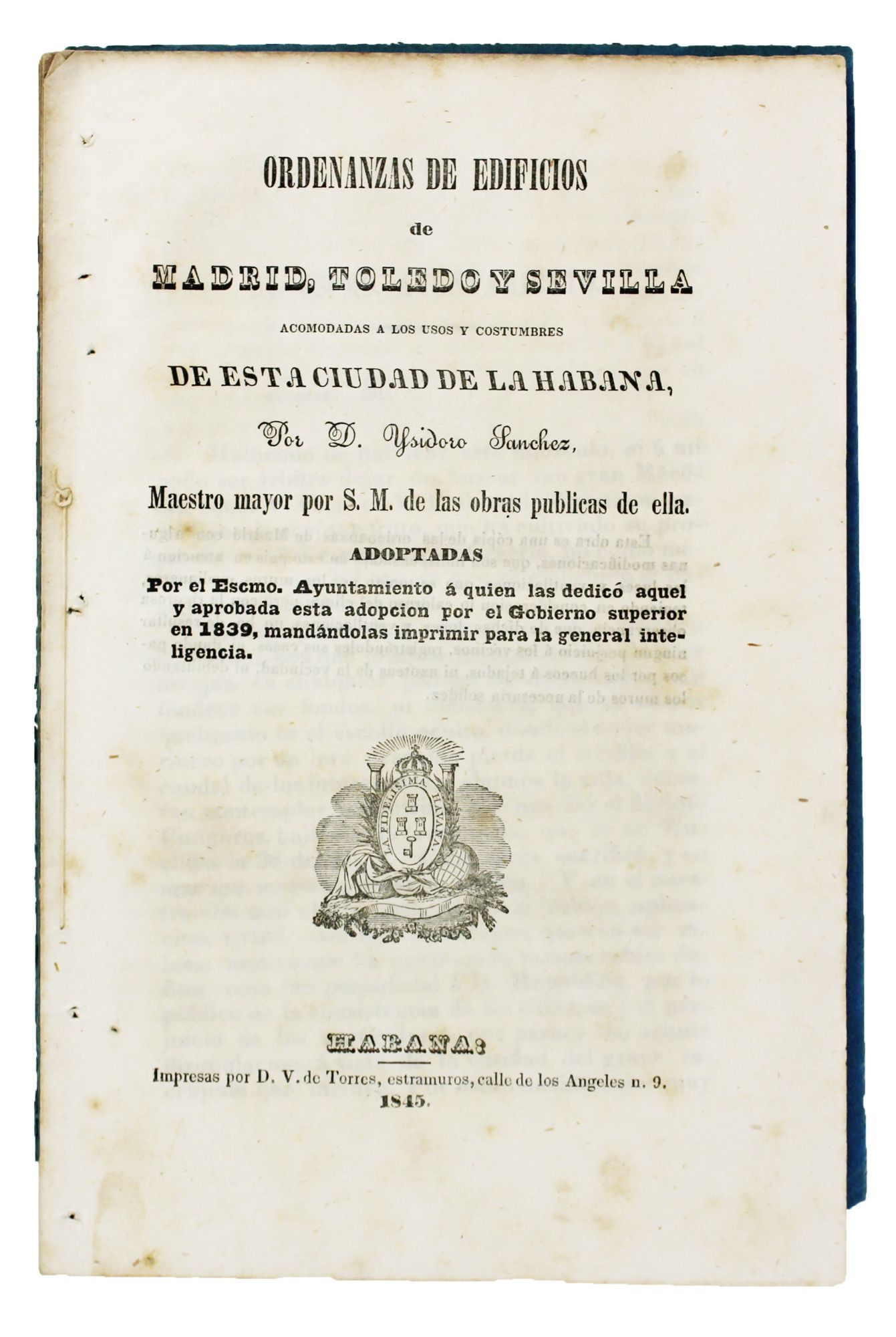
- Habana: Impresas por D. V. de Torres, 1845
Habana: Impresas por D. V. de Torres, 1845. Good.. 53,[3]pp. Contemporary plain blue wrappers, separated at spine. Stitched, as issued, with additional small stabholes at gutter where previously bound into a sammelband. Light foxing and dust soiling. A seemingly unrecorded architectural pamphlet that prints the first comprehensive building code for Havana, developed in 1837 by Isidoro Sánchez y Fuentes, the city’s Director of Public Works. The text outlines detailed rules for the construction of buildings and related infrastructure to accord to high technical, aesthetic and public health standards, influenced by such regulations as had been imposed in Madrid, Toledo and Seville. Sánchez’s code proved highly consequential, and it resulted in significant improvements to the appearance, livability, and safety of many Havana neighborhoods.
In the 18th century, Madrid, Seville, and Toledo suffered from many of the same problems of haphazard urban development as Havana. However, great efforts were made to develop and enforce building codes which cleaned up most of these city’s formerly slum-like suburbs, of great benefit to public health, not to mention aesthetics. Teodoro Ardemans, Madrid’s Director of Public Works, began the reforms in these Spanish cities, and his 1720 work on the subject was fantastically influential for generations, going through multiple reprints until 1848. Isidoro Sánchez adapted Ardemans’ concepts, but updated and improved them to the requirements of the tropical climate and customs of Havana. He thus developed the first comprehensive building code for the Cuban capital, which was one of the most progressive and well-considered in the Americas.
Two preambles begin the work by discussing the importance of taking architectural inspiration from the buildings of classical antiquity and of considering the historical context and significance of reformed Spanish building codes. The bulk of the text takes up a variety of interesting and practical topics -- erecting urban and suburban buildings; respecting neighbors’ rights when building homes, shared alleyways, building ovens in light of nearby homes; creating ventanas de medianería (large windows that can open or close depending the temperature and breeze); how garages should open onto public thoroughfares; where building materials should be manufactured; building basements; building balconies, etc. on public streets; drainage systems and sewers; creating wells and other drinking water sources; where to build forges without disturbing neighbors; large windows for basements; building attics; and air circulation.
Sánchez presented his proposed code to the City Council on June 10, 1837, and in 1839 it was approved in full by the Governor, but the printing of the text was only approved in April 1845, according to the introduction. We locate no copies of this significant work in OCLC or available auction records.
In the 18th century, Madrid, Seville, and Toledo suffered from many of the same problems of haphazard urban development as Havana. However, great efforts were made to develop and enforce building codes which cleaned up most of these city’s formerly slum-like suburbs, of great benefit to public health, not to mention aesthetics. Teodoro Ardemans, Madrid’s Director of Public Works, began the reforms in these Spanish cities, and his 1720 work on the subject was fantastically influential for generations, going through multiple reprints until 1848. Isidoro Sánchez adapted Ardemans’ concepts, but updated and improved them to the requirements of the tropical climate and customs of Havana. He thus developed the first comprehensive building code for the Cuban capital, which was one of the most progressive and well-considered in the Americas.
Two preambles begin the work by discussing the importance of taking architectural inspiration from the buildings of classical antiquity and of considering the historical context and significance of reformed Spanish building codes. The bulk of the text takes up a variety of interesting and practical topics -- erecting urban and suburban buildings; respecting neighbors’ rights when building homes, shared alleyways, building ovens in light of nearby homes; creating ventanas de medianería (large windows that can open or close depending the temperature and breeze); how garages should open onto public thoroughfares; where building materials should be manufactured; building basements; building balconies, etc. on public streets; drainage systems and sewers; creating wells and other drinking water sources; where to build forges without disturbing neighbors; large windows for basements; building attics; and air circulation.
Sánchez presented his proposed code to the City Council on June 10, 1837, and in 1839 it was approved in full by the Governor, but the printing of the text was only approved in April 1845, according to the introduction. We locate no copies of this significant work in OCLC or available auction records.
Details
Title
Ordenanzas de Edificios de Madrid, Toledo y Sevilla Acomodadas a los Usos y Costumbres de Esta Ciudad de la Habana..
Author
[Cuba]
Condition
Good
Publisher
Impresas por D. V. de Torres: Habana
Date
1845