

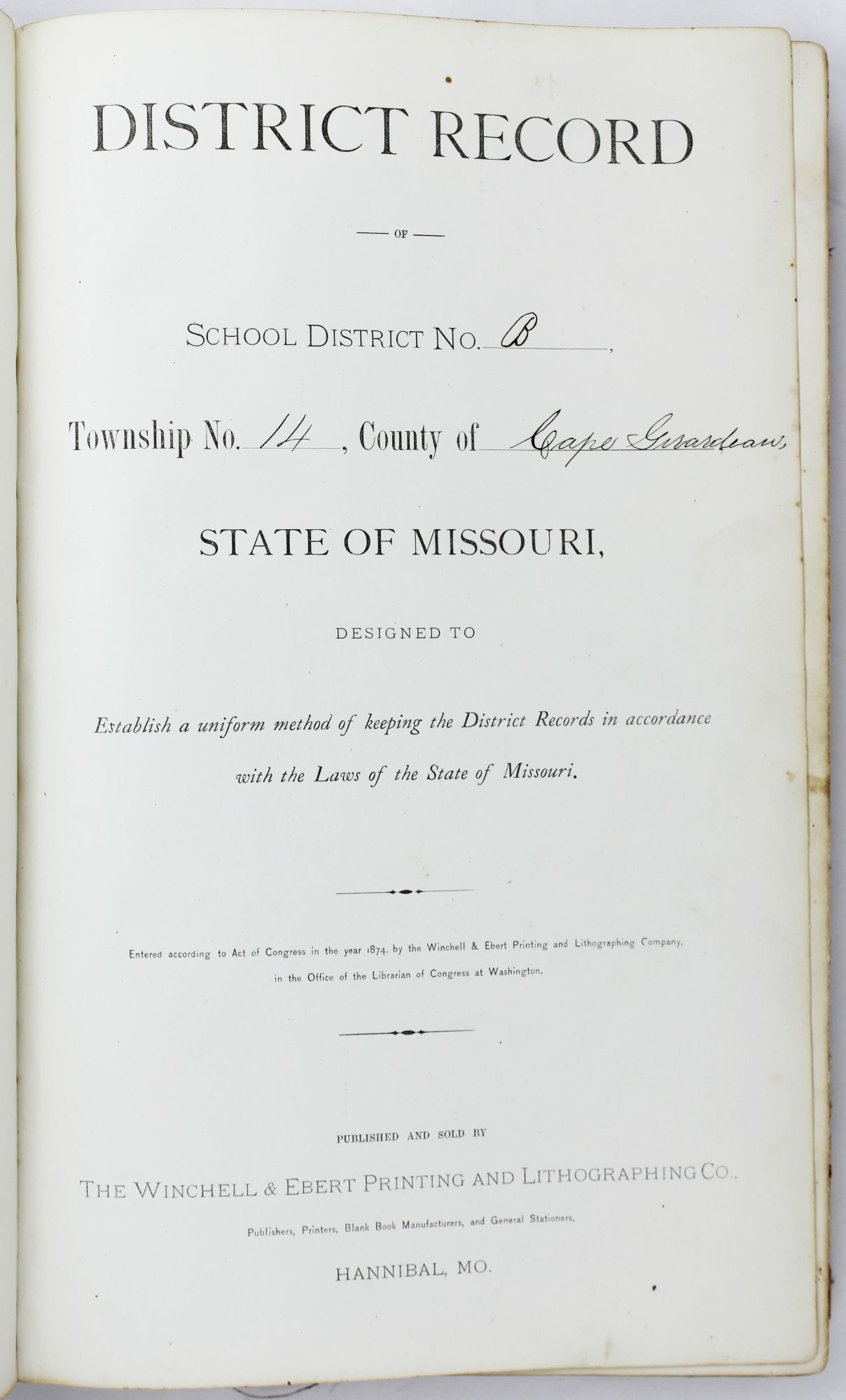
District Record of School District No. B Township No. 14, County of Cape Girardeau, State of Missouri..
- Cape Girardeau, Mo , 1892
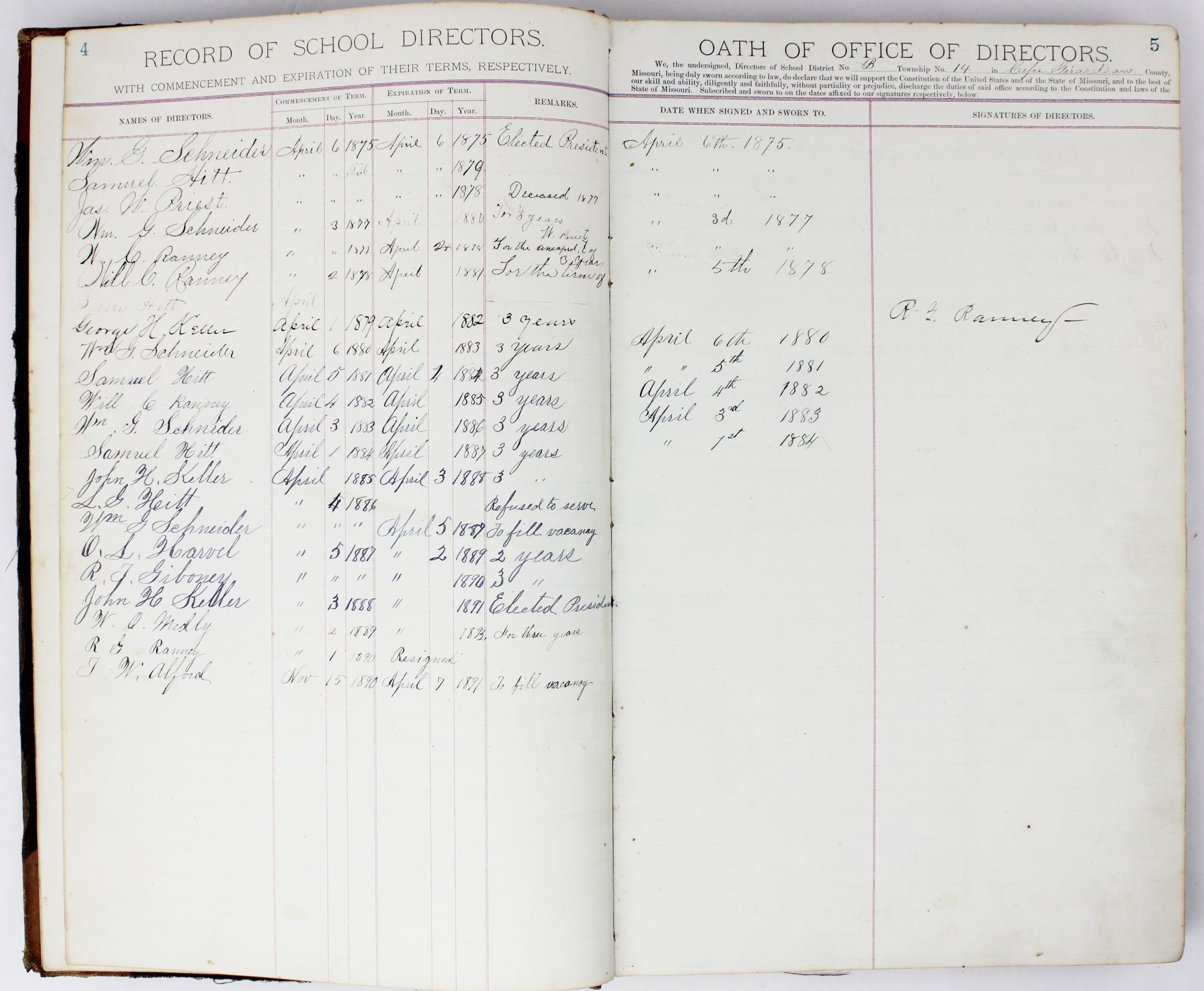
Cape Girardeau, Mo, 1892. Very good.. [138]pp. of manuscript content. Folio. Contemporary preprinted record book, with some pages partially-printed and completed in manuscript and some pages with wholly manuscript content, bound in three-quarter calf and brown pebbled cloth, gilt spine titles. Some abrasions and wear to spine and edges, minor rubbing and soiling to boards. Occasional thumb-soiling and light spotting to text. A unique manuscript record book kept by the officials of the school district in Cape Girardeau, Missouri in the late-19th century. Over the course of about fifteen years, the various sections of the ledger book record the names of school directors, a register of teachers, a short list of authorized textbooks, notes for annual school meetings, notes of the proceedings of the school district's Board of Directors, lists of parents or guardians and their school-age children, taxpayer lists, financial reports of the district clerk, payments made from the teacher's and building funds, lists of incidental charges paid by the school district, treasurer's reports, teacher's reports, and with additional notes, oaths, the text of teacher's contracts, book lists, and more on blank pages at rear.
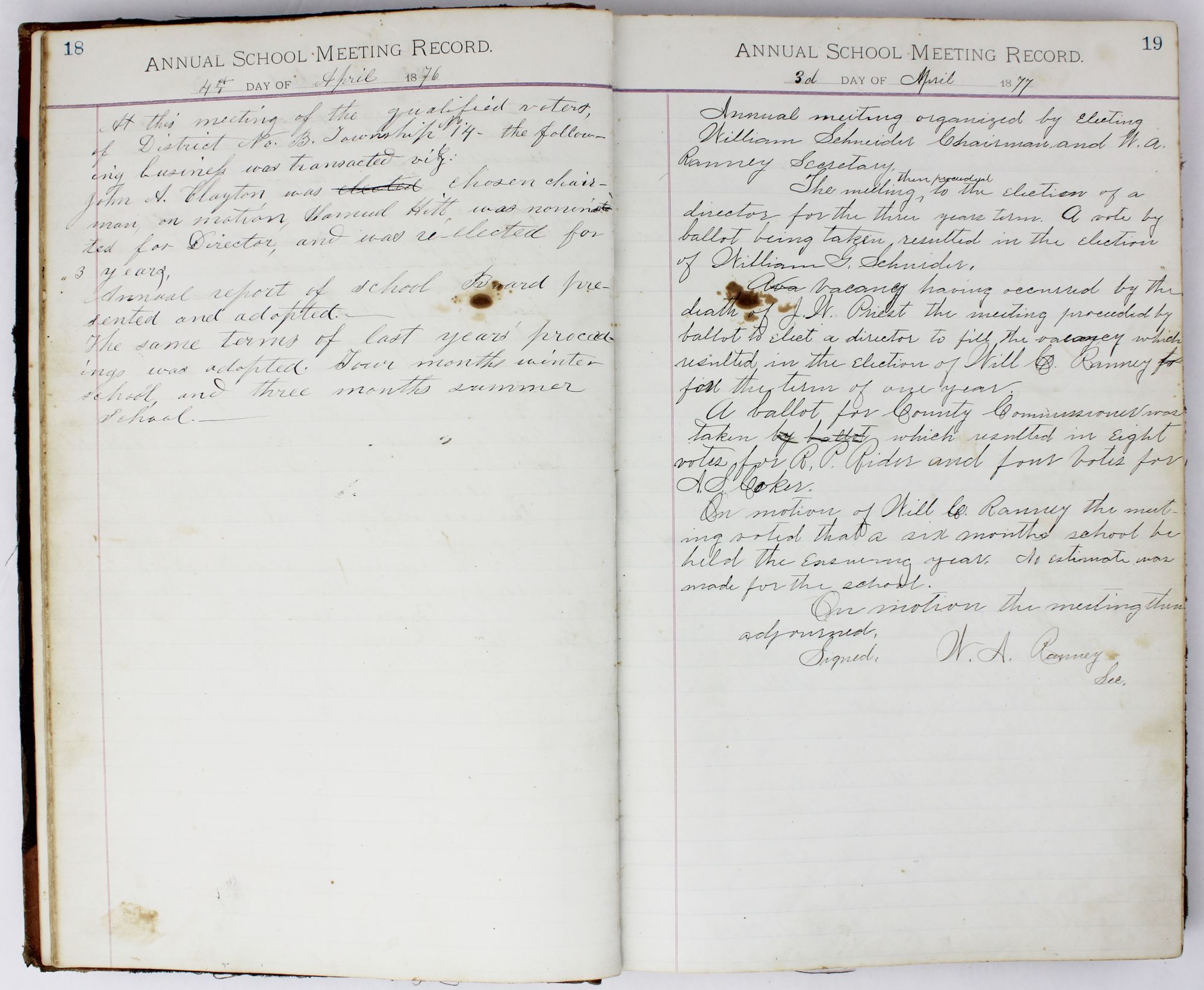
Particularly interesting are the detailed notes for the school district's annual meeting and its regularly-held board of directors' proceedings, each of which record regular district business, but also contain important mentions regarding the segregated educational situation for the local African-American population. The annual meeting notes record the approval of funds for supplies and books, summer school costs, teacher hires, the length of the school term, and more, as well as activities such as the election of school administrators, the construction of new schools and approval of funding for said schools, and so forth. Of particular interest is a motion approved at the 1887 annual meeting, which reads: "Moved and seconded that the Board of Directors be authorized to sell the land known as school land near the swamp and buy a more suitable piece of land to build a school house for the colored population." Another interesting entry occurs in the notes for the 1889 annual meeting: "The colored foalks of the district ask permission to use their school house for church and sunday school which privilege was given."
The notes from the board of directors' meetings contain much the same type of information as the annual school meeting notes, but often in more detail. For example, the details of the new schoolhouse being built in the late 1870s is described in more specific dimensions than was recorded in the annual meeting notes (as is the land to be purchased for it). And as with the annual meeting notes, the board of directors occasionally discussed the local African American population. For instance, in November 1885, a note from the directors reads: "A resolution made and carried that District No.B Twnshp 14 Range 13 propose to pay their proportion of the tuition for colored children in said District...and that the Clerk..be authorized to issue a warrant...when the bill is presented for the tuition of colored children from District No.B Townshp 12." A similar notation is recorded on the next page during a board meeting in April 1886. At the May 28, 1887 meeting of the board, they authorized $124.75 "for the purpose of...building a school house for the colored population...to be finished on or before the first day of October 1887 according to contract." At their November 12, 1887 meeting, the board "examined the colored schoolhouse" and them approved payment for its contractor for the aforementioned $124.75. An entry for July 9, 1887 records that a teacher was hired for five months at the white school at a rate of $35 per month; another teacher was hired for the same term, but for a teaching position at the "colored school" for five dollars less per month. A similar entry in 1889 notes that the white school teacher would earn $40 per month while the man hired "to teach the colored school" would do so for $30 a month, widening the disparity (this would persist for the next two years, as well). The record book also notes approvals by the board for separate purchases of stove wood for both the white and African-American schools. It is also interesting to observe that the names of African Americans on the enumeration lists (listing parents or guardians and their school-age children), and the taxpayers' list are noted as "Col." for "Colored." A fascinating record of segregated schooling in action in Jim Crow Missouri.
Particularly interesting are the detailed notes for the school district's annual meeting and its regularly-held board of directors' proceedings, each of which record regular district business, but also contain important mentions regarding the segregated educational situation for the local African-American population. The annual meeting notes record the approval of funds for supplies and books, summer school costs, teacher hires, the length of the school term, and more, as well as activities such as the election of school administrators, the construction of new schools and approval of funding for said schools, and so forth. Of particular interest is a motion approved at the 1887 annual meeting, which reads: "Moved and seconded that the Board of Directors be authorized to sell the land known as school land near the swamp and buy a more suitable piece of land to build a school house for the colored population." Another interesting entry occurs in the notes for the 1889 annual meeting: "The colored foalks of the district ask permission to use their school house for church and sunday school which privilege was given."
The notes from the board of directors' meetings contain much the same type of information as the annual school meeting notes, but often in more detail. For example, the details of the new schoolhouse being built in the late 1870s is described in more specific dimensions than was recorded in the annual meeting notes (as is the land to be purchased for it). And as with the annual meeting notes, the board of directors occasionally discussed the local African American population. For instance, in November 1885, a note from the directors reads: "A resolution made and carried that District No.B Twnshp 14 Range 13 propose to pay their proportion of the tuition for colored children in said District...and that the Clerk..be authorized to issue a warrant...when the bill is presented for the tuition of colored children from District No.B Townshp 12." A similar notation is recorded on the next page during a board meeting in April 1886. At the May 28, 1887 meeting of the board, they authorized $124.75 "for the purpose of...building a school house for the colored population...to be finished on or before the first day of October 1887 according to contract." At their November 12, 1887 meeting, the board "examined the colored schoolhouse" and them approved payment for its contractor for the aforementioned $124.75. An entry for July 9, 1887 records that a teacher was hired for five months at the white school at a rate of $35 per month; another teacher was hired for the same term, but for a teaching position at the "colored school" for five dollars less per month. A similar entry in 1889 notes that the white school teacher would earn $40 per month while the man hired "to teach the colored school" would do so for $30 a month, widening the disparity (this would persist for the next two years, as well). The record book also notes approvals by the board for separate purchases of stove wood for both the white and African-American schools. It is also interesting to observe that the names of African Americans on the enumeration lists (listing parents or guardians and their school-age children), and the taxpayers' list are noted as "Col." for "Colored." A fascinating record of segregated schooling in action in Jim Crow Missouri.
Details
Title
District Record of School District No. B Township No. 14, County of Cape Girardeau, State of Missouri..
Author
[Missouri]. [African American Education]
Condition
Very Good
Publisher
Cape Girardeau, Mo
Date
1892