

Magnificentissimi spectaculi, a Regina Regum Matre in hortis suburbanis editi, in Henrici Regis Poloniae invictissimi nuper renunciati gratulationem, Descriptio. Io. Aurato Poeta Regio Autore
- Hardcover
- Paris: Ex officina Federici Morelli Typograhi Regii, 1573
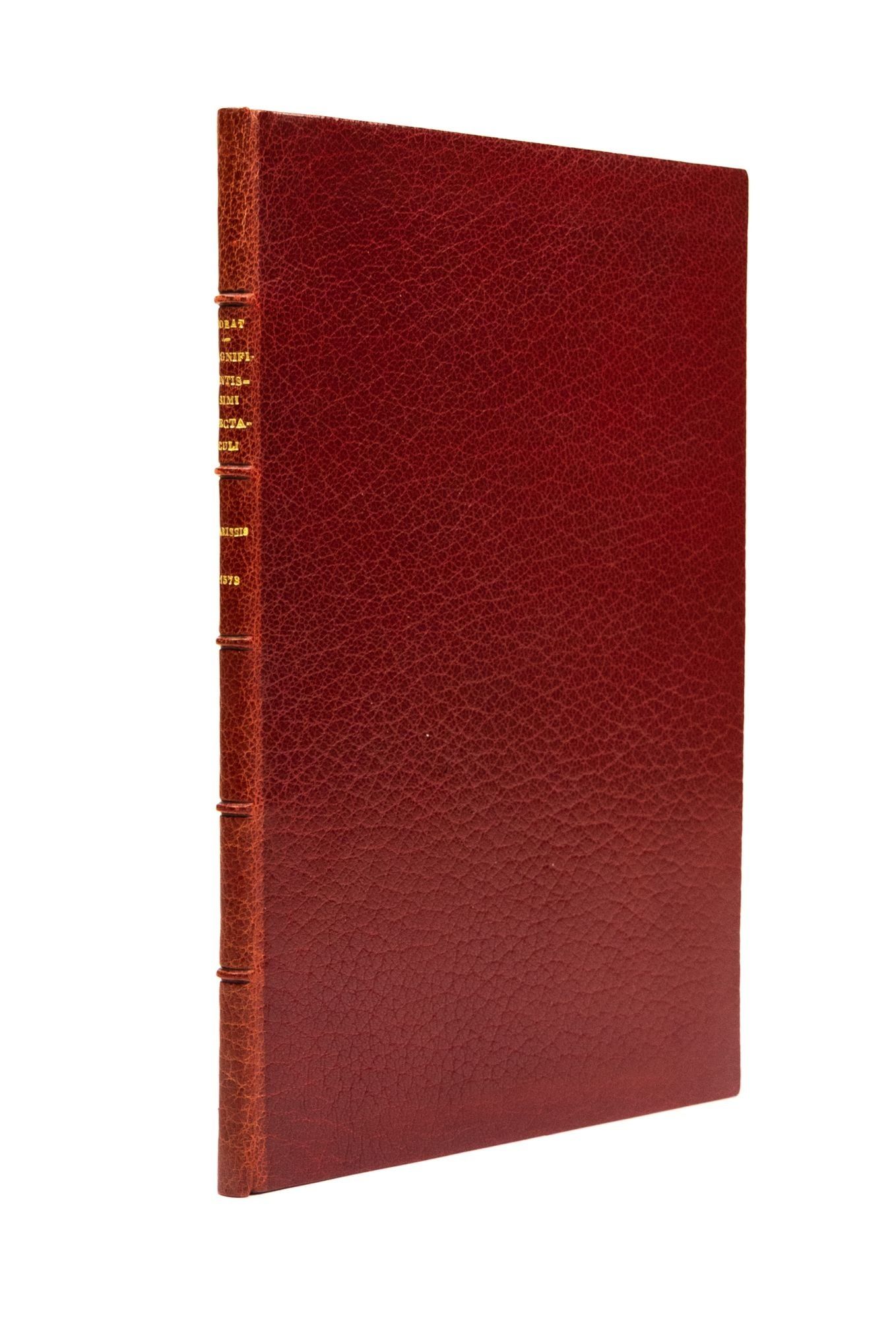
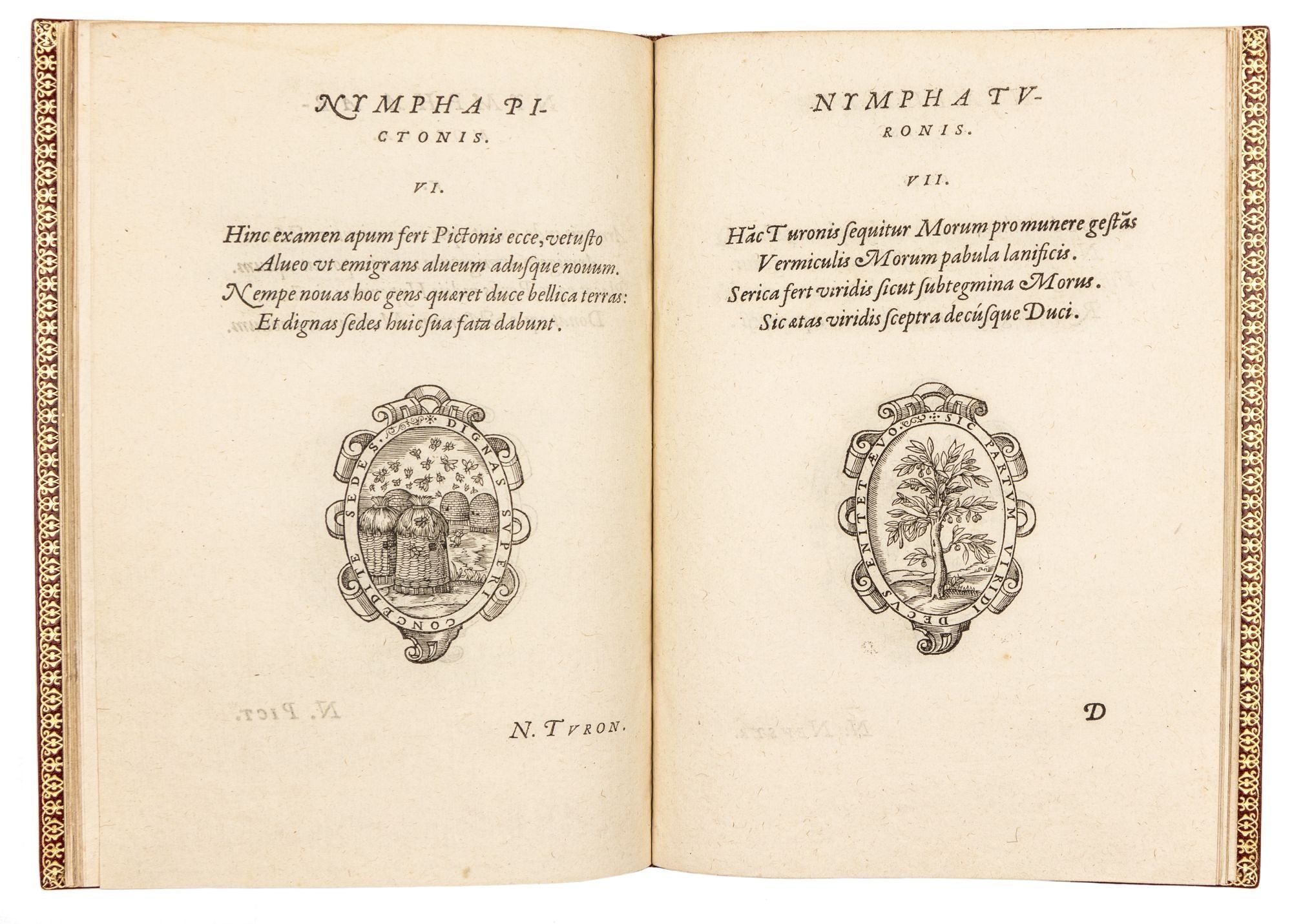
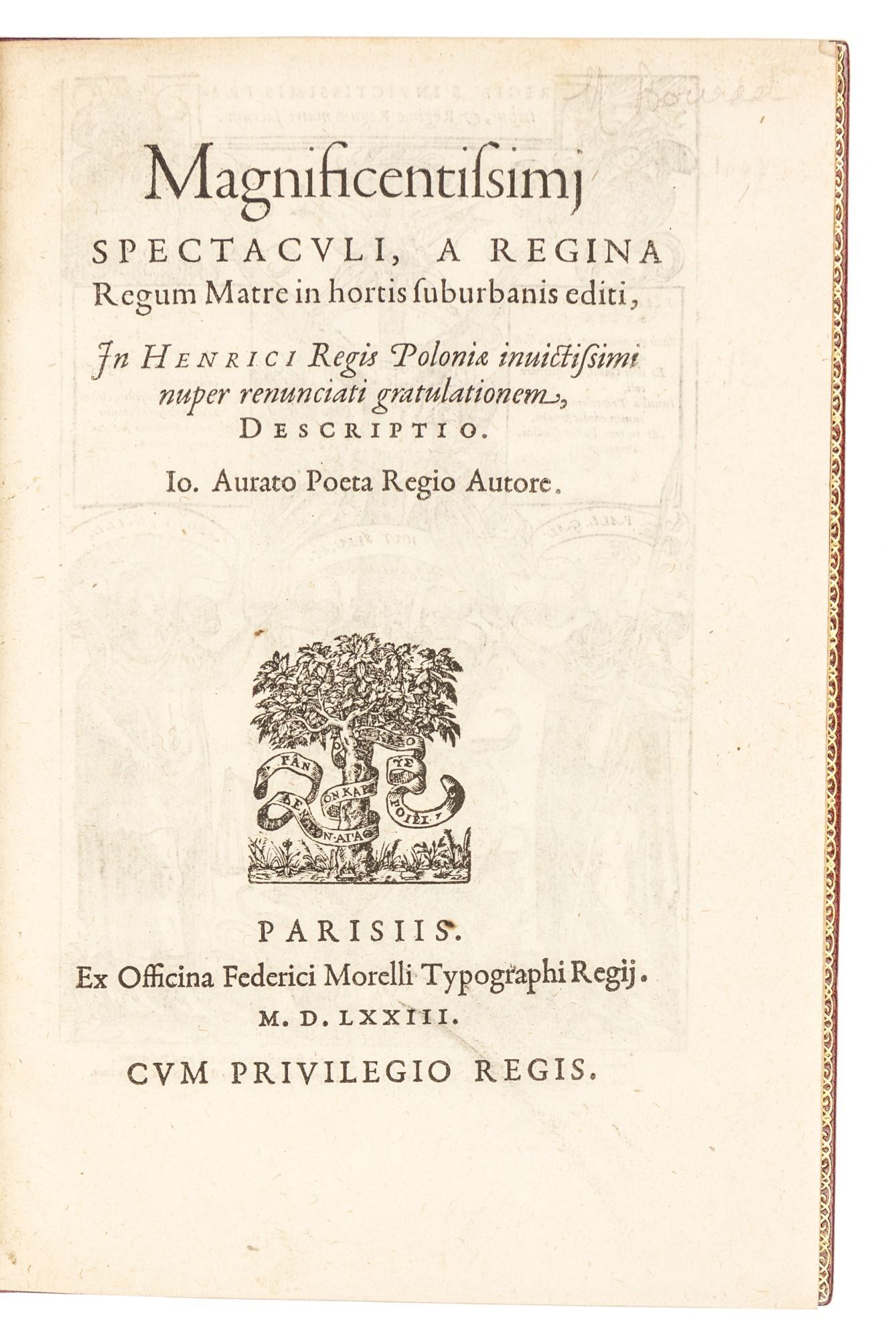
Paris: Ex officina Federici Morelli Typograhi Regii, 1573. SOLE EDITION. Hardcover. Fine. Bound in red morocco by René Aussourd. Gilt turn-ins, title and date tooled in gold on spine. A truly excellent copy with only discreet repairs to the upper margin of bifolium F2-3, not affecting the images. Beautifully illustrated. An illustrated account of the spectacular ballet staged by Catherine de Médicis for the Polish ambassadors in the Jardin des Tuileries in August 1573, on the occasion of the elevation to the Polish throne of her son Henri, duc d'Anjou, the future Henri III. The ballet was created by the Savoyard violinist, choreographer, and dance-master Balthasar de Beaujoyeulx (before 1535-ca. 1587), would come to be known as the "Ballet des Polonais", "a landmark in the history of ballet and a great achievement of the splendid patronage of Catherine de Médicis."(Kociszewska). The basic framework for the spectacle was provided by book 5 of the Aeneid.
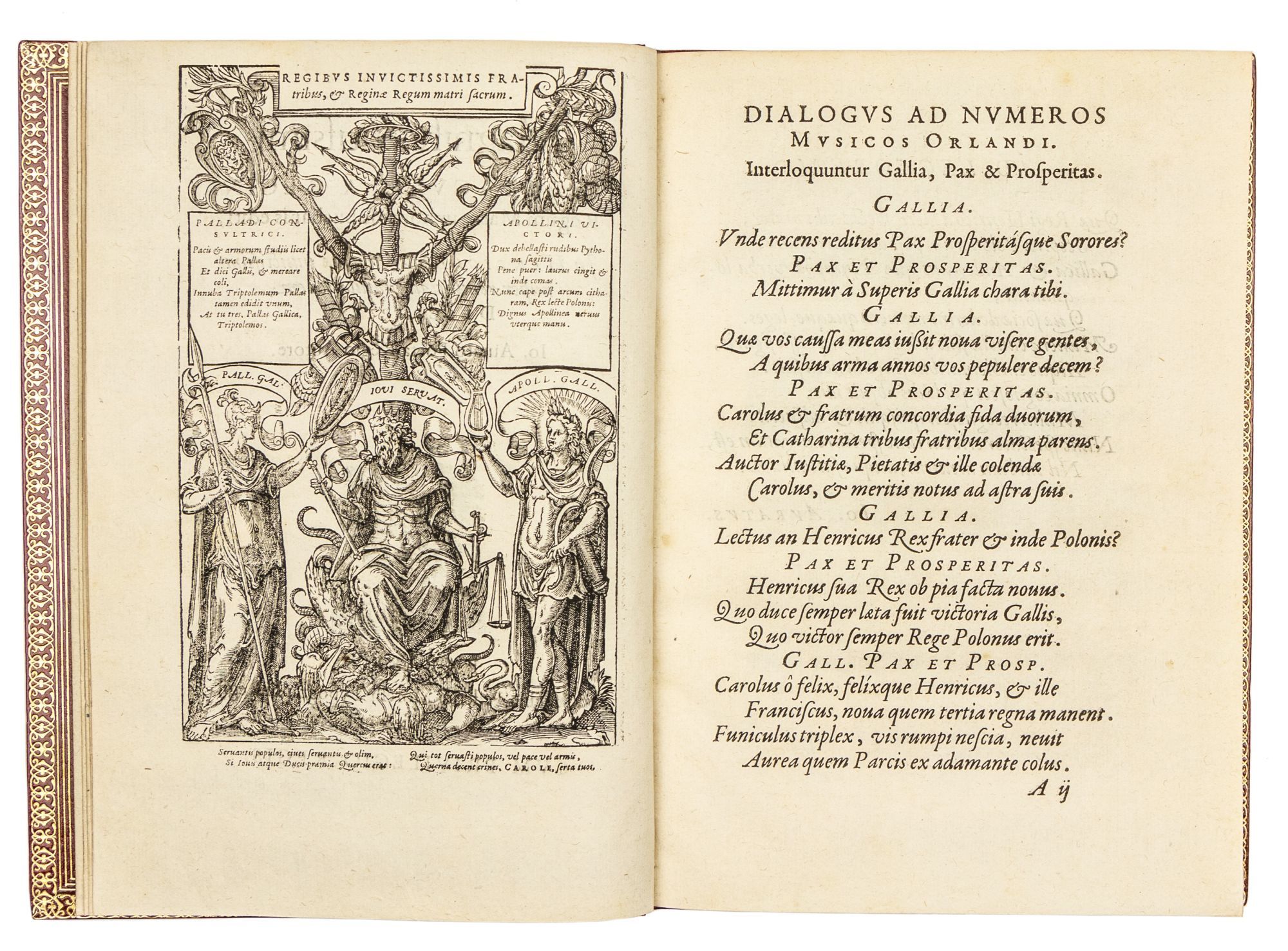
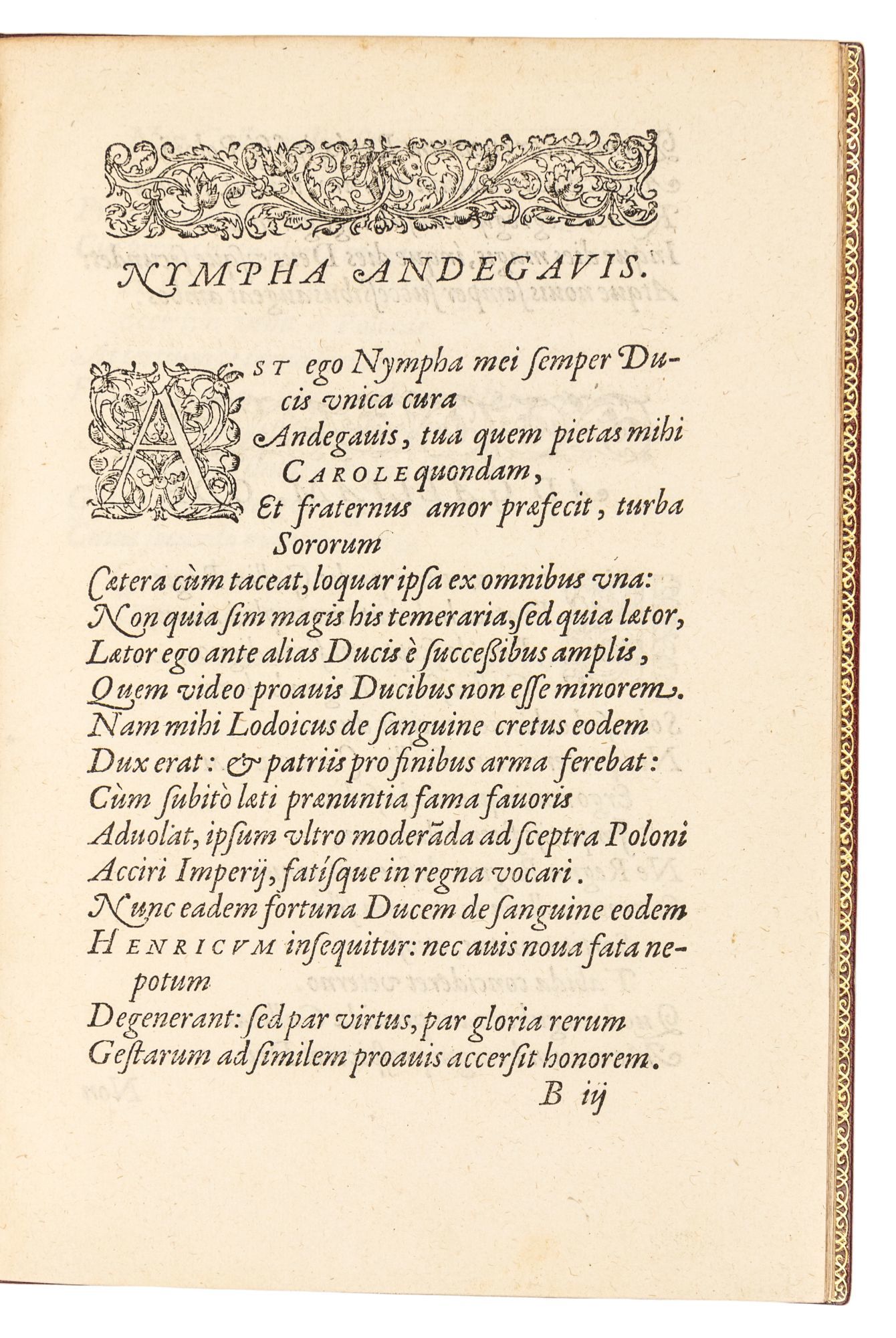
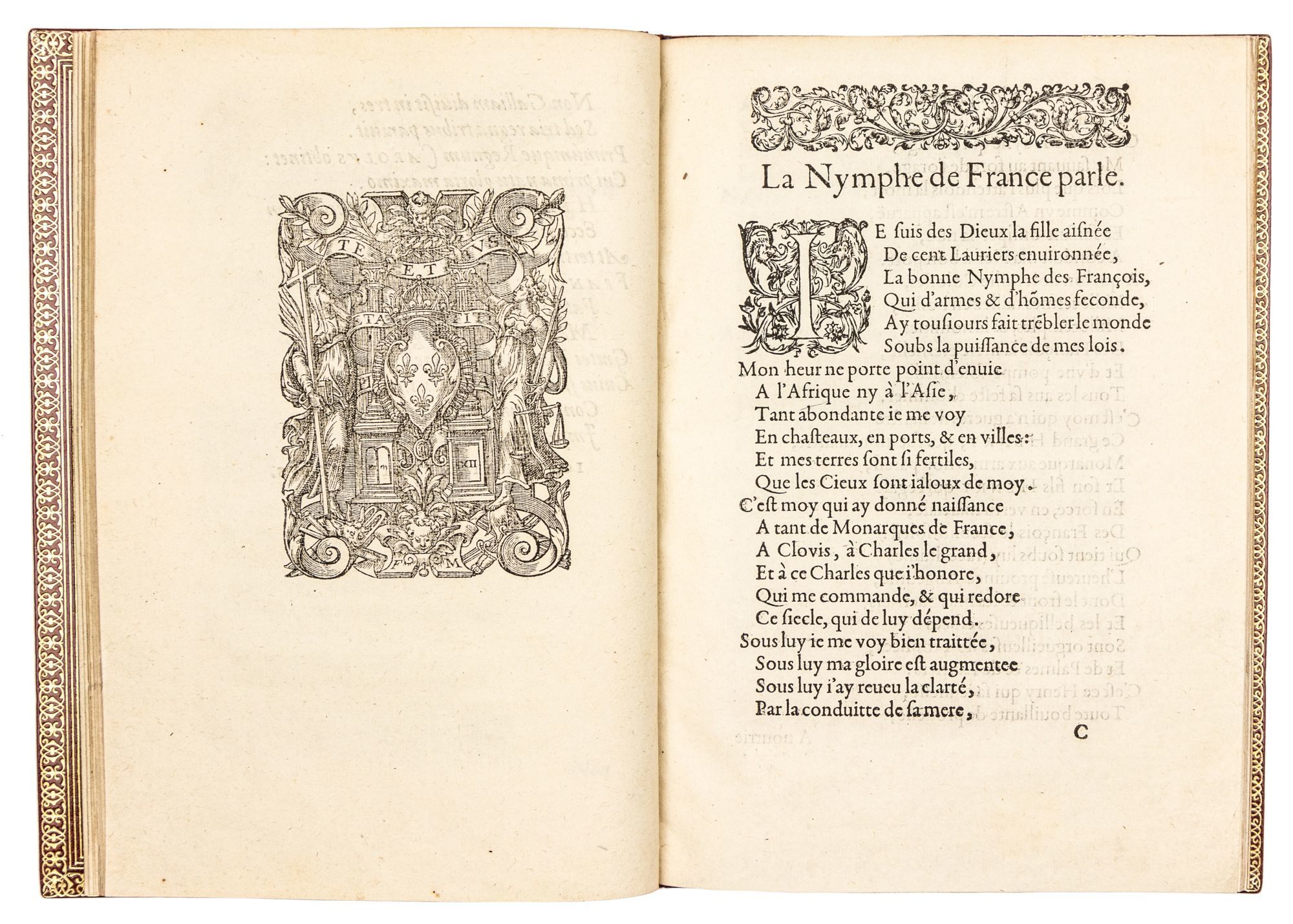
The author of the book, Jean Dorat (1508-1588), founding member of La Pléiade, was also the primary designer of the festival program. Dorat's poem "Chorea Nympharum" (''Dance of the Nymphs'') describes the balletic spectacle. The book also includes two pieces in French verse that were sung during the performance. The first, "La Nymphe de France parle" is by the premiere poet of La Pléiade, Pierre de Ronsard (1524-85); the other, "La nymphe angevine parle", is by Ronsard's secretary and close friend, Amadis Jamyn (1538-92). These are followed by Latin renditions of the poems by Dorat.
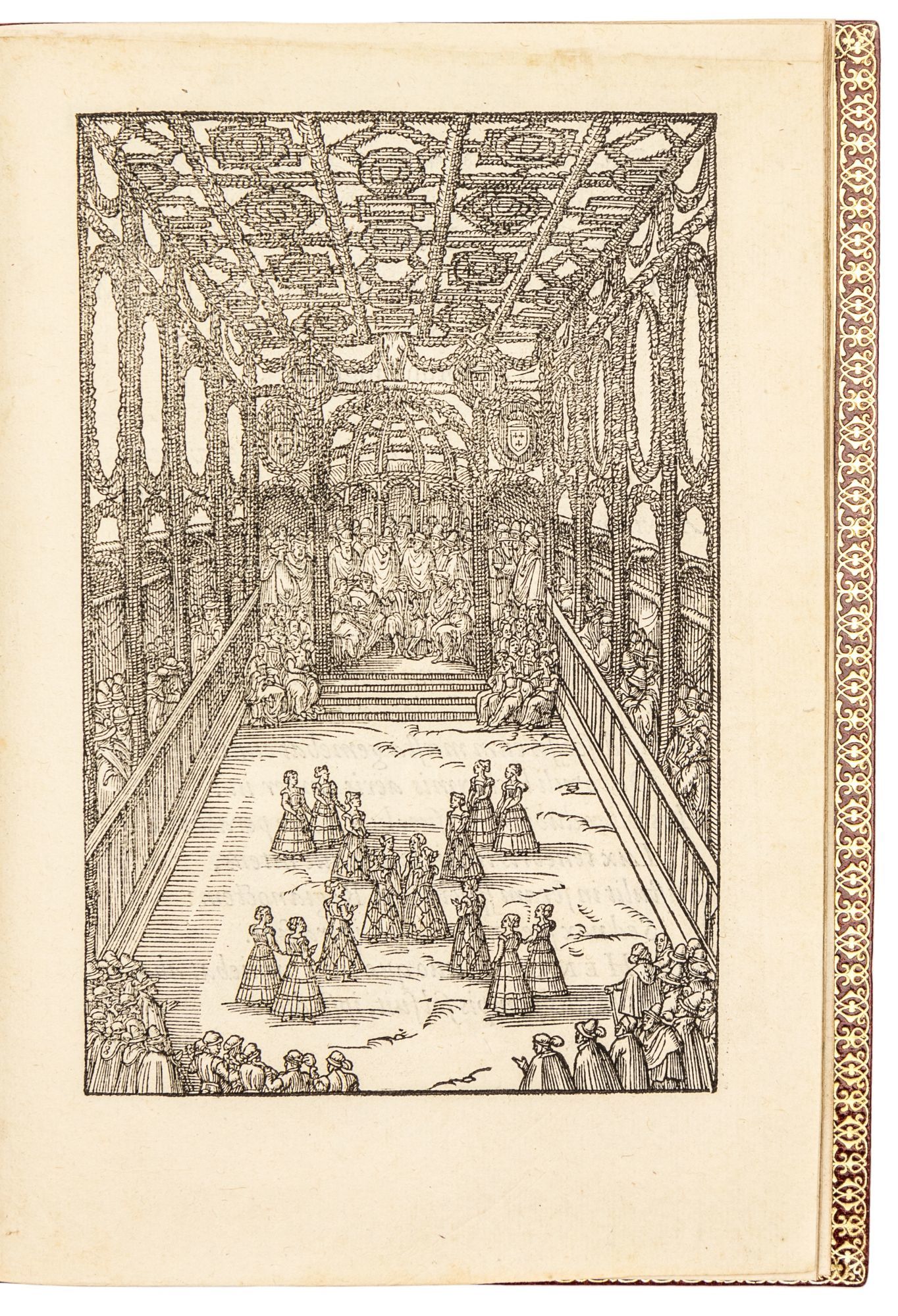
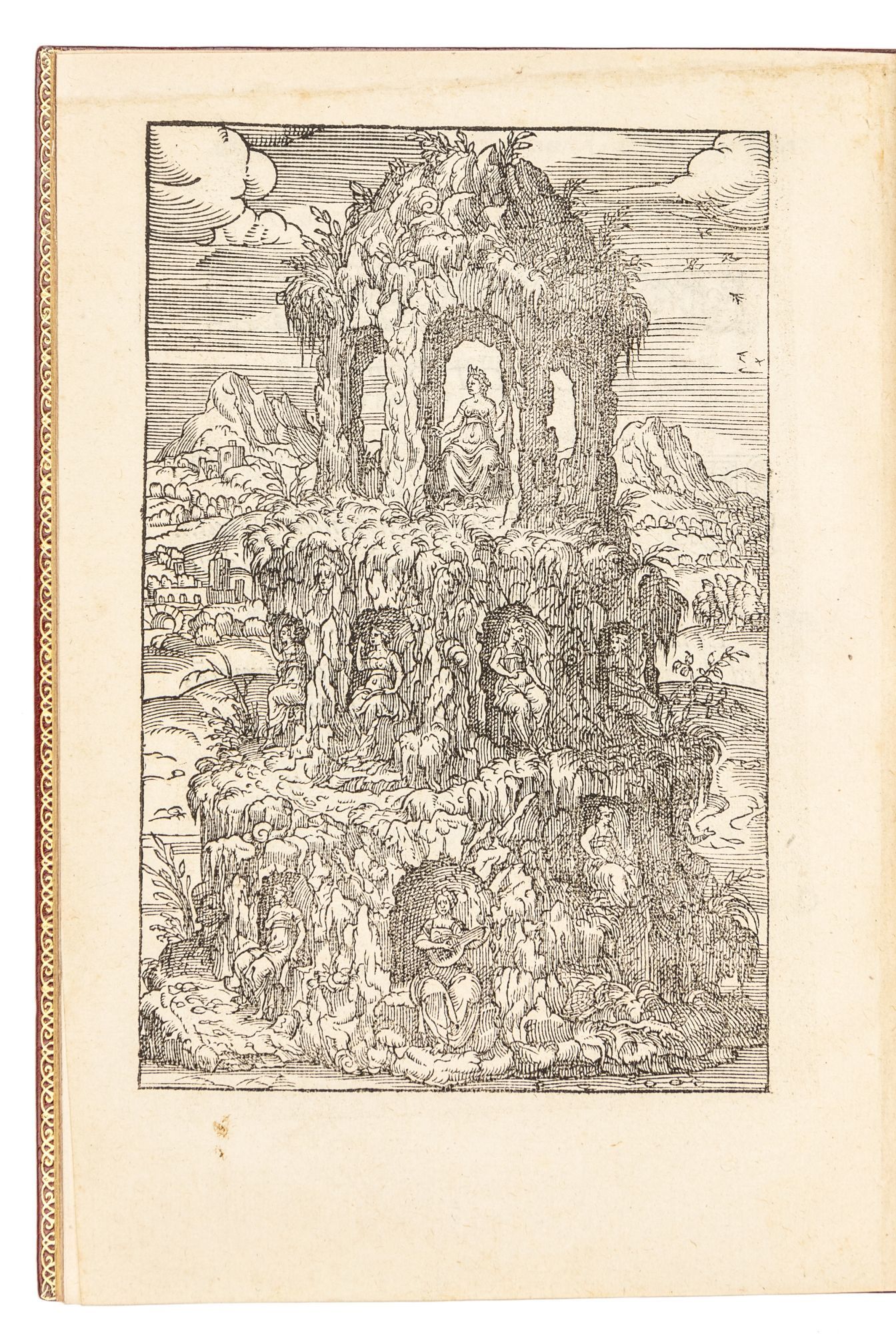
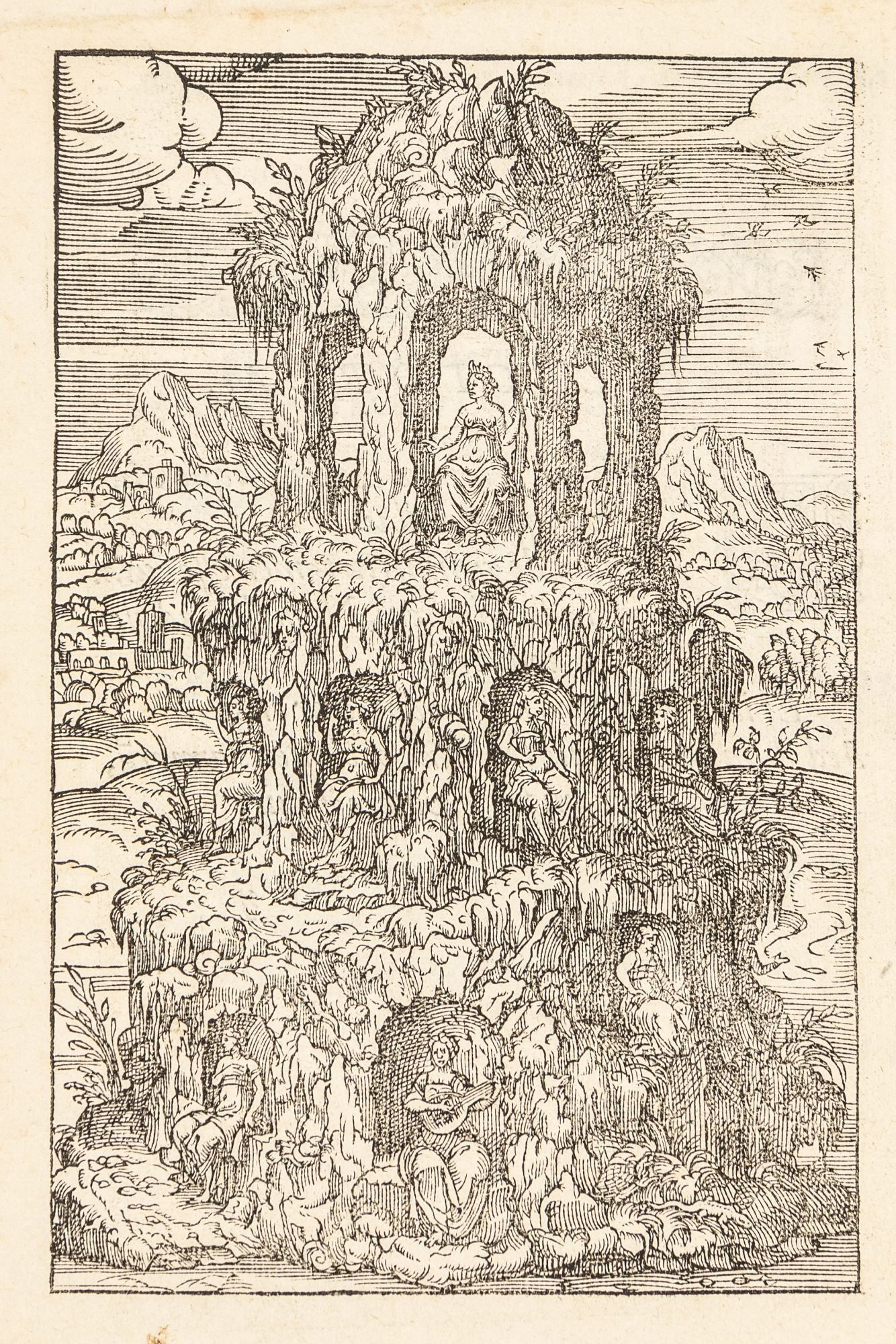
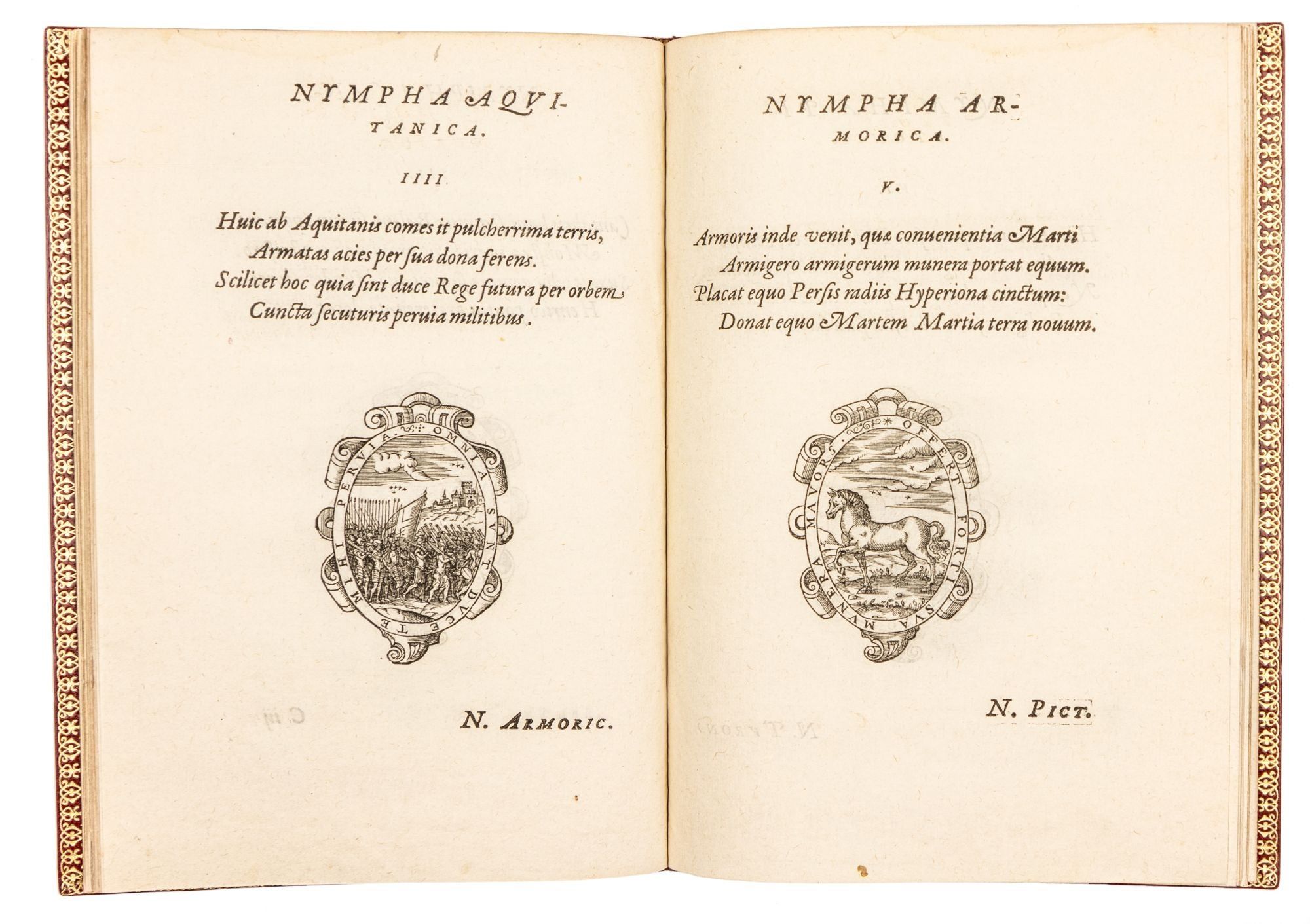
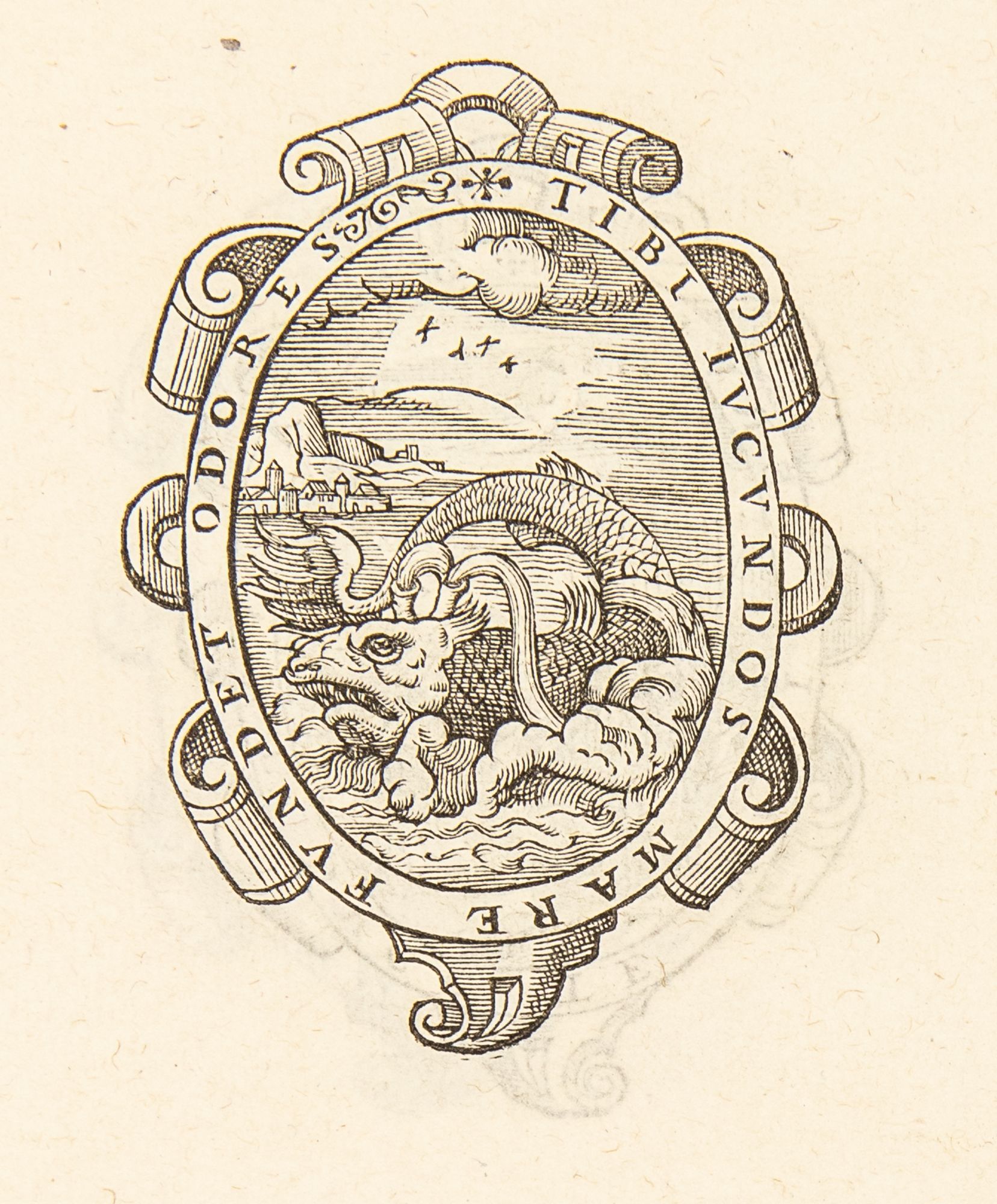
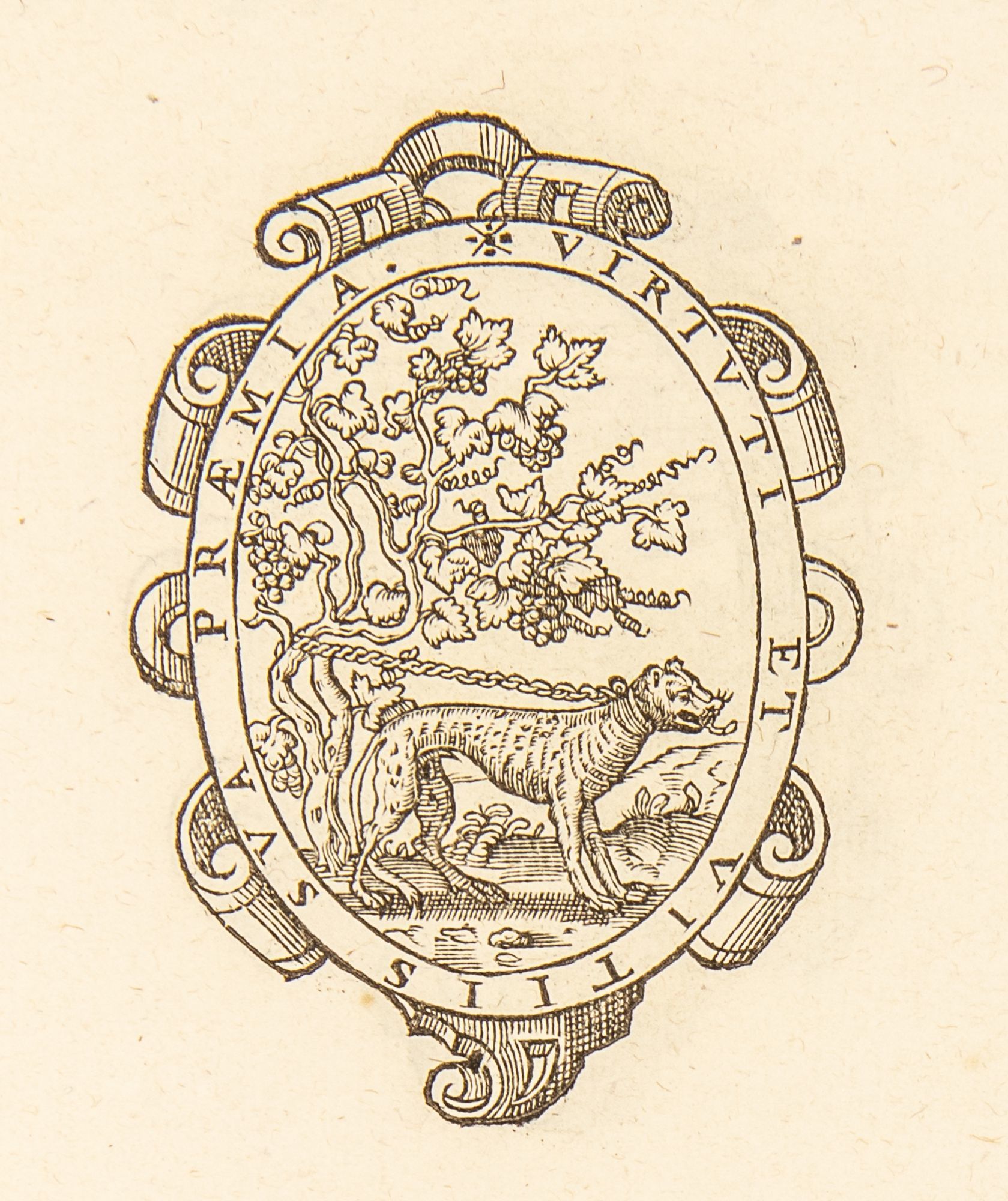
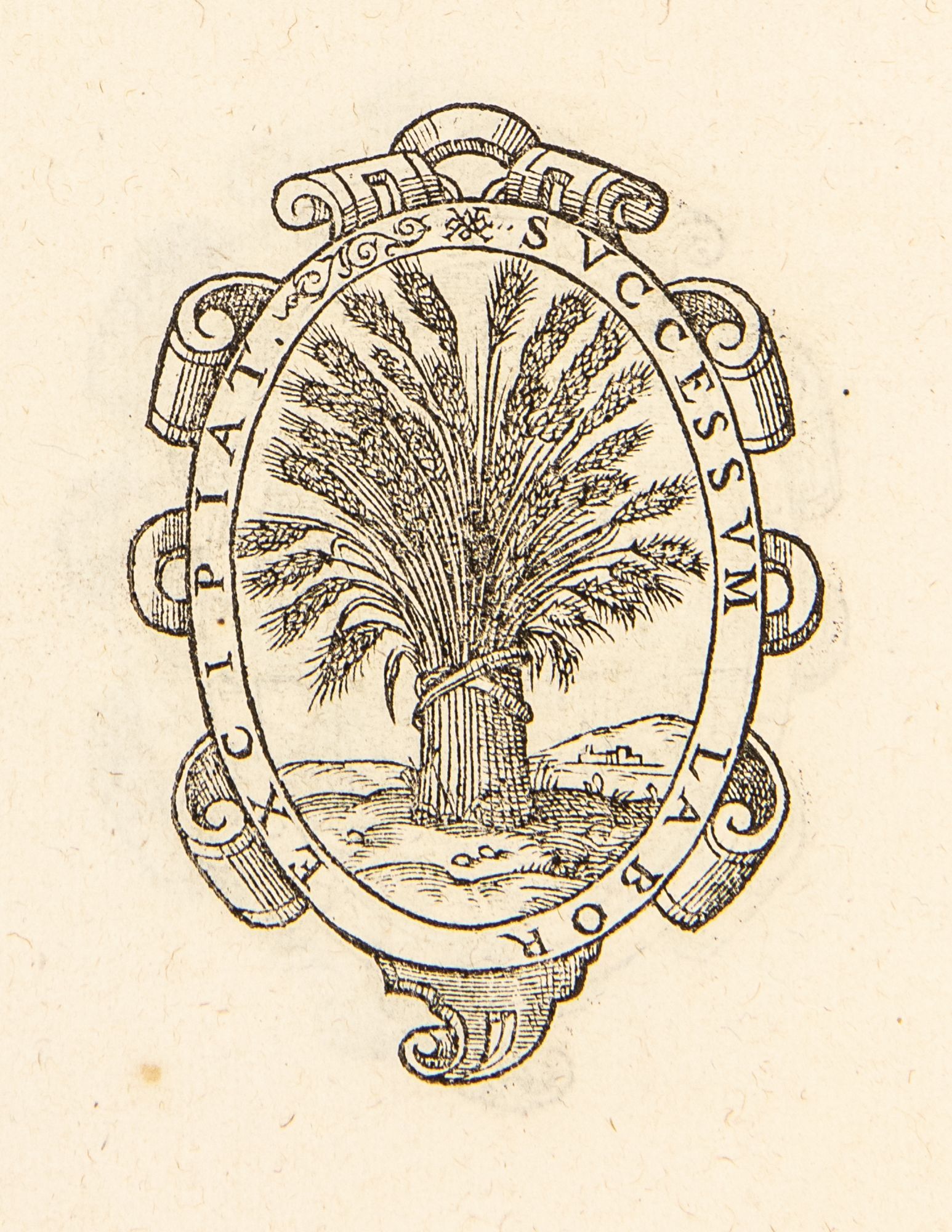
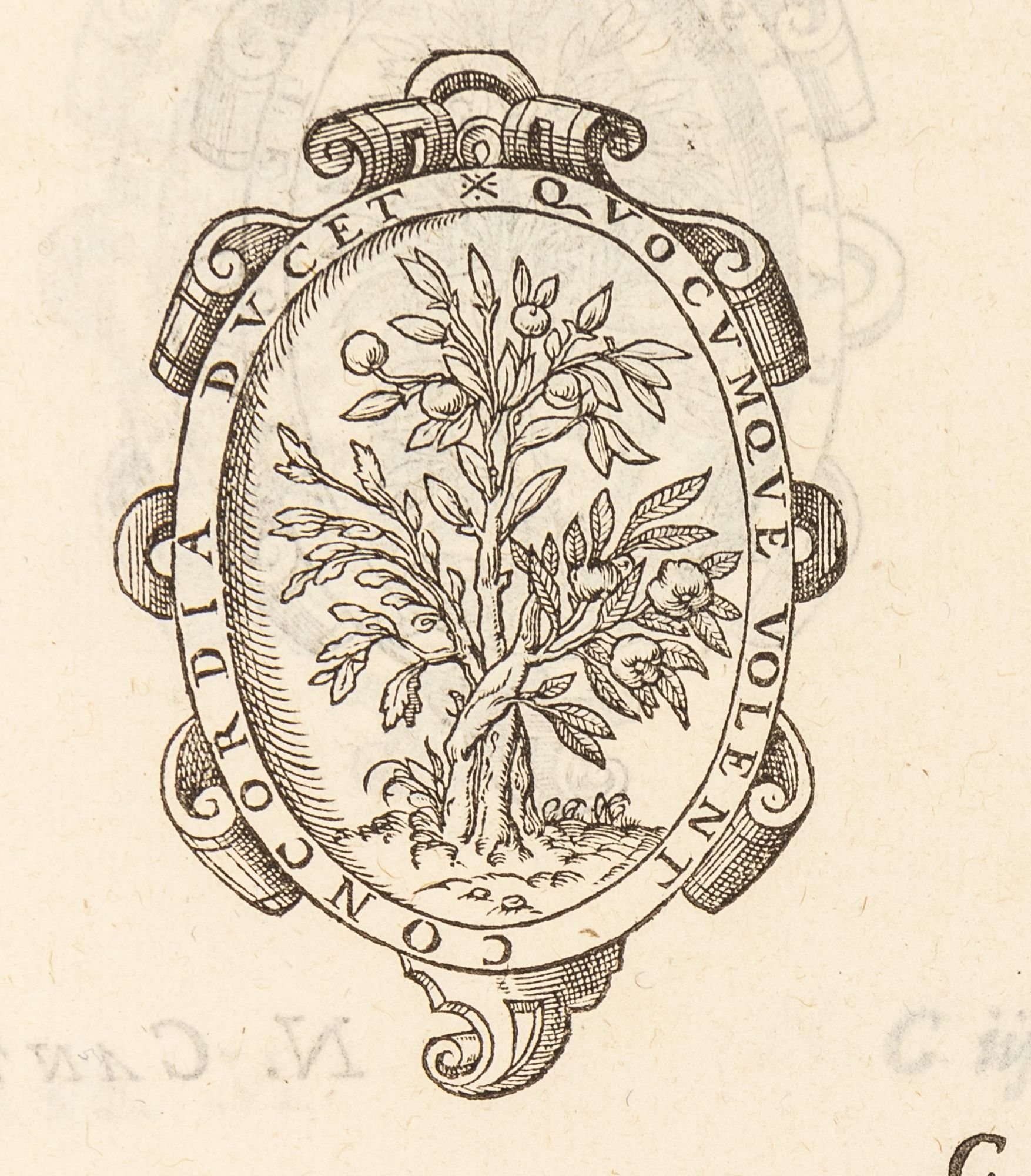
The book is illustrated with 4 full-page woodcuts and 16 woodcut emblems in the text, possibly by Jean Cousin (1500 - before 1593) or Olivier Codoré (d. 1588). The large woodcuts show an allegorical scene, the arms of France, a chariot surmounted by a mountain with nymphs (from the ballet); and the ballet hall built for the occasion, with sixteen dancers symbolizing the French provinces surrounded by spectators.
"Described as 'The most beautiful ballet in the world' and 'impossible to surpass by any king on earth' - witnesses enthusiastically applauded the spectacle given by Catherine de Médicis (1519-89) in the Tuileries garden in 1573. The opulence and elaborate poetic invention of this celebrated festival made it the quintessential example of the taste of the last Valois court and its use of the arts in diplomacy.
"[T]he purpose of the festival was to produce a positive image of the Duke d'Anjou and his mother, Catherine de Médicis. The main subject behind the ballet was a Valois Empire, which was to be established thanks to Henri's accession to the throne of Poland with the support of his mother. The spectacle solidified an image of the duke as a great military commander and a worthy King of Poland. The most important message, however, was devoted to Catherine. The queen was fashioned into a loving mother, a guardian of dynasty, and a promoter of its power - and, finally, a strong woman who for the sake of the kingdom was capable of overcoming female sentiments...
"The ambassadors were lodged in residences in the area of Saint-André-des-Arts on the Left Bank. To get to the Tuileries they crossed the Seine in splendidly decorated boats to the accompaniment of music. The ambassadors promenaded in the 'greatly delightful garden' with the Queen Mother and feasted with the royal family in a garden pavilion. After supper they moved to another pavilion, made from green foliage with golden elements and decorated with coats-of-arms, where an immense crowd of courtiers, sitting in the galleries, on benches, and on the ground, was already waiting. The spectacle opened with an hour-long gymnastics show performed by three 'jumpers,' who vigorously danced moresche and galliards. When this came to an end, the niche of the pavilion was uncovered and a sixteen-foot-high artificial mountain appeared. On this silvered structure, described in the festival book as Mons Nympharum ('Mountain of the Nymphs'), sat eighteen masked Nymphs in white and red gowns. Inside were hidden six strongmen, invisible to the audience, under whose power the mountain (equipped with wheels) moved to the middle of the arena, turned around, and approached the seats of the royal family. The passage of the mountain was led by a marshal in a fancy red costume and ten dwarfs with swords, and was accompanied by the singing of four singers, also hidden inside. When the mountain stopped before the seats of the kings, the musical component of the spectacle began. For one hour, the Nymph of France, seated on top of the mountain, chanted French verses by Ronsard. Thanks to a letter sent home by a member of the Polish entourage, we know that the wonderful voice of this Nymph belonged to a castrato, probably Etienne Le Roy. After this performance came the song of the Nymph of Anjou, seated lower on the mountain. She chanted verses by Amadis Jamyn, Ronsard's secretary, to the accompaniment of the lute. Górka notes that her singing was judged as incomparable throughout the whole kingdom.
"The texts of these two songs were printed in the festival book in both French (by Ronsard and Jamyn) and in Latin (by Dorat). It seems that the meaning of their verses was immediately understood by the ambassadors. Polish sources report that the songs praised Henri's heroic deeds, deplored his departure, and wished him a great future in the new kingdom. Indeed, these three main themes explored in the Nymphs' recital were also, as this essay will try to prove, the subjects of the balletic performance, which began immediately after.
"When the Nymph of France and the Nymph of Anjou finished their chants, the mountain returned to its niche. The sixteen Nymphs (all but the two who had just finished singing) descended from their seats on the mountain and moved to the middle of the arena. Six violinists in sumptuous yellow costumes appeared and started to play, and the ballet began. As a Polish author suggests, the ballet probably consisted of a series of dances performed to music of different tempi. All records tell of the intriguing, never-before-seen, complicated movements that made up 'the well-ordered confusions, the well-formed ciphers of ballet, the diverse music.' The most informative account of the dancing is provided by Brantóme (ca. 1540-1614), who writes about the peculiar combination of seemingly chaotic, but in fact carefully planned, movements: 'their ballet so curiously designed, with so many turns, swerves, and sinuosities, interlacings and minglings, confrontations and withdrawals, that [it was surprising that] no lady ever failed to be at her appointed turn or place.'
"This odd dancing, which one of the 'ciphers' is shown performing in the illustration in the livret, took one hour. 'Chorea Nympharum', by Dorat, describes the ballet in these words:
'Such was the song sung by the French Siren, for the other French Siren was a Nymph. Once the song was finished, see the band of the Nymphs begin to Dance in a set rhythm. Their rhythmical movements testify to their joy for the newly chosen king, Henri. Now you would think as many Queens were passing by as Nymphs, such is their dignity in their slow severity. Now you might think them as many Dolphins swimming playfully as they flit with effortless mobility. They repeat a thousand short advances and a thousand returns; they combine a thousand flights, a thousand pauses of the feet. Now they cling like bees by clasping hands together, now they form a point like a flock of voiceless cranes. Now some cleave to others in oblique knots, like a hedge made of artfully entangled brambles. Now they form variously this figure, now that, on the dance-floor; no writing-tablet ever carried more signs, nor that which shows Euclidean lines drawn in the sand, nor that on which a fleeing [chess] piece is lost to the swift enemy. There were nor so many turnings in the structure of the Labyrinth, nor did the waters of the Meander ever wind so sinuously. You would have thought this to be the game in which Trojan Julus delighted, as he imitated real battles with pretended maneuvers. In such a way they form their lines head on, now to the side; now they rush forward, now they flee back lightly. But already they are approaching with their formation restored like troops after combat as they pass before the faces of Kings. While they pass, each carries her royal golden gift, which, as you look at them, you might take to be small shields, and on each shield an incised figure has I know not what happy omen for Kings.'
"When the dancing came to an end, the ladies formed a procession. Each of them approached Henri, kissed him, and gave him a golden medallion with a poem. Then they walked out. Catherine called them back and asked them to remove their masks. To prove that it was really they who had been dancing, the girls performed the entire ballet again. After this, there was a ball, and the kings danced. Then the guests moved to the first pavilion where 'confectioneries, marzipans, and sweets' were served. The banquet ended at midnight."(Kociszewska, "War and Seduction in Cybele's Garden: Contextualizing the Ballet des Polonais", Renaissance Quarterly , Vol. 65, No. 3 (Fall 2012), pp. 809-863).
The author of the book, Jean Dorat (1508-1588), founding member of La Pléiade, was also the primary designer of the festival program. Dorat's poem "Chorea Nympharum" (''Dance of the Nymphs'') describes the balletic spectacle. The book also includes two pieces in French verse that were sung during the performance. The first, "La Nymphe de France parle" is by the premiere poet of La Pléiade, Pierre de Ronsard (1524-85); the other, "La nymphe angevine parle", is by Ronsard's secretary and close friend, Amadis Jamyn (1538-92). These are followed by Latin renditions of the poems by Dorat.
The book is illustrated with 4 full-page woodcuts and 16 woodcut emblems in the text, possibly by Jean Cousin (1500 - before 1593) or Olivier Codoré (d. 1588). The large woodcuts show an allegorical scene, the arms of France, a chariot surmounted by a mountain with nymphs (from the ballet); and the ballet hall built for the occasion, with sixteen dancers symbolizing the French provinces surrounded by spectators.
"Described as 'The most beautiful ballet in the world' and 'impossible to surpass by any king on earth' - witnesses enthusiastically applauded the spectacle given by Catherine de Médicis (1519-89) in the Tuileries garden in 1573. The opulence and elaborate poetic invention of this celebrated festival made it the quintessential example of the taste of the last Valois court and its use of the arts in diplomacy.
"[T]he purpose of the festival was to produce a positive image of the Duke d'Anjou and his mother, Catherine de Médicis. The main subject behind the ballet was a Valois Empire, which was to be established thanks to Henri's accession to the throne of Poland with the support of his mother. The spectacle solidified an image of the duke as a great military commander and a worthy King of Poland. The most important message, however, was devoted to Catherine. The queen was fashioned into a loving mother, a guardian of dynasty, and a promoter of its power - and, finally, a strong woman who for the sake of the kingdom was capable of overcoming female sentiments...
"The ambassadors were lodged in residences in the area of Saint-André-des-Arts on the Left Bank. To get to the Tuileries they crossed the Seine in splendidly decorated boats to the accompaniment of music. The ambassadors promenaded in the 'greatly delightful garden' with the Queen Mother and feasted with the royal family in a garden pavilion. After supper they moved to another pavilion, made from green foliage with golden elements and decorated with coats-of-arms, where an immense crowd of courtiers, sitting in the galleries, on benches, and on the ground, was already waiting. The spectacle opened with an hour-long gymnastics show performed by three 'jumpers,' who vigorously danced moresche and galliards. When this came to an end, the niche of the pavilion was uncovered and a sixteen-foot-high artificial mountain appeared. On this silvered structure, described in the festival book as Mons Nympharum ('Mountain of the Nymphs'), sat eighteen masked Nymphs in white and red gowns. Inside were hidden six strongmen, invisible to the audience, under whose power the mountain (equipped with wheels) moved to the middle of the arena, turned around, and approached the seats of the royal family. The passage of the mountain was led by a marshal in a fancy red costume and ten dwarfs with swords, and was accompanied by the singing of four singers, also hidden inside. When the mountain stopped before the seats of the kings, the musical component of the spectacle began. For one hour, the Nymph of France, seated on top of the mountain, chanted French verses by Ronsard. Thanks to a letter sent home by a member of the Polish entourage, we know that the wonderful voice of this Nymph belonged to a castrato, probably Etienne Le Roy. After this performance came the song of the Nymph of Anjou, seated lower on the mountain. She chanted verses by Amadis Jamyn, Ronsard's secretary, to the accompaniment of the lute. Górka notes that her singing was judged as incomparable throughout the whole kingdom.
"The texts of these two songs were printed in the festival book in both French (by Ronsard and Jamyn) and in Latin (by Dorat). It seems that the meaning of their verses was immediately understood by the ambassadors. Polish sources report that the songs praised Henri's heroic deeds, deplored his departure, and wished him a great future in the new kingdom. Indeed, these three main themes explored in the Nymphs' recital were also, as this essay will try to prove, the subjects of the balletic performance, which began immediately after.
"When the Nymph of France and the Nymph of Anjou finished their chants, the mountain returned to its niche. The sixteen Nymphs (all but the two who had just finished singing) descended from their seats on the mountain and moved to the middle of the arena. Six violinists in sumptuous yellow costumes appeared and started to play, and the ballet began. As a Polish author suggests, the ballet probably consisted of a series of dances performed to music of different tempi. All records tell of the intriguing, never-before-seen, complicated movements that made up 'the well-ordered confusions, the well-formed ciphers of ballet, the diverse music.' The most informative account of the dancing is provided by Brantóme (ca. 1540-1614), who writes about the peculiar combination of seemingly chaotic, but in fact carefully planned, movements: 'their ballet so curiously designed, with so many turns, swerves, and sinuosities, interlacings and minglings, confrontations and withdrawals, that [it was surprising that] no lady ever failed to be at her appointed turn or place.'
"This odd dancing, which one of the 'ciphers' is shown performing in the illustration in the livret, took one hour. 'Chorea Nympharum', by Dorat, describes the ballet in these words:
'Such was the song sung by the French Siren, for the other French Siren was a Nymph. Once the song was finished, see the band of the Nymphs begin to Dance in a set rhythm. Their rhythmical movements testify to their joy for the newly chosen king, Henri. Now you would think as many Queens were passing by as Nymphs, such is their dignity in their slow severity. Now you might think them as many Dolphins swimming playfully as they flit with effortless mobility. They repeat a thousand short advances and a thousand returns; they combine a thousand flights, a thousand pauses of the feet. Now they cling like bees by clasping hands together, now they form a point like a flock of voiceless cranes. Now some cleave to others in oblique knots, like a hedge made of artfully entangled brambles. Now they form variously this figure, now that, on the dance-floor; no writing-tablet ever carried more signs, nor that which shows Euclidean lines drawn in the sand, nor that on which a fleeing [chess] piece is lost to the swift enemy. There were nor so many turnings in the structure of the Labyrinth, nor did the waters of the Meander ever wind so sinuously. You would have thought this to be the game in which Trojan Julus delighted, as he imitated real battles with pretended maneuvers. In such a way they form their lines head on, now to the side; now they rush forward, now they flee back lightly. But already they are approaching with their formation restored like troops after combat as they pass before the faces of Kings. While they pass, each carries her royal golden gift, which, as you look at them, you might take to be small shields, and on each shield an incised figure has I know not what happy omen for Kings.'
"When the dancing came to an end, the ladies formed a procession. Each of them approached Henri, kissed him, and gave him a golden medallion with a poem. Then they walked out. Catherine called them back and asked them to remove their masks. To prove that it was really they who had been dancing, the girls performed the entire ballet again. After this, there was a ball, and the kings danced. Then the guests moved to the first pavilion where 'confectioneries, marzipans, and sweets' were served. The banquet ended at midnight."(Kociszewska, "War and Seduction in Cybele's Garden: Contextualizing the Ballet des Polonais", Renaissance Quarterly , Vol. 65, No. 3 (Fall 2012), pp. 809-863).
Details
Title
Magnificentissimi spectaculi, a Regina Regum Matre in hortis suburbanis editi, in Henrici Regis Poloniae invictissimi nuper renunciati gratulationem, Descriptio. Io. Aurato Poeta Regio Autore
Author
SPLENDID CEREMONIES. Dorat, Jean (1508-1588); Ronsard, Pierre de (1524-85)
Binding
Hardcover
Condition
Fine
Publisher
Ex officina Federici Morelli Typograhi Regii: Paris
Date
1573
Edition
SOLE EDITION