

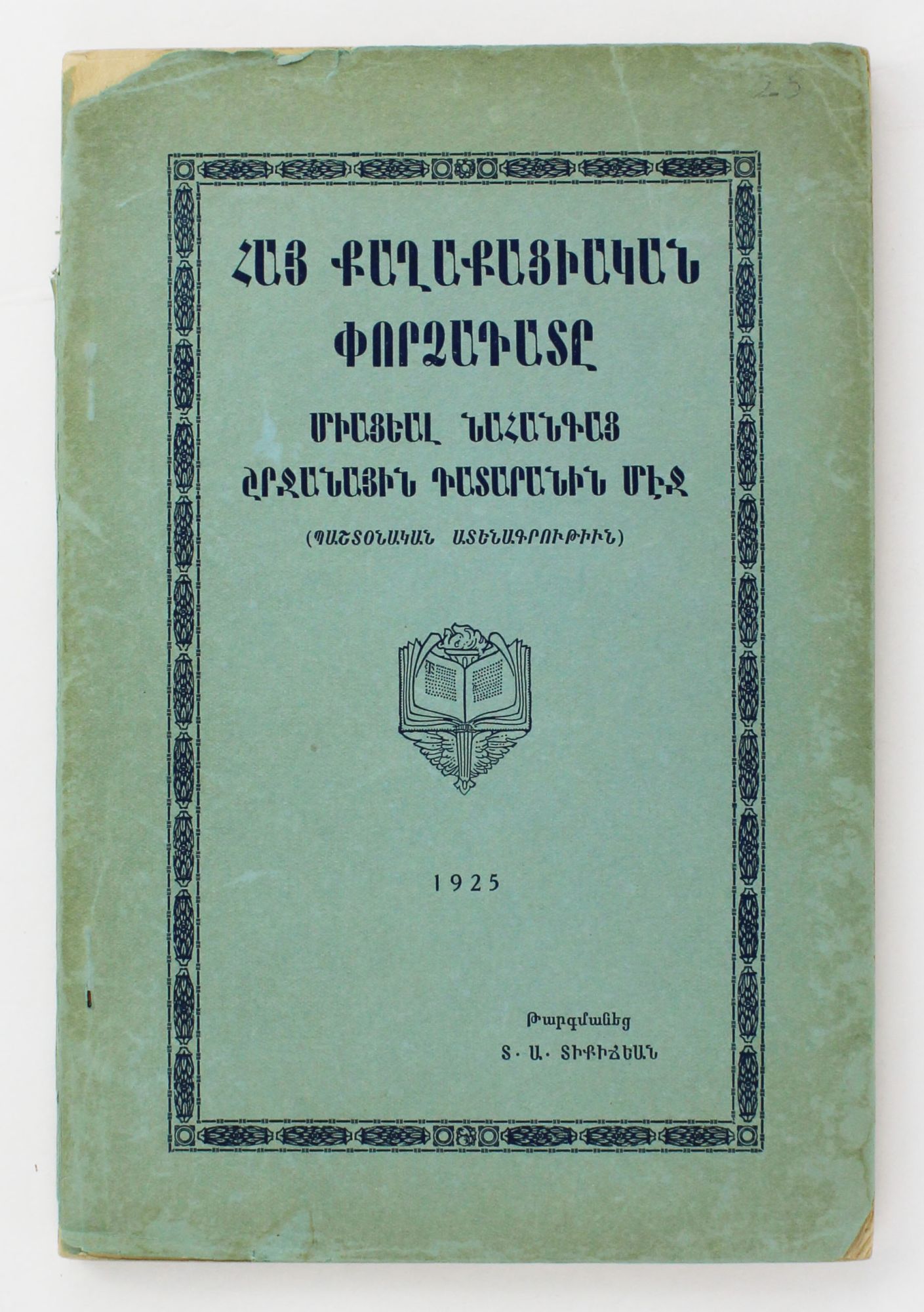
Hay k'Aghak'ats'iakan p'Ordzadate Miats'eal Nahangats' Shrjanayin Dataranin Mej: Pashtonakan Atenagrut'iwn
- Boston , 1925
Boston, 1925. Good plus.. 104pp. Original light blue wrappers printed in dark blue. Some chipping to spine, moderate edge wear and soiling. Internally clean. Inscribed by the translator on the title page. An unrecorded Armenian translation of the transcript of an important trial in Portland, Oregon involving Armenian-American rug dealer Tatos O. Cartozian, whose citizenship was challenged by the United States government in 1924 on the basis that Armenians were supposedly Asian and therefore ineligible to become American citizens. The defense argued that Armenians were white, even bringing witnesses from racially exclusive fraternal organizations who stated that they admitted Armenians. The court decided that Armenians were indeed eligible for citizenship. The cover title of the present pamphlet translates to The Armenian Civil Expert in United States District Court (Official Transcript) 1925. The final three pages list other books for sale published by the Armenian Educational Foundation. We could locate no other copies of this Armenian translation of Cartozian's famous naturalization case.
"In 1790, with the passage of the Naturalization Act, citizenship in the United States became officially restricted to 'free white persons'.... Between 1878 and 1952 -- when racial restrictions were removed from U.S. naturalization law -- émigrés from China, Burma, Japan, Mexico, Armenia, and other countries fought fifty-two race-defining legal battles in U.S. courts to either gain or maintain their American citizenship -- all of which hinged on judicial interpretations of whiteness. In In re Halladjian (1909), Armenians were declared white and made eligible for citizenship.... But, during the early 1920s a significant shift in judicial interpretations of naturalization law led to a reevaluation of Armenian status.... In 1924, the United States challenged the citizenship of Tatos O. Cartozian, a Portland rug dealer who had gained his citizenship in 1923, seventeen years after his emigration from Armenia. The prosecuting attorney, John S. Coke, argued that 'It is the contention of the government that it makes no difference whether a man is a Caucasian or not or what the racial and language history of his people may be if the man on the street does not recognize him as white.' Cartozian’s lawyers responded by arguing that both science and common knowledge identified Armenians as white. Scientific testimony was given by anthropologist Franz Boas and ethnologists Roland Dixon and Paul Rohrbach in support of Cartozian's case. To support the claim that Armenians were also commonly known to be white, the defense team drew testimony from leaders of racially-restrictive fraternal organizations like the Loyal Order of the Moose and the Masonic Grand Lodge of Oregon all of who attested to the common interpretation of Armenians as racially white, using Armenian membership in their organizations as evidence. In the end, the judge agreed with the defense -- Armenians were white, not Asian" - Oregon History Project.
"In 1790, with the passage of the Naturalization Act, citizenship in the United States became officially restricted to 'free white persons'.... Between 1878 and 1952 -- when racial restrictions were removed from U.S. naturalization law -- émigrés from China, Burma, Japan, Mexico, Armenia, and other countries fought fifty-two race-defining legal battles in U.S. courts to either gain or maintain their American citizenship -- all of which hinged on judicial interpretations of whiteness. In In re Halladjian (1909), Armenians were declared white and made eligible for citizenship.... But, during the early 1920s a significant shift in judicial interpretations of naturalization law led to a reevaluation of Armenian status.... In 1924, the United States challenged the citizenship of Tatos O. Cartozian, a Portland rug dealer who had gained his citizenship in 1923, seventeen years after his emigration from Armenia. The prosecuting attorney, John S. Coke, argued that 'It is the contention of the government that it makes no difference whether a man is a Caucasian or not or what the racial and language history of his people may be if the man on the street does not recognize him as white.' Cartozian’s lawyers responded by arguing that both science and common knowledge identified Armenians as white. Scientific testimony was given by anthropologist Franz Boas and ethnologists Roland Dixon and Paul Rohrbach in support of Cartozian's case. To support the claim that Armenians were also commonly known to be white, the defense team drew testimony from leaders of racially-restrictive fraternal organizations like the Loyal Order of the Moose and the Masonic Grand Lodge of Oregon all of who attested to the common interpretation of Armenians as racially white, using Armenian membership in their organizations as evidence. In the end, the judge agreed with the defense -- Armenians were white, not Asian" - Oregon History Project.
Details
Title
Hay k'Aghak'ats'iakan p'Ordzadate Miats'eal Nahangats' Shrjanayin Dataranin Mej: Pashtonakan Atenagrut'iwn
Author
[Armenian Americana]. Tik'ichean, T.A., translator
Condition
Good
Publisher
Boston
Date
1925