

Manuscript draft for essay entitled "My Short Novels
- n.p., 1953
n.p., 1953. n.p.: 1953.
Full Description:
STEINBECK, John. Manuscript draft for essay entitled "My Short Novels". [n.p.n.d ca: 1953].
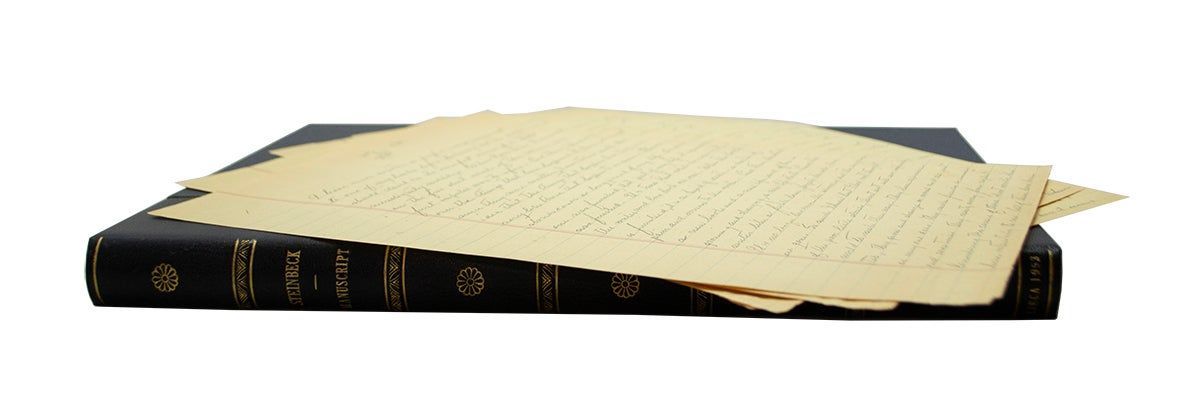
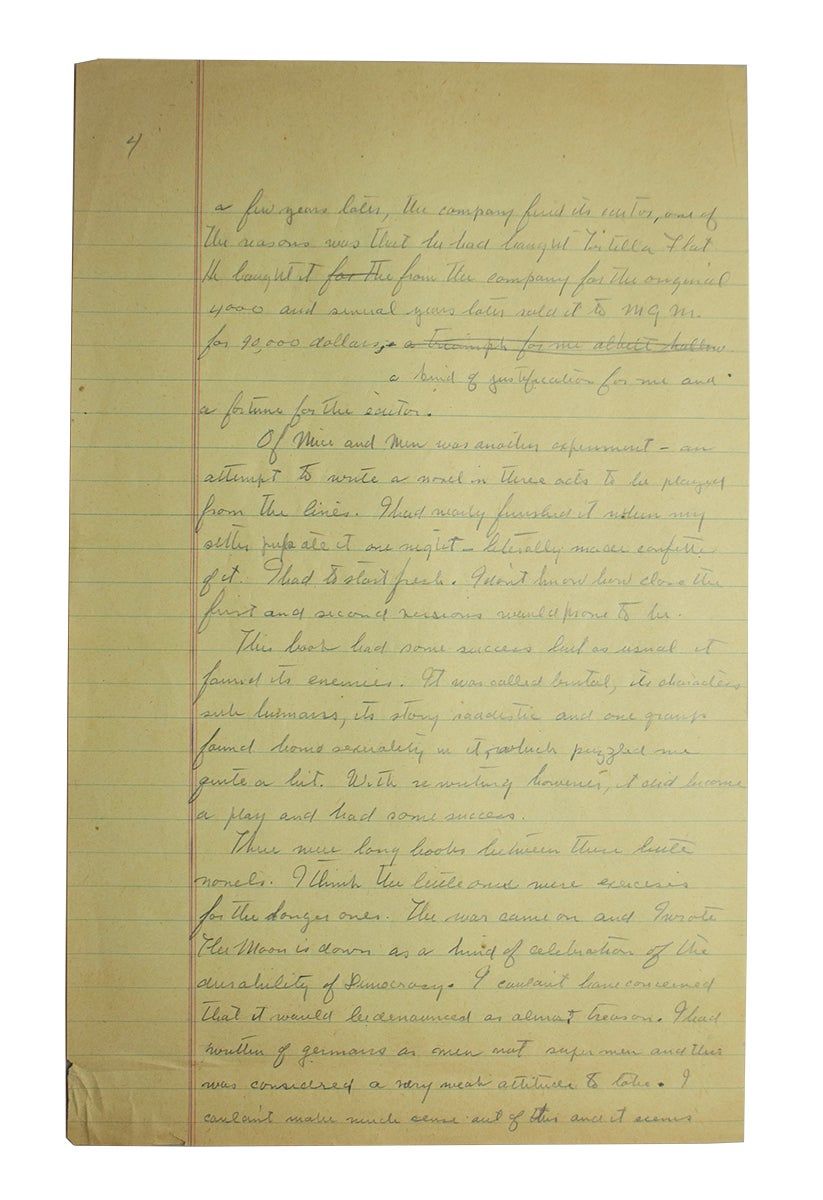
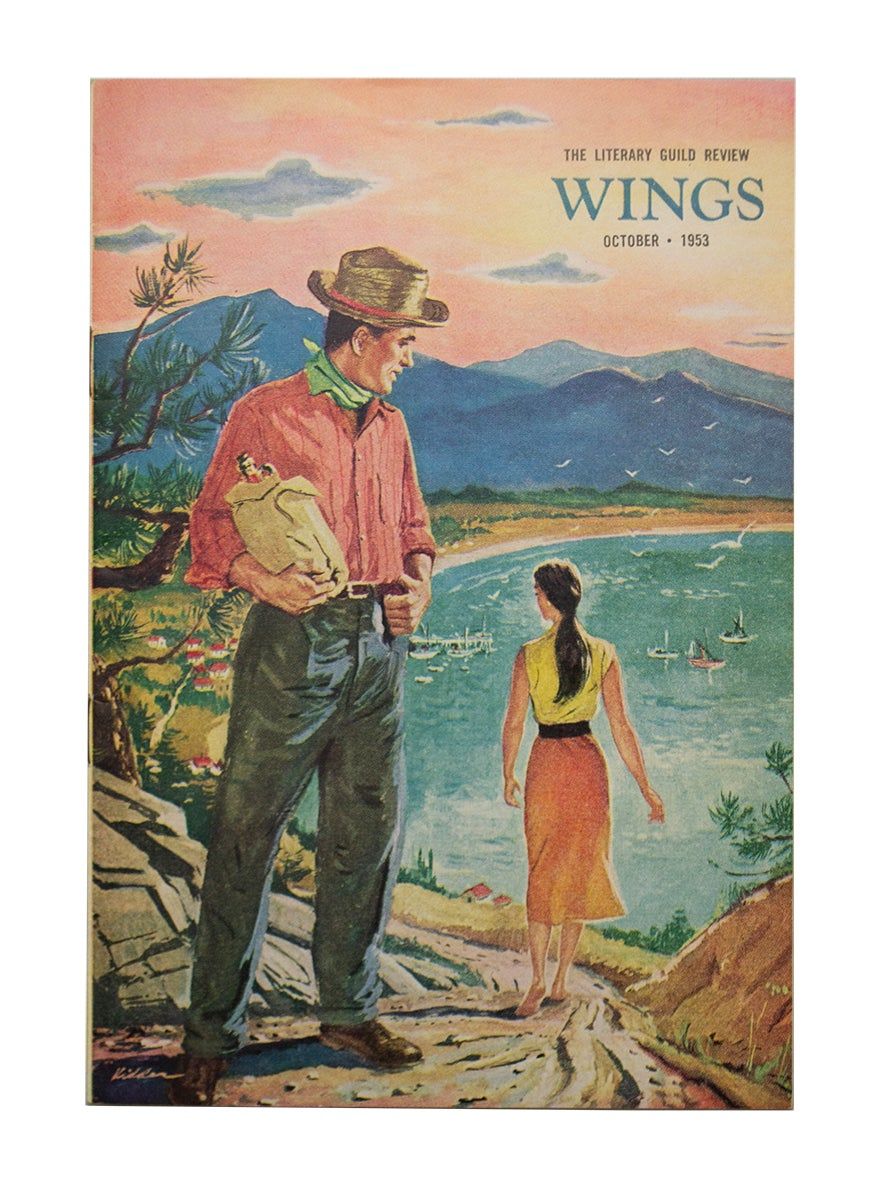
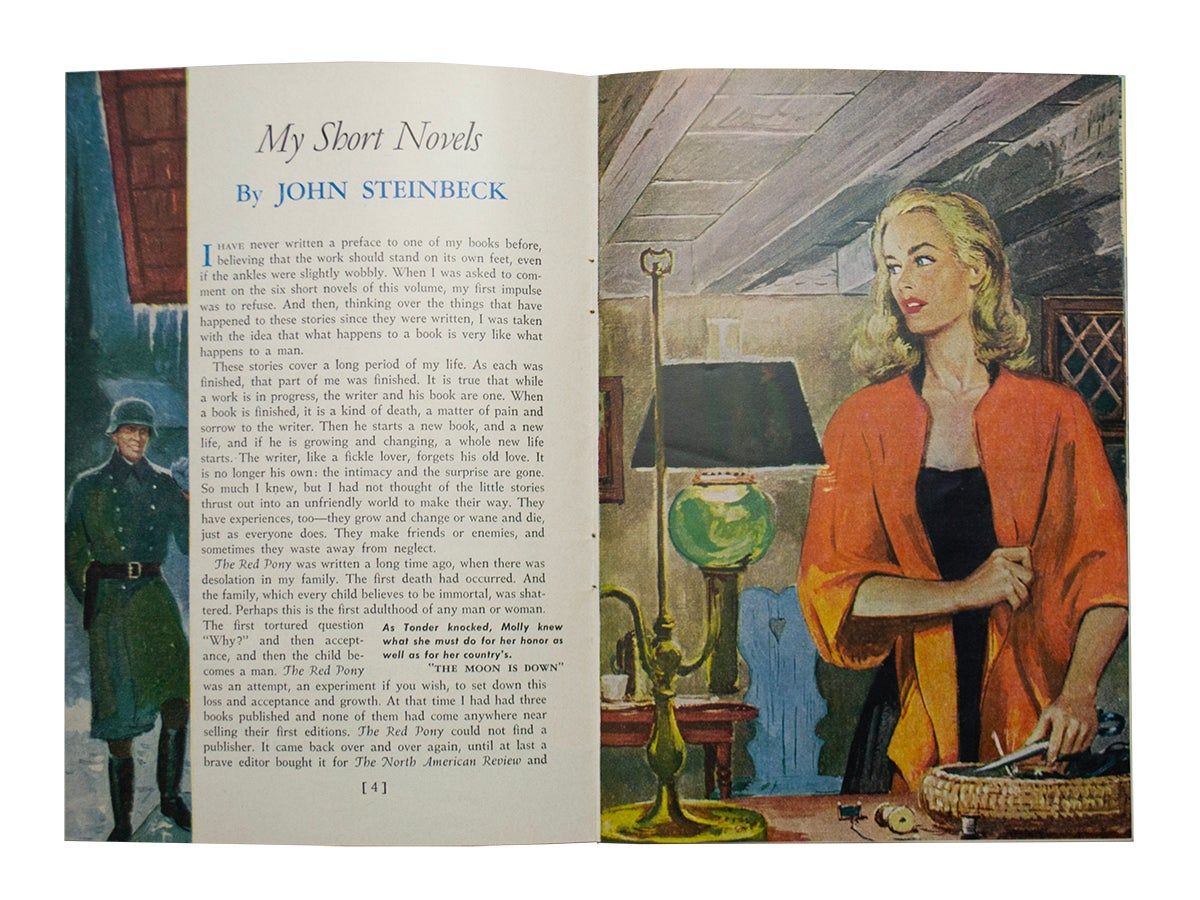
Manuscript draft in Steinbeck's hand for the essay entitled "My Short Novels, which served as a preface to the Literary Guild's 1953 edition of "The Short Novels of John Steinbeck." A near word for word representation of the essay which was originally published by The Literary Guild Review and found in their magazine "Wings" in October 1953 (Pages 4-8). This manuscript is exciting because it is an close representation but still a draft of what was finally printed. In comparing the two documents, you can see that the published piece was trimmed down a bit from what Steinbeck wrote in this manuscript draft. Many of the edits are eliminations of a few words here and there, but there are a few places where whole sentences and ideas have been cut. Most of these are some what self-deprecating, which is interesting to watch him ultimately play down. Apart from punctuation changes, the parts of this manuscript that are not found in the final publication have been indicated by us below by being housed within brackets.
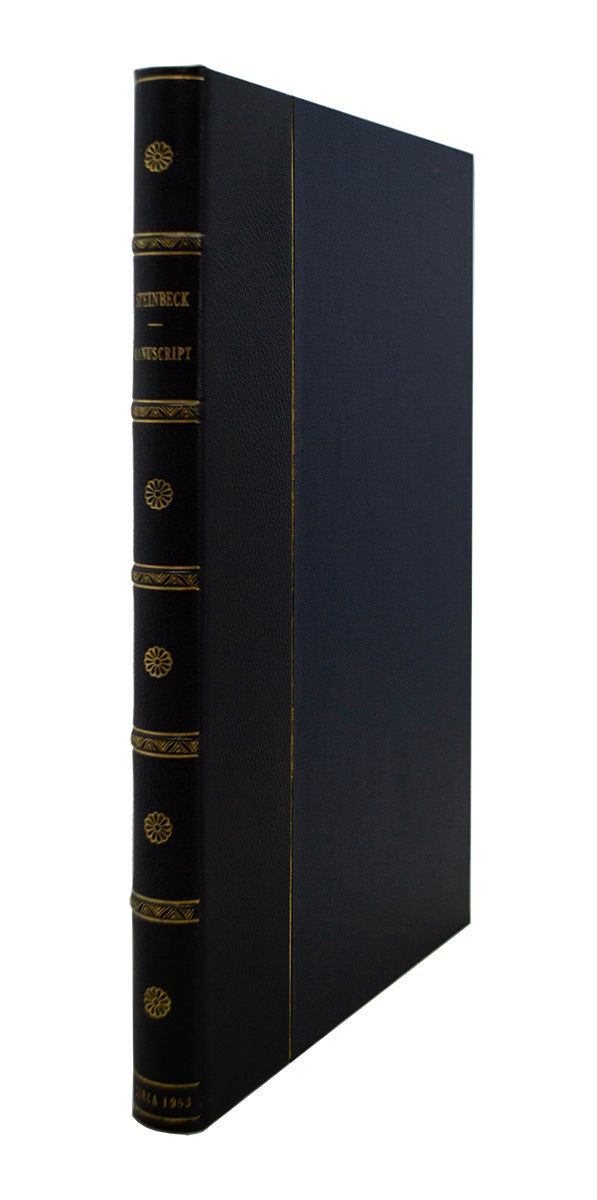
Four foolscap legal-sized pages (12 1/2 x 8 inches; 318 x 202 mm). Written in pencil on recto only of each page. With a few notes and corrections. Each page is approximately 28 lines long. Lacking a final leaf which would go on to discuss the final two stories. Some minor toning and a small bump to bottom left corner of all leaves. Still a near fine example of a wonderful Steinbeck manuscript. Housed in a blue quarter morocco clamshell. Another manuscript draft version of this essay was sold at auction in 2023 for 32,500 Euros and was also incomplete.
[Together with] A copy of the The Literary Guild Review Magazine "Wings" which includes the entire essay.
In the four present pages he discusses the origins of the stories The Red Pony, Tortilla Flat, Of Mice and Men, and The Moon is Down. The final page which is lacking goes on to discuss Cannery Row and The Pearl.
The Manuscript reads:
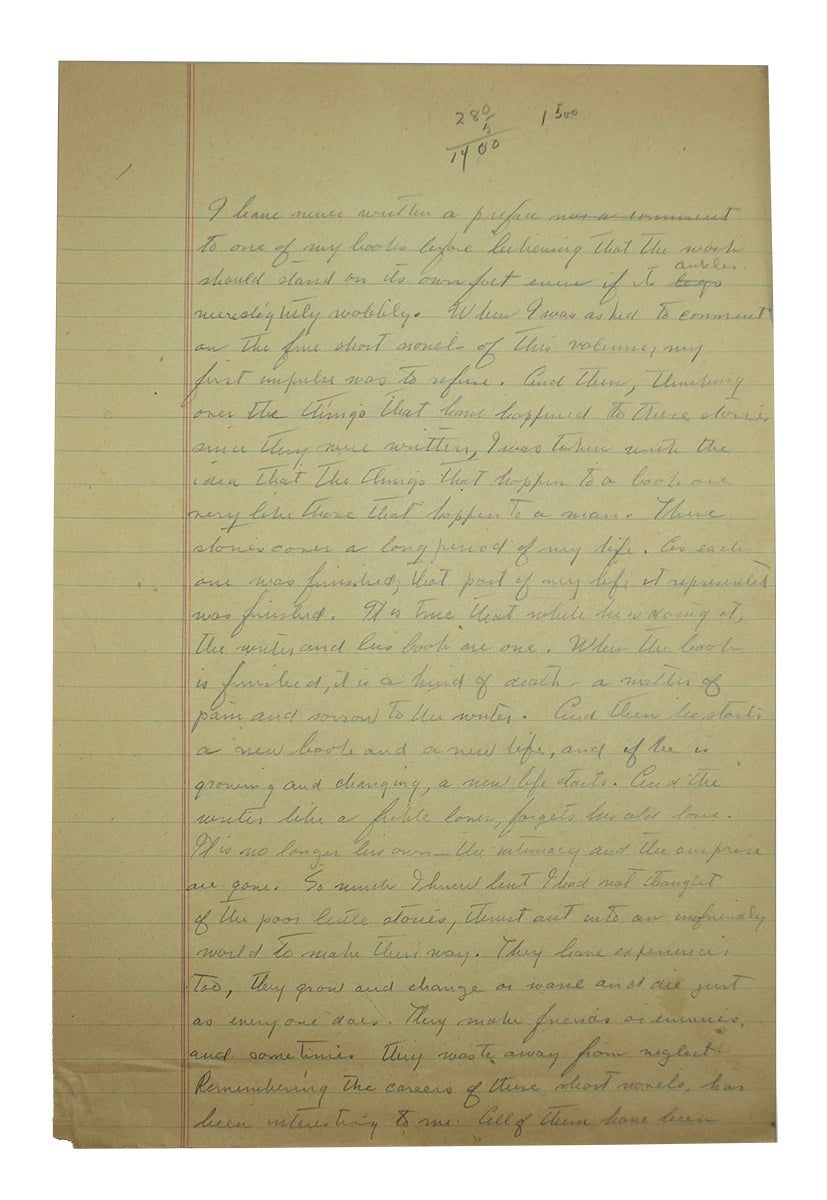
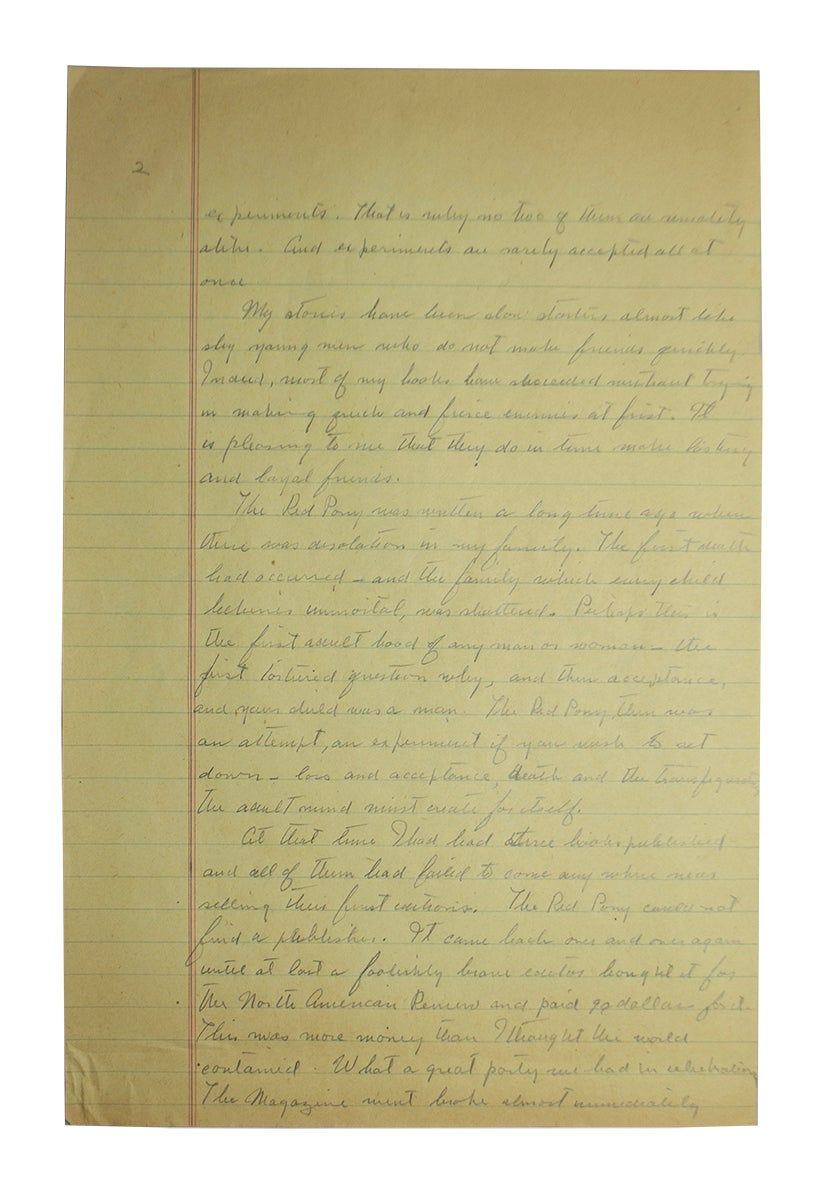
"I have never written a preface [nor a comment] to one of my books before believing that the work should stand on its own feet even if it's legs ankles were slightly wobbly. When I was asked to comment on the [five] short novels of this volume, my first impulse was to refuse. And then, thinking over the things that have happened to these stories since they were written, I was taken with the idea that [the things that] happen to a book are very like [those that happen] to a man. These stories cover a long period of my life. As each [one] was finished, that part of my life [it represented] was finished. It is true that while [he is doing it], the writer and his book are one. When the book is finished, it is a kind of death, a matter of pain and sorrow to the writer. [And] then he starts a new book and a new life, and if he is growing and changing, a new life starts. [And] the writer like a fickle lover, forgets his old love. It is no longer his own- the intimacy and the surprise are gone. So much I knew but I had not thought of the [poor] little stories, thrust out into an unfriendly world to make their way. They have experiences too, they grow and change or wane and die just as everyone does. They make friends or enemies, and sometimes they waste away from neglect. [Remembering the careers of these short novels, has been interesting to me. All of the have been experiments. That is why no two of them are remotely alike. And experiments are rarely accepted all at once.]
[My stories have been slow starters almost like shy young men who do not make friends quickly. Indeed most of my books have succeeded without trying in making quick and fierce enemies at first. It is pleasing to me that they do in time make lasting and loyal friends.]
The Red Pony was written a long time ago when there was desolation in my family. The first death had occurred- and the family which every child believes immortal, was shattered. Perhaps this is the first adulthood of any man or woman- the first tortured question why, and then acceptance and [your] child [was] a man. The Red Pony [then] was an attempt, an experiment if you [must] to set down loss and acceptance, [death a the transfiguration the adult mind must create for itself.]
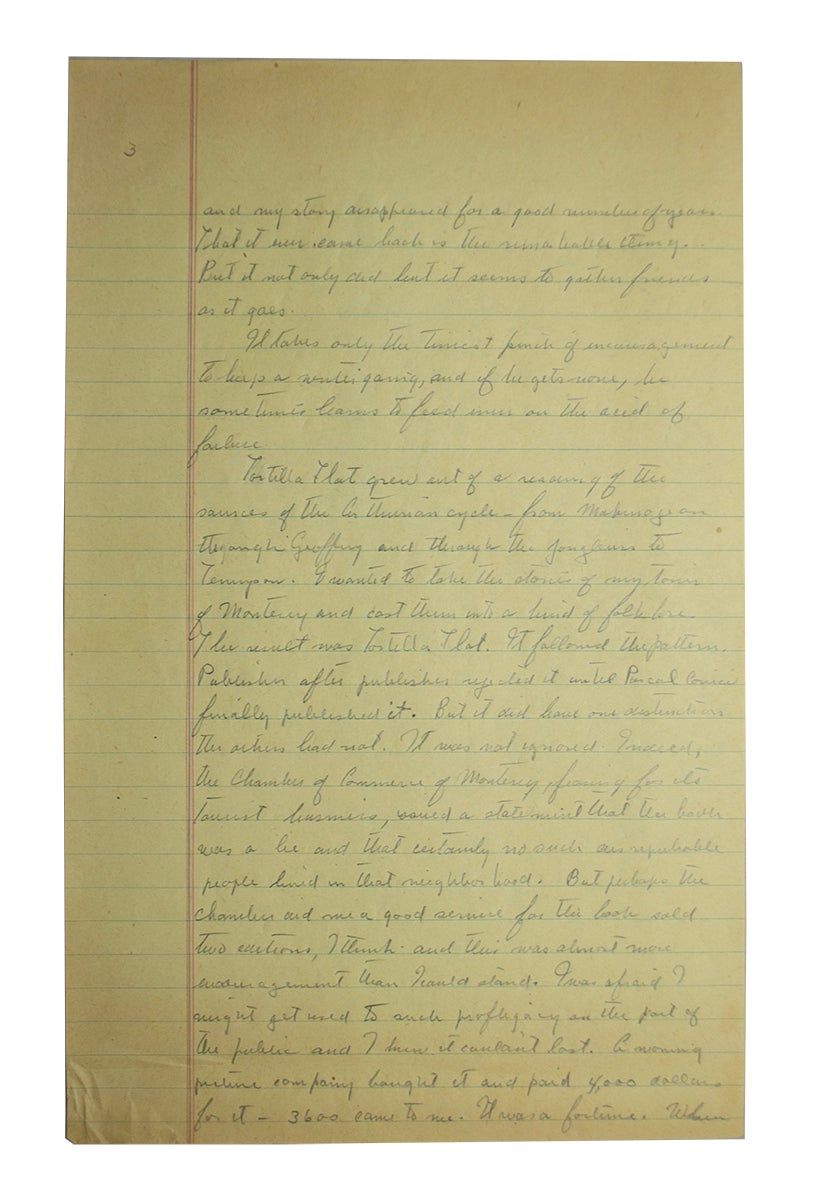
At that time I had had three books published and [all of them had failed to] come any where near selling their first editions. The Red Pony could not find a publisher. It came back over and over again until at last a [foolishly] brave editor bought it for The North American Review and paid 90 dollars for it. [This was] more money than I thought the world contained. What a great party we had in celebration. [The Magazine went broke almost immediately and my story disappeared for a good number of years. That it ever came back is the remarkable thing. But it not only did but it seems to gather friends as it goes.]
It takes only the tiniest pinch of encouragement to keep a writer going, and if he gets none, he sometimes learns to feed even on the acid of failure.
Tortilla Flat grew out [of a reading of the sources] of The Arthurian cycle- [from Mabinogion Through Geoffrey and through the ? to Tennyson.] I wanted to take the stories of my town of Monterey and cast them into a kind of folklore. The result was Tortilla Flat. It followed the pattern. Publisher after publisher rejected it until Pascal Covici finally published it. But it did have one distinction the others had not. It was not ignored. Indeed, the Chamber of Commerce of Monterey, fearing for its tourist business, issued a statement that the book was a lie and that certainly no such disreputable people lived in that neighborhood. But perhaps the chamber did me a good service for this book sold two editions, [I think] and this was almost more encouragement than I could stand. I was afraid I might get used to such profligacy on the part of the public and I knew it couldn't last. A moving picture company bought it and paid 4,000 dollars for it- 3600 came to me. It was a fortune. When a few years later, the company fired its editor, one of the reasons was that he had bought Tortilla Flat. He bought it [for the] from the company for the original 4000 and several years later sold it to MGM for 90,000 dollars, [a triumph for me albeit shallow] a kind of justification for me and a fortune for the editor.
Of Mice and Men was another [experiment- an] attempt to write a novel in three acts to be played from the lines. I had nearly finished it when my setter pup ate it one night- literally made confetti of it. [I had to start fresh.] I don't know how close the first and second versions would prove to be.
This book had some success but as usual it found its enemies. [It was called brutal, its characters sub humans, its story sadistic and one group found homosexuality in it which puzzled me quite a bit.] With rewriting however, it did become a play and had some success.
There were long books [written] between these little novel. I think the little ones were exercises for the long[er] ones. The war came on and I wrote The Moon is Down as a kind of celebration of the durability of democracy. I couldn't [have] conceived that it would be denounced [as almost treason.] I had written of Germans as men not super men and this was considered a very weak attitude to take. I couldn't make much sense out of this and it seems..."
HBS 69082.
$10,000.
Full Description:
STEINBECK, John. Manuscript draft for essay entitled "My Short Novels". [n.p.n.d ca: 1953].
Manuscript draft in Steinbeck's hand for the essay entitled "My Short Novels, which served as a preface to the Literary Guild's 1953 edition of "The Short Novels of John Steinbeck." A near word for word representation of the essay which was originally published by The Literary Guild Review and found in their magazine "Wings" in October 1953 (Pages 4-8). This manuscript is exciting because it is an close representation but still a draft of what was finally printed. In comparing the two documents, you can see that the published piece was trimmed down a bit from what Steinbeck wrote in this manuscript draft. Many of the edits are eliminations of a few words here and there, but there are a few places where whole sentences and ideas have been cut. Most of these are some what self-deprecating, which is interesting to watch him ultimately play down. Apart from punctuation changes, the parts of this manuscript that are not found in the final publication have been indicated by us below by being housed within brackets.
Four foolscap legal-sized pages (12 1/2 x 8 inches; 318 x 202 mm). Written in pencil on recto only of each page. With a few notes and corrections. Each page is approximately 28 lines long. Lacking a final leaf which would go on to discuss the final two stories. Some minor toning and a small bump to bottom left corner of all leaves. Still a near fine example of a wonderful Steinbeck manuscript. Housed in a blue quarter morocco clamshell. Another manuscript draft version of this essay was sold at auction in 2023 for 32,500 Euros and was also incomplete.
[Together with] A copy of the The Literary Guild Review Magazine "Wings" which includes the entire essay.
In the four present pages he discusses the origins of the stories The Red Pony, Tortilla Flat, Of Mice and Men, and The Moon is Down. The final page which is lacking goes on to discuss Cannery Row and The Pearl.
The Manuscript reads:
"I have never written a preface [nor a comment] to one of my books before believing that the work should stand on its own feet even if it's legs ankles were slightly wobbly. When I was asked to comment on the [five] short novels of this volume, my first impulse was to refuse. And then, thinking over the things that have happened to these stories since they were written, I was taken with the idea that [the things that] happen to a book are very like [those that happen] to a man. These stories cover a long period of my life. As each [one] was finished, that part of my life [it represented] was finished. It is true that while [he is doing it], the writer and his book are one. When the book is finished, it is a kind of death, a matter of pain and sorrow to the writer. [And] then he starts a new book and a new life, and if he is growing and changing, a new life starts. [And] the writer like a fickle lover, forgets his old love. It is no longer his own- the intimacy and the surprise are gone. So much I knew but I had not thought of the [poor] little stories, thrust out into an unfriendly world to make their way. They have experiences too, they grow and change or wane and die just as everyone does. They make friends or enemies, and sometimes they waste away from neglect. [Remembering the careers of these short novels, has been interesting to me. All of the have been experiments. That is why no two of them are remotely alike. And experiments are rarely accepted all at once.]
[My stories have been slow starters almost like shy young men who do not make friends quickly. Indeed most of my books have succeeded without trying in making quick and fierce enemies at first. It is pleasing to me that they do in time make lasting and loyal friends.]
The Red Pony was written a long time ago when there was desolation in my family. The first death had occurred- and the family which every child believes immortal, was shattered. Perhaps this is the first adulthood of any man or woman- the first tortured question why, and then acceptance and [your] child [was] a man. The Red Pony [then] was an attempt, an experiment if you [must] to set down loss and acceptance, [death a the transfiguration the adult mind must create for itself.]
At that time I had had three books published and [all of them had failed to] come any where near selling their first editions. The Red Pony could not find a publisher. It came back over and over again until at last a [foolishly] brave editor bought it for The North American Review and paid 90 dollars for it. [This was] more money than I thought the world contained. What a great party we had in celebration. [The Magazine went broke almost immediately and my story disappeared for a good number of years. That it ever came back is the remarkable thing. But it not only did but it seems to gather friends as it goes.]
It takes only the tiniest pinch of encouragement to keep a writer going, and if he gets none, he sometimes learns to feed even on the acid of failure.
Tortilla Flat grew out [of a reading of the sources] of The Arthurian cycle- [from Mabinogion Through Geoffrey and through the ? to Tennyson.] I wanted to take the stories of my town of Monterey and cast them into a kind of folklore. The result was Tortilla Flat. It followed the pattern. Publisher after publisher rejected it until Pascal Covici finally published it. But it did have one distinction the others had not. It was not ignored. Indeed, the Chamber of Commerce of Monterey, fearing for its tourist business, issued a statement that the book was a lie and that certainly no such disreputable people lived in that neighborhood. But perhaps the chamber did me a good service for this book sold two editions, [I think] and this was almost more encouragement than I could stand. I was afraid I might get used to such profligacy on the part of the public and I knew it couldn't last. A moving picture company bought it and paid 4,000 dollars for it- 3600 came to me. It was a fortune. When a few years later, the company fired its editor, one of the reasons was that he had bought Tortilla Flat. He bought it [for the] from the company for the original 4000 and several years later sold it to MGM for 90,000 dollars, [a triumph for me albeit shallow] a kind of justification for me and a fortune for the editor.
Of Mice and Men was another [experiment- an] attempt to write a novel in three acts to be played from the lines. I had nearly finished it when my setter pup ate it one night- literally made confetti of it. [I had to start fresh.] I don't know how close the first and second versions would prove to be.
This book had some success but as usual it found its enemies. [It was called brutal, its characters sub humans, its story sadistic and one group found homosexuality in it which puzzled me quite a bit.] With rewriting however, it did become a play and had some success.
There were long books [written] between these little novel. I think the little ones were exercises for the long[er] ones. The war came on and I wrote The Moon is Down as a kind of celebration of the durability of democracy. I couldn't [have] conceived that it would be denounced [as almost treason.] I had written of Germans as men not super men and this was considered a very weak attitude to take. I couldn't make much sense out of this and it seems..."
HBS 69082.
$10,000.
Details
Title
Manuscript draft for essay entitled "My Short Novels
Author
STEINBECK, John
Condition
Unknown
Publisher
n.p.
Date
1953