

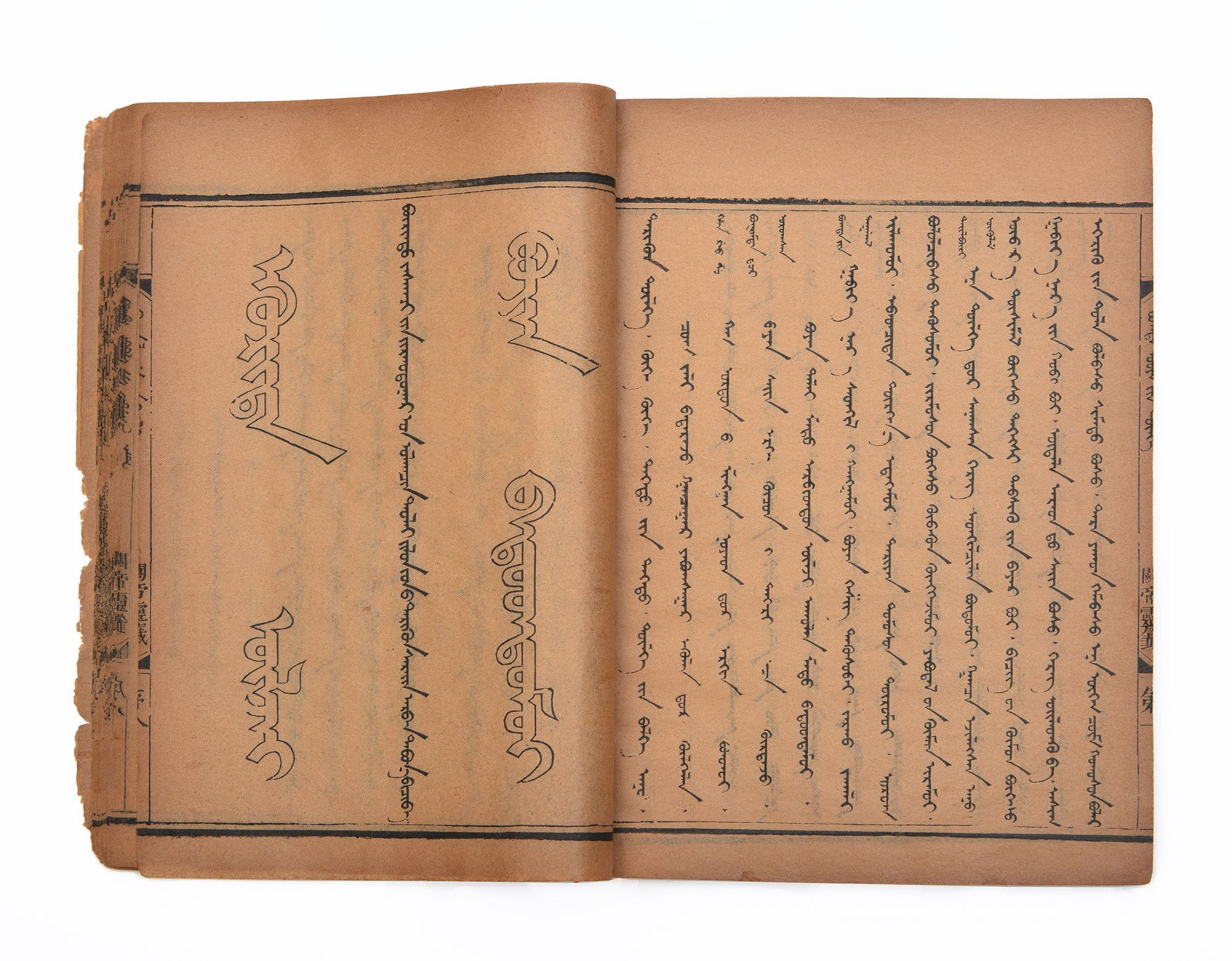
BOΓDA LOOYE-YIN SURΓAN [Teaching of the Holy Gentleman]; Ch. Guan sheng di jun jue shi zhen jing 關聖帝君覺世真經 [True Scripture Holy Lord Guan Enlightening the World] [or] Boγda looye tölge [Divination of the Holy Gentleman]; Ch. Guan di ling qian 關帝靈籤 [Divination of Lord Guan] (titles on page centerfolds)
- 1867
1867. 114 folding pages (many split along fore-edge). Large 4to (295 x 225 mm.), orig. wrappers (somewhat frail & frayed), orig. stitching. [China]: 1867 (date of Preface).
A Mongolian translation of a Chinese religious text dedicated to Guandi, or Lord Guan. "Guandi, Chinese god of war whose immense popularity with the common people rests on the firm belief that his control over evil spirits is so great that even actors who play his part in dramas share his power over demons. Guandi is not only a natural favourite of soldiers but has been chosen patron of numerous trades and professions. This is because Guan Yu, the mortal who became Guandi after death, is said by tradition to have been a peddler of bean curd early in life.
"Guan Yu lived during the chivalrous era of the Three Kingdoms (3rd century CE) and has been romanticized in popular lore...as a sort of Chinese Robin Hood. When a magistrate was about to carry off a young girl, Guan Yu came to her rescue and killed the man. Guan Yu, fleeing for his life, came upon a guarded barrier. Suddenly his face changed to a reddish hue, and Guan Yu was able to pass unrecognized...
"Guan Yu was captured and executed in 219 CE, but his fame continued to grow as rulers conferred successively greater titles upon him. Finally, in 1594, a Ming dynasty emperor canonized him as god of war - protector of China and of all its citizens. Thousands upon thousands of temples were constructed, each bearing the title Wu Miao (Warrior Temple) or Wu Sheng Miao (Sacred Warrior Temple). Many were built at government expense so that prescribed sacrifices could be offered on the 15th day of the second moon and on the 13th day of the fifth moon" (Britannica, online). Our book shows that the cult of Guandi spread to the Mongols.
The Preface is dated bürintü jasaγči-yin ǰirγuduγar on, or Tongzhi 6, i.e., 1867.
Very good copy. Very frail bamboo paper with some small tears but no loss of text.
A Mongolian translation of a Chinese religious text dedicated to Guandi, or Lord Guan. "Guandi, Chinese god of war whose immense popularity with the common people rests on the firm belief that his control over evil spirits is so great that even actors who play his part in dramas share his power over demons. Guandi is not only a natural favourite of soldiers but has been chosen patron of numerous trades and professions. This is because Guan Yu, the mortal who became Guandi after death, is said by tradition to have been a peddler of bean curd early in life.
"Guan Yu lived during the chivalrous era of the Three Kingdoms (3rd century CE) and has been romanticized in popular lore...as a sort of Chinese Robin Hood. When a magistrate was about to carry off a young girl, Guan Yu came to her rescue and killed the man. Guan Yu, fleeing for his life, came upon a guarded barrier. Suddenly his face changed to a reddish hue, and Guan Yu was able to pass unrecognized...
"Guan Yu was captured and executed in 219 CE, but his fame continued to grow as rulers conferred successively greater titles upon him. Finally, in 1594, a Ming dynasty emperor canonized him as god of war - protector of China and of all its citizens. Thousands upon thousands of temples were constructed, each bearing the title Wu Miao (Warrior Temple) or Wu Sheng Miao (Sacred Warrior Temple). Many were built at government expense so that prescribed sacrifices could be offered on the 15th day of the second moon and on the 13th day of the fifth moon" (Britannica, online). Our book shows that the cult of Guandi spread to the Mongols.
The Preface is dated bürintü jasaγči-yin ǰirγuduγar on, or Tongzhi 6, i.e., 1867.
Very good copy. Very frail bamboo paper with some small tears but no loss of text.
Details
Title
BOΓDA LOOYE-YIN SURΓAN [Teaching of the Holy Gentleman]; Ch. Guan sheng di jun jue shi zhen jing 關聖帝君覺世真經 [True Scripture Holy Lord Guan Enlightening the World] [or] Boγda looye tölge [Divination of the Holy Gentleman]; Ch. Guan di ling qian 關帝靈籤 [Divination of Lord Guan] (titles on page centerfolds)
Condition
Unknown
Date
1867