

As febres intermittentes e a hematuria: memoria sobre as febres palustres de Timor
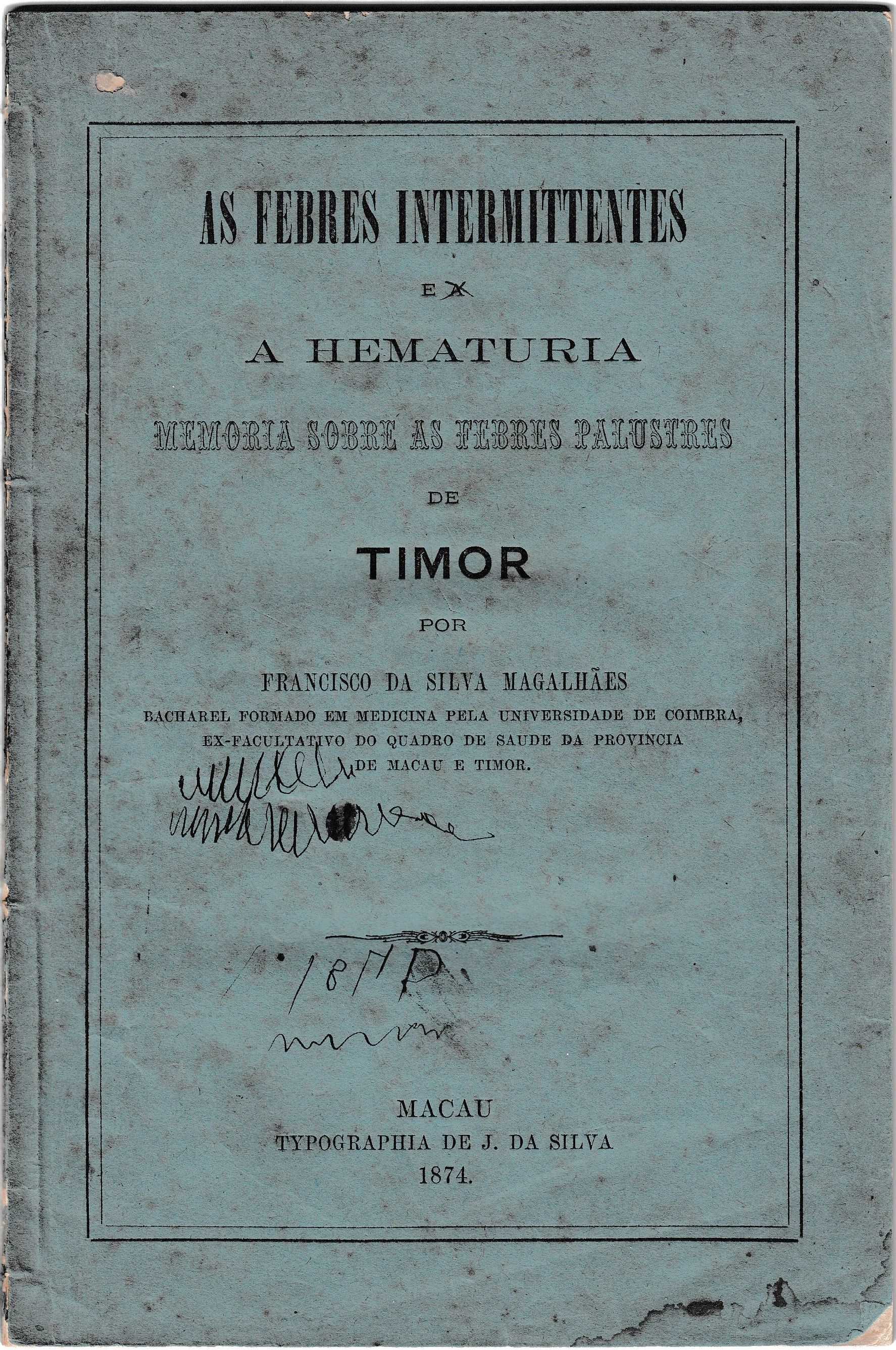
- Original printed publisher's wrappers.
- Macau: Typ. de J Da Silva, 1874
Macau: Typ. de J Da Silva, 1874. First (only) Edition.. Original printed publisher's wrappers.. Very good; some modest spotting and scribbling on the front wrapper; one small wear spot on the front wrapper.. 8vo, [4], [5] - 42, [2 - blank] pp.
Hematuria is a symptom of a diseased condition; it is blood in the urine. General acute fevers in tropical climates that were accompanied by this symptom (usually the result of an untreated infection by the plasmodium malaria parasite engorging the kidneys and producing a hemorrhage) were relegated to the general category of "intermittant fevers" or "swamp fevers" (here palustres). Prior to 1880, the date when Laveran first announced the discovery of the malaria parasite in Paris (publishing the result in 1881), no cause for the condition was known. Exiled to the wilderness of East Timor, Magalhães undertook a series of case studies (at the military hospital in Dili, the capital of East Timor, from 1869-1873) in an attempt to elucidate the cause(s) of what he identified as an "ailment" and to suggest remedies (it was, in a way, a similar action to that of Anton Chekov, who, two decades later in Siberia, on the island of Sakhalin, would carry out his studies of tuberculosis). Ameliorative at best, his work was careful and indicative of the general ignorance and limits of such a specialized field within tropical medicine of the day - there are citations to Rayer's notable atlas and work on the kidney and to Piorry. Malaria was no secret or rare ailment. Quinine was the generally available palliative - but no cure. One of the rare attempts at serious research in tropical medicine, in situ, prior to WWI. There is but one copy of the pamphlet located (Amsterdam).
Hematuria is a symptom of a diseased condition; it is blood in the urine. General acute fevers in tropical climates that were accompanied by this symptom (usually the result of an untreated infection by the plasmodium malaria parasite engorging the kidneys and producing a hemorrhage) were relegated to the general category of "intermittant fevers" or "swamp fevers" (here palustres). Prior to 1880, the date when Laveran first announced the discovery of the malaria parasite in Paris (publishing the result in 1881), no cause for the condition was known. Exiled to the wilderness of East Timor, Magalhães undertook a series of case studies (at the military hospital in Dili, the capital of East Timor, from 1869-1873) in an attempt to elucidate the cause(s) of what he identified as an "ailment" and to suggest remedies (it was, in a way, a similar action to that of Anton Chekov, who, two decades later in Siberia, on the island of Sakhalin, would carry out his studies of tuberculosis). Ameliorative at best, his work was careful and indicative of the general ignorance and limits of such a specialized field within tropical medicine of the day - there are citations to Rayer's notable atlas and work on the kidney and to Piorry. Malaria was no secret or rare ailment. Quinine was the generally available palliative - but no cure. One of the rare attempts at serious research in tropical medicine, in situ, prior to WWI. There is but one copy of the pamphlet located (Amsterdam).
Details
Title
As febres intermittentes e a hematuria: memoria sobre as febres palustres de Timor
Author
Magalhães, Francisco da Silva - AT THE EQUATOR
Binding
Original printed publisher's wrappers.
Condition
Very Good
Publisher
Typ. de J Da Silva: Macau
Date
1874
Edition
First (only) Edition.