

1867 – Letter from an early settler in Cimarron, New Mexico, informing a friend back home in Ohio, that a gold rush had begun in earnest and that he might mine a claim and marry one “of these Black Eyed Mexican galls”
- Envelope or Cover
- Cimarron, New Mexico Territory , 1867
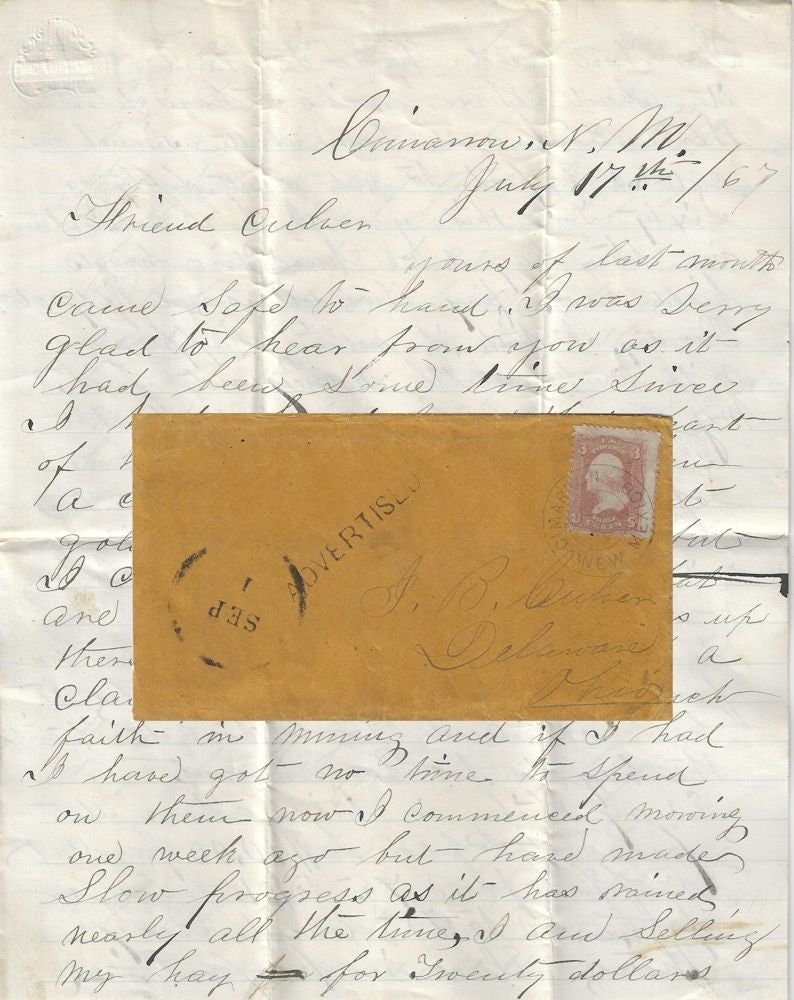
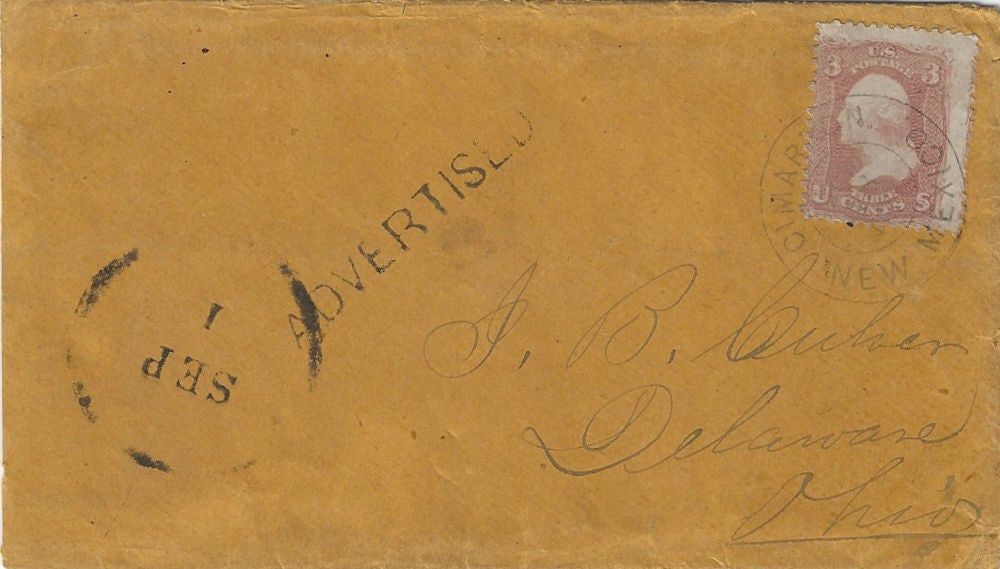
This three-page stampless letter was sent by A. J. Thomas, a hay farmer from Cimarron, New Mexico Territory, to J. B. Culver in Delaware, Ohio. It is franked with a 3-cent Washington stamp (Scott #65) tied to the envelope with a “Cimarron, New Mexico, Jul 18, 1867” postmark. It bears a straightline “ADVERTISED” hand stamp a circular handstamp that reads only “Sep 1” that were applied after the letter had sat unclaimed in the Delaware post office. In nice shape.
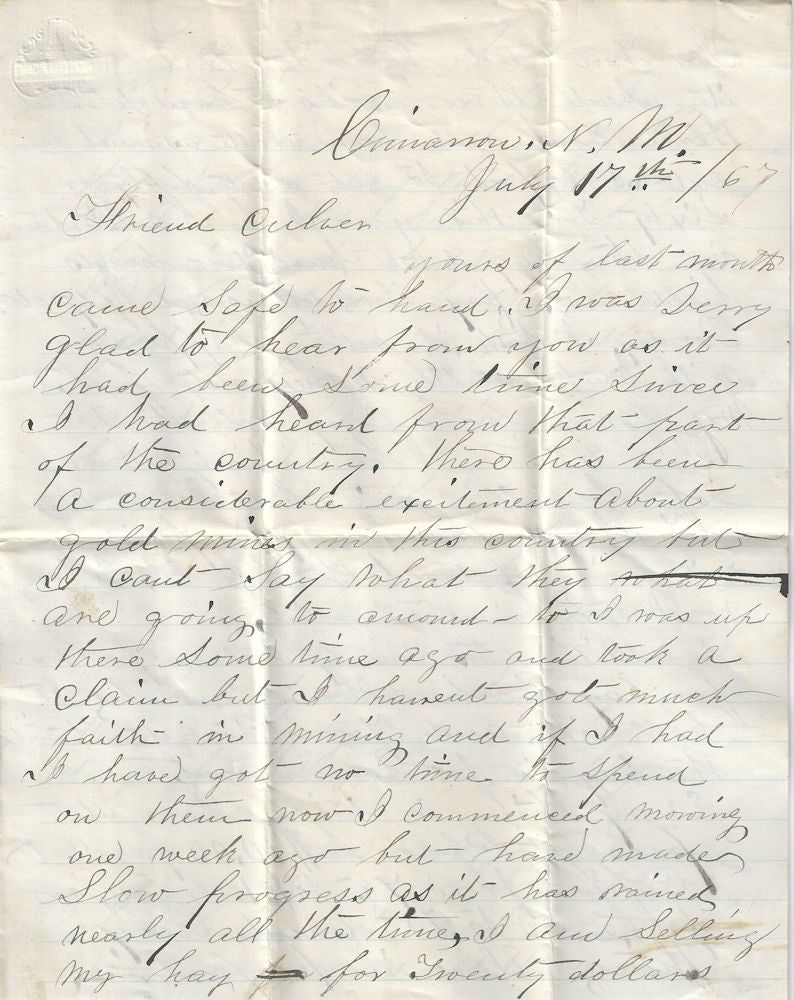
In the letter, Thomas discusses the gold boom that began in 1866.
“There has been a considerable excitement about gold mines in this country but I cant say what they are going to amount to. I was up there some time ago and took a claim but I havent got much faith in mining and if I had, I have got no time to spend on them now. I commenced mowing one week ago but make slow progress as it has rained nearly all the time. . .. I was talking some of coming to the States this fall but I don’t know whether I will get there or not. I may take a notion to get married to Some of these Black Eyed Mexican galls one of these days. . ..”
.Cimarron had long been a ranching community at edge of Sangre de Cristo Mountains along the Santa Fe Trail. In 1841, a fur trapper, Charles Beaubien, married a young Native American girl, opened a store in Taos, and became a Mexican citizen. Together with Guadalupe Miranda, a local businessman-politician, he petitioned Governor Manuel Armijo and received a 1.7 million acre land grant. A year later, Charles Lucien B. Maxwell, another fur trapper, married one of Beaubien’s daughters, Luz. After inheriting their share of the ranch, the Maxwells bought out Miranda’s interest as well as those of Luz’s sisters. The area American pioneers but remained quiet, except for Apache and Commanche raids. Settlement gradually increased until copper was discovered on Baldy Creek in 1866, after which Maxwell formed a company to extract the ore. Almost immediately, gold was found among the copper, and soon prospectors, saloons, brothels descended upon Cimarron, which became a wild and roaring boomtown. Several years later, Maxwell decided to sell his land grant only to find it enmeshed in legal entanglements which led directly to the vicious Colfax County Range War that lasted until 1877.
During most of the 19th century, mail was not routinely delivered by the post office. Rather, it was held for recipients to pick-up. If it was not, the postmaster would place an advertisement in the local newspaper and hold if for a little longer. If the recipient then picked up the mail, an additional fee, usually one cent, was charged. If it remained uncollected it was forwarded to the Dead Letter Office.
(For more information, see “Maxwell Land Grant – Largest Land Grant in US History” and “Cimarron, New Mexico – Wild & Bawdy Boomtown” both at the Legends of America website and Epting’s “The Letter Opener,” a 7 May 2023 blog entry at stamps.org,)
A scarce territorial letter documenting the beginning of the Cimarron Gold Rush. Nothing similar is for sale in the trade. The Rare Book Hub and ABPC show no auction records for similar items, however two companion covers from but without contents have been sold in the philatelic community. OCLC shows only one similar letter is held by an institution, the Huntington.
.Details
Title
1867 – Letter from an early settler in Cimarron, New Mexico, informing a friend back home in Ohio, that a gold rush had begun in earnest and that he might mine a claim and marry one “of these Black Eyed Mexican galls”
Author
A. J. Thomas
Binding
Envelope or Cover
Condition
Very Good
Publisher
Cimarron, New Mexico Territory
Date
1867