

The American Black Chamber
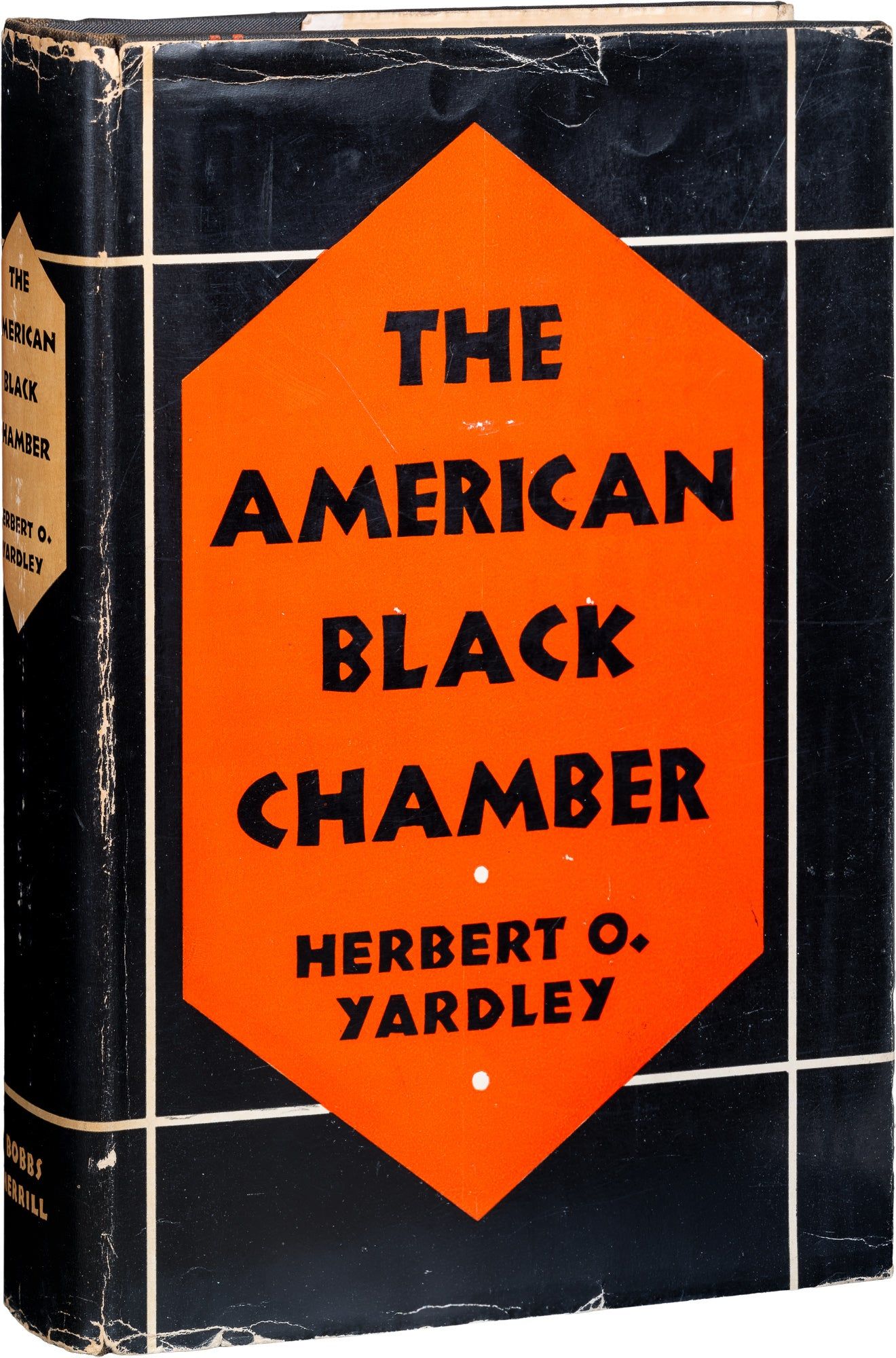
- Indianapolis: Bobbs-Merrill, 1931
Indianapolis: Bobbs-Merrill, 1931. First Edition. “1st edition” stated on the copyright page (the essential point) and reprints without “1st edition” stated are frequently offered as 1st editions. Former owner’s inscription to the endpaper, and a bookplate, else fine in a dustjacket, that is unclipped but with no printed price (as issued), the red on the spine faded to yellow, else very good, an agonizingly scarce 1st edition in a dustjacket. George Washington had his spies during the Revolution, among them Enoch Crosby. And Abraham Lincoln had his spies during the Civil War, led by Allan Pinkerton. But, in 1917, it was Herbert Yardley who showed President Wilson that American military codes were easy to break, and Wilson allowed him to build a modern organization of cryptographers and secret agents in New York, veiled and officially detached from the government, and to recruit 165 men and women to work it (mathematicians, crossword puzzle paladins, linguists, chess masters, archeologists, chemists, interpreters, etc.). The Navy called it MI–8. Yardley’s team called it The Black Chamber, and, beyond breaking codes, they captured foreign spies, dispatched pretty women to seduce the men of adversary governments out of their secrets, broke into safes, forged diplomatic seals, and their chemists made, among other things, invisible ink visible. In 1921 they broke the Japanese diplomatic code and read the dispatches sent to Japanese officials at the Naval Conference that settled fleet size after WWI. In the 1920s The Black Chamber reached its peak of skill, inventiveness, ingenuity, and success, but in 1929 Herbert Hoover’s Secretary of State (Henry Stimson) closed them down saying, “Gentlemen do not read each other’s mail” (what an idiot).
Yardley, out of a job and, because The Black Chamber was not official, he didn’t have a pension. He examined the laws surrounding state secrets and determined that he could write a book on code breaking generally, and could reference his bureau and their cases, and be pretty indiscrete about it, if he was careful about a few names and some specifics. This is his book. It caused 19 nations to change their codes. In 1933 Franklin Roosevelt became President and his Government wrote a new espionage act to prevent another book like this one, then resurrected the cypher bureau under William Friedman, and when the U. S. entered W. W. II, set them up at Arlington Hall. In a great success, Genevieve Grotjan cracked the Japanese military code. In a great failure the U. S. got manipulated by Russians imbedded in The Manhattan Project. But once the war was over, Friedman sliced up Soviet espionage in the cold war with Venona and Boris. In 1952 the bureau was folded into the N. S. A.
My wife told me that our phones were spying on us. “Nonsense” she said. She laughed. I laughed. Siri laughed. Alexa laughed.
Yardley, out of a job and, because The Black Chamber was not official, he didn’t have a pension. He examined the laws surrounding state secrets and determined that he could write a book on code breaking generally, and could reference his bureau and their cases, and be pretty indiscrete about it, if he was careful about a few names and some specifics. This is his book. It caused 19 nations to change their codes. In 1933 Franklin Roosevelt became President and his Government wrote a new espionage act to prevent another book like this one, then resurrected the cypher bureau under William Friedman, and when the U. S. entered W. W. II, set them up at Arlington Hall. In a great success, Genevieve Grotjan cracked the Japanese military code. In a great failure the U. S. got manipulated by Russians imbedded in The Manhattan Project. But once the war was over, Friedman sliced up Soviet espionage in the cold war with Venona and Boris. In 1952 the bureau was folded into the N. S. A.
My wife told me that our phones were spying on us. “Nonsense” she said. She laughed. I laughed. Siri laughed. Alexa laughed.
Details
Title
The American Black Chamber
Author
Yardley, Herbert
Condition
Unknown
Publisher
Bobbs-Merrill: Indianapolis
Date
1931
Edition
First Edition