

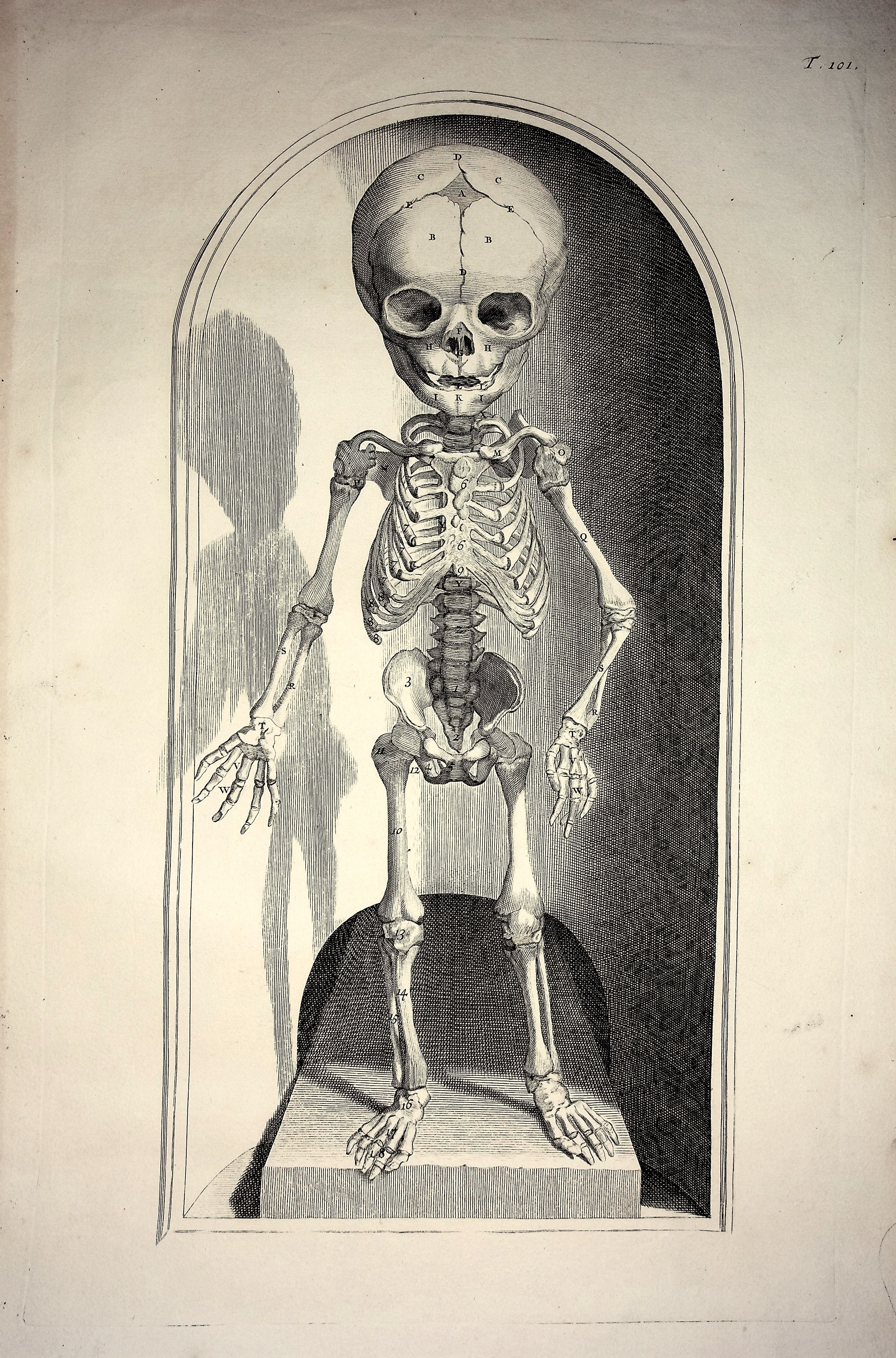
READY TO FRAME. Infant Skeleton - Plate 101 from Bidloo, Anatomia Humani Corpus
- Amsterdam: For the Widow of Joannes van Someren, the Heirs of Joannes va Dyk, Henry Boom and Widow of Theodore Boom, 1685
Amsterdam: For the Widow of Joannes van Someren, the Heirs of Joannes va Dyk, Henry Boom and Widow of Theodore Boom, 1685. First edition.
1685 DRAMATIC LARGE ENGRAVED PLATE FROM BIDLOO'S FAMOUS ATLAS: A LIFELIKE CHILD'S SKELETON.
Copperplate engraving, 33x50 cm folio, plate mark 27.5x44 cm on heavy laid paper. Browning to page edges, not affecting image. Very good. Originally published in 1685 (a later, Dutch edition, was published in 1690), Anatomia Humani Corporis features 105 copperplate engravings of the body, illustrating the muscular, skeletal, reproductive, and systemic organization of the human body with commentary. Bidloo's anatomical atlas is one of the largest atlases created in the early modern period. The drawings for the illustrations were designed by the Dutch artist Gerard de Lairesse, a close acquaintance of Bidloo's, and engraved by the brothers Peter and Philip van Gunst. A painter and writer on art theory, Lairesse was influenced by Rembrandt, who painted his portrait in 1665, and also by the French styles of Nicolas Poussin and Claude Lorrain. Considered as an artistic meditation on anatomy, Lairesse's designs are a total departure from the idealistic tradition inaugurated by the Vesalian woodcuts. They present the body not only in almost life size scale, but with the finely detailed accuracy that only a skilled artist could provide. The infant mortality rate in 1685 was about 30% of live births. Note the hesitant posture of the child's skeleton at the edge of a slab protruding from a shadowy arch below, and the shadow of the living child on the left side of the wall. He thus brought the qualities of Dutch still-life painting into anatomical illustration. Letters label the different bones that make up the skeleton, though the anatomist has decided to only provide labeling for the larger and more easily identifiable bones.
GOVARD BIDLOO (1649-1713) was born in Amsterdam, in 1649. He earned his medical degree at Franeker Unviersity in 1682. During his years in Amsterdam, Bidloo was heavily involved in the theatre community through the writing and translation of many plays. It is here that Bidloo became acquainted with the artist, Gerard de Lairesse. Bidloo was appointed Professor of Anatomy at the Hague, which he held between the years of 1688 and 1694.
GERARD DE LARAISSE (1641 – 1711) was a Dutch Golden Age painter and art theorist. His importance grew in the period following the death of Rembrandt, and his baroque style made him one of the most popular painters in Amsterdam at that time. For him theory meant the strict adherence to rules. The ultimate purpose of the visual arts was the improvement of mankind, and therefore art must, above all, be lofty and edifying. He maintained that "a good painting has a clue, indicating what holds the composition together."
GARRISON-MORTON No. 385 "Lairesse displayed his figures with everyday realism and sensuality, setting objects such as a book, a jar, a crawling fly in the same space as a dissected limb or torso. He thus brought the qualities of Dutch still-life painting into anatomical illustration, De Lairesse's images of dissected pregnancies and premature infants also reflect compassion—a quality unusual in art that was intended primarily to be scientific."
THIS PLATE IS PICTURED in Rifkin BA, Ackerman MJ: Human Anatomy From the Renaissance to the Digital Age, p 135. New York, Abrams, 2006.
Details
Title
READY TO FRAME. Infant Skeleton - Plate 101 from Bidloo, Anatomia Humani Corpus
Author
Bidloo, Govard
Condition
Unknown
Publisher
For the Widow of Joannes van Someren, the Heirs of Joannes va Dyk, Henry Boom and Widow of Theodore Boom: Amsterdam
Date
1685
Edition
First edition