

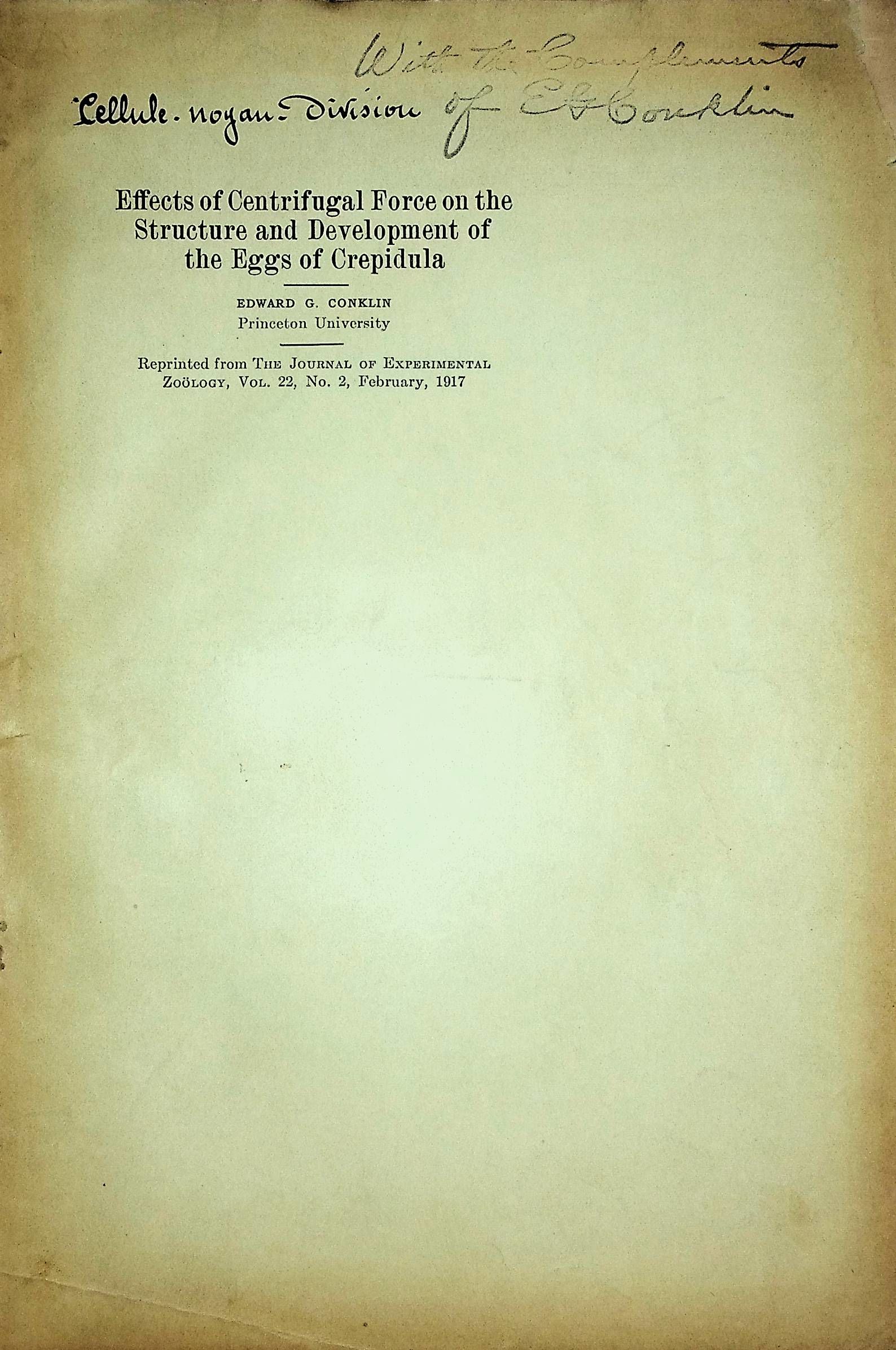
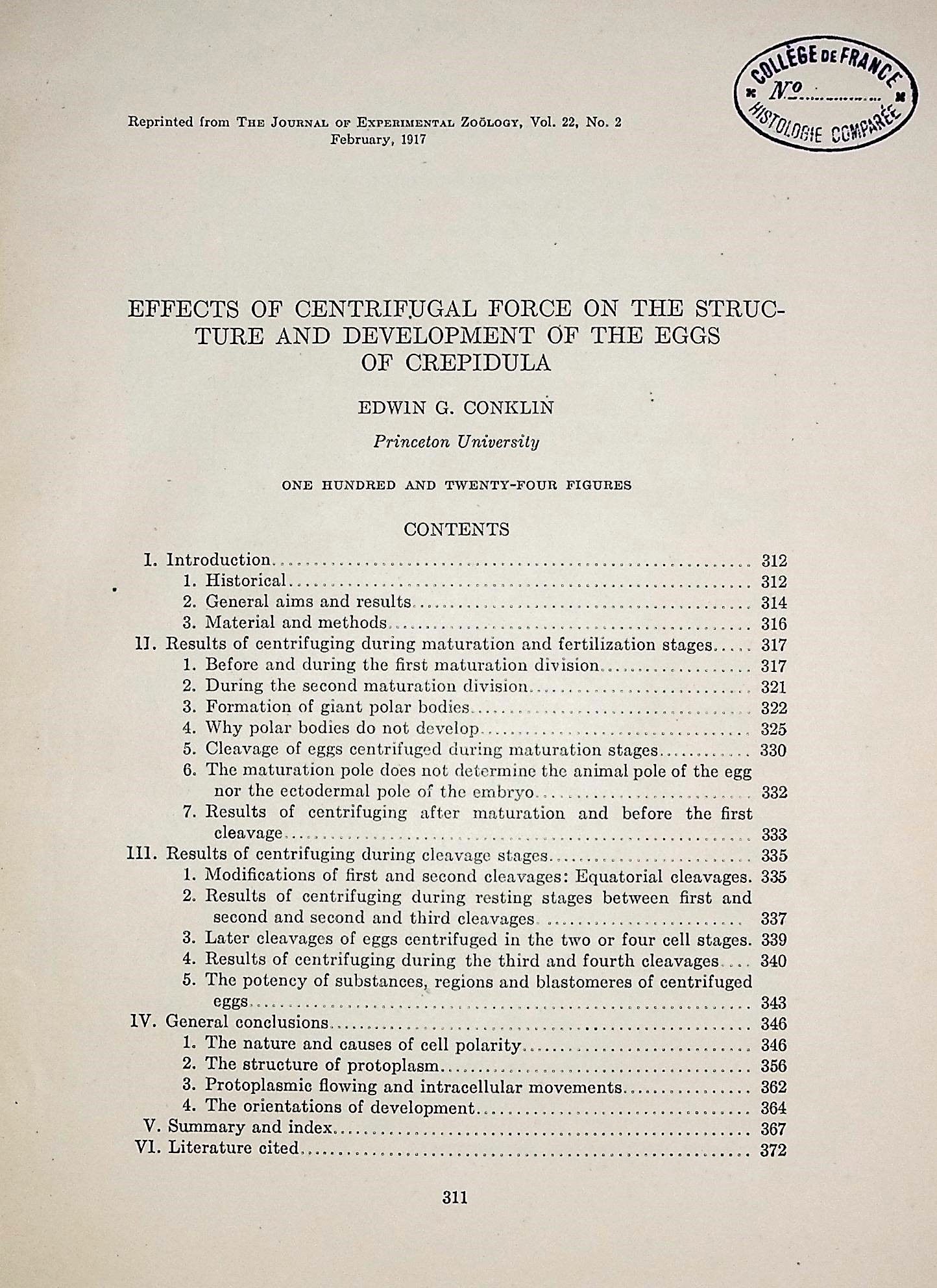
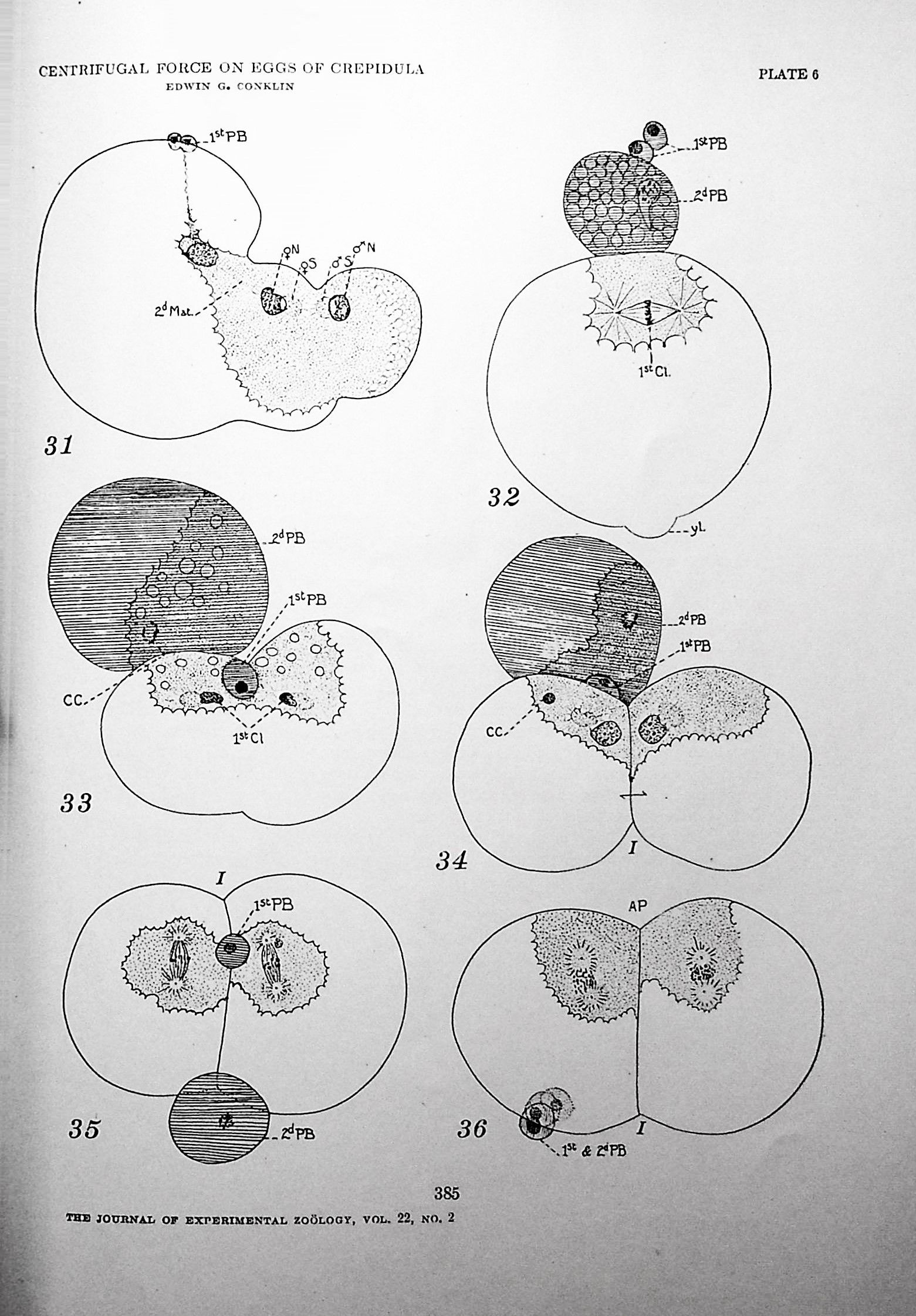
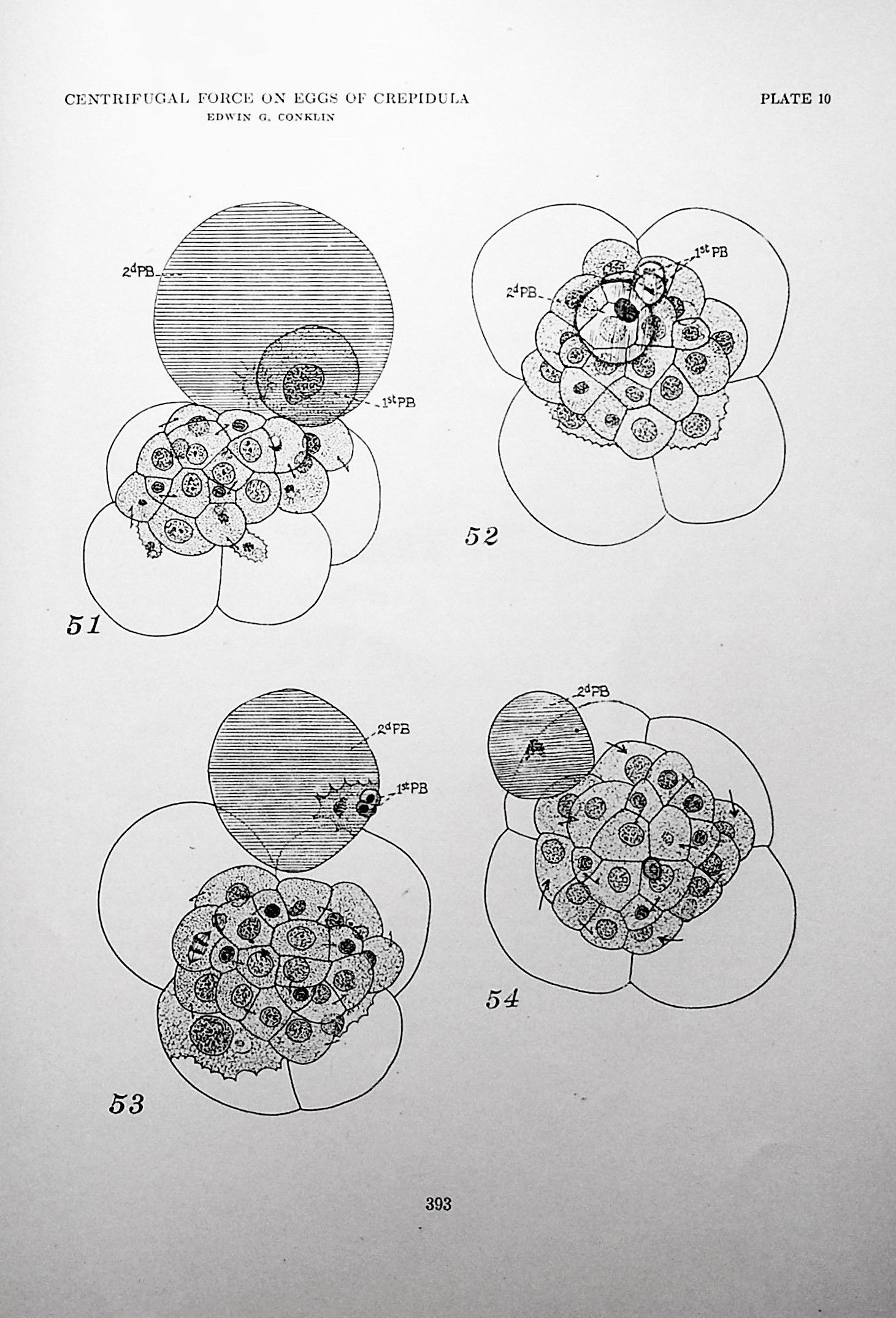
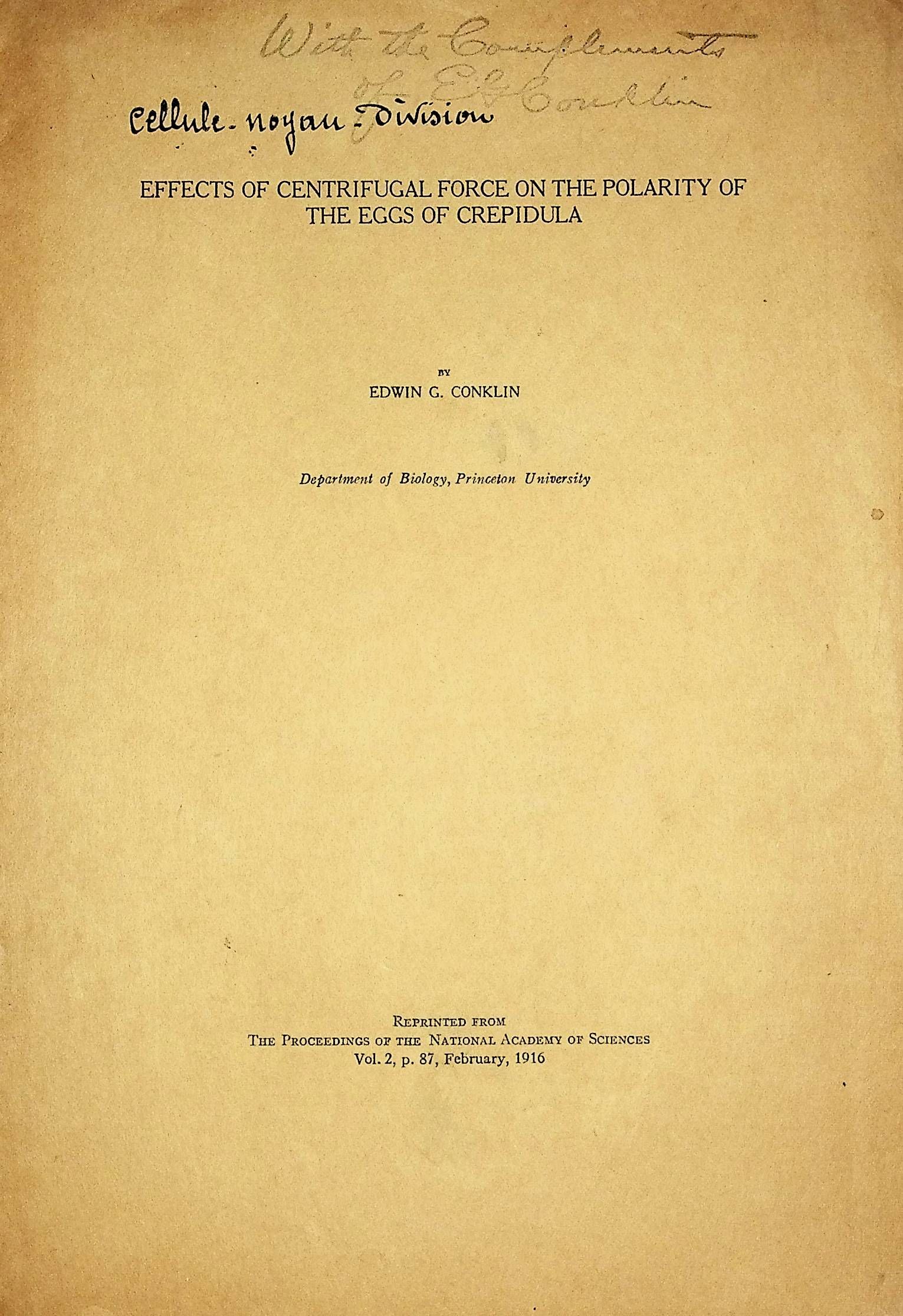
1. Effects of centrifugal force on the structure and development of Crepidula. Journal of Experimental Zoology Vol. 22 (2), pp 311-419, 23 plates, Feb 1917, TOGETHER WITH 2. Effects of centrifugal force on the polarity of the egg of Crepidula. Proceedings of the National Academy of Sciences Vol. 2 p 87, Feb 1916
- Printed paper covers
- 1916, 1917
LANDMARK STUDIES REVEALING ROLE OF PHYSICAL FACTORS IN EMBRYONIC PATTERNING.
Two 17.5x25 cm offprints in brown printed wraps, handstamp "With the Compliments of EG Conklin" to covers, handstamp of College de France Histologie Comparee to title pages. 1) 4pp with references by CM Child, EG Conklin, FR Lillie, and TH Morgan; 2) 60 pp, 23 plates with facing descriptive text. Browning to both offprints, covers and spine of 2nd offprint chipped: contents of both very good in mylar sleeve. Conklin's studies set the stage for a century of exploration of epigenetic mechanisms governing embryogenesis. A current publication reveals the cellular Spindle reorientation in response to mechanical stress is an emergent property of the spindle positioning mechanisms. Cited in: Kelkar M, et al., Proc Natl Acad Sci U S A. 2022 Jun 28;119(26):e2121868119. doi: 10.1073/pnas.2121868119. Epub 2022 Jun 21. This paper concludes, "spindle rotation in response to mechanical stress is an emergent phenomenon arising from the interaction between the spindle positioning machinery and the cell cortex. … Our study indicates that despite their transient nature, these stresses may be sufficient to reorient the axis of division of metaphase cells. Such a phenomenon may allow the tissue to optimize its organization to reduce stress in the direction of extension."
EDWIN G. CONKLIN (1863 – 1952) carried out meticulous studies of cell lineage in marine organisms, including the slipper snail Crepidula. Much of that work took place at the Marine Biological Laboratory, where Conklin played important leadership roles and gained life-long friendships and collaborations. He was educated at Ohio Wesleyan University and Johns Hopkins University. He was professor of biology at Ohio Wesleyan (1891–94) and professor of zoology at Northwestern University (1894–96), the University of Pennsylvania (1896-1908), and Princeton University (1908-1935). He became coeditor of the Journal of Morphology, The Biological Bulletin, and the Journal of Experimental Zoology. In 1897, he was elected to the American Philosophical Society, and to the United States National Academy of Sciences in 1908. He was president of the American Society of Naturalists in 1912, became a member of the American Academy of Arts and Sciences in 1914, and was president of the American Association for the Advancement of Science in 1936. He was elected a Fellow of the American Academy of Arts and Sciences in 1914. He also served on the board of trustees for Science Service, now known as Society for Science and the Public, from 1937 to 1952. In 1943, Conklin was awarded the John J. Carty Award from the National Academy of Sciences. In 1995, the Society for Developmental Biology inaugurated the Edwin Grant Conklin Medal in his honor.
Details
Title
1. Effects of centrifugal force on the structure and development of Crepidula. Journal of Experimental Zoology Vol. 22 (2), pp 311-419, 23 plates, Feb 1917, TOGETHER WITH 2. Effects of centrifugal force on the polarity of the egg of Crepidula. Proceedings of the National Academy of Sciences Vol. 2 p 87, Feb 1916
Author
Conklin, Edwin G.
Binding
Printed paper covers
Condition
Unknown
Date
1916, 1917
Edition
First edition