

[BLINDNESS / LITERATURE]. [EXTREMELY EARLY SIGNED HELEN KELLER AUTOGRAPH LETTER, WRITTEN TO HER MOTHER]. "helen will write mother letter / papa did give helen medicine" [...]
![[BLINDNESS / LITERATURE]. [EXTREMELY EARLY SIGNED](https://d3525k1ryd2155.cloudfront.net/h/191/188/1653188191.0.x.0.jpg)
- [Huntsville, Alabama] , 1887
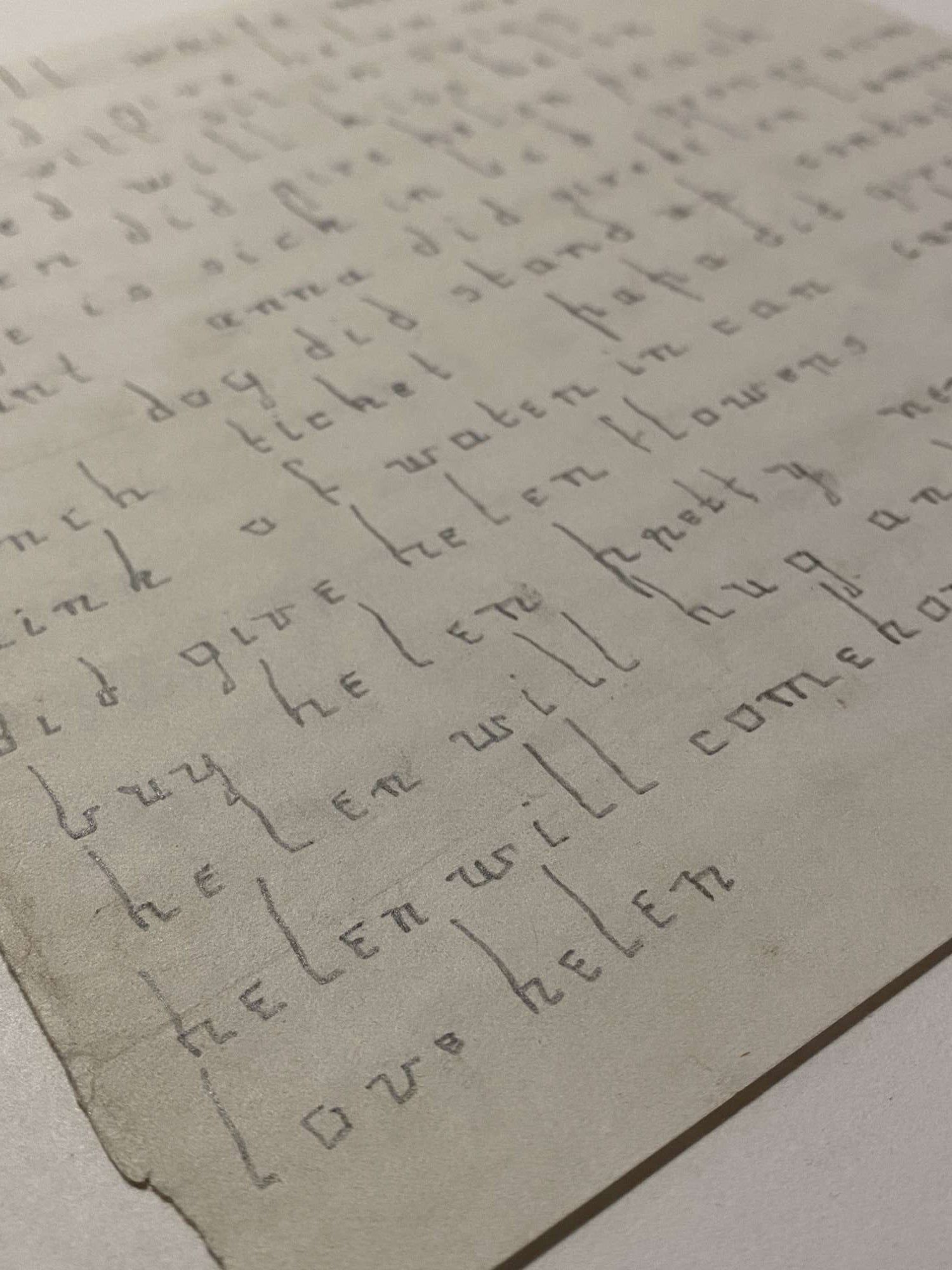
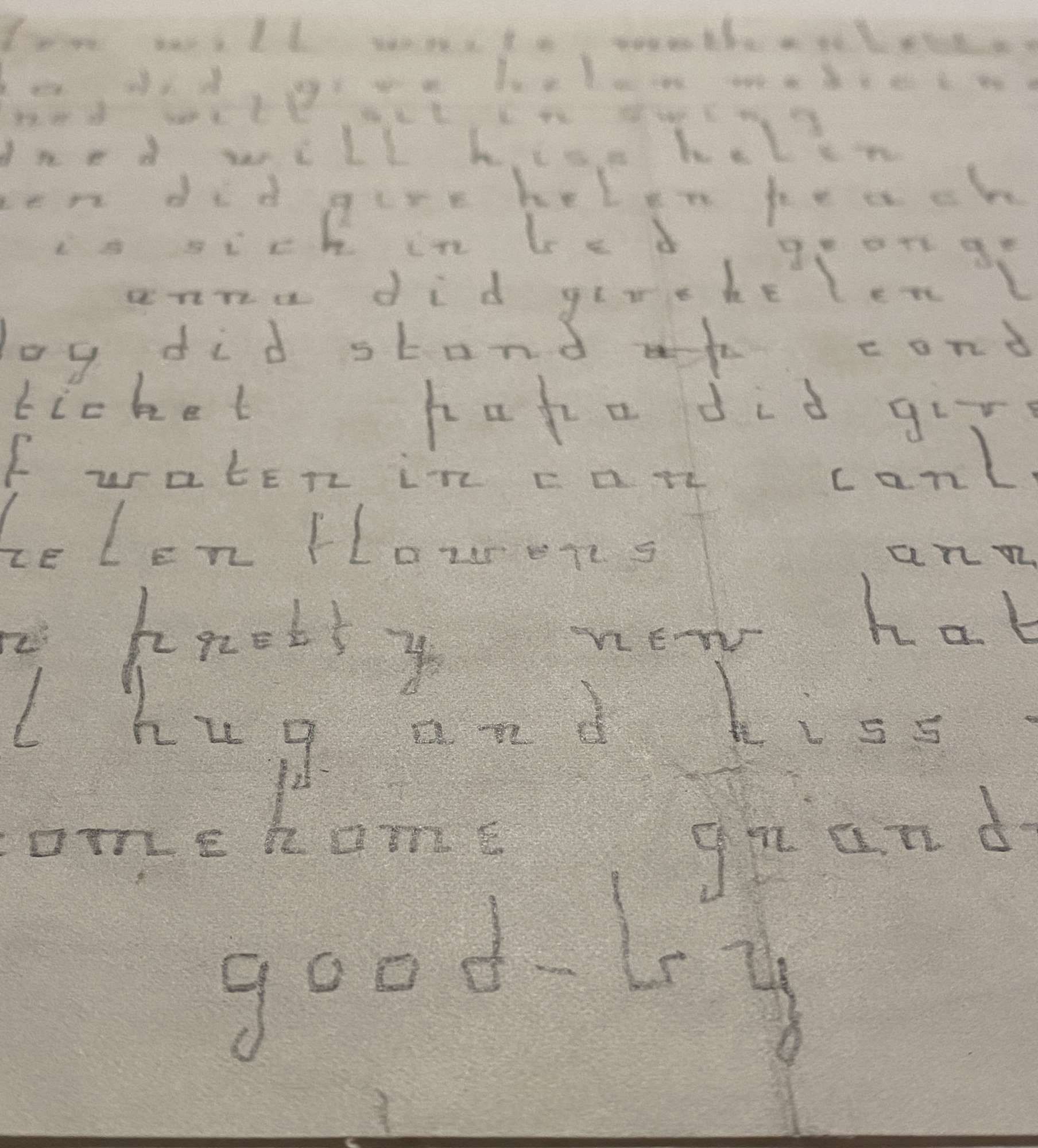
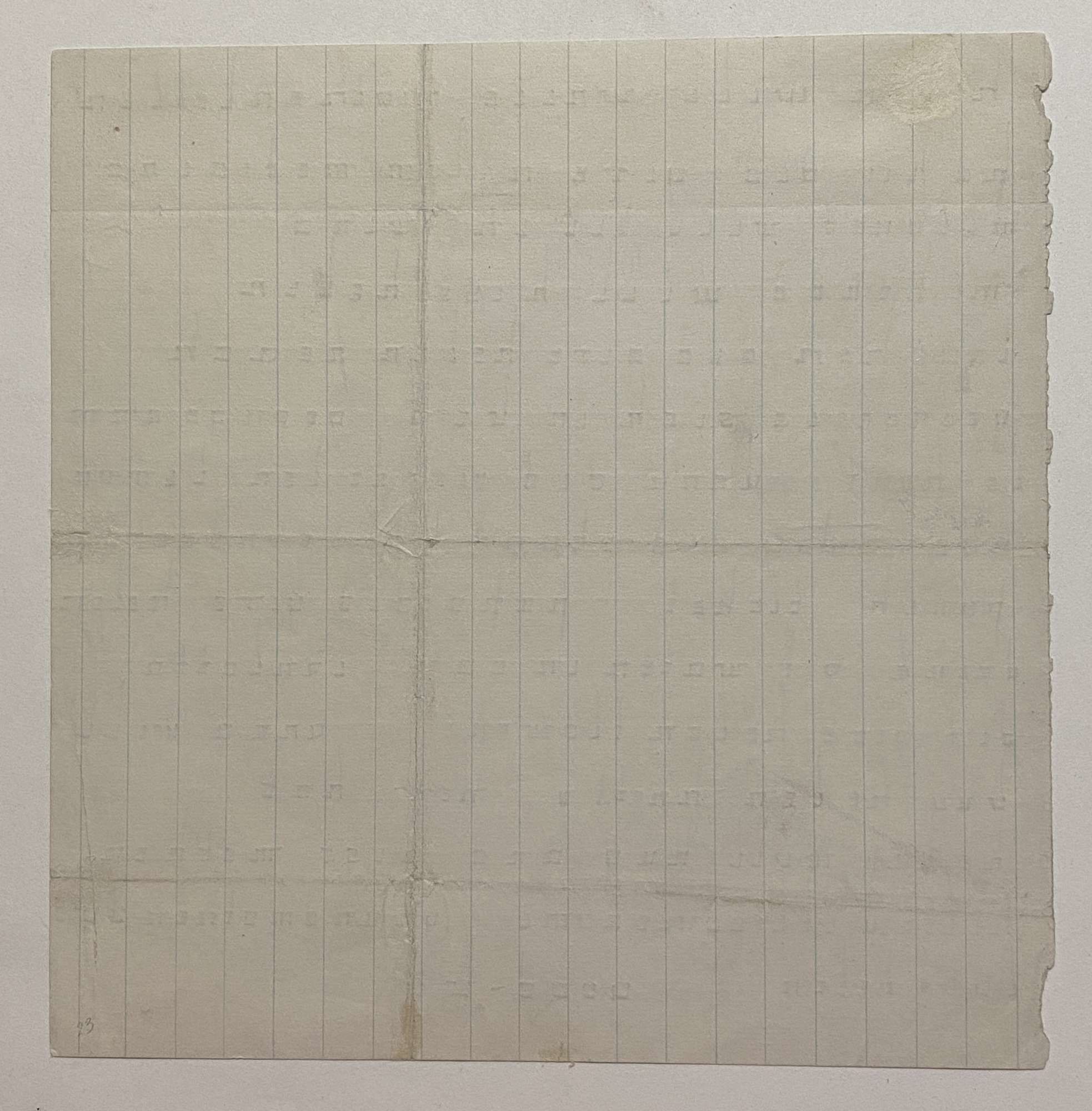
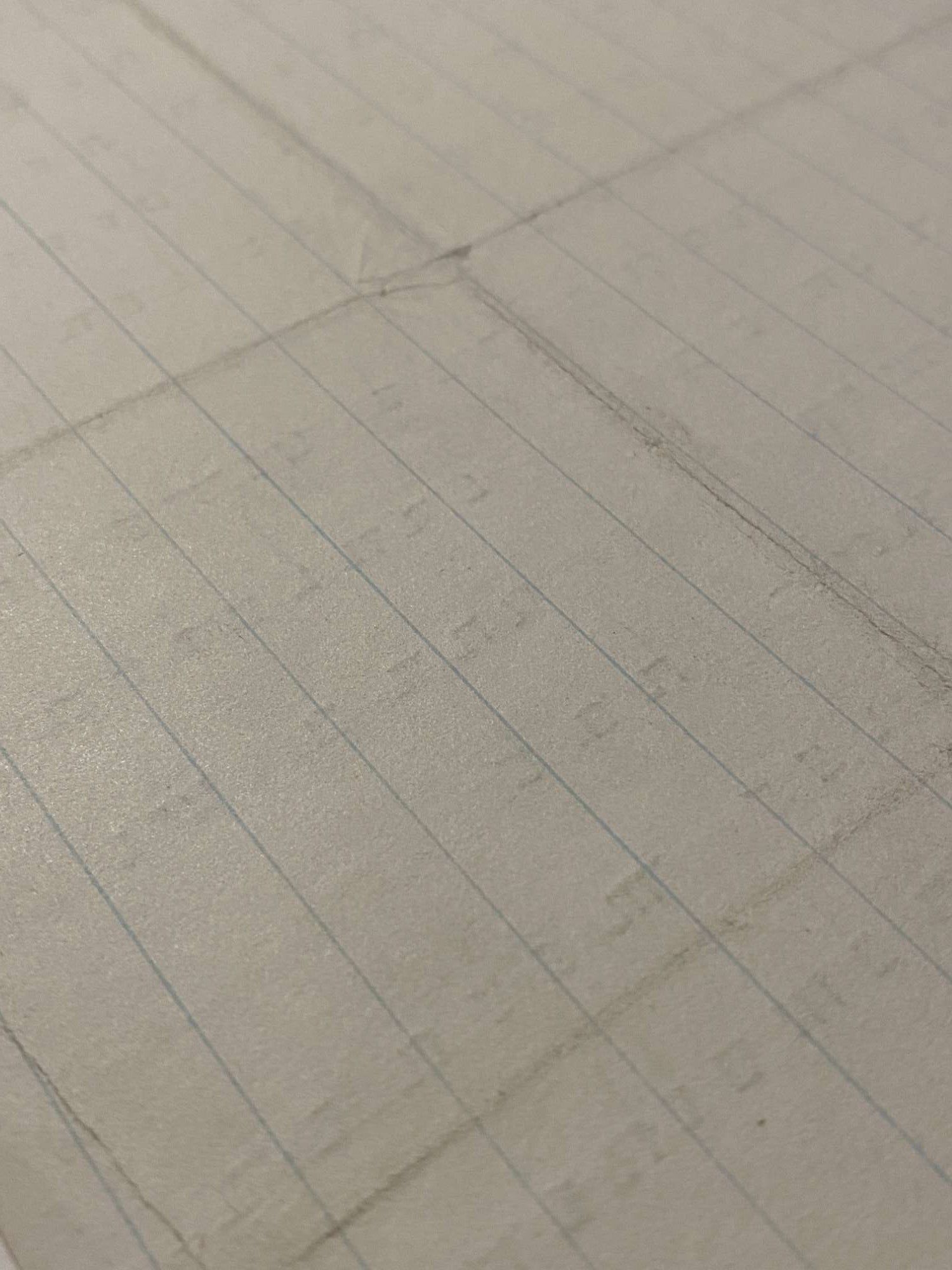
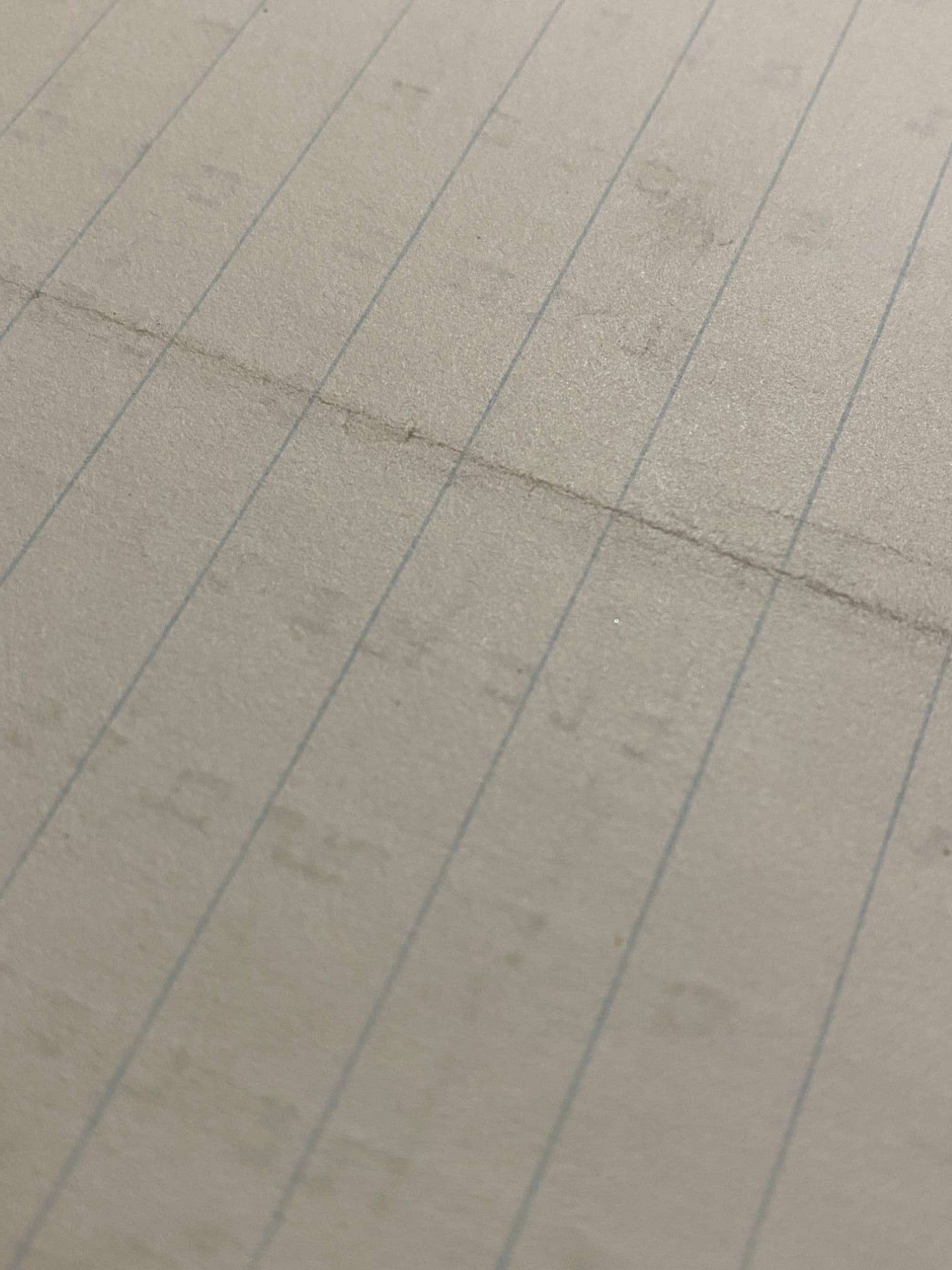
[Huntsville, Alabama], 1887. Very good. Square 8vo. (205 x 200 mm; 8 1/8" x 7 7/8"), 1 p. written "square-hand" in pencil on the lower portion of a blank side of a ruled sheet of notebook paper; the sheet was cleanly torn in half and rotated 90 degrees counterclockwise so that the ruled lines on the verso are vertical. Evidence of four folds, a few short repaired tears on verso including a 6 mm long hole affecting the letter "l" in "helen." Overall in excellent condition. OF STAGGERING PROFUNDITY. THIS IS THE EARLIEST HELEN KELLER LETTER THAT HAS EVER BEEN OFFERED FOR PUBLIC SALE, AND HAS AN IMPECCABLE, UNBROKEN PROVENANCE FOR THE LAST 77 YEARS - AT LEAST.
WRITTEN TO HER MOTHER ON AUGUST 12, 1887, THIS ALS WAS DESCRIBED BY ANNE SULLIVAN AS BEING KELLER'S SECOND HANDWRITTEN LETTER, THE FIRST HAVING BEEN WRITTEN TO ONE OF HER COUSINS ON JULY 17 OF THAT YEAR.
Our manuscript dates from the earliest moments of Keller's astonishing, exponential intellectual growth out of a seemingly impossible void, a world of darkness, silence, and terrible isolation, only to become the most important activist for disabled people worldwide. Trapped in an existential solitary confinement for six years, this precious relic reflects only the second tangible expression of the beginning of her freedom and her communication with the "outside" world. It is the bi-product of a courageous, tenacious girl and an equally courageous and tenacious young woman, Anne Sullivan, whom Keller would later describe as "my guardian angel" (see below).
THE BEGINNING OF A LIFE IN LETTERS: This inauspicious, crudely-formed little ALS is tantamount to a tiny herald for the publication of 14 books, over 475 speeches and essays, and thousands of letters. Even as a seven-year-old, the more she grew to understand the injustices of the world the more she railed against them, and this she did for the rest of her long life. She wrote on topics such as blindness prevention, overpopulation, the rise of fascism in Europe, the Holocaust, poverty, the lack of higher education for women, socialism, pacifism, and atomic energy. But hers was not a morose world; it was a world of faith, a world in which it was the moral duty of thinking, feeling people to act for public good. The world of letters became her world, and to do so more effectively she learned Latin, German, French, and even Greek. Furthermore, she wrote one of the most inspirational autobiographies ever published, "The Story of My Life" (1902), which became an international bestseller (translated into 50 languages) and is still in print to this day. Indeed, the royalties of all her writings continue to provide very substantial support for charitable institutions that provide services for the blind and visually impaired.
In adulthood Keller always considered herself as a writer first and foremost (indeed, on her passport she listed her profession as "author"), and she wrote countless letters to supporters of her causes (see below), to admirers across the globe, to politicians, and to activists. From an early age, she championed the rights of the underprivileged and the oppressed, and used her writing skills to speak truth to power. A pacifist, she protested U.S. involvement in World War I. A committed socialist, she took up the cause of workers' rights. She was also a tireless advocate for women's suffrage and an early American Civil Liberties Union member.
Anne Sullivan (herself a graduate of the Perkins School for the Blind) arrived at the Keller home in Tuscumbia, Alabama on March 3, 1887 to try to be a "governess" to a wild, thrashing girl who was not only blind but deaf. Through Sullivan's now-legendary care and teaching, Keller was able to write by hand her FIRST LETTER only fifteen weeks later, on July 17th. This letter, now in the permanent collection of the Perkins School for the Blind, was addressed to her cousin Anna (Mrs. George T. Turner):
helen write anna
george will give
helen apple
simpson will shoot
bird jack will give
helen stick of candy
doctor will give mil-
dred medicine mother
will make mildred
new dress
[unsigned]
Less than a month later, while she was visiting a relative in Huntsville, AL, Keller wrote THIS SECOND LETTER, addressed to her mother Mrs. Kate Adams Keller. It is datable to August 12, 1887 according to Anne Sullivan (see below):
helen will write mother letter
papa did give helen medicine
mildred will sit in swing
mildred will kiss helen
teacher did give helen peach
george is sick in bed george arm
is hurt anna did give helen lemon
ade dog did stand up conductor
punch ticket papa did give helen
drink of water in car [can?] carlotta
did give helen flowers anna will
buy helen pretty new hat
helen will hug and kiss mother
helen will come home grandmother does
love helen good-by
PUBLICATION OF HELEN KELLER'S LETTER TO HER MOTHER IN 1888: A scribal transcription of the present letter was published by Michael Anagnos, then director of the Perkins School for the Blind, in the 56th Annual Report (1888, p. 19). His 28-page article was entitled: "Helen Keller. A Second Laura Bridgman." Here Anagnos introduced to the world Helen Keller, her unbelievable progress, and her extraordinary yet humble teacher. In his description of the present letter, he introduced certain chronological and textual errors that have persisted. First, he wrongly dated the letter July 12, 1887, when in fact it was written on August 12 as was attested by Sullivan herself in communication with Anagnos (see below). Secondly, he did not reproduce the actual letter itself but instead had a handwritten scribal transcription made "on a smaller size than the original merely in order to fit the width of the page." Indeed, the shape of this page is square (the Annual Report is decidedly rectangular). Anagnos calls it an "autograph [i.e. handwritten] fac-simile copy of the first letter which she wrote her mother" [i.e. THIS letter]. Anagnos stated that the text of the letter was printed "without the slightest addition or alteration" but in fact the copyist (at his behest?) added the word "did" in the phrase "Conductor did punch ticket," presumably for easier comprehension. Also, we can see that the lines in his scribal transcription are wavy which would be an impossibility for Keller, who wrote "square-hand" using grooved lines embedded in metal or pasteboard (see below).
ANAGNOS'S ERRONEOUS DATE: Anne Sullivan, in the envelope of an August 23rd letter to Anagnos, enclosed what she described as Keller's "third letter," while making reference to THIS letter to her mother, which had preceded it. Sullivan stated: "We [i.e. her and Keller] spent a week at her Cousin George's and while there she wrote her mother a beautiful letter. I would like so much to send it, but Mrs. Keller will not part with it."
But Anagnos persisted, and on October 17 he asked Sullivan to loan him the present letter for his forthcoming article in the 56th Annual Report. Sullivan convinced Keller's mother (Kate) to loan the letter; upon returning it (in November), Anagnos wrote: "I herewith enclose the letter which Mrs. Keller was so very good as to lend me, and I beg of you to present to her my thanks and grateful acknowledgements for the loan. As you will see by the enclosed COPY [emphasis ours], the fac-simile reproduction was very successful." [COMMENT: it was the scribal (rewritten) copy of Keller's first letter to her mother that was reproduced in the Annual Report]. Sullivan responded to Anagnos on November 16th, stating "We think the fac-simile excellent," and confirming that OUR original letter had been written on August 12th].
TEXTUAL TRANSMISSION: The text of our letter was published again in Keller's autobiography, "The Story of My Life" (1903), on pp. 145-146 of the "Letters" section. This section was compiled not by Keller but by the book's editor, John Albert Macy, who transcribed all letters from the 1887-1892 period not from the original but from the Perkins Annual Reports. In doing so, Macy not only followed Anagnos's erroneous dating of the present letter, he also perpetuated the silent introduction of a word that Keller never wrote.
HANDWRITING: Sullivan taught Keller the "manual alphabet," through which words were spelled into her hand through mutually recognized signs for the letters. In less than five months she had a shockingly good working vocabulary. Sullivan then taught her "square-hand" - a now obsolete handwriting method developed for the blind in which a metal or pasteboard guide with slotted horizontal grooves was placed under a sheet of paper; the grooves facilitated the uniformity of the lines and the proportions of the letters.
FURTHER REFERENCES: Reprinted in Joseph P. Lash's biography, "Helen and Teacher" (1980), p. 76 (wrongly described as Keller's FIRST letter; this error is perpetuated on the Smithsonian's own website for Classroom Resources: "Helen Adams Keller 1880-1968"). Not in the digitized Helen Keller and Arthur Gilman Collection at Perkins Institute for the Blind.
PROVENANCE:
1. Mrs. Kate Keller (Helen Keller's mother) -
2. [unknown auction (in Boston? 1890s?) -
3. James Beach Beckett (1871-1947), by descent to his wife -
4. Mrs. Florence Mills Macy Beckett (1886-1964), presented by her in a scrapbook to -
5. Hadley (formerly Hadley School for the Blind and Visually Impaired), deaccessioned and sold at -
6. Hindman Auction 7 June 2024, lot 251.
COMMENT: Ours is one of 38 Helen Keller letters formerly contained in a scrapbook donated in 1959 to the Hadley School for the Blind and Visually Impaired, Winnetka, IL. Thirteen of the letters were written square-hand, as here. The donor of the scrapbook was Mrs. Florence Mills (nee Macy) Beckett; the scrapbook had been bequeathed to her by her late husband James Beach Beckett (1871-1947), a keen collector of manuscripts and a great supporter of the Hadley School. As it turns out, Mrs. Beckett was a distant relative of Dr. William A. Hadley, founder of the School, and so Beckett's interest in the Keller letters is easily understood. In a 1972 article in the esteemed journal "Manuscripts," Michael Carbery described the scrapbook and reproduced the present letter; he conjectured about the earlier provenance of the scrapbook: "Where [James Beckett] bought the collection and the identity of the previous owner or owners are questions not so easily answered. Among the papers was a [now lost?] slip from an auction catalogue but no date or place is given. I have reason to believe that the auction took place in Boston and I would suggest, from the nature of the items, that the 'scrapbook' belonged to someone very close to Miss Keller. The obvious candidate is Miss Sullivan, but this is a guess. I would not like to be asked to defend such a guess." Neither would we, but in any event Carbery suggested that the scrapbook had been formed in the 1890s. The compiler of it, James Beckett graduated from Yale in 1893 and attended law school at the University of Michigan Law School. He died in Los Angeles in 1947. Florence Beckett died in Los Angeles in 1964. (SOURCE: Carbery, "A Helen Keller Scrapbook" in: Manuscripts, Fall 1972, Vol. XXIV, no. 4, p. 243 et seq. The present letter is reproduced on p. 244).
CATALOGUER'S NOTE: We are grateful to Lauren Walsh for her research on this extraordinary letter.
COMMENT: Whereas Keller's subsequent literary abilities have been the subject of considerable and much deserved scholarly inquiry, few know of Keller's 1936 typed letter of acknowledgement of which a copy is now in the Berg Collection (NYPL, acquired from us in 2006). It is difficult to imagine that the present little manuscript letter, crudely formed by little seven-year-old hands in a world of total silence and total darkness, could possibly be a distant relative of the profoundly beautiful Berg letter, the text of which we present here:
"The birds are gone. The life that throbbed through tree, bush and grass is stilled. The ground is frozen so that it hurts our feet to tread on it. Yet we thank God for the deed-time and the harvest that have vanished, for the rough, steep ways that again led to beauty and fertility. Even so it is winter in my life since the guardian angel of fifty years no longer walks by my side on earth. Yet I thank God for the wondrous gift... and for the difficulties to be overcome that shall be my tribute to Anne Sullivan Macy. Out of the darkness in which she died and I still am living. I thank you, O friend, for the joy of lending a helping hand to those whose eyes seek light in vain...
WRITTEN TO HER MOTHER ON AUGUST 12, 1887, THIS ALS WAS DESCRIBED BY ANNE SULLIVAN AS BEING KELLER'S SECOND HANDWRITTEN LETTER, THE FIRST HAVING BEEN WRITTEN TO ONE OF HER COUSINS ON JULY 17 OF THAT YEAR.
Our manuscript dates from the earliest moments of Keller's astonishing, exponential intellectual growth out of a seemingly impossible void, a world of darkness, silence, and terrible isolation, only to become the most important activist for disabled people worldwide. Trapped in an existential solitary confinement for six years, this precious relic reflects only the second tangible expression of the beginning of her freedom and her communication with the "outside" world. It is the bi-product of a courageous, tenacious girl and an equally courageous and tenacious young woman, Anne Sullivan, whom Keller would later describe as "my guardian angel" (see below).
THE BEGINNING OF A LIFE IN LETTERS: This inauspicious, crudely-formed little ALS is tantamount to a tiny herald for the publication of 14 books, over 475 speeches and essays, and thousands of letters. Even as a seven-year-old, the more she grew to understand the injustices of the world the more she railed against them, and this she did for the rest of her long life. She wrote on topics such as blindness prevention, overpopulation, the rise of fascism in Europe, the Holocaust, poverty, the lack of higher education for women, socialism, pacifism, and atomic energy. But hers was not a morose world; it was a world of faith, a world in which it was the moral duty of thinking, feeling people to act for public good. The world of letters became her world, and to do so more effectively she learned Latin, German, French, and even Greek. Furthermore, she wrote one of the most inspirational autobiographies ever published, "The Story of My Life" (1902), which became an international bestseller (translated into 50 languages) and is still in print to this day. Indeed, the royalties of all her writings continue to provide very substantial support for charitable institutions that provide services for the blind and visually impaired.
In adulthood Keller always considered herself as a writer first and foremost (indeed, on her passport she listed her profession as "author"), and she wrote countless letters to supporters of her causes (see below), to admirers across the globe, to politicians, and to activists. From an early age, she championed the rights of the underprivileged and the oppressed, and used her writing skills to speak truth to power. A pacifist, she protested U.S. involvement in World War I. A committed socialist, she took up the cause of workers' rights. She was also a tireless advocate for women's suffrage and an early American Civil Liberties Union member.
Anne Sullivan (herself a graduate of the Perkins School for the Blind) arrived at the Keller home in Tuscumbia, Alabama on March 3, 1887 to try to be a "governess" to a wild, thrashing girl who was not only blind but deaf. Through Sullivan's now-legendary care and teaching, Keller was able to write by hand her FIRST LETTER only fifteen weeks later, on July 17th. This letter, now in the permanent collection of the Perkins School for the Blind, was addressed to her cousin Anna (Mrs. George T. Turner):
helen write anna
george will give
helen apple
simpson will shoot
bird jack will give
helen stick of candy
doctor will give mil-
dred medicine mother
will make mildred
new dress
[unsigned]
Less than a month later, while she was visiting a relative in Huntsville, AL, Keller wrote THIS SECOND LETTER, addressed to her mother Mrs. Kate Adams Keller. It is datable to August 12, 1887 according to Anne Sullivan (see below):
helen will write mother letter
papa did give helen medicine
mildred will sit in swing
mildred will kiss helen
teacher did give helen peach
george is sick in bed george arm
is hurt anna did give helen lemon
ade dog did stand up conductor
punch ticket papa did give helen
drink of water in car [can?] carlotta
did give helen flowers anna will
buy helen pretty new hat
helen will hug and kiss mother
helen will come home grandmother does
love helen good-by
PUBLICATION OF HELEN KELLER'S LETTER TO HER MOTHER IN 1888: A scribal transcription of the present letter was published by Michael Anagnos, then director of the Perkins School for the Blind, in the 56th Annual Report (1888, p. 19). His 28-page article was entitled: "Helen Keller. A Second Laura Bridgman." Here Anagnos introduced to the world Helen Keller, her unbelievable progress, and her extraordinary yet humble teacher. In his description of the present letter, he introduced certain chronological and textual errors that have persisted. First, he wrongly dated the letter July 12, 1887, when in fact it was written on August 12 as was attested by Sullivan herself in communication with Anagnos (see below). Secondly, he did not reproduce the actual letter itself but instead had a handwritten scribal transcription made "on a smaller size than the original merely in order to fit the width of the page." Indeed, the shape of this page is square (the Annual Report is decidedly rectangular). Anagnos calls it an "autograph [i.e. handwritten] fac-simile copy of the first letter which she wrote her mother" [i.e. THIS letter]. Anagnos stated that the text of the letter was printed "without the slightest addition or alteration" but in fact the copyist (at his behest?) added the word "did" in the phrase "Conductor did punch ticket," presumably for easier comprehension. Also, we can see that the lines in his scribal transcription are wavy which would be an impossibility for Keller, who wrote "square-hand" using grooved lines embedded in metal or pasteboard (see below).
ANAGNOS'S ERRONEOUS DATE: Anne Sullivan, in the envelope of an August 23rd letter to Anagnos, enclosed what she described as Keller's "third letter," while making reference to THIS letter to her mother, which had preceded it. Sullivan stated: "We [i.e. her and Keller] spent a week at her Cousin George's and while there she wrote her mother a beautiful letter. I would like so much to send it, but Mrs. Keller will not part with it."
But Anagnos persisted, and on October 17 he asked Sullivan to loan him the present letter for his forthcoming article in the 56th Annual Report. Sullivan convinced Keller's mother (Kate) to loan the letter; upon returning it (in November), Anagnos wrote: "I herewith enclose the letter which Mrs. Keller was so very good as to lend me, and I beg of you to present to her my thanks and grateful acknowledgements for the loan. As you will see by the enclosed COPY [emphasis ours], the fac-simile reproduction was very successful." [COMMENT: it was the scribal (rewritten) copy of Keller's first letter to her mother that was reproduced in the Annual Report]. Sullivan responded to Anagnos on November 16th, stating "We think the fac-simile excellent," and confirming that OUR original letter had been written on August 12th].
TEXTUAL TRANSMISSION: The text of our letter was published again in Keller's autobiography, "The Story of My Life" (1903), on pp. 145-146 of the "Letters" section. This section was compiled not by Keller but by the book's editor, John Albert Macy, who transcribed all letters from the 1887-1892 period not from the original but from the Perkins Annual Reports. In doing so, Macy not only followed Anagnos's erroneous dating of the present letter, he also perpetuated the silent introduction of a word that Keller never wrote.
HANDWRITING: Sullivan taught Keller the "manual alphabet," through which words were spelled into her hand through mutually recognized signs for the letters. In less than five months she had a shockingly good working vocabulary. Sullivan then taught her "square-hand" - a now obsolete handwriting method developed for the blind in which a metal or pasteboard guide with slotted horizontal grooves was placed under a sheet of paper; the grooves facilitated the uniformity of the lines and the proportions of the letters.
FURTHER REFERENCES: Reprinted in Joseph P. Lash's biography, "Helen and Teacher" (1980), p. 76 (wrongly described as Keller's FIRST letter; this error is perpetuated on the Smithsonian's own website for Classroom Resources: "Helen Adams Keller 1880-1968"). Not in the digitized Helen Keller and Arthur Gilman Collection at Perkins Institute for the Blind.
PROVENANCE:
1. Mrs. Kate Keller (Helen Keller's mother) -
2. [unknown auction (in Boston? 1890s?) -
3. James Beach Beckett (1871-1947), by descent to his wife -
4. Mrs. Florence Mills Macy Beckett (1886-1964), presented by her in a scrapbook to -
5. Hadley (formerly Hadley School for the Blind and Visually Impaired), deaccessioned and sold at -
6. Hindman Auction 7 June 2024, lot 251.
COMMENT: Ours is one of 38 Helen Keller letters formerly contained in a scrapbook donated in 1959 to the Hadley School for the Blind and Visually Impaired, Winnetka, IL. Thirteen of the letters were written square-hand, as here. The donor of the scrapbook was Mrs. Florence Mills (nee Macy) Beckett; the scrapbook had been bequeathed to her by her late husband James Beach Beckett (1871-1947), a keen collector of manuscripts and a great supporter of the Hadley School. As it turns out, Mrs. Beckett was a distant relative of Dr. William A. Hadley, founder of the School, and so Beckett's interest in the Keller letters is easily understood. In a 1972 article in the esteemed journal "Manuscripts," Michael Carbery described the scrapbook and reproduced the present letter; he conjectured about the earlier provenance of the scrapbook: "Where [James Beckett] bought the collection and the identity of the previous owner or owners are questions not so easily answered. Among the papers was a [now lost?] slip from an auction catalogue but no date or place is given. I have reason to believe that the auction took place in Boston and I would suggest, from the nature of the items, that the 'scrapbook' belonged to someone very close to Miss Keller. The obvious candidate is Miss Sullivan, but this is a guess. I would not like to be asked to defend such a guess." Neither would we, but in any event Carbery suggested that the scrapbook had been formed in the 1890s. The compiler of it, James Beckett graduated from Yale in 1893 and attended law school at the University of Michigan Law School. He died in Los Angeles in 1947. Florence Beckett died in Los Angeles in 1964. (SOURCE: Carbery, "A Helen Keller Scrapbook" in: Manuscripts, Fall 1972, Vol. XXIV, no. 4, p. 243 et seq. The present letter is reproduced on p. 244).
CATALOGUER'S NOTE: We are grateful to Lauren Walsh for her research on this extraordinary letter.
COMMENT: Whereas Keller's subsequent literary abilities have been the subject of considerable and much deserved scholarly inquiry, few know of Keller's 1936 typed letter of acknowledgement of which a copy is now in the Berg Collection (NYPL, acquired from us in 2006). It is difficult to imagine that the present little manuscript letter, crudely formed by little seven-year-old hands in a world of total silence and total darkness, could possibly be a distant relative of the profoundly beautiful Berg letter, the text of which we present here:
"The birds are gone. The life that throbbed through tree, bush and grass is stilled. The ground is frozen so that it hurts our feet to tread on it. Yet we thank God for the deed-time and the harvest that have vanished, for the rough, steep ways that again led to beauty and fertility. Even so it is winter in my life since the guardian angel of fifty years no longer walks by my side on earth. Yet I thank God for the wondrous gift... and for the difficulties to be overcome that shall be my tribute to Anne Sullivan Macy. Out of the darkness in which she died and I still am living. I thank you, O friend, for the joy of lending a helping hand to those whose eyes seek light in vain...
Details
Title
[BLINDNESS / LITERATURE]. [EXTREMELY EARLY SIGNED HELEN KELLER AUTOGRAPH LETTER, WRITTEN TO HER MOTHER]. "helen will write mother letter / papa did give helen medicine" [...]
Author
Keller, Helen
Condition
Very Good
Publisher
[Huntsville, Alabama]
Date
1887