

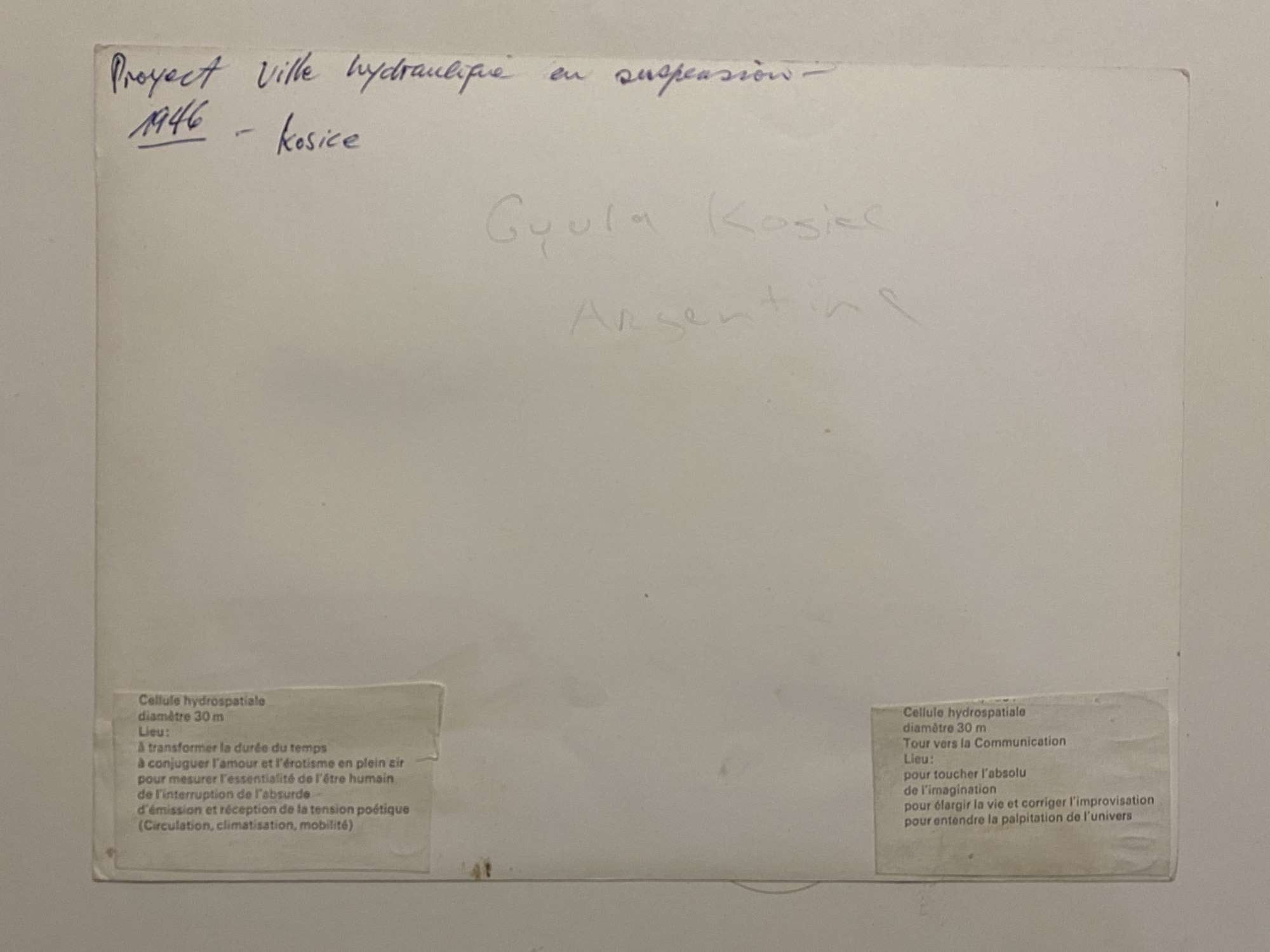
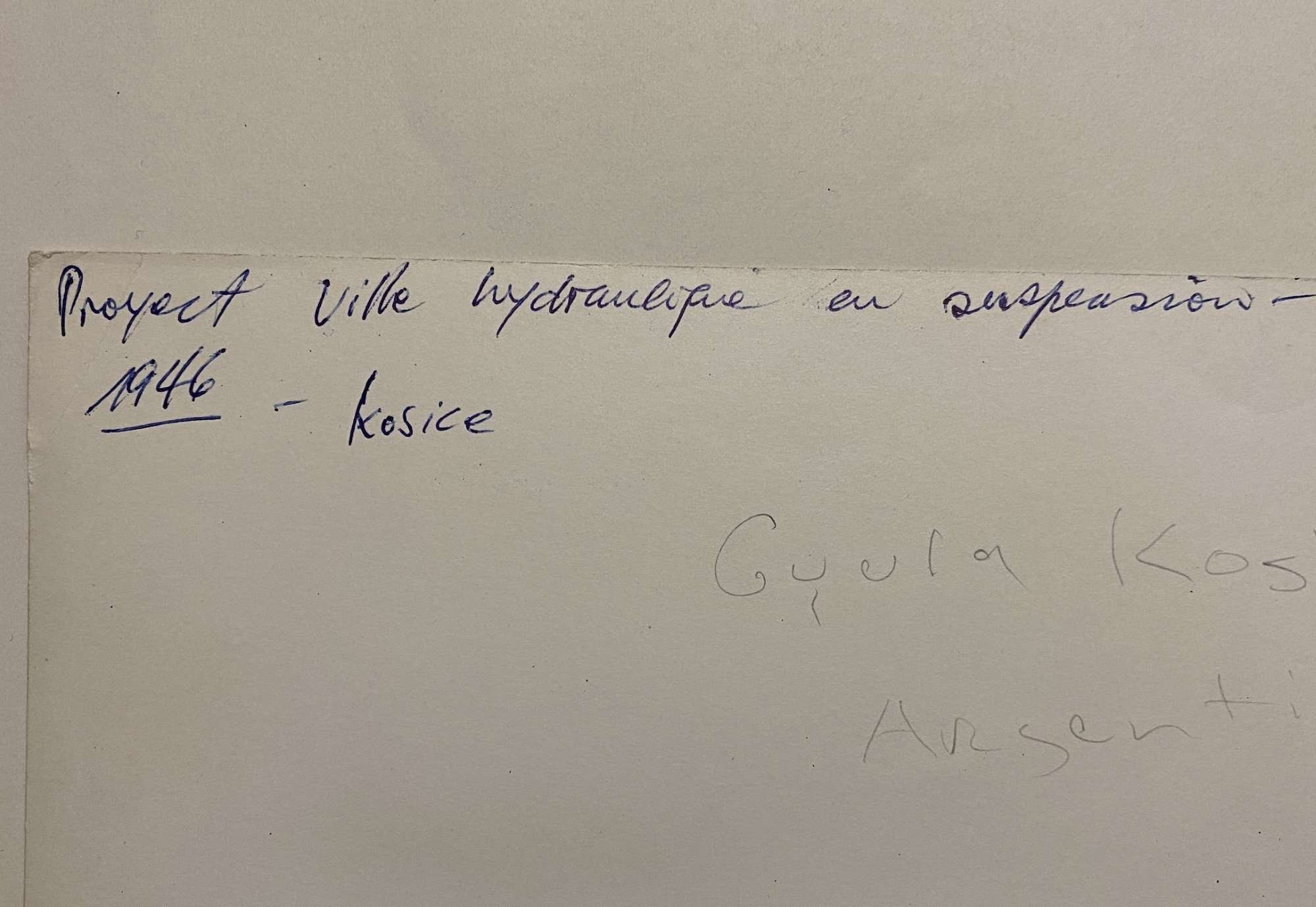
[ART AND PHOTOGRAPHY]. "Projet ville hydraulique en suspension 1946 - Kosice" (on verso). La Ciudad Hidroespacial (The Hydrospatial City)
![[ART AND PHOTOGRAPHY]. "Projet ville hydraulique e](https://d3525k1ryd2155.cloudfront.net/h/673/984/1653984673.0.x.0.jpg)
- Buenos Aires , 1946
Buenos Aires, 1946. Good. Original photograph (240 x 180). Two paper labels pasted on verso with descriptive text. Some creasing, wrinkling to outer edges. IMPORTANT AND EXTREMELY EARLY PHOTOGRAPHIC RENDITION OF KOSICE'S "HYDROSPATIAL CITY" WHICH HE BEGAN IN 1946. THE TEXT ON THE VERSO IS UNSIGNED BUT CERTAINLY IN THE HAND OF THE ARTIST; THE WORK IS IDENTIFIED BY HIM (IN FRENCH) AND DATED "1946," THE YEAR THAT THE PROJECT WAS CONCEIVED. AS SUCH IT MUST BE AMONG THE VERY FIRST OF THE MAQUETTES OF THE "CIUDAD HIDROESPACIAL." THE PRESENT PHOTOGRAPH SEEMS TO BE UNPUBLISHED, AS DOES THE TEXT OF THE TWO PRINTED LABELS ON THE VERSO.
As per the Museum of Fine Arts Houston, which describes the complete finished array of sculptures: "This utopian exploration of space architecture illustrates some of Gyula Kosice's fundamental preoccupations with water and space. Begun in 1946 and completed in 1972, La ciudad hidroespacial (The Hydrospacial City) is the Argentinean artist's most ambitious and longest-running project. By the early 1970s, the project had evolved into multiple sculptures/maquettes that now total 19 three-dimensional space habitats and 7 two-dimensional light boxes coming together in an immersive, single-room installation.
"The work has emerged as a monumental, theoretical summary of Kosice's use of innovative materials, light, and acrylic. Although many of the individual components have been exhibited in the past, the MFAH is the only museum in the world to house the complete La ciudad hidroespacial, a fascinating and poetic discourse on the intelligent relationship between civilization and community in the near future."
The French text of the two labels on the verso of the present photograph provides information that does not seem to have been published.
[Kosice] "is remembered for his innovative contributions to the kinetic art movement in Argentina. He was the first to use neon light and gas, creating nonrepresentational patterns in his sculptures. He created many monumental sculptures, hydrospatial walks, and hydrowalls using these elements." (SOURCE: Barnitz and Frank, Twentieth-Century Art of Latin America (2001), pp. 149-150).
Born in Czechoslovakia in 1924 as Ferdinand Fallik, the artist became a naturalized Argentine citizen, changing his name to Kosice after his birthplace. Sculptor, plastic artist, theorist, and poet, Kosice was fundamental in developing concrete art in Argentina and became highly respected internationally. He died in 2016.
As per the Museum of Fine Arts Houston, which describes the complete finished array of sculptures: "This utopian exploration of space architecture illustrates some of Gyula Kosice's fundamental preoccupations with water and space. Begun in 1946 and completed in 1972, La ciudad hidroespacial (The Hydrospacial City) is the Argentinean artist's most ambitious and longest-running project. By the early 1970s, the project had evolved into multiple sculptures/maquettes that now total 19 three-dimensional space habitats and 7 two-dimensional light boxes coming together in an immersive, single-room installation.
"The work has emerged as a monumental, theoretical summary of Kosice's use of innovative materials, light, and acrylic. Although many of the individual components have been exhibited in the past, the MFAH is the only museum in the world to house the complete La ciudad hidroespacial, a fascinating and poetic discourse on the intelligent relationship between civilization and community in the near future."
The French text of the two labels on the verso of the present photograph provides information that does not seem to have been published.
[Kosice] "is remembered for his innovative contributions to the kinetic art movement in Argentina. He was the first to use neon light and gas, creating nonrepresentational patterns in his sculptures. He created many monumental sculptures, hydrospatial walks, and hydrowalls using these elements." (SOURCE: Barnitz and Frank, Twentieth-Century Art of Latin America (2001), pp. 149-150).
Born in Czechoslovakia in 1924 as Ferdinand Fallik, the artist became a naturalized Argentine citizen, changing his name to Kosice after his birthplace. Sculptor, plastic artist, theorist, and poet, Kosice was fundamental in developing concrete art in Argentina and became highly respected internationally. He died in 2016.
Details
Title
[ART AND PHOTOGRAPHY]. "Projet ville hydraulique en suspension 1946 - Kosice" (on verso). La Ciudad Hidroespacial (The Hydrospatial City)
Author
Kosice, Gyula
Condition
Good
Publisher
Buenos Aires
Date
1946