

Quadrivio, il quale contiene un trattato della strada che si ha da tenere in scrivere Istoria. Un Modo, che insegna à scriver epistole latine, & volgari ... Alcune avvertenze del tesser dialoghi. Et alcuni artificii delle Ode di Oratio Flacco
- Venice: Giovanni Bariletto, 1567
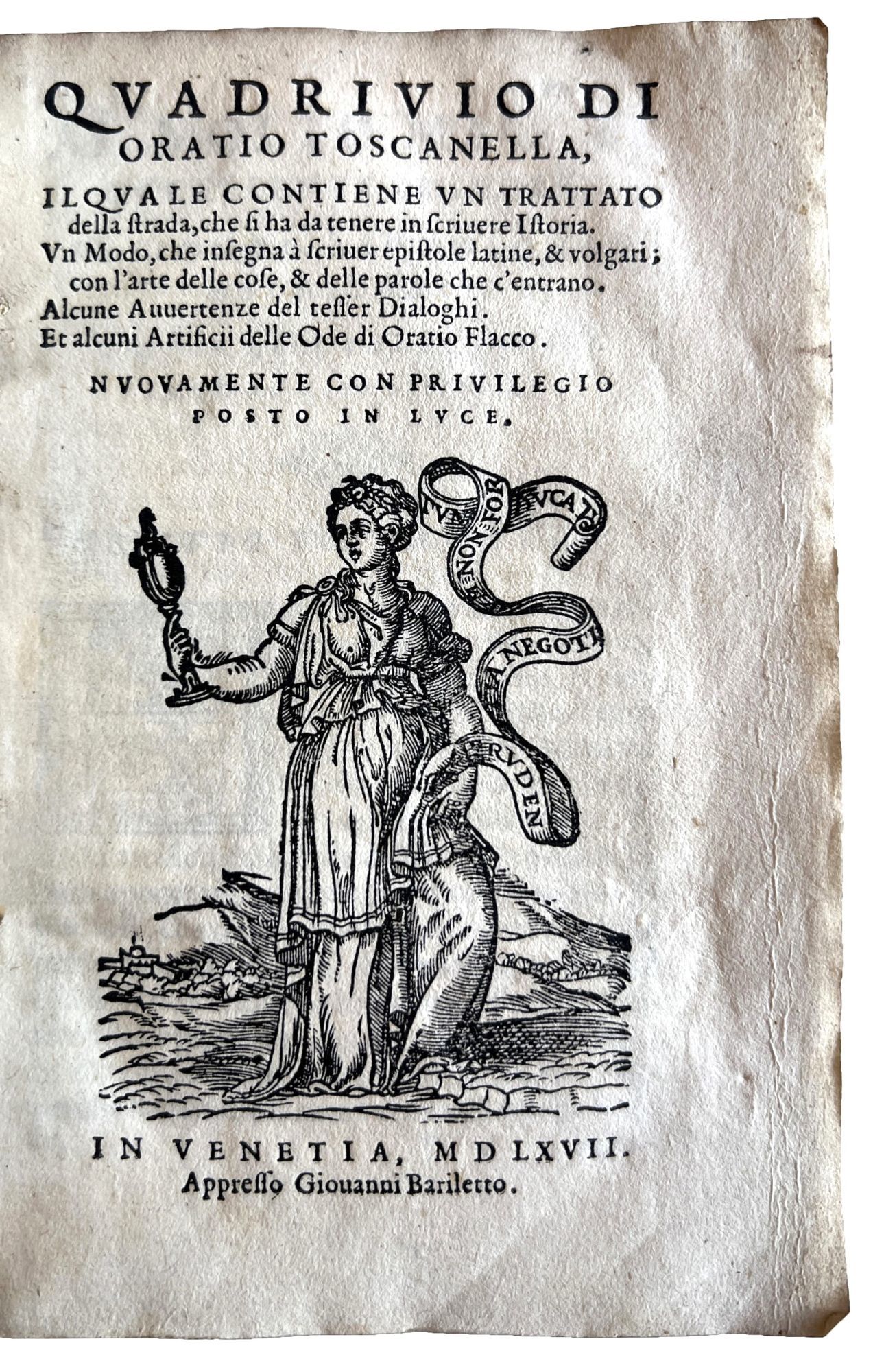
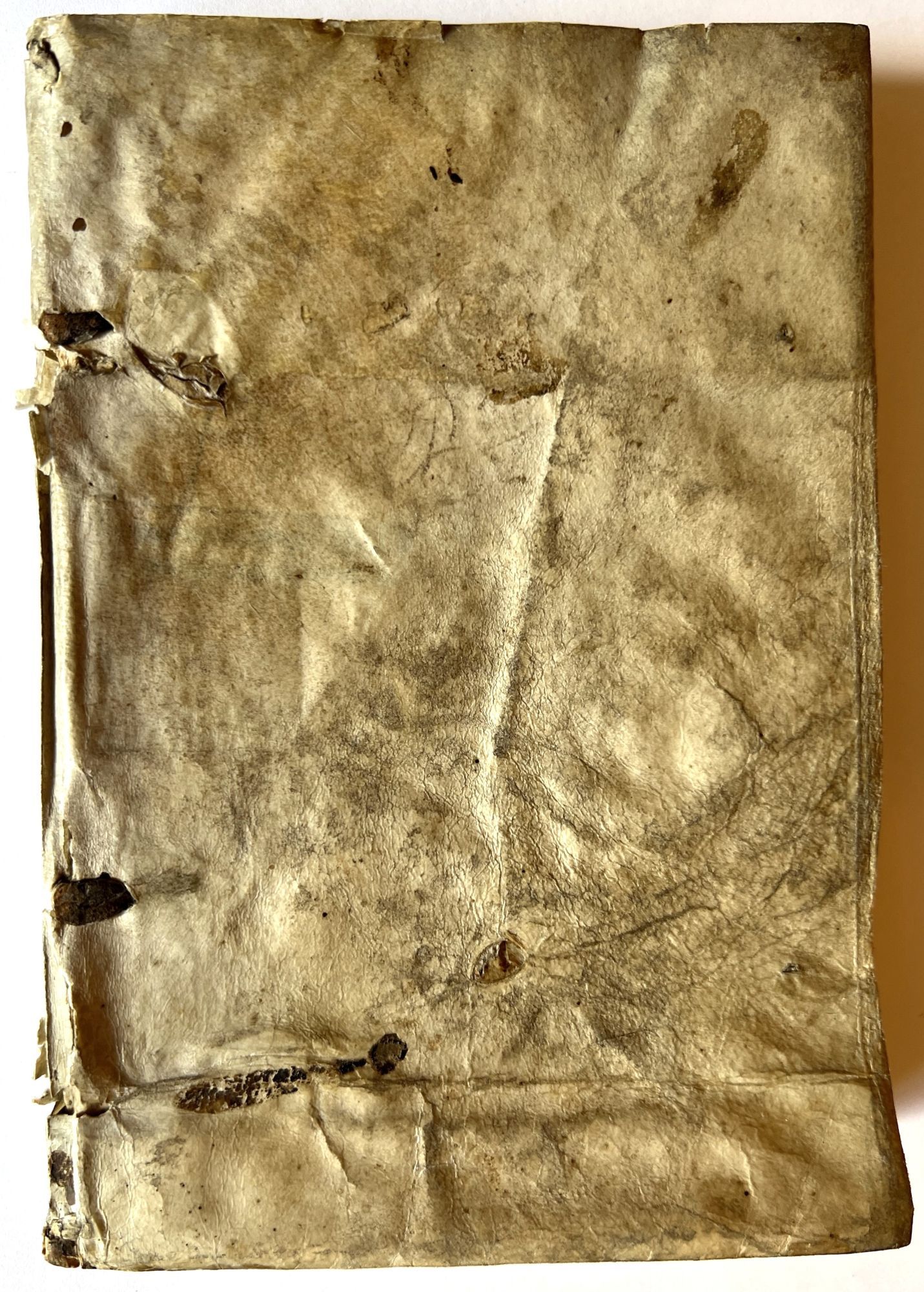
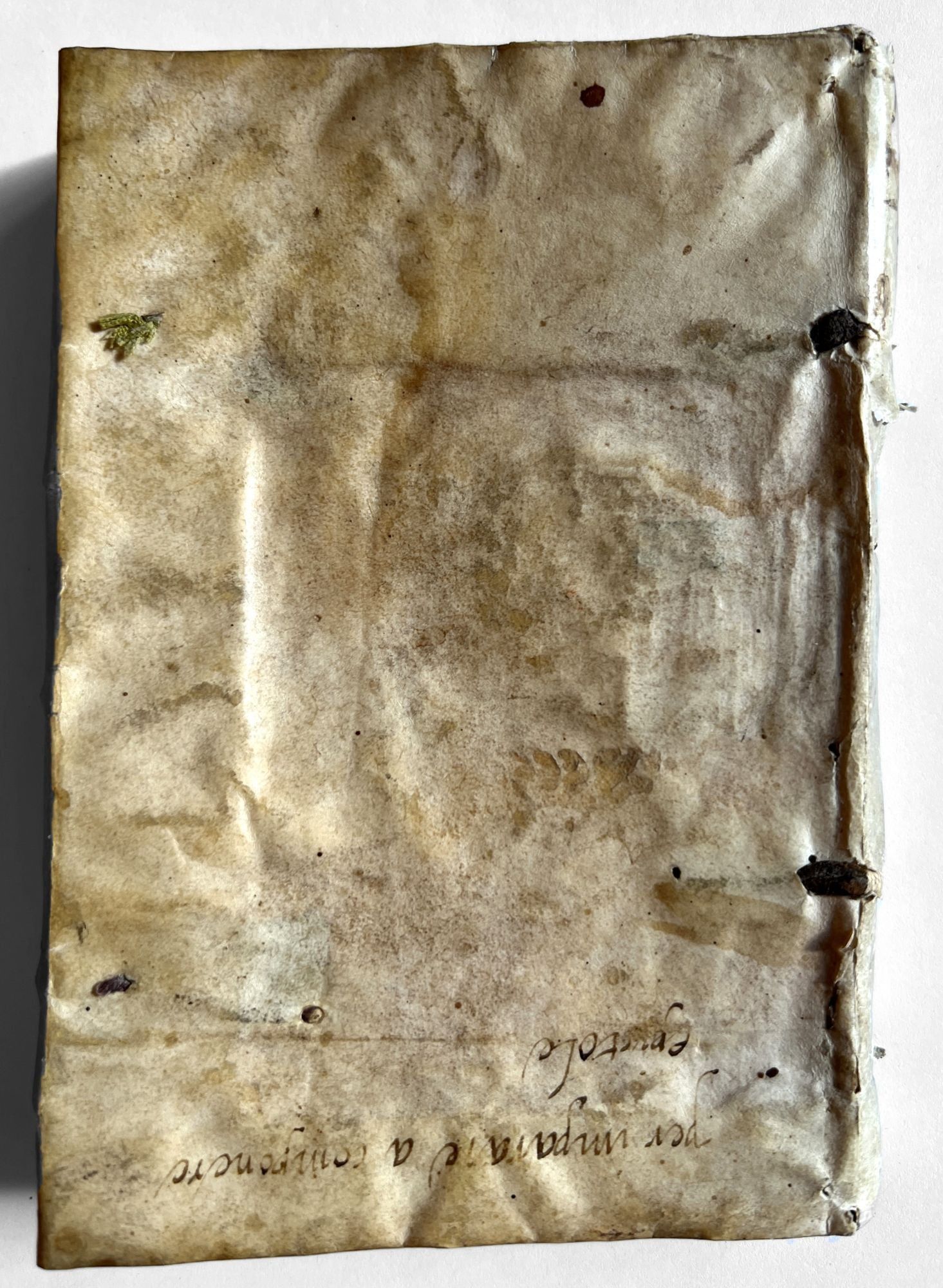
Venice: Giovanni Bariletto, 1567. Small 8vo (151 x 103 mm). [8], 83 [recte 82], [1] leaves. Text in italics, dedication and headings in roman. Woodcut printer’s device on title (Prudentia gazing into a mirror held in her right hand, with motto on a banner "Prudentia negotia non fortuna ducat"), repeated on final verso, five woodcut historiated initials. Contemporary limp parchment, two thong sewing supports laced through joints, traces of two fore-edge ties, Toscanella in contemporary ink on spine, Quadrivio del Toscanella inscribed on upper text block edge, “per impararare a componere epistole” written in apparently the same elegant humanist hand on the lower cover, upside down (soiling, a few small holes, tears to backstrip exposing sewing structure, tears to flyleaves). ***
Only edition of a Renaissance guide to good writing by a Latinist philologist and pedagogue who promoted the Italian vernacular. Toscanella’s pocket-sized guidebook conveys in clear, well-indexed chapters the basics of the studia humanitatis, which during the previous century had gradually replaced the old medieval curriculum in Italy. The Quadrivio of his title, presumably a playful allusion to the antiquated Quadrivium of medieval schooling, simply refers to the four parts of the book, of which the first two are the longest and most important: how to write history, how to write letters, some notes on writing dialogues, and a short guide to some stylistic artifices in Horace’s Odes.
Toscanella, who may have been Paduan but whose family origins are unknown, was a teacher in the Veneto countryside for at least a decade, before moving to Venice, where he made his living as a “poligrafo,” writing, translating, and editing mainly pedagogical works. These included didactic treatises on Ciceronian rhetoric, Latin meter, and the ars epistolaria, as well as a popular Latin grammar and translations of Quintilian and Cicero, all intended for schoolboys or an educated but non-specialist public.
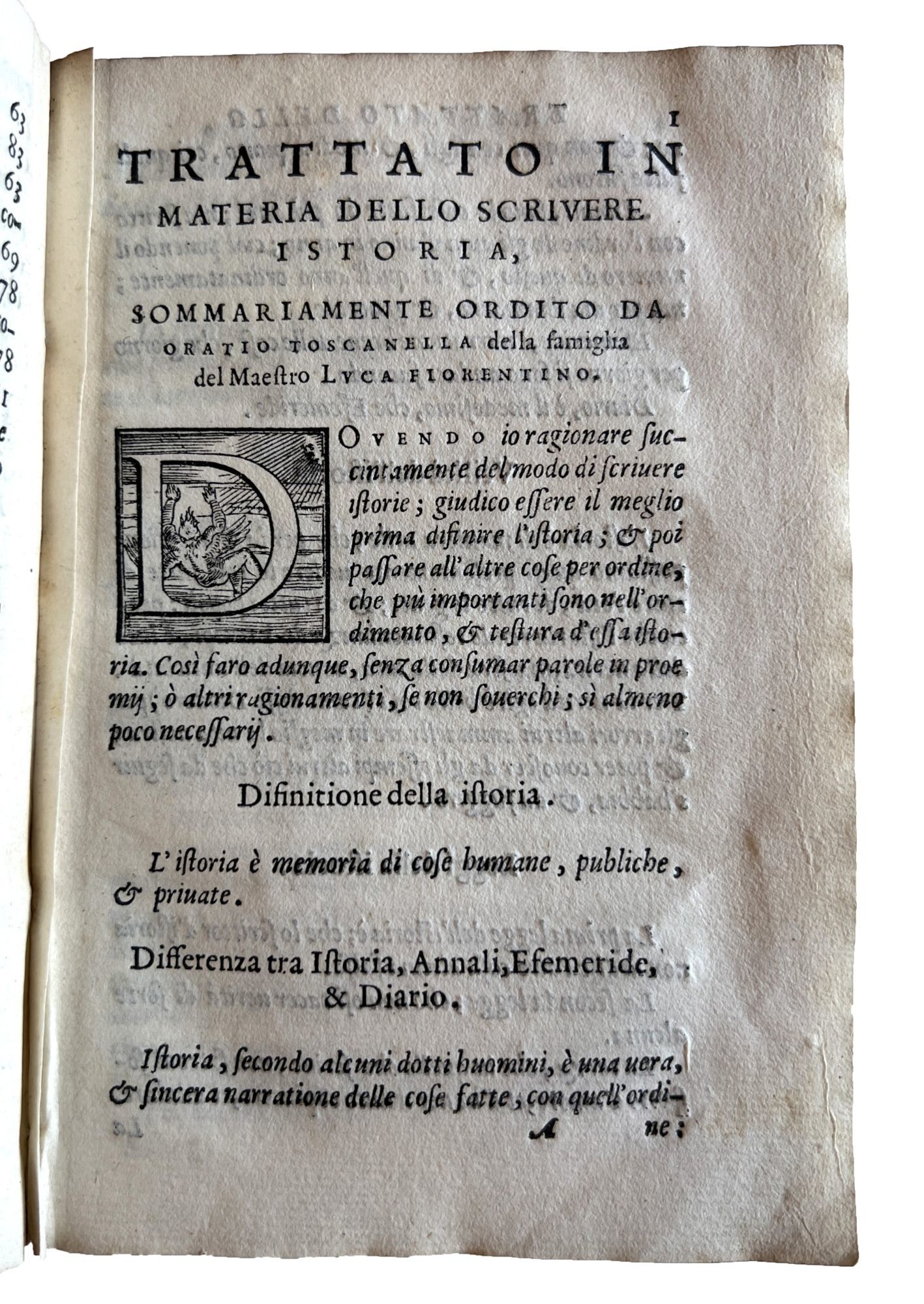
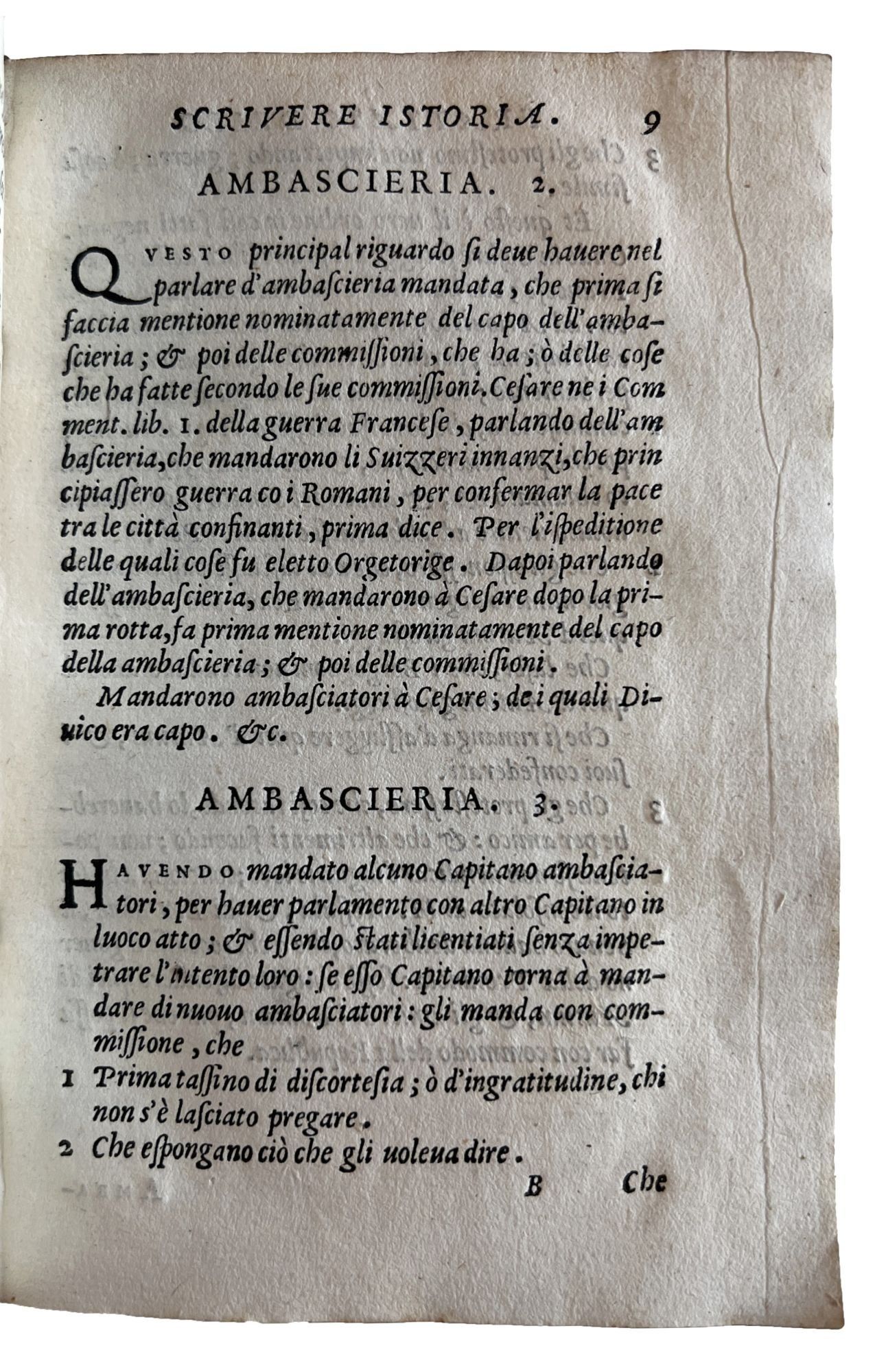
History was “the Renaissance’s most original curricular innovation” (Grendler p. 255), and it comes first in Toscanella’s handbook. His introductory exposition of history’s meaning and purpose (customary among Renaissance pedagogues) includes exhortations concerning its value and general statements concerning the writing of it: e.g., that the study of history will help us avoid the errors of our forebears, that the historian must honor truth above all, and that a good historian manages to thread the needle between excessive detail and oversimplification. While these points are eternally pertinent and make sense to the modern reader, as does Toscanella’s choice of Caesar’s Commentaries as a model of historical writing, the schematic tables and rather Borgesian lists of historical topics that follow — Battles, Cavalry, Cities, Punishment, Deceptive Promises, Provisions, Fear, etc., evoke a pre-modern approach to classifying reality.
Medieval education was grounded in the study of rhetoric, which was transformed by the humanists’ study of classical texts, above all, of course, those of Cicero. In the second part, on letter-writing, Toscanella analyzes Cicero’s letters, and by extension, all letters, using rhetorical labels for the various epistolary genres (playful, choleric, accusatory, excusatory, persuasive, etc.); traditionally there were 24, but Toscanella lists only 19. Each genre requires a different style and vocabulary. For certain genres the student is urged to also consult modern writers, such as Erasmus’ Adagia, or the author's own collection of Motti, facetie, argutie... (published in 1561). At the end the interested reader is invited to purchase a copy of Toscanella's Modo di studiare le pistole famigliari di M. Tullio Cicerone, first published the previous year. In his final paragraph he asserts that all the Ciceronian stylistic precepts reviewed apply equally to writing in the vernacular.
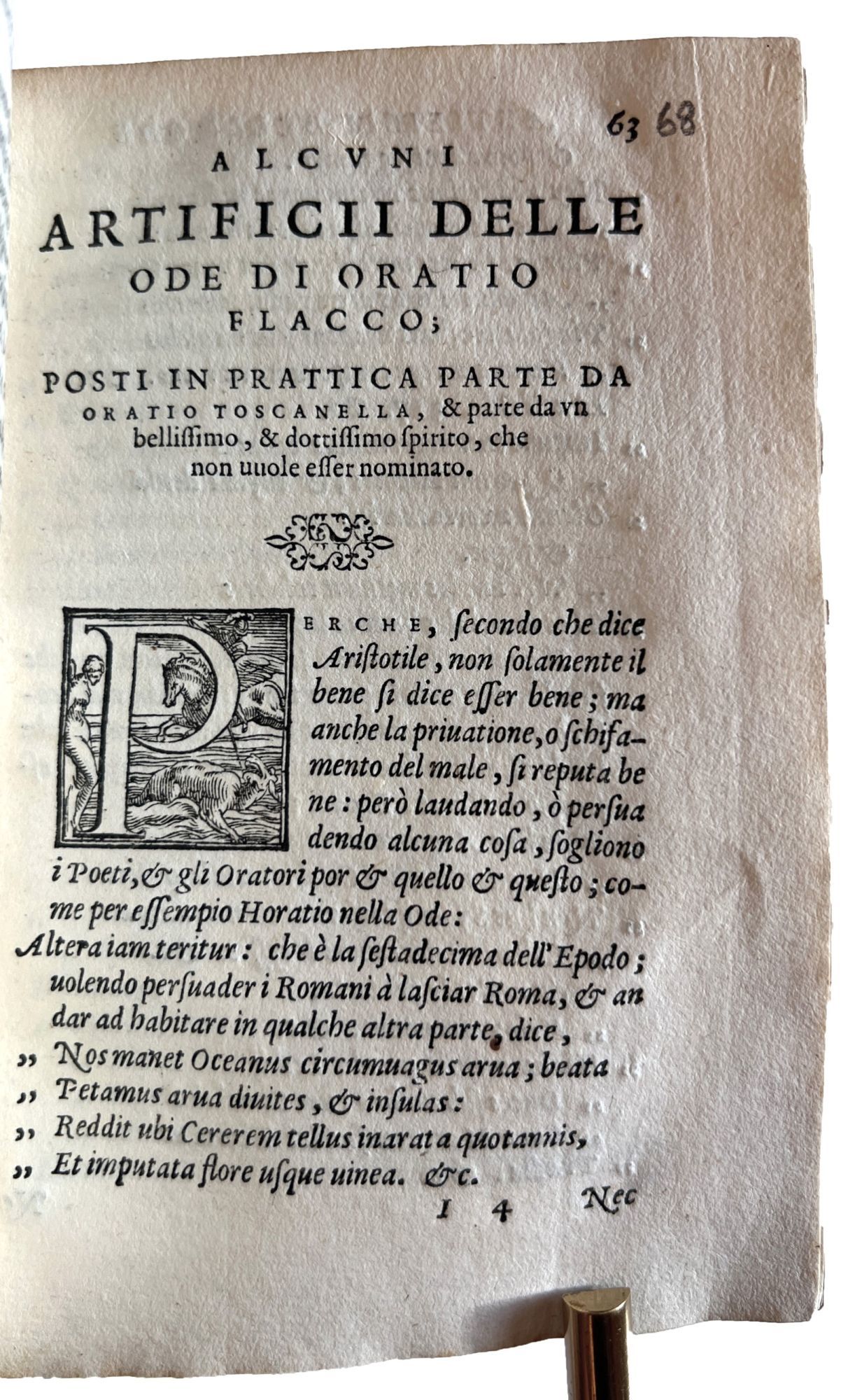
In his short essay on writing dialogues Toscanella refers the reader to Quintilian, Aristotle, and modern writers like Agricola, of whose De inventione dialectica Toscanella’s own Italian translation was published in 1567, apparently soon after this edition. The final section of tips to some Horatian stylistic devices was co-written with another “dottissimo spirito” who preferred not to be identified.
Adams T-841; BM / STC Italian, p. 677; cf. Paul Grendler, Schooling in Renaissance Italy (1989), passim.
Only edition of a Renaissance guide to good writing by a Latinist philologist and pedagogue who promoted the Italian vernacular. Toscanella’s pocket-sized guidebook conveys in clear, well-indexed chapters the basics of the studia humanitatis, which during the previous century had gradually replaced the old medieval curriculum in Italy. The Quadrivio of his title, presumably a playful allusion to the antiquated Quadrivium of medieval schooling, simply refers to the four parts of the book, of which the first two are the longest and most important: how to write history, how to write letters, some notes on writing dialogues, and a short guide to some stylistic artifices in Horace’s Odes.
Toscanella, who may have been Paduan but whose family origins are unknown, was a teacher in the Veneto countryside for at least a decade, before moving to Venice, where he made his living as a “poligrafo,” writing, translating, and editing mainly pedagogical works. These included didactic treatises on Ciceronian rhetoric, Latin meter, and the ars epistolaria, as well as a popular Latin grammar and translations of Quintilian and Cicero, all intended for schoolboys or an educated but non-specialist public.
History was “the Renaissance’s most original curricular innovation” (Grendler p. 255), and it comes first in Toscanella’s handbook. His introductory exposition of history’s meaning and purpose (customary among Renaissance pedagogues) includes exhortations concerning its value and general statements concerning the writing of it: e.g., that the study of history will help us avoid the errors of our forebears, that the historian must honor truth above all, and that a good historian manages to thread the needle between excessive detail and oversimplification. While these points are eternally pertinent and make sense to the modern reader, as does Toscanella’s choice of Caesar’s Commentaries as a model of historical writing, the schematic tables and rather Borgesian lists of historical topics that follow — Battles, Cavalry, Cities, Punishment, Deceptive Promises, Provisions, Fear, etc., evoke a pre-modern approach to classifying reality.
Medieval education was grounded in the study of rhetoric, which was transformed by the humanists’ study of classical texts, above all, of course, those of Cicero. In the second part, on letter-writing, Toscanella analyzes Cicero’s letters, and by extension, all letters, using rhetorical labels for the various epistolary genres (playful, choleric, accusatory, excusatory, persuasive, etc.); traditionally there were 24, but Toscanella lists only 19. Each genre requires a different style and vocabulary. For certain genres the student is urged to also consult modern writers, such as Erasmus’ Adagia, or the author's own collection of Motti, facetie, argutie... (published in 1561). At the end the interested reader is invited to purchase a copy of Toscanella's Modo di studiare le pistole famigliari di M. Tullio Cicerone, first published the previous year. In his final paragraph he asserts that all the Ciceronian stylistic precepts reviewed apply equally to writing in the vernacular.
In his short essay on writing dialogues Toscanella refers the reader to Quintilian, Aristotle, and modern writers like Agricola, of whose De inventione dialectica Toscanella’s own Italian translation was published in 1567, apparently soon after this edition. The final section of tips to some Horatian stylistic devices was co-written with another “dottissimo spirito” who preferred not to be identified.
Adams T-841; BM / STC Italian, p. 677; cf. Paul Grendler, Schooling in Renaissance Italy (1989), passim.
Details
Title
Quadrivio, il quale contiene un trattato della strada che si ha da tenere in scrivere Istoria. Un Modo, che insegna à scriver epistole latine, & volgari ... Alcune avvertenze del tesser dialoghi. Et alcuni artificii delle Ode di Oratio Flacco
Author
TOSCANELLA, Orazio (1520-1579)
Condition
Unknown
Publisher
Giovanni Bariletto: Venice
Date
1567