

Le Promptvaire de tovt ce qui est advenv plvs digne de memoire depuis la creation du monde iusques à present
- Paris: Jean de Bordeaux, 1579
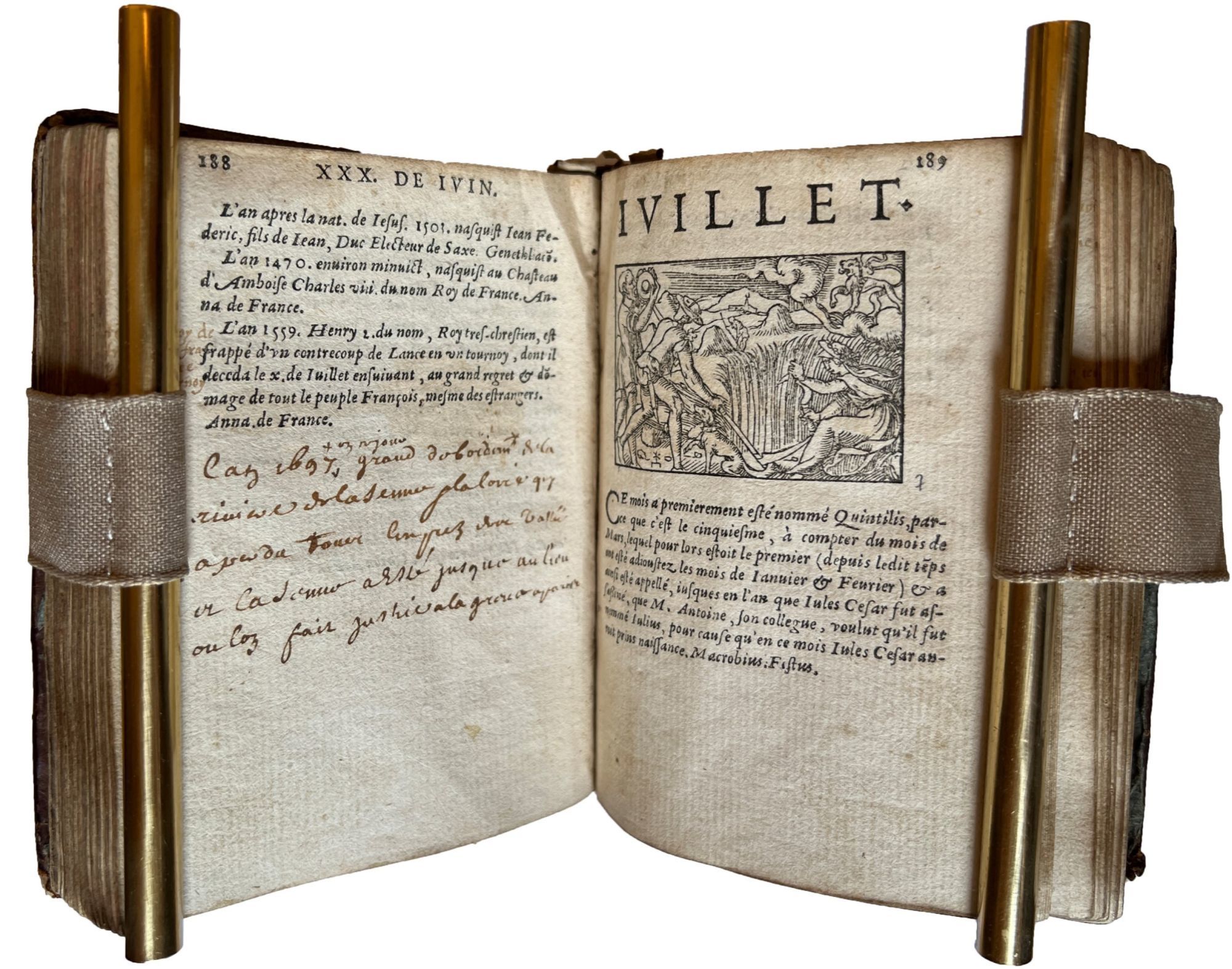
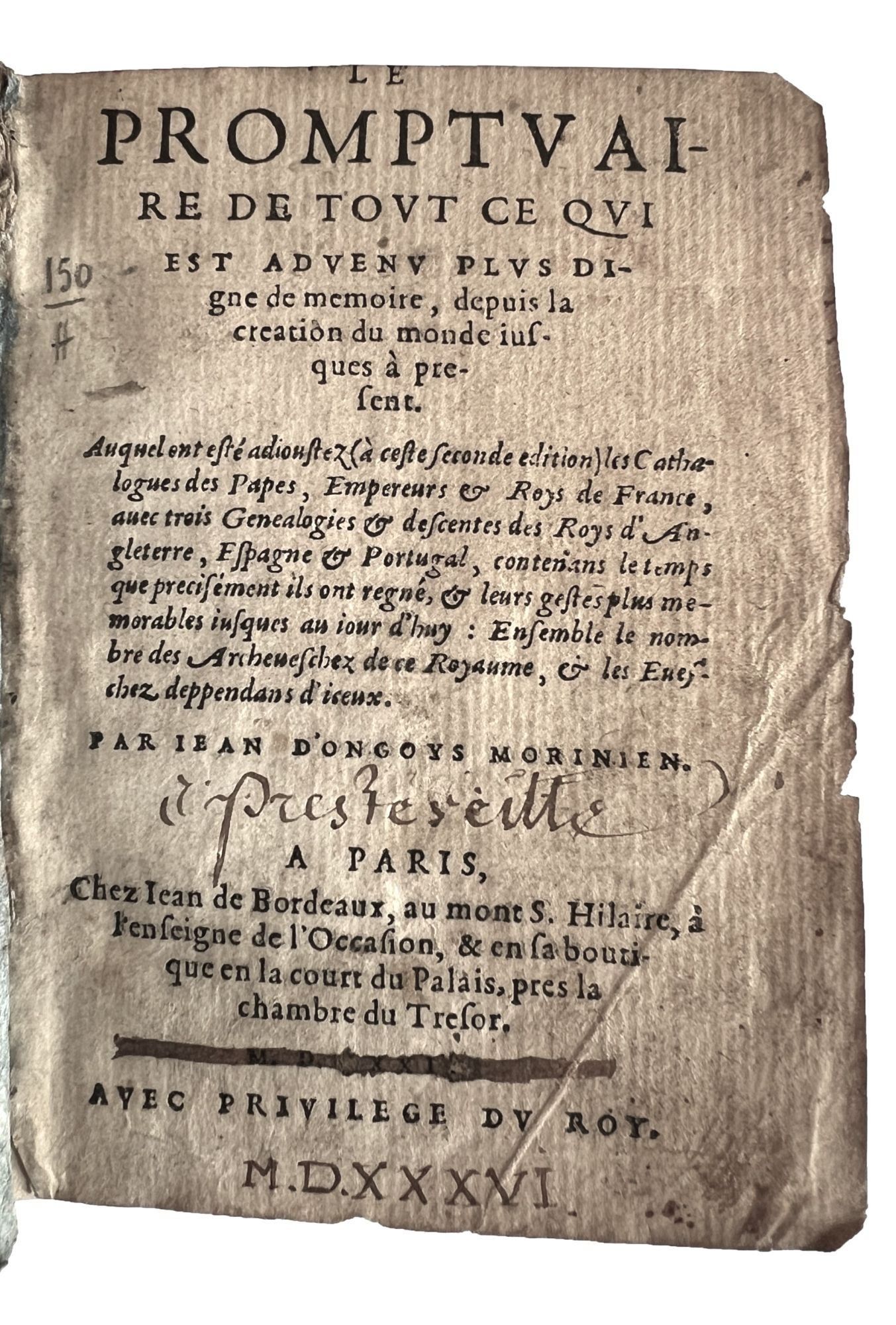
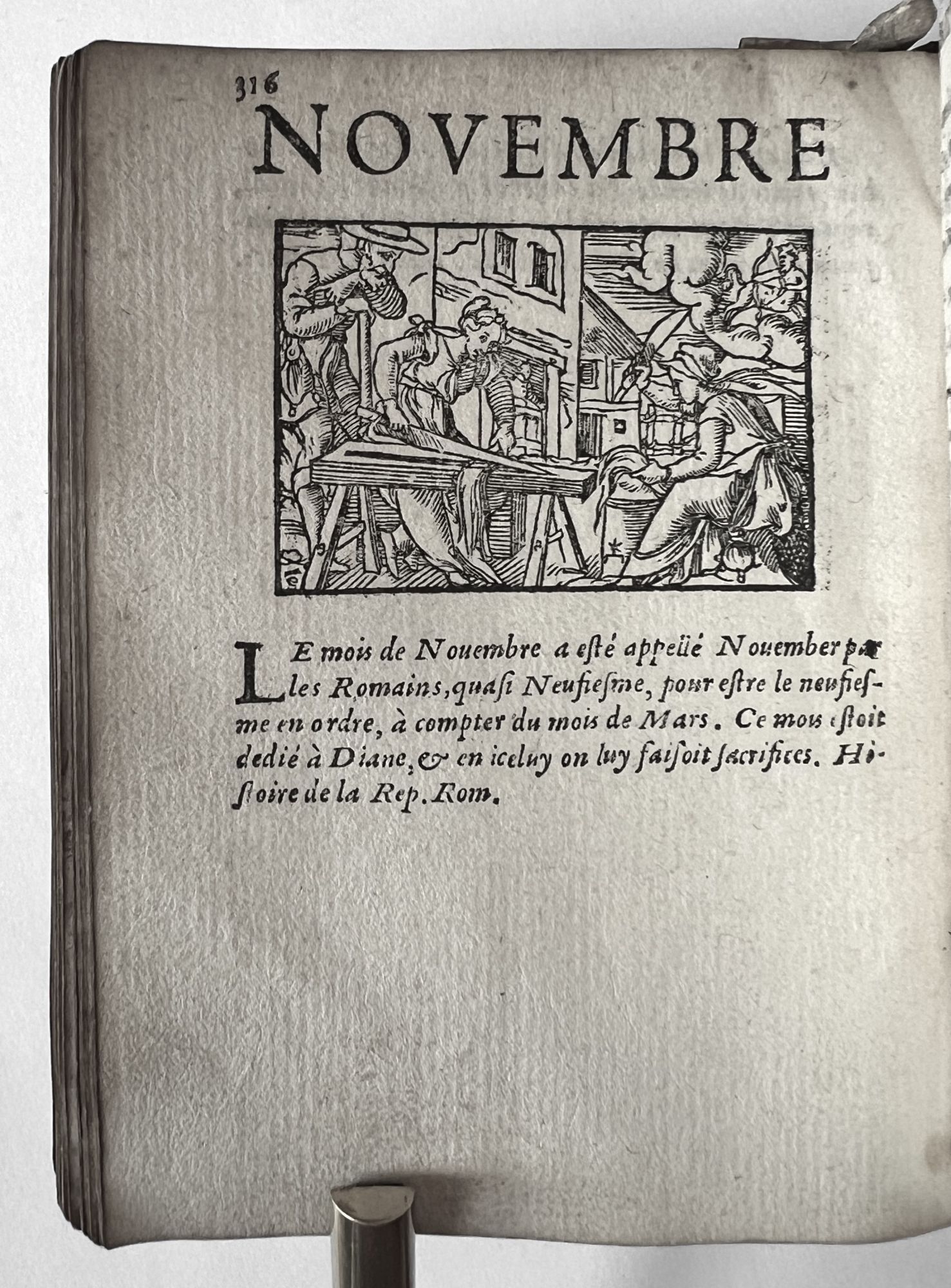
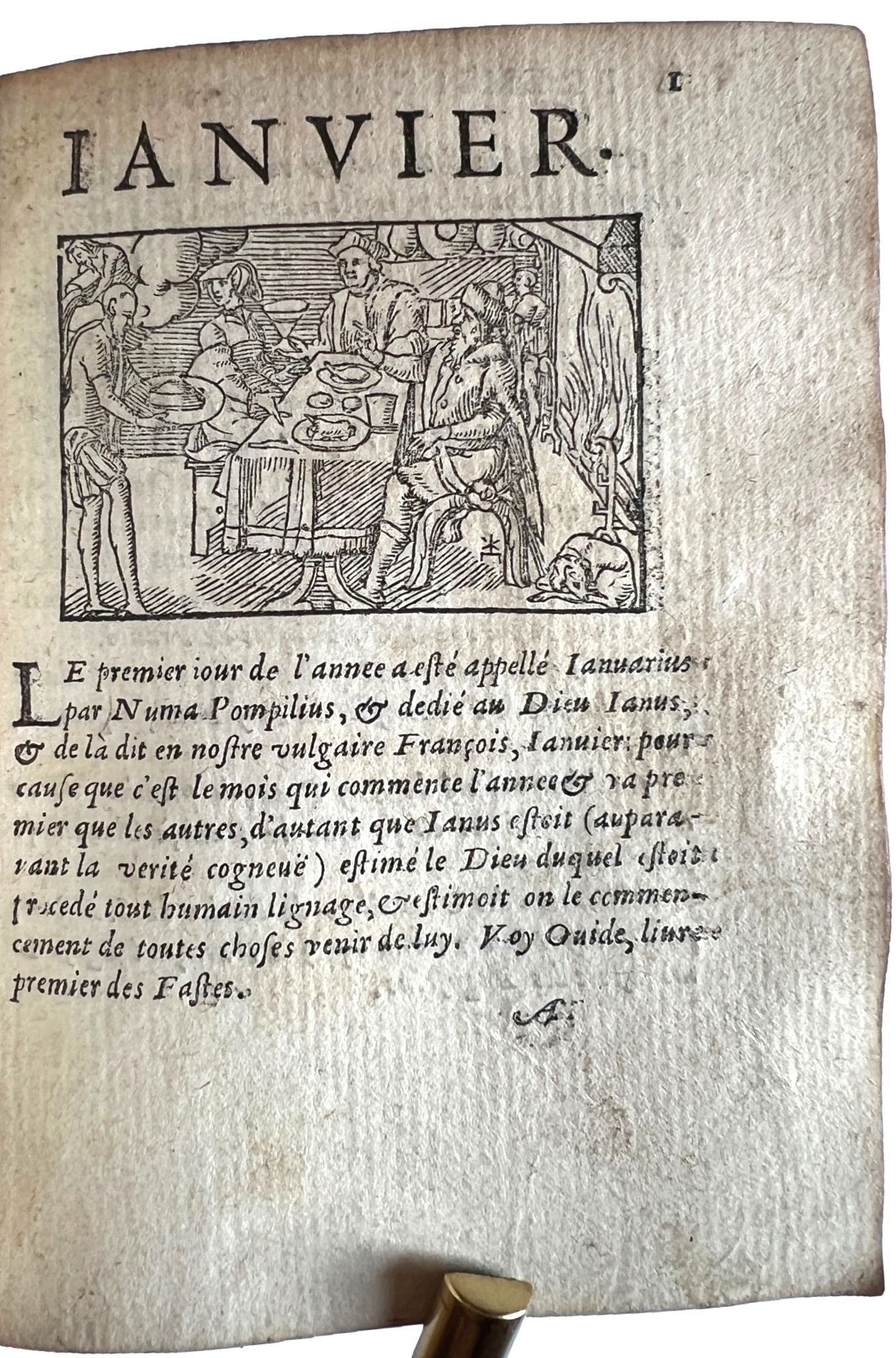
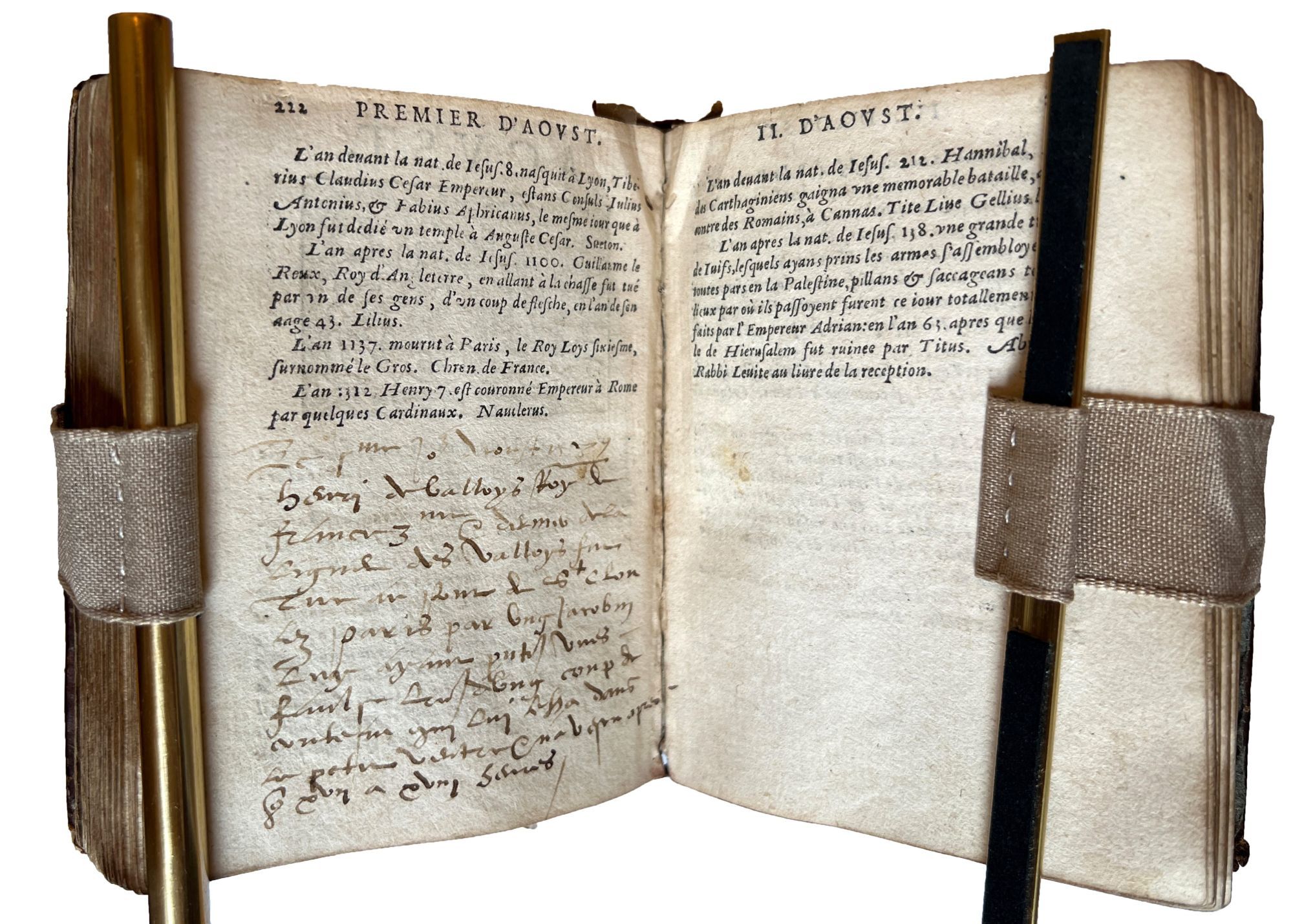
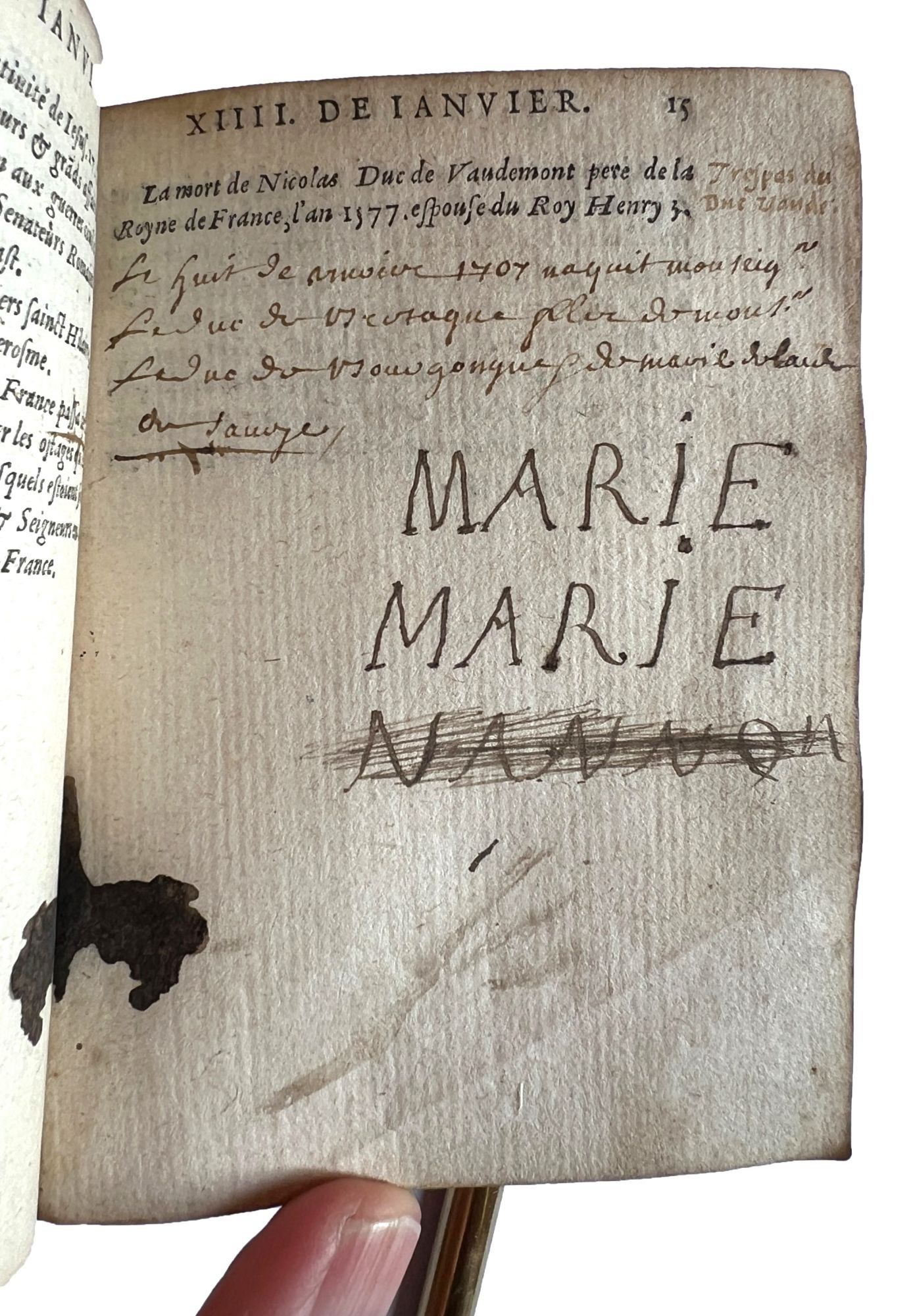
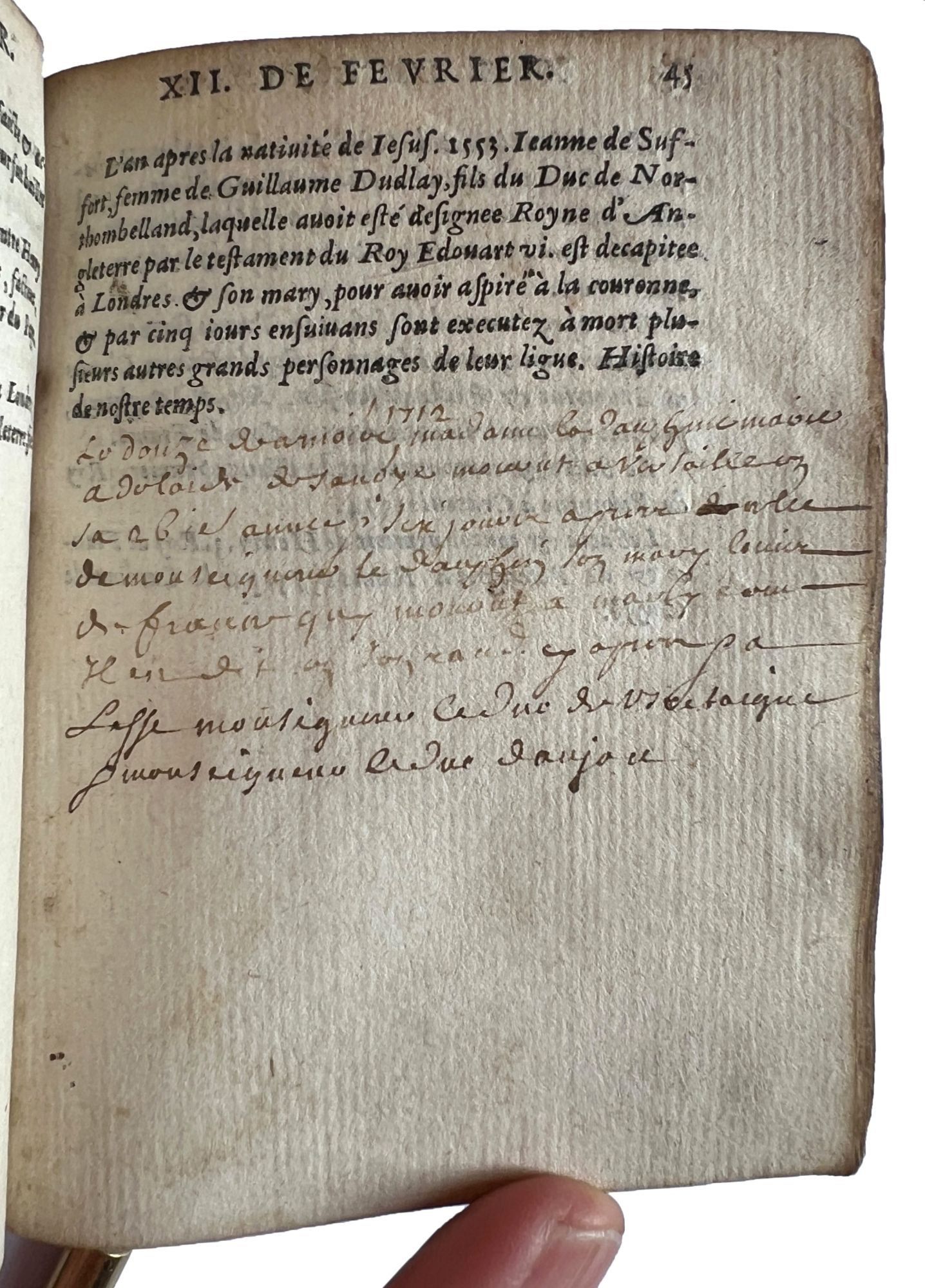
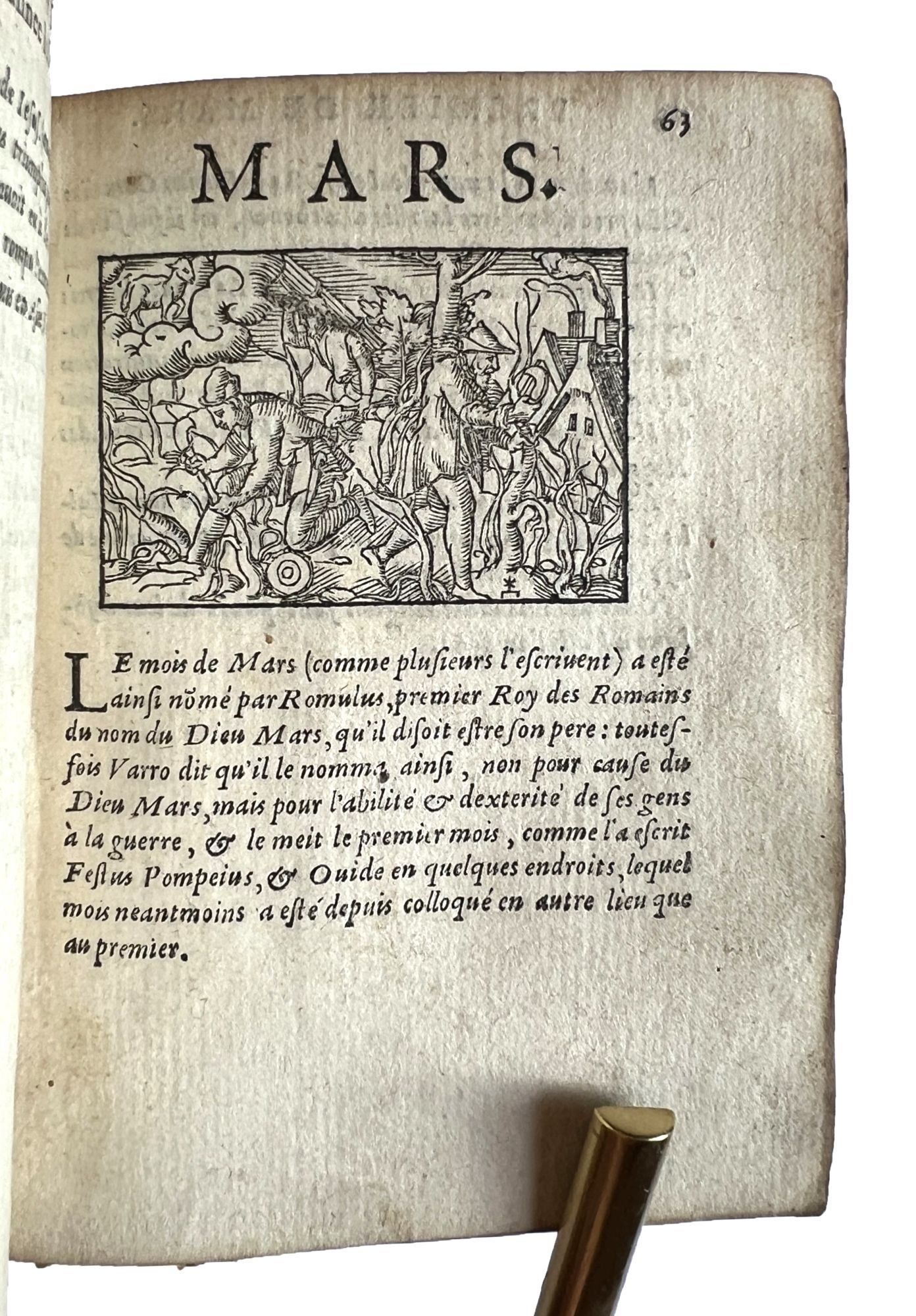
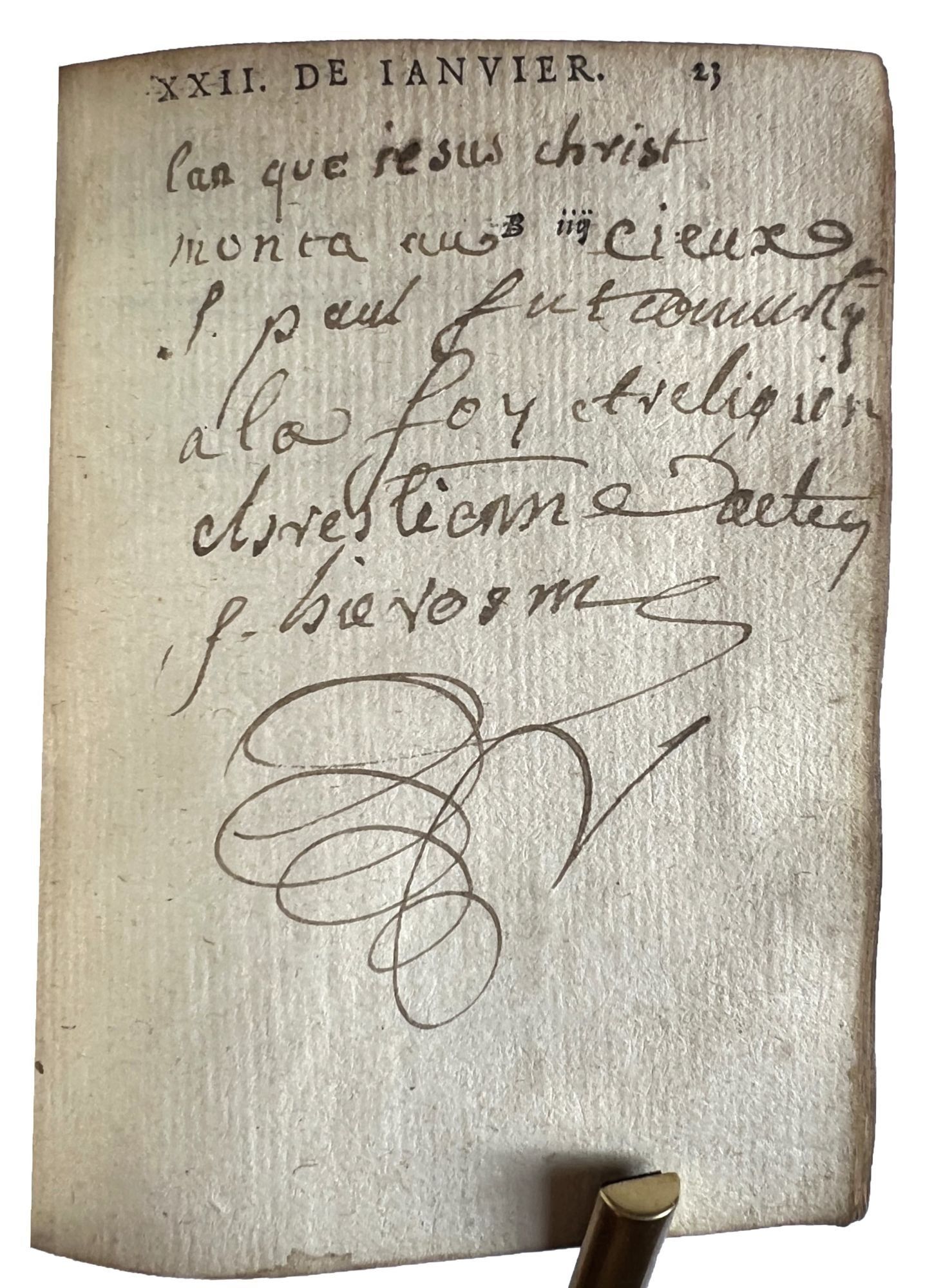
Paris: Jean de Bordeaux, 1579. 16mo (112 x 82 mm). Collation: ã⁸ ẽ⁸ ĩ⁸ õ⁸ A-Z Aa-Pp⁸ (-Pp3-8). [64], 602 pages (with mispaginations); bound without the last 3 leaves, a supplemental index of bishoprics in France. Italic type, headlines and headings in roman. 12 half-page woodcuts in text, one for each month, all signed with a symbol-monogram of an asterisk atop a small 3-sided rectangle. Typographic headpiece ornaments. (First line of title shaved, a few headlines shaved, especially in quires Hh to the end, title and a few other leaves somewhat finger-soiled, occasional small inkstains). Contemporary sheep over pasteboards, sewn on three double cords, gilt lettering-piece on spine (Chronologie de l’Ongoys), red-speckled edges, blue paper pastedowns, no free endpapers (joints and edges quite worn, some chipping of leather, lower headcap loose). Provenance: a[?] Presteveille, contemporary signature on title-page, the title date crossed out in ink and replaced at the foot with the date 1536 (M.D.XXXVI) in the same hand; contemporary and later marginalia and annotations in the blank portions of the pages on approximately 243 pages (mainly long entries, but including a few pen trials, doodles, and manicules), in at least seven contemporary and later hands (a few early marginalia slightly shaved). ***
An illustrated pocket-sized largely secular chronological calendar, copiously annotated by several generations of readers. Printed in small italic types, the calendar records historical events for each day of the year, with a single page devoted to each day. The opening day of each month bears a woodcut illustration. Since only one or two events are recorded for many of the days, large blank spaces abound, inviting readers’ annotations. Whether or not the author and/or printer intended readers to supply their own notes, it was almost inevitable, given the contents and layout, making this a de facto “interactive” book.
For this edition d’Ongoys enlarged his historical calendar, first published in 1575, adding supplementary lists of Popes, Emperors, and Kings of France, England, Spain and Portugal. This copy was bound without the final 3-leaf index of French archbishoprics and bishoprics (perhaps for a Protestant reader?).
The work may have been inspired by Paul Eber’s bestselling Protestant Calendarium historicum (1st ed. 1550), the first calendar to replace the traditional daily Saints with historical and Reformist figures. D’Ongoy’s emphasis is more secular than Protestant, although a few Biblical references were unavoidable, but he may have himself been of the Reformed faith. (There is only a brief mention of the “troubles” under the 24th of August; it would have been risky in 1579 to allude to the St. Bartholomew’s Day massacre, Henri III having revoked in 1577 most of the concessions granted to the Huguenots the previous year.) A native of northern France, d’Ongoys wrote a few historical compilations and popular circumstantial works, including (according to the BnF) an allegorical satire of the events of St. Bartholomew’s Day. He worked as a printer after his marriage in 1573 to Marie Gervais, widow of the printer Mahiet Le Roux, whose stock she had inherited.
Preceding the calendar is a long alphabetical index of the events listed, an index of sources (mainly biblical, classical, and medieval), and, enhancing the resemblance of the work to an almanac, a list of the annual French fairs. Following is a chronological “memoire” of notable historical events which cannot be associated with specific days of the year. The catalogues of Emperors, etc., complete the volume.
The fine woodcuts illustrating each month of d’Ongoys’ Promptuaire are signed with a symbol of an asterisk above a table-like 3-sided rectangle. The blocks had previously appeared in 1565 in the calendar of a sextodecimo Book of Hours printed by Thielman II Kerver, where they at that time bore the monogram “I.L.B.” (the abbreviation of the printer-bookseller Jean Le Blanc). Monograms and initials on 16th-century French woodblocks were ownership marks of the publishers or printers who used them, and they were easily excised and replaced. Brun somewhat fancifully called the symbol used here (and in the 1575 edition) a “simplified version” of the device of the de Marnef printing firm. Whether it had anything to do with the de Marnefs (it seems unlikely), the symbol was certainly a mark of the new ownership of the blocks (possibly by Jean de Bordeaux), which had evidently been dispersed along with the rest of Kerver’s printing material after his death in 1572 or 1573.
Seven or eight annotators wrote in this copy from shortly after its publication to the second half of the 18th century. The most consistent writer was a contemporary, educated reader whose very small, neat, and now faint notes, in French and Latin, are confined mainly to the margins of the calendar and the following Memoire: he preferred to ignore the large blank spaces on most pages. His notes (I assume he was a man) highlight facts of interest and add personal comments as well as supplementary details, including remarks on the defeat of the Ottomans in Spain in 1491 and 1492 (p. 341). Subsequent annotators recorded later historical events, both political and local: these include floods (in 1697 and again 1755, in and around Tours) and other weather-related events, deaths of well-known individuals, and political events.
USTC and OCLC together locate five US institutional copies of this edition, and one of the 1575 edition. The work was reprinted in 1589 under the title Memoire certain des choses les plus notables... (one US copy, Houghton).
USTC 3593; Brunet IV: 187, Brun, Livre illustré, p. 260. Cf. Cioranesco 16769 (a 1576 edition, now lost).
An illustrated pocket-sized largely secular chronological calendar, copiously annotated by several generations of readers. Printed in small italic types, the calendar records historical events for each day of the year, with a single page devoted to each day. The opening day of each month bears a woodcut illustration. Since only one or two events are recorded for many of the days, large blank spaces abound, inviting readers’ annotations. Whether or not the author and/or printer intended readers to supply their own notes, it was almost inevitable, given the contents and layout, making this a de facto “interactive” book.
For this edition d’Ongoys enlarged his historical calendar, first published in 1575, adding supplementary lists of Popes, Emperors, and Kings of France, England, Spain and Portugal. This copy was bound without the final 3-leaf index of French archbishoprics and bishoprics (perhaps for a Protestant reader?).
The work may have been inspired by Paul Eber’s bestselling Protestant Calendarium historicum (1st ed. 1550), the first calendar to replace the traditional daily Saints with historical and Reformist figures. D’Ongoy’s emphasis is more secular than Protestant, although a few Biblical references were unavoidable, but he may have himself been of the Reformed faith. (There is only a brief mention of the “troubles” under the 24th of August; it would have been risky in 1579 to allude to the St. Bartholomew’s Day massacre, Henri III having revoked in 1577 most of the concessions granted to the Huguenots the previous year.) A native of northern France, d’Ongoys wrote a few historical compilations and popular circumstantial works, including (according to the BnF) an allegorical satire of the events of St. Bartholomew’s Day. He worked as a printer after his marriage in 1573 to Marie Gervais, widow of the printer Mahiet Le Roux, whose stock she had inherited.
Preceding the calendar is a long alphabetical index of the events listed, an index of sources (mainly biblical, classical, and medieval), and, enhancing the resemblance of the work to an almanac, a list of the annual French fairs. Following is a chronological “memoire” of notable historical events which cannot be associated with specific days of the year. The catalogues of Emperors, etc., complete the volume.
The fine woodcuts illustrating each month of d’Ongoys’ Promptuaire are signed with a symbol of an asterisk above a table-like 3-sided rectangle. The blocks had previously appeared in 1565 in the calendar of a sextodecimo Book of Hours printed by Thielman II Kerver, where they at that time bore the monogram “I.L.B.” (the abbreviation of the printer-bookseller Jean Le Blanc). Monograms and initials on 16th-century French woodblocks were ownership marks of the publishers or printers who used them, and they were easily excised and replaced. Brun somewhat fancifully called the symbol used here (and in the 1575 edition) a “simplified version” of the device of the de Marnef printing firm. Whether it had anything to do with the de Marnefs (it seems unlikely), the symbol was certainly a mark of the new ownership of the blocks (possibly by Jean de Bordeaux), which had evidently been dispersed along with the rest of Kerver’s printing material after his death in 1572 or 1573.
Seven or eight annotators wrote in this copy from shortly after its publication to the second half of the 18th century. The most consistent writer was a contemporary, educated reader whose very small, neat, and now faint notes, in French and Latin, are confined mainly to the margins of the calendar and the following Memoire: he preferred to ignore the large blank spaces on most pages. His notes (I assume he was a man) highlight facts of interest and add personal comments as well as supplementary details, including remarks on the defeat of the Ottomans in Spain in 1491 and 1492 (p. 341). Subsequent annotators recorded later historical events, both political and local: these include floods (in 1697 and again 1755, in and around Tours) and other weather-related events, deaths of well-known individuals, and political events.
USTC and OCLC together locate five US institutional copies of this edition, and one of the 1575 edition. The work was reprinted in 1589 under the title Memoire certain des choses les plus notables... (one US copy, Houghton).
USTC 3593; Brunet IV: 187, Brun, Livre illustré, p. 260. Cf. Cioranesco 16769 (a 1576 edition, now lost).
Details
Title
Le Promptvaire de tovt ce qui est advenv plvs digne de memoire depuis la creation du monde iusques à present
Author
ONGOYS, Jean d' (1530?-1600?)
Condition
Unknown
Publisher
Jean de Bordeaux: Paris
Date
1579