

Étrennes plaisantes, ou Almanach nouveau contenant les plus jolies Chansons sur différens sujets comiques et sérieux; avec des proverbes chantans. Par un auteur réformé
- “Au Parnasse,” et se trouve à Paris: Cuissard, 1762
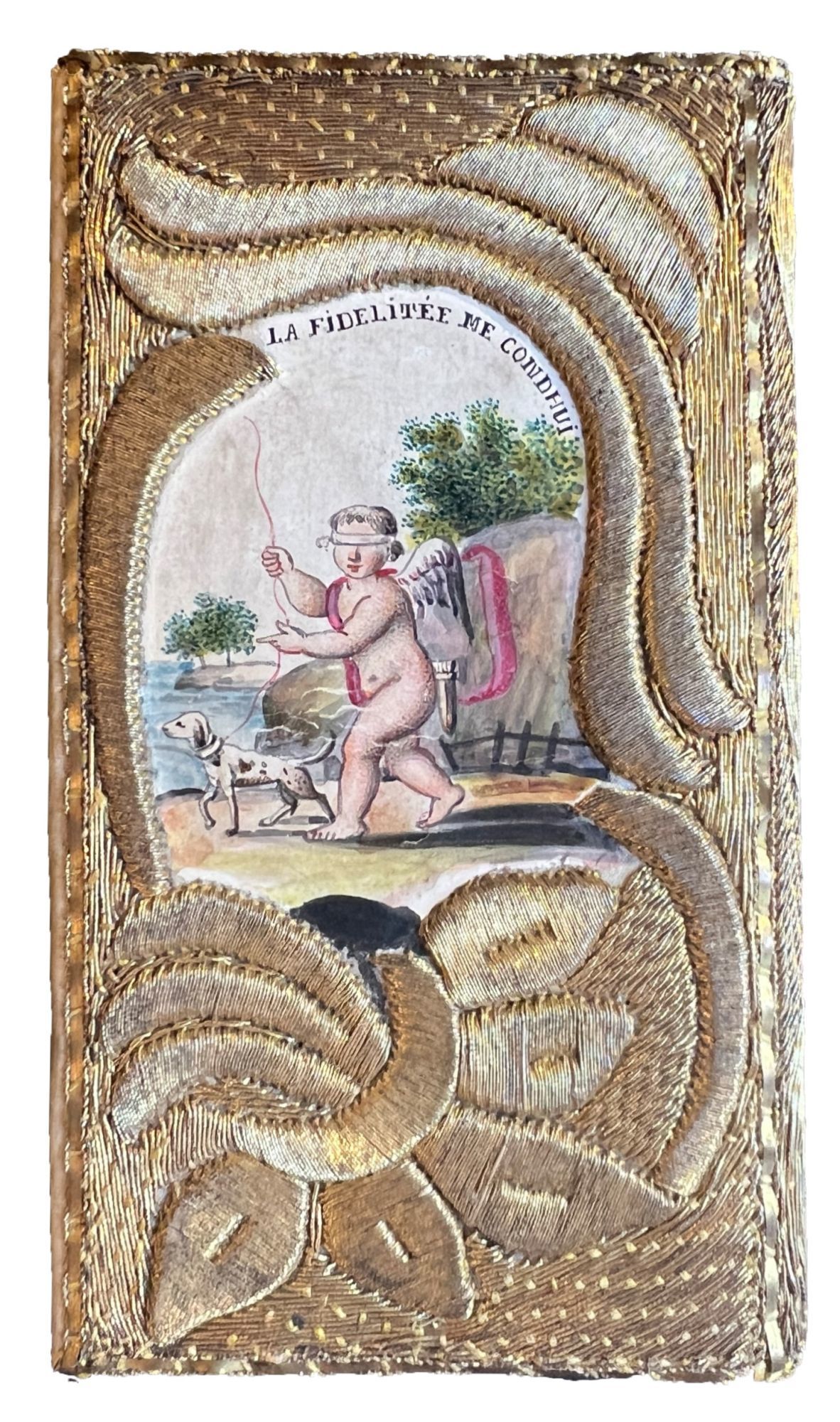
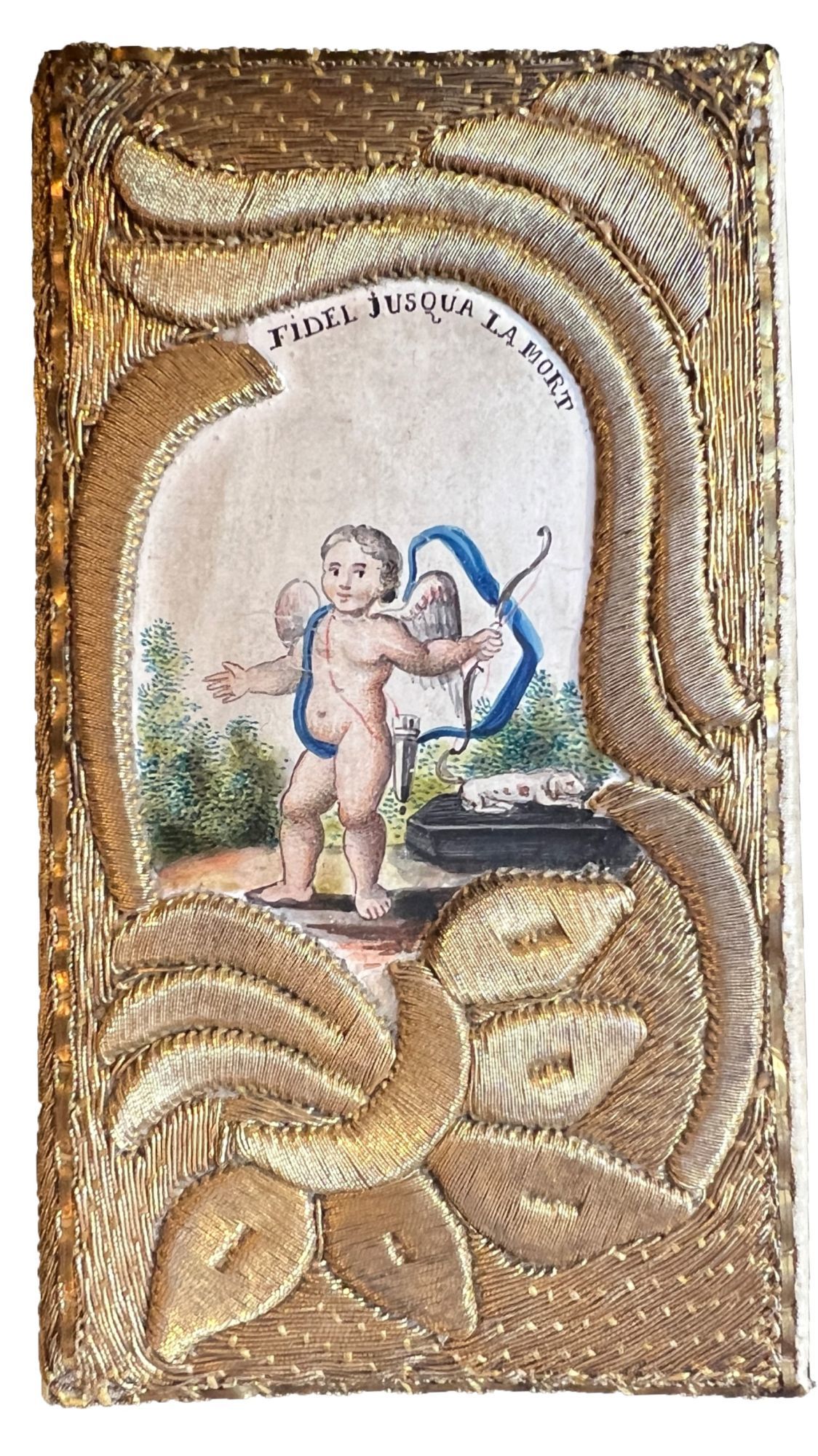
“Au Parnasse,” et se trouve à Paris: Cuissard, 1762. 24mo (binding size 96 x 55 mm). [80] pp. Rule page borders (fore-edges cut close, some borders shaved, small hole in title). Text block stitched into a contemporary gold-embroidered case binding with two original watercolor drawings: both covers with large asymmetrical curving goldwork design couched on a gold basketwork ground, embroidered on a plain textile (visible at board edges), the design incorporating an abstract plant or cornucopia, and framing on each cover a different watercolor emblem of fidelity, painted on glazed paper (or possibly vellum): on the front cover a putto holds a bow and arrow, while a dog rests behind him, below a neat manuscript caption in majuscules, “Fidel jusqu’à la mort”; on the rear cover a blindfolded putto with his quiver on his back is led by a dog on a pink leash through a coastal landscape, with caption “La Fidelité me conduit”; the covers edged with vermeil strips, spine with sinuous couched goldwork band, edges gilt, dark purple silk liners; housed in a contemporary two-part morocco pull-off case, lined in color-blocked paper. In near-perfect condition (very slight darkening of some of the goldwork on lower cover).***
A superb example of one of the earliest and most sought-after types of French luxury almanac bindings. A single, probably Parisian atelier, active in the 1760s, seems to have been responsible for a group of innovative small bindings featuring small painted love-emblems on vellum, enclosed in glowing rococo frames composed of padded fretwork covered in gold-wrapped thread which entirely hides the plain textile cover. These inventive and successful bindings inspired emulators, paving the way for an explosion of imaginative almanac bindings over the next three decades, incorporating silk, embroidery, paintings, glass, mica, metal foil, and other materials, as well as the more traditional leathers, arranged in an enticing variety of patterns and designs and creating a full-fledged industry of these little books, produced by stationer-binders, who sub-contracted their textile bindings to professional embroiderers.
It may seem extraordinary that such an elaborate binding would be used for a small, cheap publication like the present almanac, printed by Léonard Cuissart soon after 5 November 1762 (date of the printing permission on the last page). Containing songs, proverbs, and a calendar of Saints’ days, it is an unillustrated precursor to the more elaborate almanachs galants produced during the next few decades. Like them, it would have been given as a New Year’s gift (étrenne), and indeed a love-gift. This fact explains the apparent paradox of such a labor-intensive production method for the cover decoration of an ephemeral publication: “The status of gifts held by these little works ... quickly conferred upon them, in the eyes of an elite clientele, the double role of bibelot [bauble] and of an object of gallantry likely to become a precious souvenir, and thus worthy of receiving a decoration formerly reserved only for the most precious publications” (Fabienne le Bars, no. 35b, Éloge de la rareté, trans.).
It was in the 1760s that the fashion for such palm-sized treasure books first surfaced. A few later imitations of this “goldwork” style are known, of somewhat inferior workmanship, on almanacs from the 1770s (see, for example, no. 35b in the Bibliothèque nationale de France 2014 exhibition catalogue Eloge de la rareté). The frequent misattribution of this type of goldwork binding to the Low Countries seems to be based on a few examples of those emulative bindings from the 1770s, found on almanacs from Liège (see, for example, Livres en broderie, no. 176). Whether or not those later imitations were indeed produced in or near Liège, the original examples of these goldwork bindings, such as this one, were almost certainly produced in Paris, as is evident from the almanacs they cover: see, for example, a group of four such almanacs, offered by Patrice Rossignol, in his catalogue 18, no. 25, all on Paris almanacs from 1760 to 1769 (with a fifth, inferior example from 1773).
Most surviving goldwork bindings have suffered from handling, and are worn or darkened; thanks to its original case, the present lovely binding has been exceptionally well preserved.
I locate no other copies of the almanac, which was not recorded by Grand Carteret. Cf. Bibliothèque nationale de France, Éloge de la rareté: cent trésors de la Réserve des livres rares (Paris: BnF, 2014) and ibid., Livres en broderie (Paris: BnF, 1995-96).
A superb example of one of the earliest and most sought-after types of French luxury almanac bindings. A single, probably Parisian atelier, active in the 1760s, seems to have been responsible for a group of innovative small bindings featuring small painted love-emblems on vellum, enclosed in glowing rococo frames composed of padded fretwork covered in gold-wrapped thread which entirely hides the plain textile cover. These inventive and successful bindings inspired emulators, paving the way for an explosion of imaginative almanac bindings over the next three decades, incorporating silk, embroidery, paintings, glass, mica, metal foil, and other materials, as well as the more traditional leathers, arranged in an enticing variety of patterns and designs and creating a full-fledged industry of these little books, produced by stationer-binders, who sub-contracted their textile bindings to professional embroiderers.
It may seem extraordinary that such an elaborate binding would be used for a small, cheap publication like the present almanac, printed by Léonard Cuissart soon after 5 November 1762 (date of the printing permission on the last page). Containing songs, proverbs, and a calendar of Saints’ days, it is an unillustrated precursor to the more elaborate almanachs galants produced during the next few decades. Like them, it would have been given as a New Year’s gift (étrenne), and indeed a love-gift. This fact explains the apparent paradox of such a labor-intensive production method for the cover decoration of an ephemeral publication: “The status of gifts held by these little works ... quickly conferred upon them, in the eyes of an elite clientele, the double role of bibelot [bauble] and of an object of gallantry likely to become a precious souvenir, and thus worthy of receiving a decoration formerly reserved only for the most precious publications” (Fabienne le Bars, no. 35b, Éloge de la rareté, trans.).
It was in the 1760s that the fashion for such palm-sized treasure books first surfaced. A few later imitations of this “goldwork” style are known, of somewhat inferior workmanship, on almanacs from the 1770s (see, for example, no. 35b in the Bibliothèque nationale de France 2014 exhibition catalogue Eloge de la rareté). The frequent misattribution of this type of goldwork binding to the Low Countries seems to be based on a few examples of those emulative bindings from the 1770s, found on almanacs from Liège (see, for example, Livres en broderie, no. 176). Whether or not those later imitations were indeed produced in or near Liège, the original examples of these goldwork bindings, such as this one, were almost certainly produced in Paris, as is evident from the almanacs they cover: see, for example, a group of four such almanacs, offered by Patrice Rossignol, in his catalogue 18, no. 25, all on Paris almanacs from 1760 to 1769 (with a fifth, inferior example from 1773).
Most surviving goldwork bindings have suffered from handling, and are worn or darkened; thanks to its original case, the present lovely binding has been exceptionally well preserved.
I locate no other copies of the almanac, which was not recorded by Grand Carteret. Cf. Bibliothèque nationale de France, Éloge de la rareté: cent trésors de la Réserve des livres rares (Paris: BnF, 2014) and ibid., Livres en broderie (Paris: BnF, 1995-96).
Details
Title
Étrennes plaisantes, ou Almanach nouveau contenant les plus jolies Chansons sur différens sujets comiques et sérieux; avec des proverbes chantans. Par un auteur réformé
Author
GOLD-EMBROIDERED AND PAINTED BINDING
Condition
Unknown
Publisher
Cuissard: “Au Parnasse,” et se trouve à Paris
Date
1762