

Unequal Justice under Law: Women and the Constitution
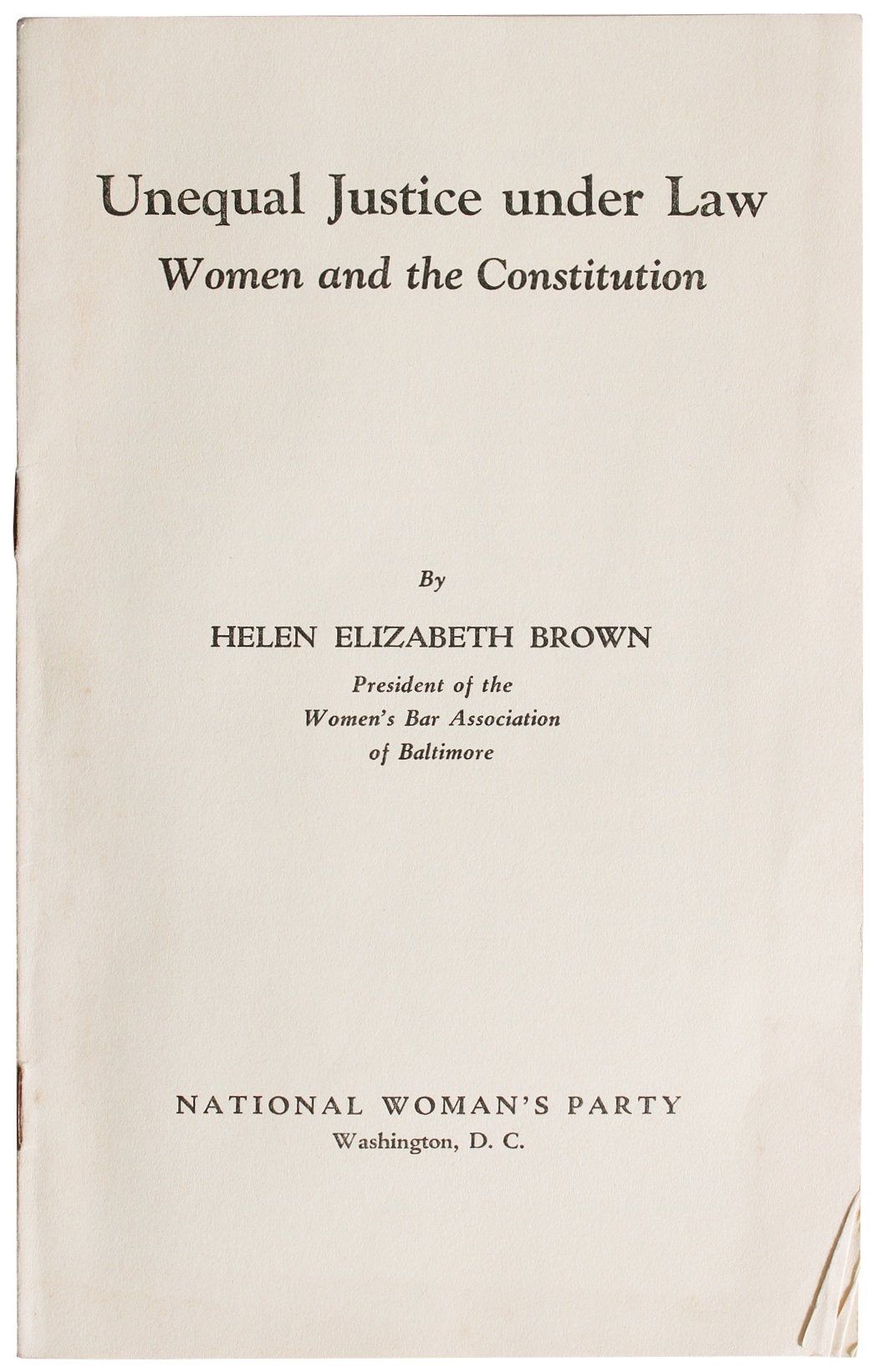
- Washington, D.C.: National Woman's Party, 1942
Washington, D.C.: National Woman's Party, 1942. Very good. 7 7/8” x 5”. Stapled self-wrappers. Pp. 15. Very good: a touch of faint soiling to wrapper edges; a few small dogears.
This is an offprint of an article by an important lawyer, Helen Elizabeth Brown, intended to drum up support for the National Woman's Party (NWP) and to promote equal rights and legal justice for women.
Helen Elizabeth Brown was born in Indiana in 1899 but grew up in Fort Worth, Texas. Upon finishing high school she went to work for the Fort Worth Star-Telegram, where she paved the way for female reporters by covering the police court circuit, City Hall and local politics. In 1922 she accepted a position on the staff of the Baltimore Post and was the first woman at that paper to cover the courthouse as well. Brown attended law school at the University of Maryland and was admitted to the bar in 1926. In 1927 she formed the first organization for women lawyers in Maryland, and one year later founded the Business and Professional Woman's Council. Brown also served as Assistant City Solicitor, Judge of the Baltimore Housing Court and instructor at the University of Baltimore Law School.
This article originally appeared in Equal Rights, the official magazine of the NWP. Founded in 1923, the publication was directed towards women, but also strove to educate men about the benefits of women's suffrage and women's rights. NWP was an outgrowth of the Congressional Union for Woman Suffrage, formed in 1913 by Alice Paul and Lucy Burns. The group is best known for their efforts in writing, revising, publicizing and advocating for the passage of the Equal Rights Amendment (ERA). The fight for this bill lasted decades, including a pivotal rewrite in 1943, and it was finally passed by Congress in 1972. With a sharp wit, Brown's article systematically reviewed the legal inequalities women faced, covering labor laws, the 14th and 19th Amendments, “the miracle of marriage” and the “biased masculine process.” Ultimately, Brown posited that “There is now but one remedy for this accumulated injustice, and that is the prompt passage and ratification” of the ERA – “This Amendment will end the lingering tyrannies of the dark ages and counteract the corrosive common-law interpretations by men judges which have destroyed the Constitutional rights which should have been the just heritage of every American woman.”
An uncommon and inspiring work on legal justice for women. OCLC shows six holdings.
This is an offprint of an article by an important lawyer, Helen Elizabeth Brown, intended to drum up support for the National Woman's Party (NWP) and to promote equal rights and legal justice for women.
Helen Elizabeth Brown was born in Indiana in 1899 but grew up in Fort Worth, Texas. Upon finishing high school she went to work for the Fort Worth Star-Telegram, where she paved the way for female reporters by covering the police court circuit, City Hall and local politics. In 1922 she accepted a position on the staff of the Baltimore Post and was the first woman at that paper to cover the courthouse as well. Brown attended law school at the University of Maryland and was admitted to the bar in 1926. In 1927 she formed the first organization for women lawyers in Maryland, and one year later founded the Business and Professional Woman's Council. Brown also served as Assistant City Solicitor, Judge of the Baltimore Housing Court and instructor at the University of Baltimore Law School.
This article originally appeared in Equal Rights, the official magazine of the NWP. Founded in 1923, the publication was directed towards women, but also strove to educate men about the benefits of women's suffrage and women's rights. NWP was an outgrowth of the Congressional Union for Woman Suffrage, formed in 1913 by Alice Paul and Lucy Burns. The group is best known for their efforts in writing, revising, publicizing and advocating for the passage of the Equal Rights Amendment (ERA). The fight for this bill lasted decades, including a pivotal rewrite in 1943, and it was finally passed by Congress in 1972. With a sharp wit, Brown's article systematically reviewed the legal inequalities women faced, covering labor laws, the 14th and 19th Amendments, “the miracle of marriage” and the “biased masculine process.” Ultimately, Brown posited that “There is now but one remedy for this accumulated injustice, and that is the prompt passage and ratification” of the ERA – “This Amendment will end the lingering tyrannies of the dark ages and counteract the corrosive common-law interpretations by men judges which have destroyed the Constitutional rights which should have been the just heritage of every American woman.”
An uncommon and inspiring work on legal justice for women. OCLC shows six holdings.
Details
Title
Unequal Justice under Law: Women and the Constitution
Author
Brown, Helen Elizabeth
Condition
Very Good
Publisher
National Woman's Party: Washington, D.C.
Date
1942