

The Trial of Leo Frank . .
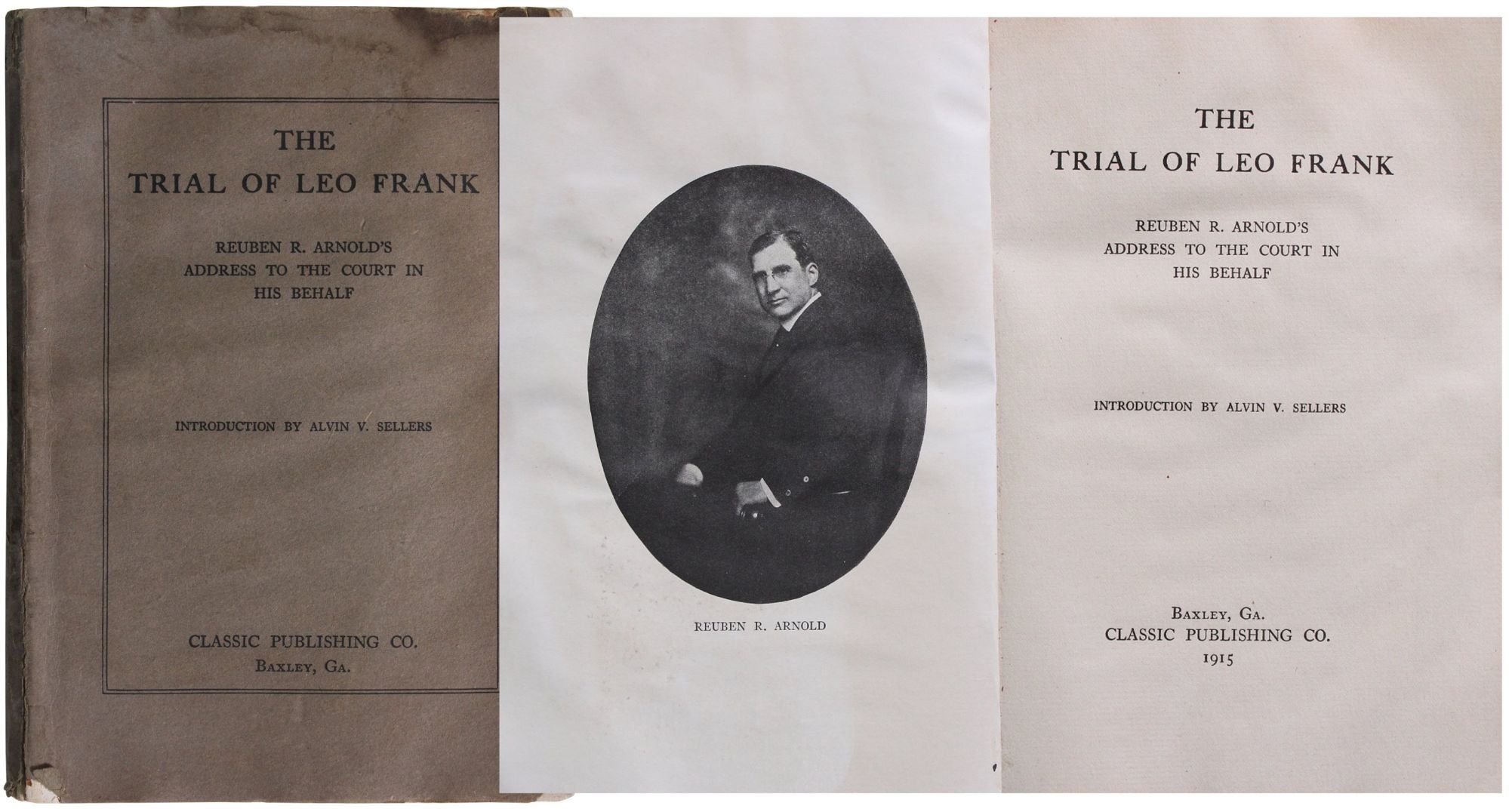
- Baxley, GA: Classic Publishing Co, 1915
Baxley, GA: Classic Publishing Co, 1915. First Edition. Good. 7¾” x 5 3/8”. Paper wrappers. Pp. 69 (including author frontis) + [2] pp. publisher's ads at rear + 2 photographic plates tipped in. Good: front wrap moderately chipped, lower third split at spine; evidence of water damage with large stain to first (halftitle) page; a bit stiff and wavy throughout.
This is the first printing of a defense attorney's heart-wrenching post-trial speech. It was addressed to the trial court in the Leo Frank case; a trial rife with misallegations, steeped in issues of racism, antisemitism and child labor, that resulted in a lynching and major implications for the Jewish population of Georgia.
Leo Frank was a Jewish community leader and superintendent of the National Pencil Company factory in Atlanta in 1913, when Mary Phagan, a 13-year-old girl who worked at the factory, was found beaten, strangled and likely raped in its cellar. Largely based on the testimony of Jim Conley, an African American janitor at the factory, Frank was convicted of murder and sentenced to death. Upon appeals, the last of which occurred in April 1915, his sentence was reduced to life in prison. Four months later, he was kidnapped from his cell by a group of armed men and lynched in Marietta, Mary's hometown. The case drew national media attention and fueled antisemitism and ire. At a 1913 conference on emerging child labor concerns, participants partly blamed Jewish factory owners. The lynchers, while locally known, were never identified or charged. Around half of Georgia's 3,000 Jews left the state.
The case was referenced in the 1913 founding of the AntiDefamation League, and likely contributed to the revival of the Ku Klux Klan, which occurred just one month after the lynching. The general consensus among researchers is of the innocence of Leo Frank.
In the present speech, addressed in the month that his client had been sentenced to be hanged, Frank's attorney Reuben Arnold declared that “It takes thirteen jurors to murder a man in cold blood” and that he felt “not only justified but required . . . to argue to the court the facts of this unusual case, and to give the reasons why the verdict of guilty should be set aside.” Arnold particularly chastised the spectacle that the trial had become:
“And how deadly is the spirit of the mob! . . . Sentiment, prejudice, excitement, had taken the place of justice . . . Argument was lost upon that jury . . . The cry rang out, 'The Jew did it.' Slanders against Frank were poured in the people’s ears. He was locked up in jail and had no chance to meet them. The seeds of prejudice were sown broadcast and Frank was condemned in the public mind.”
An important work in legal and Jewish history, traversing myriad social issues. Reasonably well-represented in institutions.
This is the first printing of a defense attorney's heart-wrenching post-trial speech. It was addressed to the trial court in the Leo Frank case; a trial rife with misallegations, steeped in issues of racism, antisemitism and child labor, that resulted in a lynching and major implications for the Jewish population of Georgia.
Leo Frank was a Jewish community leader and superintendent of the National Pencil Company factory in Atlanta in 1913, when Mary Phagan, a 13-year-old girl who worked at the factory, was found beaten, strangled and likely raped in its cellar. Largely based on the testimony of Jim Conley, an African American janitor at the factory, Frank was convicted of murder and sentenced to death. Upon appeals, the last of which occurred in April 1915, his sentence was reduced to life in prison. Four months later, he was kidnapped from his cell by a group of armed men and lynched in Marietta, Mary's hometown. The case drew national media attention and fueled antisemitism and ire. At a 1913 conference on emerging child labor concerns, participants partly blamed Jewish factory owners. The lynchers, while locally known, were never identified or charged. Around half of Georgia's 3,000 Jews left the state.
The case was referenced in the 1913 founding of the AntiDefamation League, and likely contributed to the revival of the Ku Klux Klan, which occurred just one month after the lynching. The general consensus among researchers is of the innocence of Leo Frank.
In the present speech, addressed in the month that his client had been sentenced to be hanged, Frank's attorney Reuben Arnold declared that “It takes thirteen jurors to murder a man in cold blood” and that he felt “not only justified but required . . . to argue to the court the facts of this unusual case, and to give the reasons why the verdict of guilty should be set aside.” Arnold particularly chastised the spectacle that the trial had become:
“And how deadly is the spirit of the mob! . . . Sentiment, prejudice, excitement, had taken the place of justice . . . Argument was lost upon that jury . . . The cry rang out, 'The Jew did it.' Slanders against Frank were poured in the people’s ears. He was locked up in jail and had no chance to meet them. The seeds of prejudice were sown broadcast and Frank was condemned in the public mind.”
An important work in legal and Jewish history, traversing myriad social issues. Reasonably well-represented in institutions.
Details
Title
The Trial of Leo Frank . .
Author
Arnold, Reuben R.
Condition
Good
Publisher
Classic Publishing Co: Baxley, GA
Date
1915
Edition
First Edition