

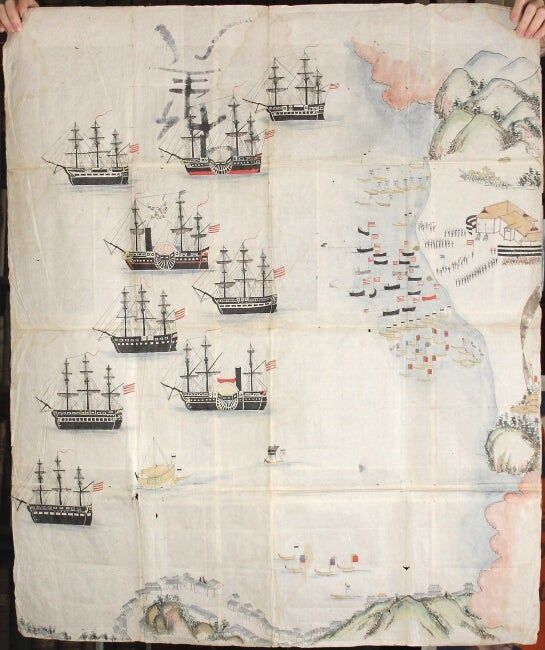
Contemporary Japanese rendition of the signing of the treaty at Kanagawa
- N.p., n.d. [Japan , 1854
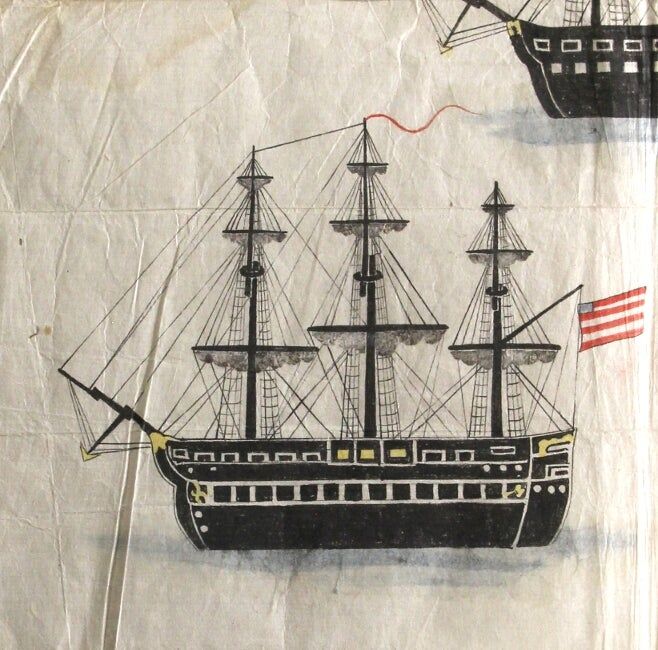
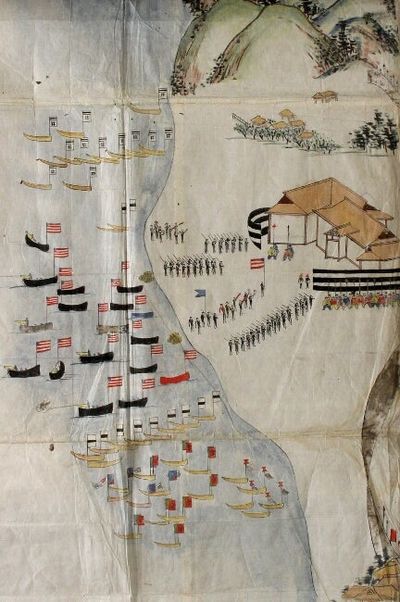
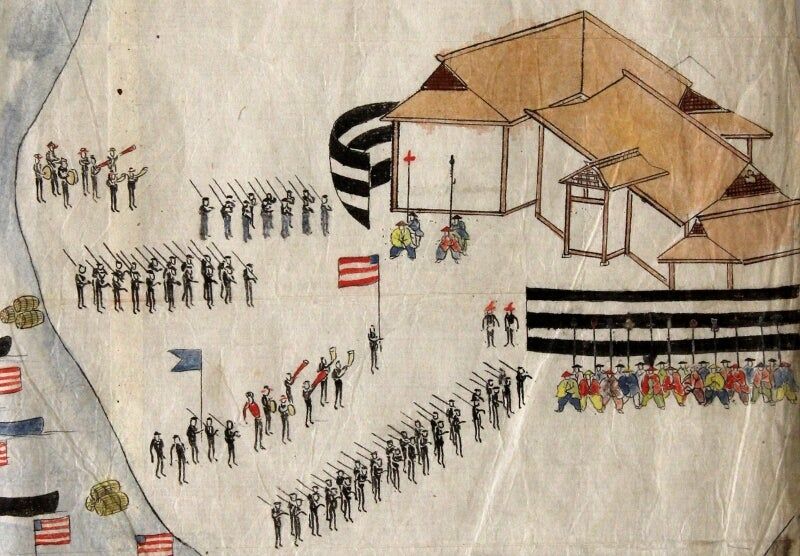
N.p., n.d. [Japan, 1854. Pictorial record of US Commodore Matthew Perry's second visit to Japan in 1854, and the signing of the famous treaty at Kanagawa. Approx. 41" x 34½", watercolor and ink on paper; old folds, several insignificant breaks at the creases; some show-through from a large Japanese character on the verso; otherwise in very good condition. A contemporary rendering of the signing of the treaty, showing Perry's nine black ships in the harbor (Perry's flagship the Steamer Mississippi, Steamer Powhatan, Steamer Susquehanna, Sloop-of-war Macedonian, Sloop-of-war Plymouth, Sloop-of-war Saratoga, Sloop-of-war Vandalia, Storeship Southampton, and Storeship Lexington); the surrounding harborfront, the cordoned security area and treaty house prepared on the shore at Yokohama where the treaty was signed, formations and drills by the US Marines, accompanied by a military band, Japanese warriors, assorted American and Japanese small craft along the shore, and other details. In July 1853 Perry arrived in Japan with four warships. He was bearing a letter from President Millard Fillmore requesting the establishment of trade relations with Japan. Perry left shortly afterwards, stating that he would return in a year to hear Japan's answer. Eight months later Perry returned with nine warships - a considerable show of force and firepower. After initial resistance, Perry was permitted to land at Kanagawa, near the site of present-day Yokohama on March 8. The Convention of Kanagawa was signed on March 31. According to the terms of the treaty, Japan would protect stranded seamen and open two ports for refueling and provisioning American ships: Shimoda and Hakodate. Japan also gave the United States the right to appoint consuls to live in these port cities, a privilege not previously granted to foreign nations. This treaty was not a commercial treaty, and it did not guarantee the right to trade with Japan. Still, in addition to providing for distressed American ships in Japanese waters, it contained a most-favored-nation clause, so that all future concessions Japan granted to other foreign powers would also be granted to the United States. As a result, Perry's treaty provided an opening that would allow future American contact and trade with Japan. Much of the following comes from John W. Dower's excellent online "Visualizing Cultures" project, which uses visual materials to reexamine the experience of Japan and China in the modern world. His "Black Ships & Samurai" is the most detailed English-language account of Perry's visits and the pictorial works to which they gave rise is the online resource at https[:]//visualizingcultures[.]mit[.]edu/black_ships_and_samurai/index[.]html. "On the Japanese side, there was no official visual record of these encounters, although we know from accounts of the time that boatloads of Japanese artists and illustrators rushed out to draw the "black ships" from virtually the moment they appeared off Uraga. What we have instead of a consolidated official collection is a scattered treasury of graphic renderings of various aspects of the startling foreign intrusion ... Japanese artists, moreover, rendered their impressions through forms of expression that differed from the lithographs, woodcuts, paintings, and photographs that Europeans and Americans of the time relied on in delineating the visual world. Vivacious woodblock prints, cruder runs of black-and-white "kawaraban" broadsheets, and drawings and brushwork in a conspicuously "Japanese" manner constituted the primary vehicles through which the great encounters of 1853 and 1854 were conveyed to a wider audience in Japan. Some of this artwork spilled over into the realm of caricature and cartoon ... Other artists, meanwhile, rendered the foreign intrusion from afar with panoramic views of the American squadrons anchored in Japanese waters. Such graphics, done in both color and black-and-white, often were designed to convey detail concerning not only the black ships but also the surrounding terrain" (as here). "There was, moreover, no counterpart on the Japanese side to the official artists employed by Perry-and thus no Japanese attempt to create a sustained visual (or written) narrative of these momentous interactions. What we have instead are representations by a variety of artists, most of whose names are unknown. Their artistic conventions differed from those of the Westerners. Their works were reproduced and disseminated not as lithographs and engravings or fine-line woodcuts, but largely as brightly colored woodblock prints as well as black-and-white broadsheets (kawaraban). They also painted in formats such as unfolding "horizontal scrolls" (emaki) that had no counterpart in the West. It was common for such scrolls to be 20 or 30 feet long, and in some cases they inspired variant copies.
Details
Title
Contemporary Japanese rendition of the signing of the treaty at Kanagawa
Condition
Unknown
Publisher
N.p., n.d. [Japan
Date
1854