

A Lengthy Philip Wylie Letter About His Influences And His Writing Life: Nobody's Born With The Typewriter In His Fingers. A Few True Geniuses, Like Mozart, May Attain Professional Status In Childhood. Writers Of My Sort, However Are More Akin To Concert Pianists And Violinists Too, Even At Their Peaks, Still Practice 5 Hours A DayYou Work Harder Than Anybody. Even, DoctorsTo Make Writing A Career Is To Decide To Spend Most Of Your Life Alone
- SIGNED
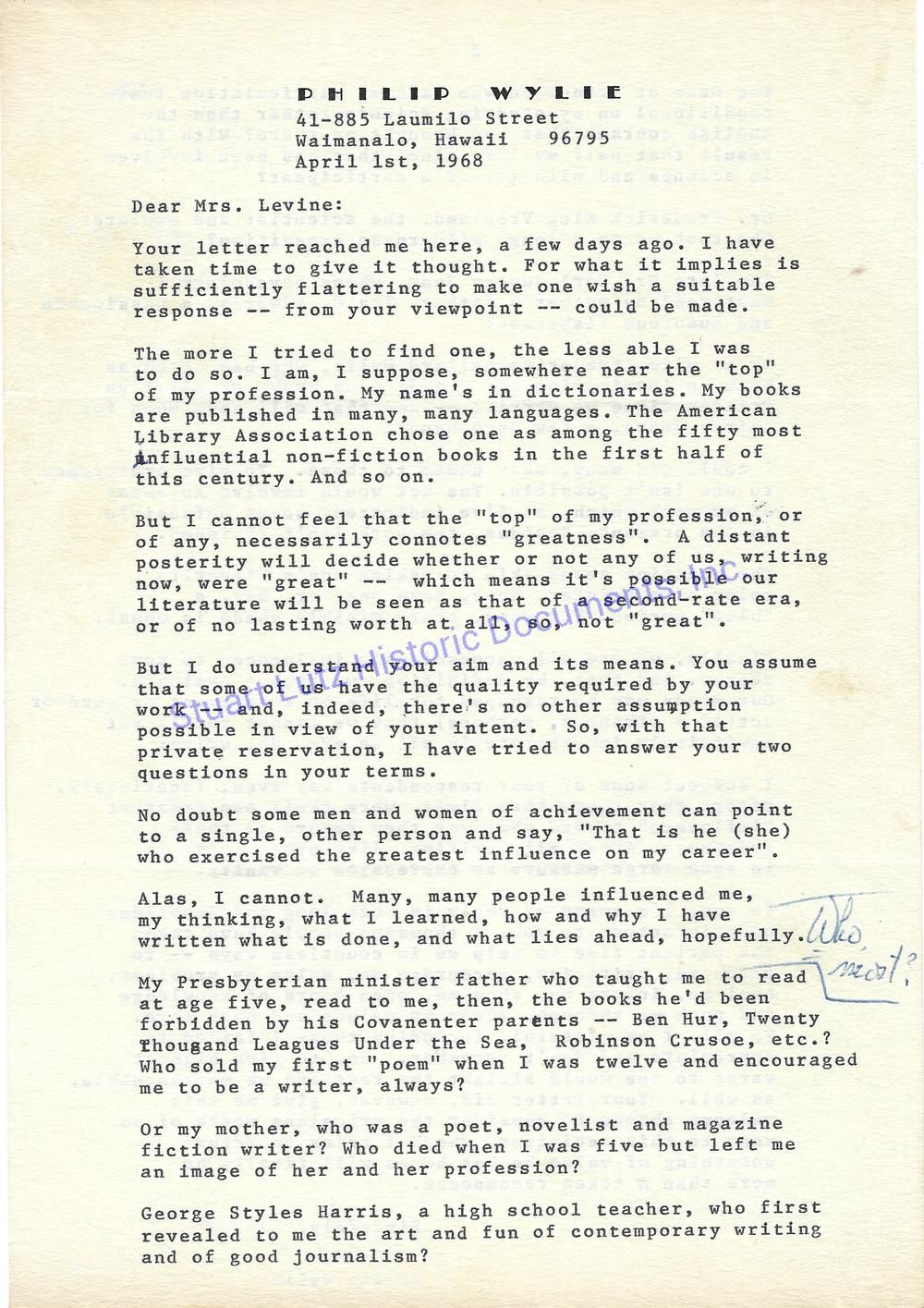
PHILIP WYLIE (1902-1971). Wylie was a prolific American author of mysteries, science fiction and satire; his best-known book may be When Worlds Collide.TLS. 7 x 10. 5pgs. April 1, 1968. Hawaii. A very lengthy typed letter signed Philip Wylie and initialed P.W.. He wrote to Mrs. Levine about his life and influences: Your let her reach me here, a few days ago. I have taken time to give a thought. For what it implies is sufficiently flattering to make one wish a suitable response - from your viewpoint - could be made I am, I suppose, somewhere near the top of my profession. My name's in dictionaries. My books are published in many many languages. The American Library Association chose one as among the 50 most influential nonfiction books in the first half of this century. And so on. But I cannot feel that the top of my profession, or of any, necessarily connotes greatness. A distant posterity will decide whether or not any of us, writing now, were great - which means it's possible our literature will be seen as that of a second-rate era, or of no lasting worth at all, so, not greatNo Doubt some men and women of achievement can point to a single, other person and say, That is he (she) who exercised the greatest influence on my career. Alas, I cannot. Many, many people influence me, my thinking, what I learned, how and why I've written what is done, and what lies ahead, hopefully. My Presbyterian minister father who taught me to read at age five, read to me, then, the books had been forbidden by his Covenanter parents - Ben Hur, Twenty Thousand Leagues Under The Sea, Robinson Crusoe, etc. Who sold my first poem when I was twelve and encouraged me to be a writer, always? Or my mother, who was a poet, novelist and magazine fiction writer? Who died when I was five but left me an image of her and her profession? George Styles Harris, A high school teacher, who first revealed to me the art and fun of contemporary writing and of good journalism? The Dean at Princeton who made my matriculation conditional on my studying science rather than the English courses that had brought me there? With the result that half my life since then has been involved in science, and with it, is a participant? Dr. Frederick King Vreeland, the scientist and explorer who took me on a long, wilderness expedition at 18? The late Dr. Carl Gustav Jung, whose psychology I mastered? My mother's father, Ira C. Edwards, a passionate and humorous fisherman?... I could add many, many names to those period to give preference to 1 isn't possible. The act would involve an assay of my work which, as I've indicated, seems unfeasible in the present period besides, the work isn't finished... Finally, we are all unconsciously influenced to some degree. And that, by definition, we cannot evaluate. Our minds may be reshaped for life by some event or word or act (of a stranger, perhaps) that we cannot recall yet unwittingly incorporate in all we are, do, writeA thousand people have taken the patient time to help me in countless ways - to teach me, criticize, encourage me, solve my problems, heal me, inform me, show me, opened doors and knowledge and pushed me through, alter my values and much more Aptitude may be inborn - but the use made of it may be owing to individual nature and its response to environment. I cannot, however, subscribe to the idea that some men are born great and others have greatness thrust upon them.' rather, to whatever degree my own work merits such a term, I tend to feel the infinite capacity for taking pains is the more complete explanation. And here, for me the correlative of pain has been interminable and relentless practice. I typed a trunkful of MS before I made any significant sale. For every book published, I have more than one, finished near to it, or half done, that I've discarded. In every form and style I have liked, and in all the classical forms, I have practice until I gained a decent competence. Moreover, I regarded every word I wrote, whether for a tin can label or a letter, is valuable to me - more practice. Nobody's born with the typewriter in his fingers. A few true geniuses, like Mozart, may attain professional status in childhood. Writers of my sort, however are more akin to concert pianists and violinists too, even at their peaks, still practice 5 hours a day. Influence, then may relate to that above all: to persistence, even, indomitability. People who have observed me at work over any long time have often said, you work harder than anybody. Even, doctors. And I often say to classes in creative writing, that to make writing a career is to decide to spend most of your life alone. And to that, I add, another belief, that a person who wants to be a writer will write, unflaggingly, all his or her days, even though not one single fragment of the writing is accepted for publication, ever. Who, then, provides that influence? That basic wheel to work, whatever the external situation, whatever the procession of failure? That drive? Four, in equating practice (irrespective of success) to the mere hope of professional triumph, I have implied it to be the fundamental attribute of or characteristic required for even the attempt toward success, let alone, greatness.
Details
Title
A Lengthy Philip Wylie Letter About His Influences And His Writing Life: Nobody's Born With The Typewriter In His Fingers. A Few True Geniuses, Like Mozart, May Attain Professional Status In Childhood. Writers Of My Sort, However Are More Akin To Concert Pianists And Violinists Too, Even At Their Peaks, Still Practice 5 Hours A DayYou Work Harder Than Anybody. Even, DoctorsTo Make Writing A Career Is To Decide To Spend Most Of Your Life Alone
Author
PHILIP WYLIE
Condition
Unknown
Pages
0