

SIGNED BY 18 NOTABLES. Dinner in Honor of Doctor A. Jacobi on the Seventieth Anniversary of his birthday, Saturday, May the fifth,, nineteen hundred, at Delmonico's [original 3-leaf program/menu], TOGETHER WITH Proceedings and Addresses at the Complimentary Dinner Tendered to Dr. A. Jacobi on the Occasion of the Seventieth Anniversary of His Birthday, May 5, Nineteen Hundred, TOGETHER WITH "Festschrift" in Honor of Abraham Jacobi, M.D., LL.D., to Commemorate the Seventieth Anniversary of His Birth, May Sixth, 1900
- SIGNED
- New York: Tiffany & Co. (program/menu), The Knickerbocker Press (Festschrift), 1900
New York: Tiffany & Co. (program/menu), The Knickerbocker Press (Festschrift), 1900. First editions.
RARE PROGRAM/MENU FOR DINNER IN HONOR OF ABRAHAM JACOBI'S 70TH BIRTHDAY--SIGNED BY JACOBI AND 17 NOTABLE ATTENDEES, TOGETHER WITH BOUND PUBLISHED PROCEEDINGS AND FESTSCHRIFT VOLUME PRESENTED TO HONOREE.
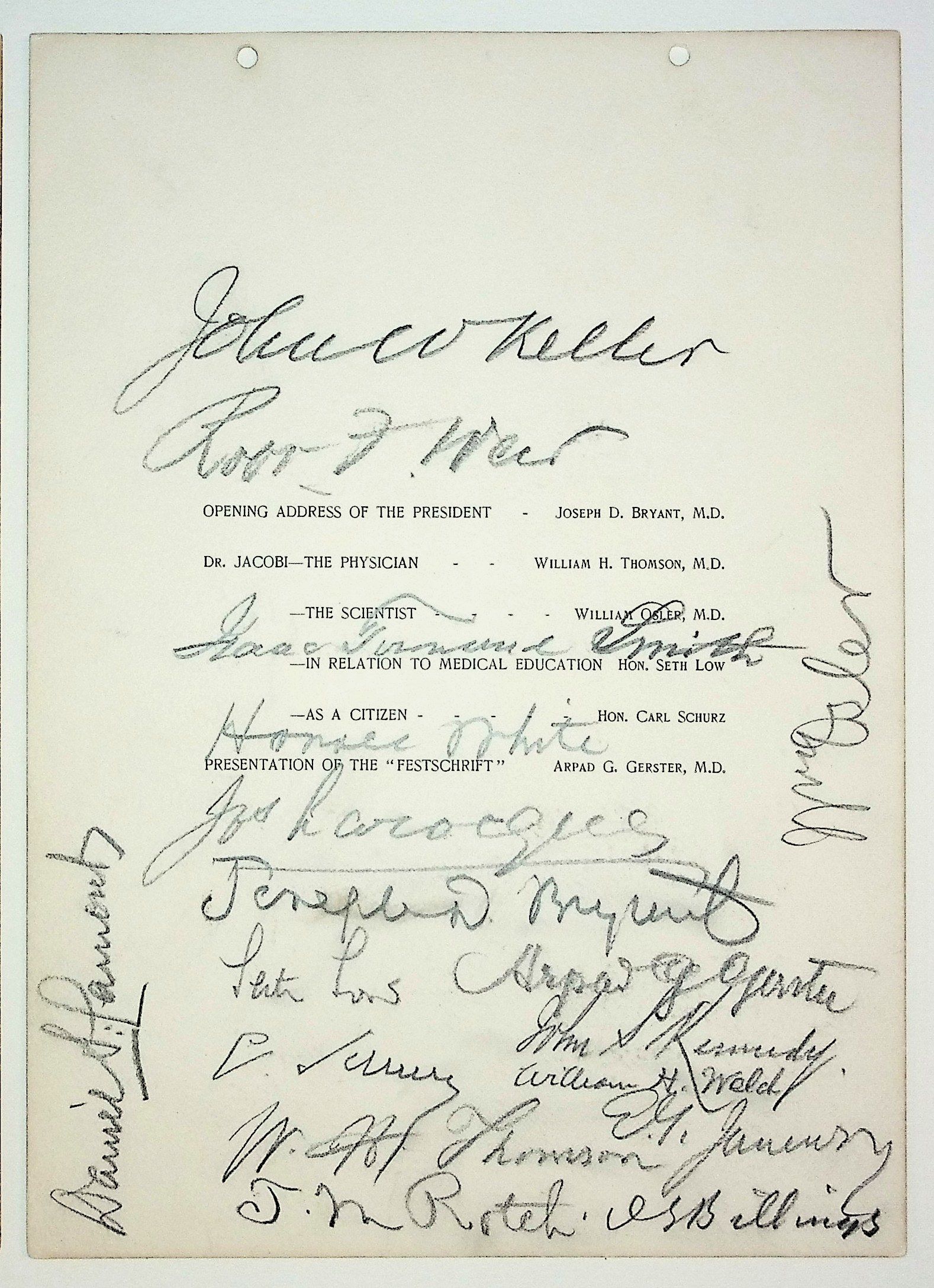
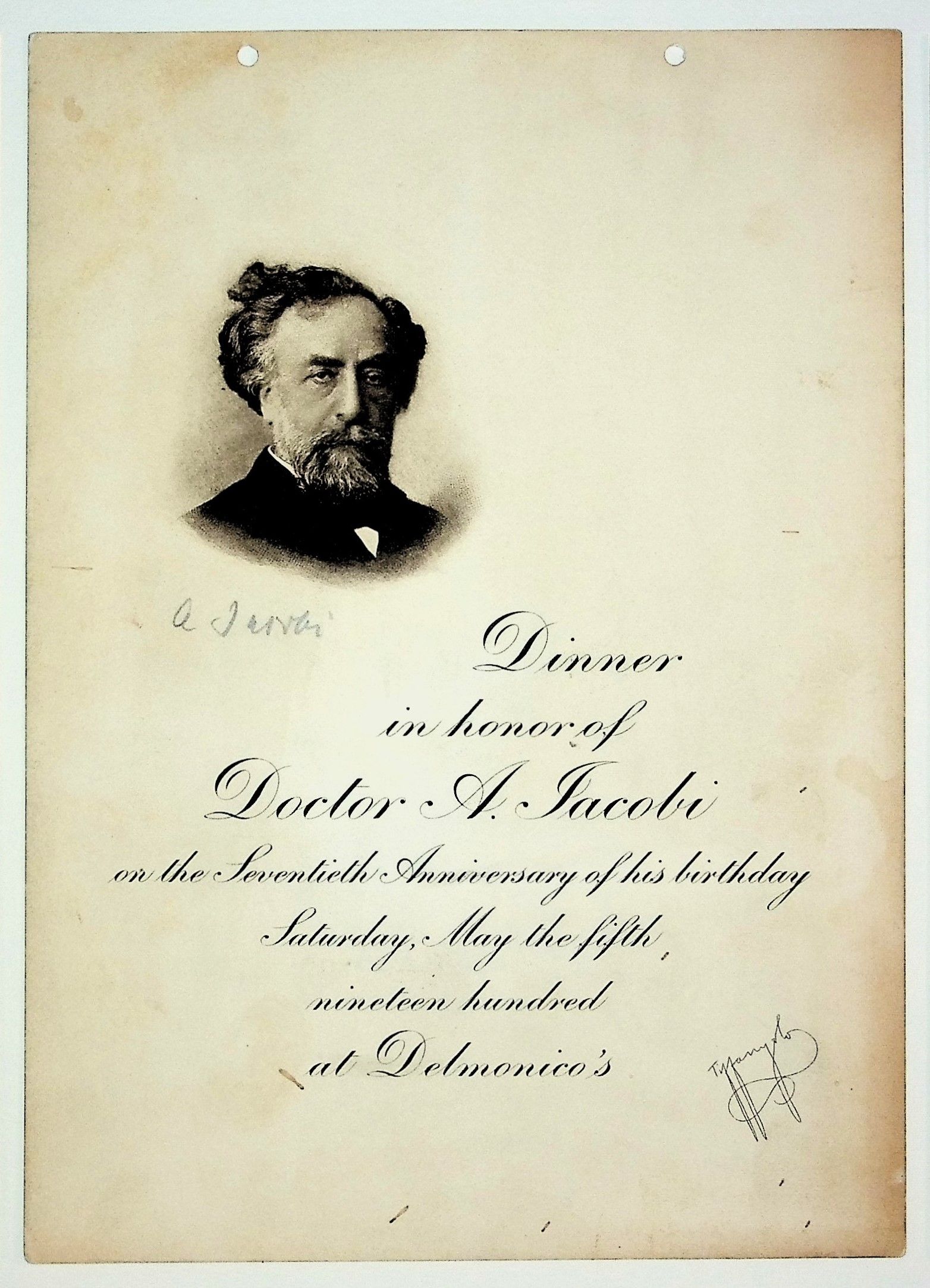
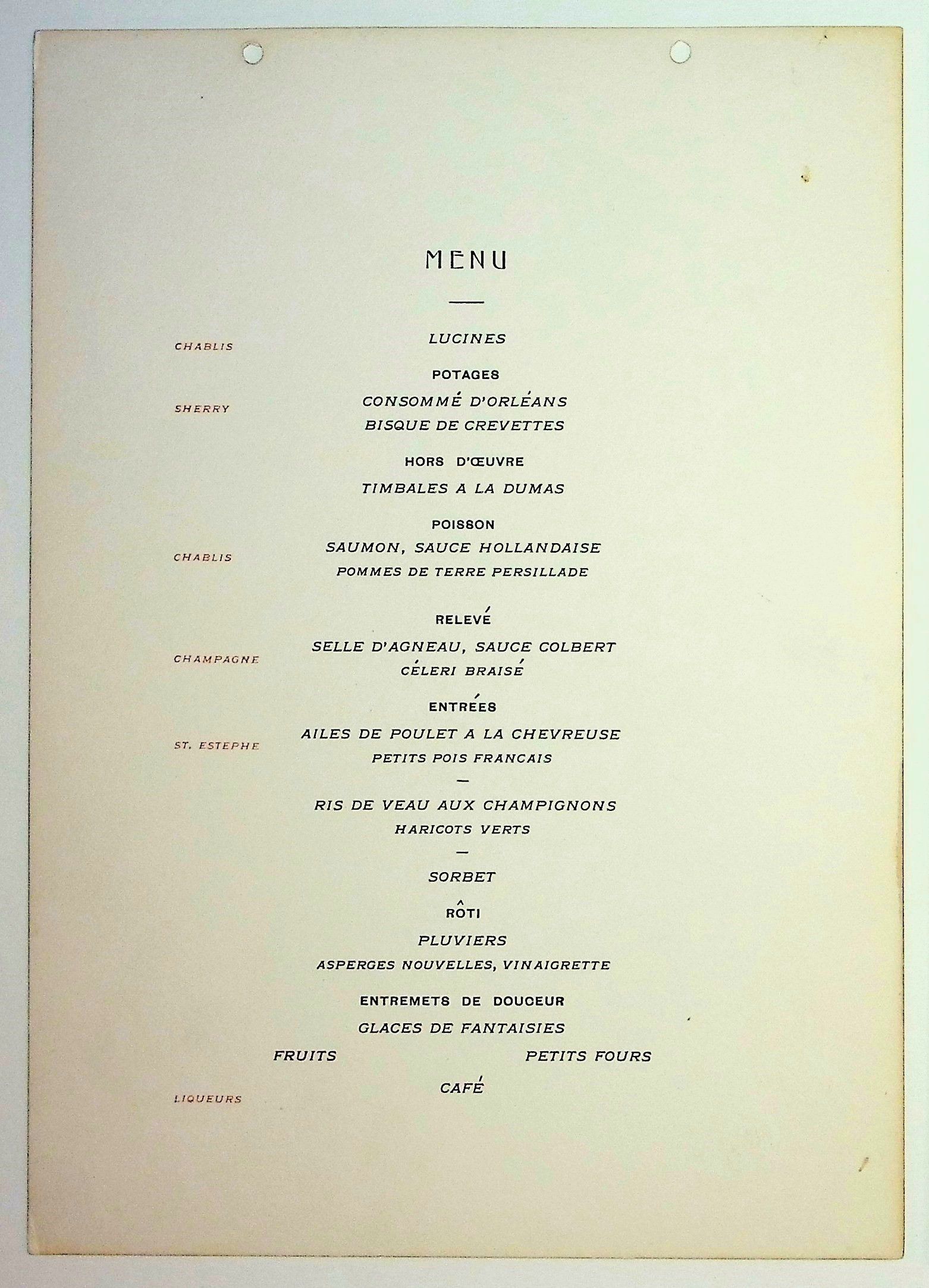
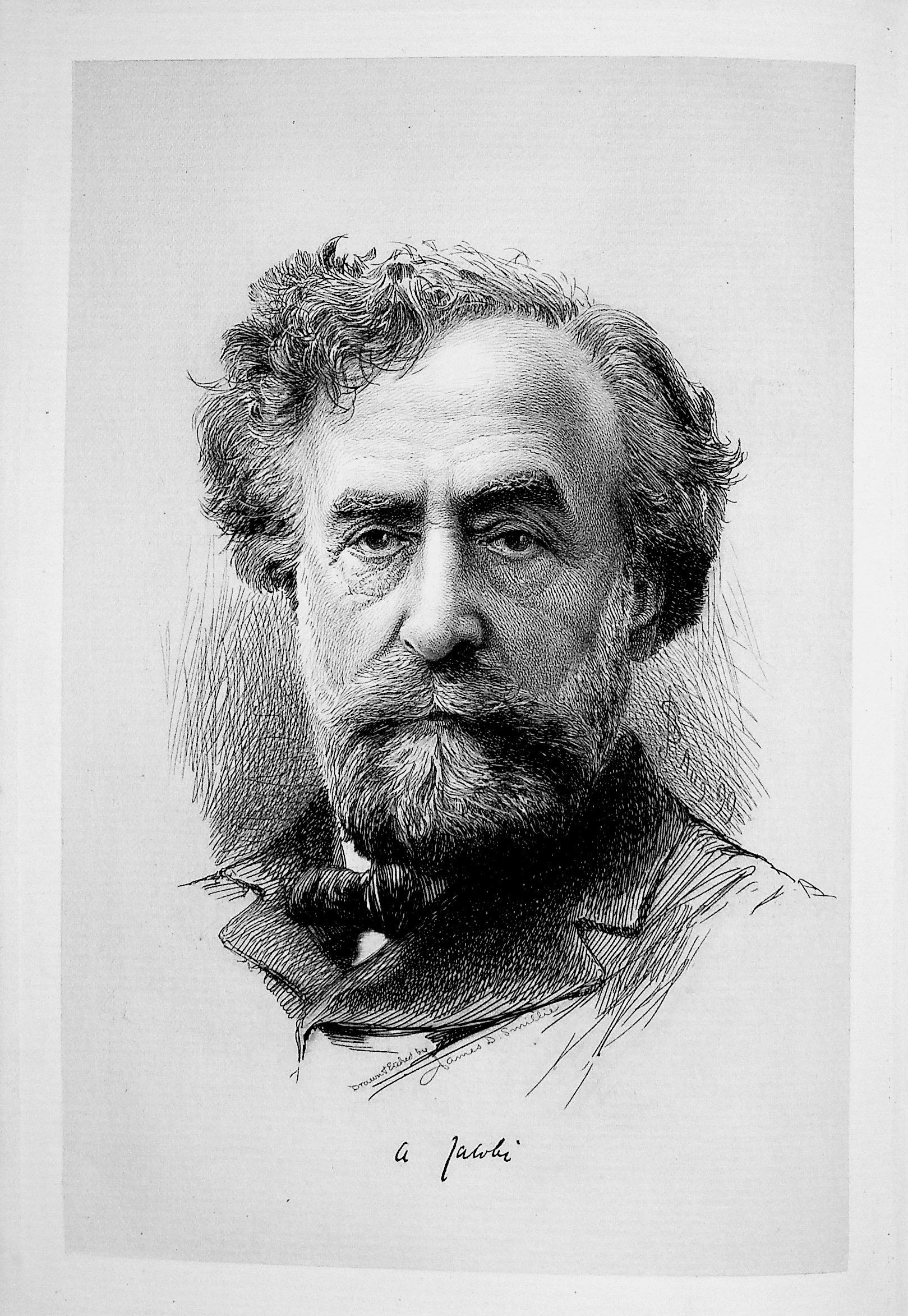
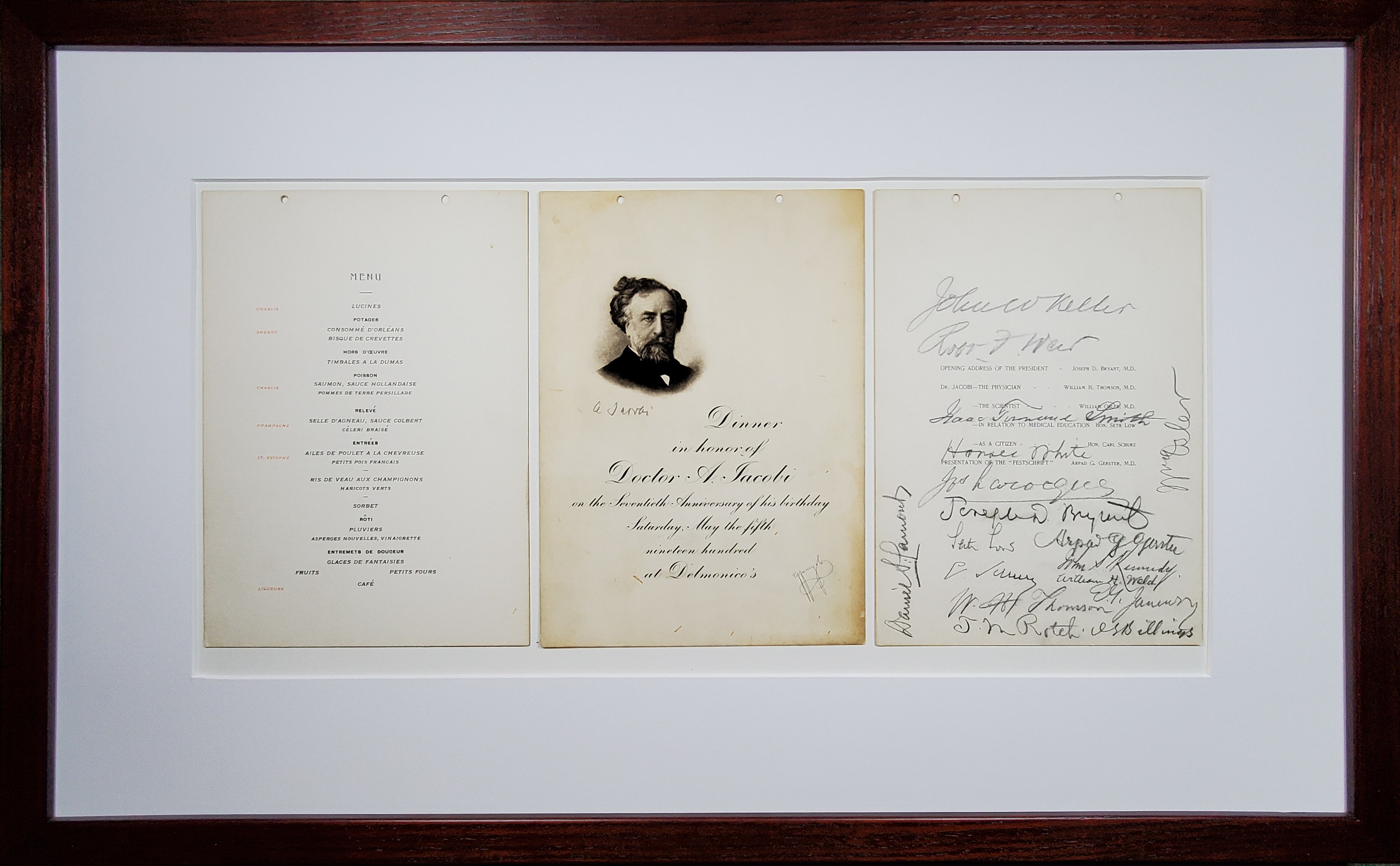
1) Program of "Dinner in Honor of Doctor A[braham] Jacobi on the Seventieth Anniversary of His Birthday Saturday, May the Fifth, Nineteen Hundred at Delmonico's." Three leaves 15.8x22.3 cm printed on fine card stock by Tiffany & Co., each with 2 small holes at top for binding by ribbon. Menu, program cover with engraved portrait of Jacobi with his pencil signature below, and program with pencil signature of 17 attendies. Framed in 41.5x66.5 cm dark wooden frame with ribbon tie in pouch attached to back of frame. Browning to page edges, otherwise very good.
SIGNERS OF THE PROGRAM:
John Shaw Billings (1838 - 1913) was an American librarian, building designer, and surgeon who modernized the Library of the Surgeon General's Office in the United States Army. His work with Andrew Carnegie led to the development and his service as the first director of the New York Public Library. Billings oversaw the building of the Surgeon General's Library, which was the nation's first comprehensive library for medicine.
Joseph Decatur Bryant (1845 - 1914) was a surgeon, New York City Health Commissioner, Surgeon-General of the National Guard Surgeons, and physician to Grover Cleveland and John D. Rockefeller. He also held a series of academic positions at Bellevue Hospital Medical College, culminating with the title of professor of the principles and practice of surgery, and professor of operative and clinical surgery, at New York University and Bellevue Hospital Medical College.
Arpad Geyza Charles Gerster (1848-1923) A surgeon who practiced at Mt. Sinai in New York City in the late 1890s and early 1900s. Hungarian by birth, he was also a sportsman, linguist, and an artist. Gerster's vivid, often humorous observations of nature and people, his delight in the outdoors, and his drawings and etchings offer a larger portrait of the Adirondack region in the age of William West Durant, Great Camps, railroads, and the beginning of the conservation movement.
Abraham Jacobi (1830 - 1919) was a German physician and pioneer of pediatrics. He was a key figure in the movement to improve child healthcare and welfare in the United States and opened the first children's clinic in the country. To date, he is the only foreign-born president of the American Medical Association. He is regarded as the Father of American Pediatrics.
Edward Gamaliel Janeway (1841 - 1911) was an American physician who served as Health Commissioner of New York, and as president of the New York Medical Journal Association in the late nineteenth century. He was considered "one of America's premier internists in the late nineteenth and early twentieth centuries".
John W. Keller (1856 -1919) was a New York newspaper man, member of Tammany Hall, and in 1900 was a delegate to the National Democratic Convention and his name was presented by the New York delegation for the Vice Presidency. From 1898 to 1902 he was Commissioner of Public Charities in New York city.
John Stewart Kennedy (1830 - 1909) was a Scottish-born American businessman, financier and philanthropist. He was a member of the Jekyll Island Club (also known as The Millionaires' Club) on Jekyll Island, Georgia along with J.P. Morgan and William Rockefeller among others.
Daniel Scott Lamont (1851 - 1905) was the United States Secretary of War during Grover Cleveland's second term. After his service as Secretary of War, Lamont was vice president of the Northern Pacific Railway Company from 1898 to 1904. In August 1904, he was supported by the New York Times as a candidate for Governor of New York.
Joseph Larocque (1831 - 1908) was a New York City lawyer and president of the New York City Bar Association. Larocque was a director of several companies, including the American Cotton Oil Company, the Commonwealth Insurance Company of New York, Niagara Falls Power Company, and Plaza Bank. He also served on the boards of a number of New York City institutions, including the Metropolitan Museum of Art, the Century Club, and Columbia University.
Seth Low (1850 - 1916) was an American educator and political figure who served as the mayor of Brooklyn from 1881 to 1885, the president of Columbia University from 1890 to 1901, a diplomatic representative of the United States, and the mayor of New York City from 1902 to 1903.
William Osler, (1849 - 1919) was a Canadian physician and one of the founding professors of Johns Hopkins Hospital. In 1889, he became the first Physician-in-Chief of the new Johns Hopkins Hospital in Baltimore, Maryland. In 1893, Osler was instrumental in creating the Johns Hopkins School of Medicine and became one of the school's first professors of medicine.
Thomas Morgan Rotch (1849 - 1914) graduated from Harvard College in 1870, and from Harvard Medical School in 1874. He was the president of the American Pediatric Society for 1890â"91 and America's first full professor of pediatrics.
Carl Schurz (1829 - 1906) was a German-American revolutionary and an American statesman, journalist, and reformer. He migrated to the United States after the German revolutions of 1848â"1849 and became a prominent member of the new Republican Party. In 1868, he was elected to the United States Senate from Missouri, becoming the first German American in that body. He supported William Jennings Bryan's anti-imperialist campaign in the 1900 presidential election. Schurz lived in a summer cottage in Northwest Bay on Lake George, New York which was built by his good friend Abraham Jacobi.
Isaac Townsend Smith (1813 - 1906) was one of the incorporators of the Metropolitan Savings Bank of New York and was for many years its president. He was also Commissioner of Immigration for the state of New York, and a presidential elector in 1864, when Abraham Lincoln was reelected. For the following 50 years, Smith was in intimate touch with the Siamese government, as its financial agent, Consul and Consul General.
William Hanna Thomson (1833 - 1918) was assistant physician at Quarantine Hospital in New York and physician to the Charity Hospital, consulting physician to Roosevelt Hospital and Bellevue Hospital, Professor of Medicine at New York University Medical College, a member of the New York Neurological Society, and President of the New York Academy of Medicine during 1899â"1900.
Robert Fulton Weir (1837 - 1927) professor of surgery in the College of Physicians and Surgeons, from 1873 to 1903, and President of The New York Academy of Medicine from 1900 to 1903. His wide experience was gained chiefly in the Civil War, in which he served as surgeon in charge of the hospital of Frederick, Maryland, one of the largest Government hospitals, from 1862 to 1865.
William Henry Welch (1850 - 934) was an American physician, pathologist, bacteriologist, and medical school administrator. He was one of the founding professors at the Johns Hopkins Hospital and the first dean of the Johns Hopkins School of Medicine. He was also the founder of the Johns Hopkins School of Hygiene and Public Health, the first school of public health in the country.
Horace White (1865 - 943) was a member of the New York State Senate from 1896 to 1908 and Lieutenant Governor of New York from 1909 to 1910. White, who was the nephew of Cornell's first President, Andrew Dickson White, left three-quarters of his estate to the university, and that fund had grown to $1.5 million by 1973.
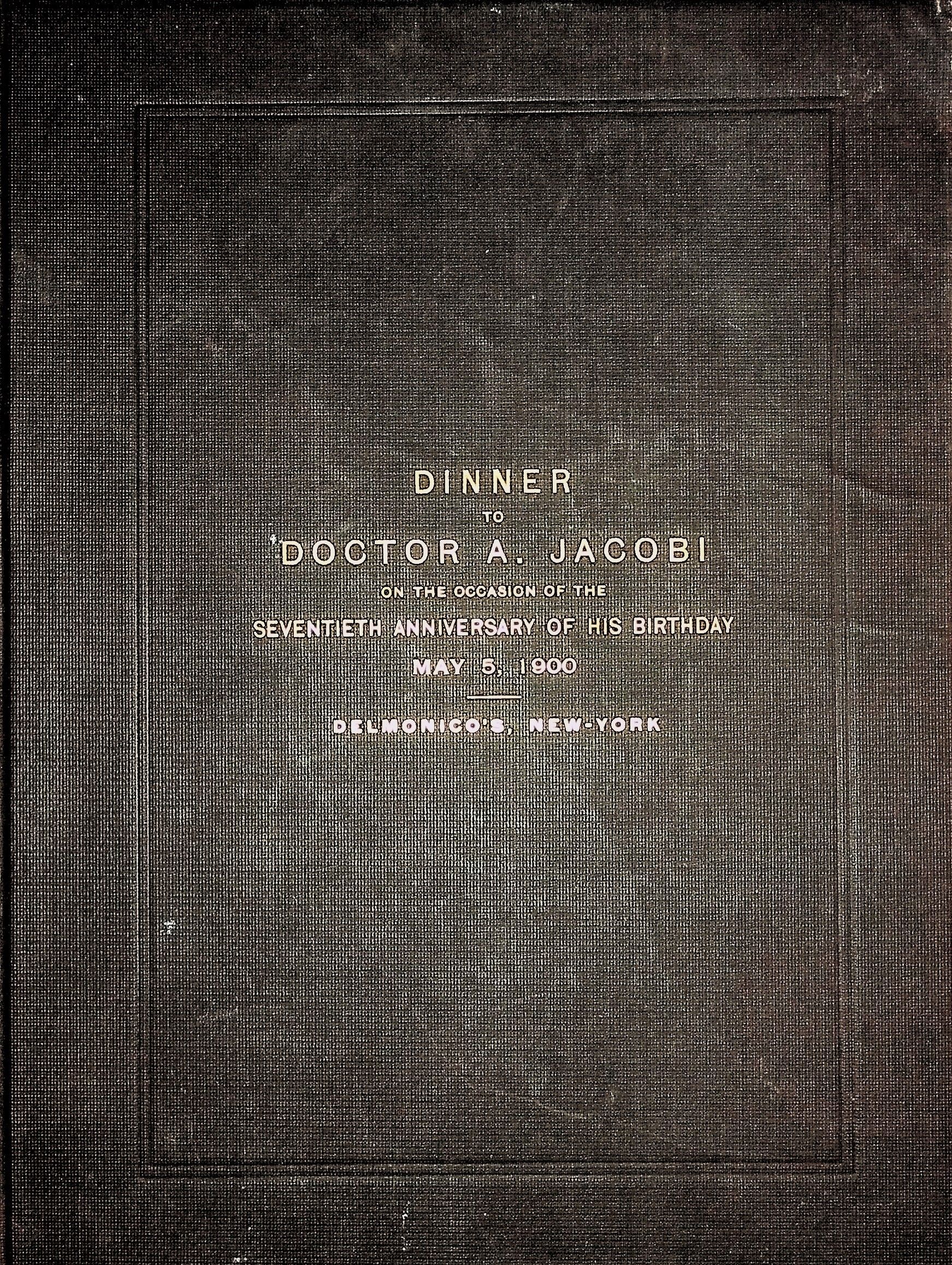
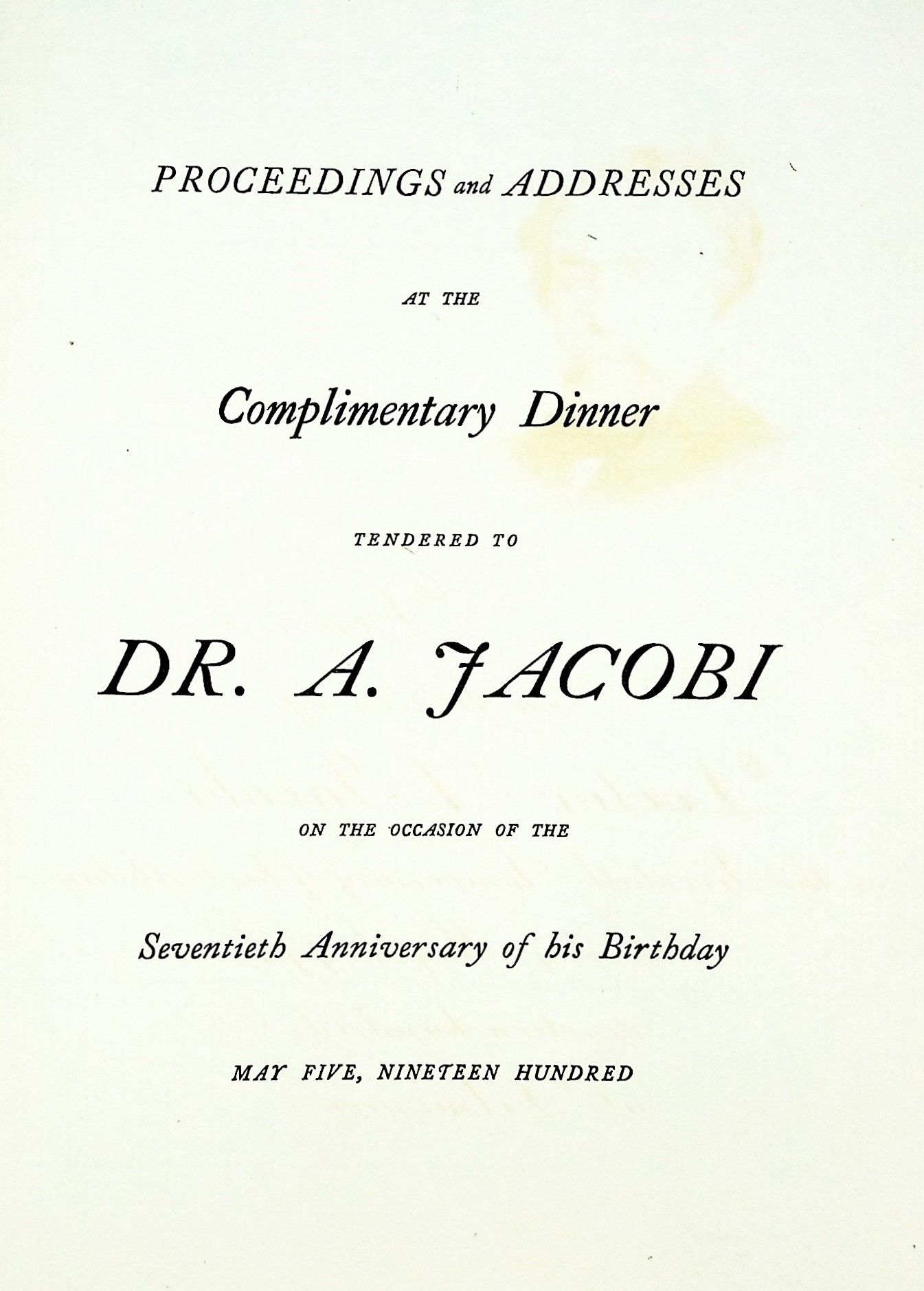
2) Proceedings and Addresses at the Complimentary Dinner Tendered to Dr. A. Jacobi on the Occasion of the Seventieth Anniversary of His Birthday, May 5, Nineteen Hundred. 18.5x25.5 cm hardcover, black cloth binding, gilt title to cover, covers with beveled edges, top edge gilt, floral endpapers, engraved frontispiece including portrait of Jacobi (reproducing first leaf of dinner program), 74 pp, including the following: i) Introductory Note by the committee of physicians and laymen convened to celebrate Jacobi's 70th birthday, "a fit occasion for a hearty manifestation of the esteem in which Dr. Jacobi is held, and for a recognition of the services he has rendered, in various relations--during the course of almost fifty yearsâ"as a physician, educator and civic worker. It was felt also that such an occasion would afford an appropriate setting for the unusual honor to be paid Dr. Jacobi in the presentation of a 'Festschrift,' comprising original contributions to medical literature, dedicated to him by fifty physicians and scientists, including many of the most prominent, in all parts of the world." ii) Address of Dr. Joseph D. Bryant, Chairman; iii) Poem of Dr. S. Weir Mitchell: 'Abraham Jacobi, Medicus, Magister, Amicus'; iv) Address of Dr. William H. Thomson: 'Jacobi the Physician'; v) Address of Dr. William Osler: 'The Scientist'; vi) Address of the Honorable Seth Low: 'In Relation to Medical Education'; vii) Address of the Honorable Carl Schurz: 'The Citizen'; viii) Address of Dr. Arpad G. Gerster: Presentation of the 'Jacobi Festschrift, "Mr. Chairman, I hold in my hand a volume containing the scientific contributions of fifty-three medical men of note, men representing two continents and eleven nations"; ix) Remarks of Dr. Francis Foerster presenting the address of the German Hospital; x) Remarks of Dr. Emil Gruening presenting the resolutions for Mount Sinai Hospital; 10) Address of Dr. Jacobi: The Guest of the Evening; xi) Letters and Telegrams Received; xii) Subscribers to the Dinner. Very good in custom archival mylar cover.
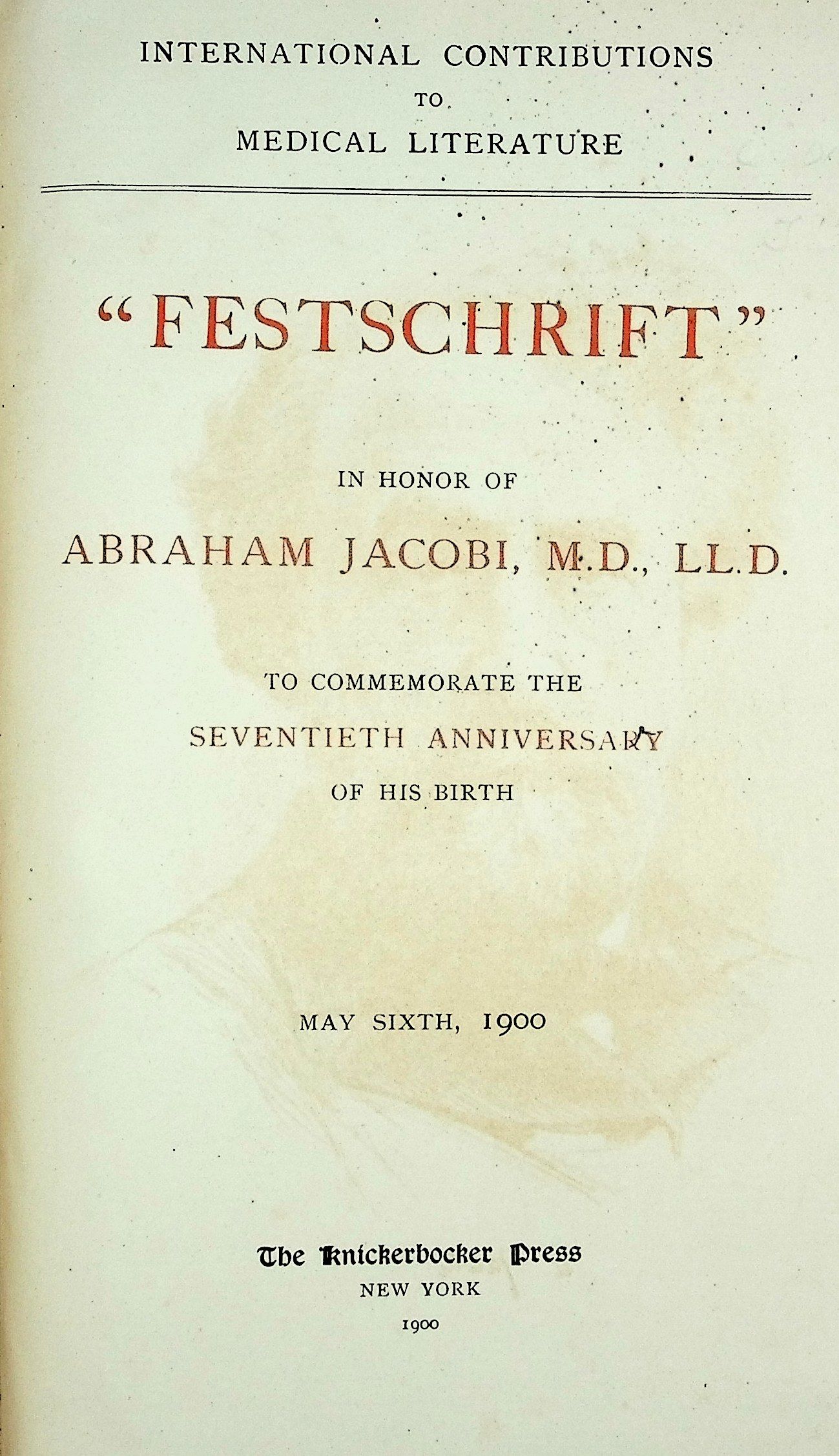
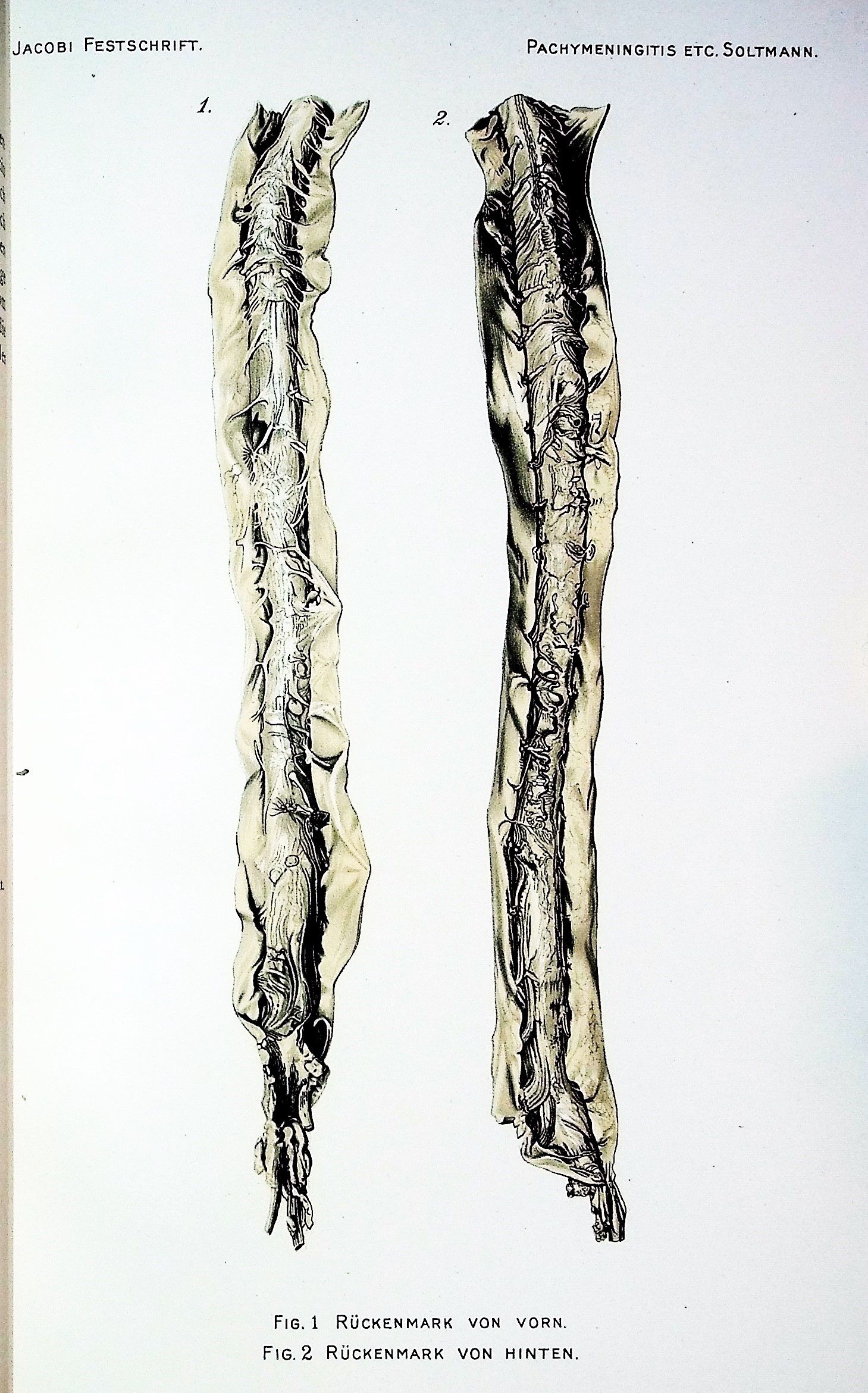
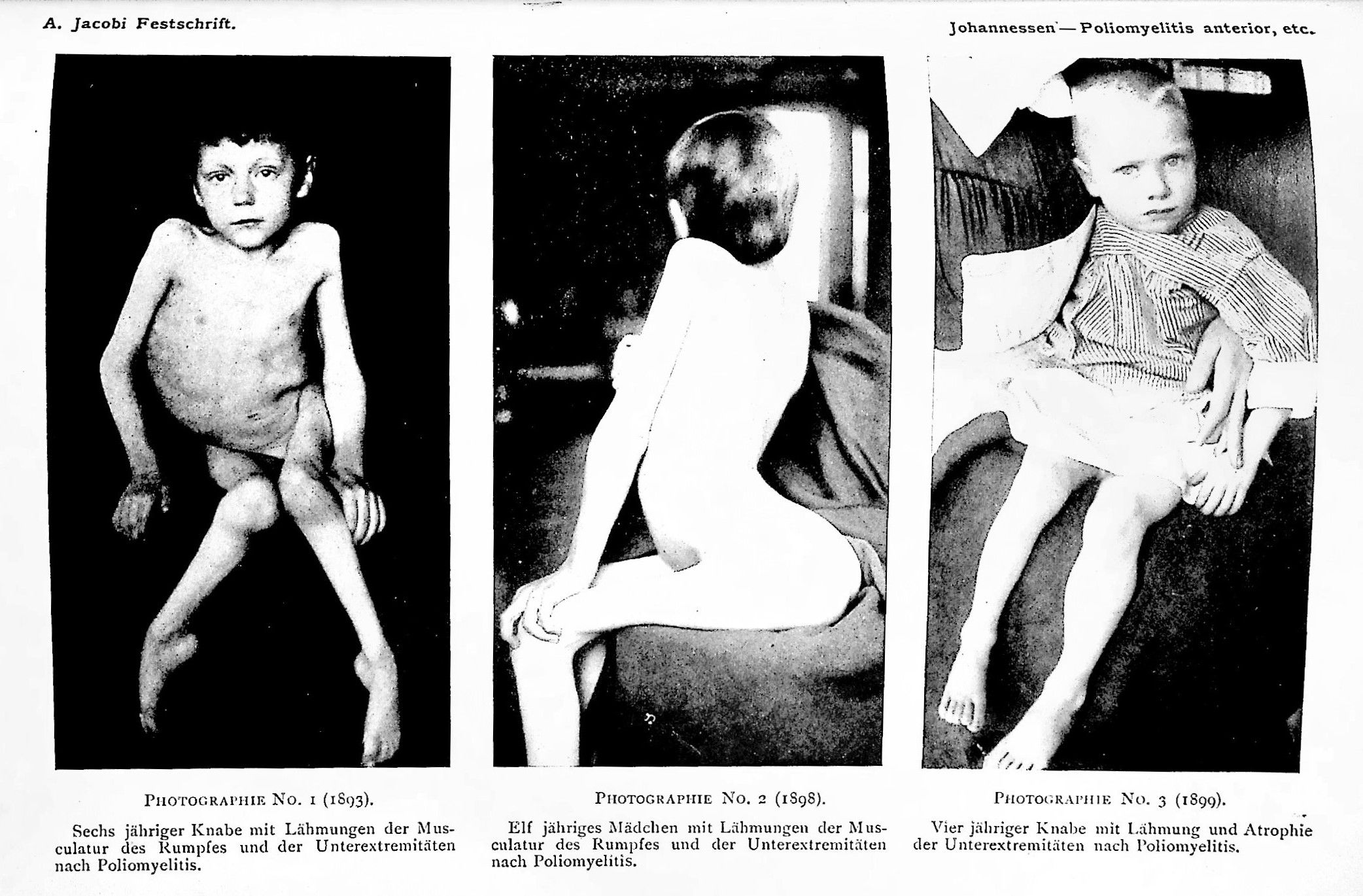
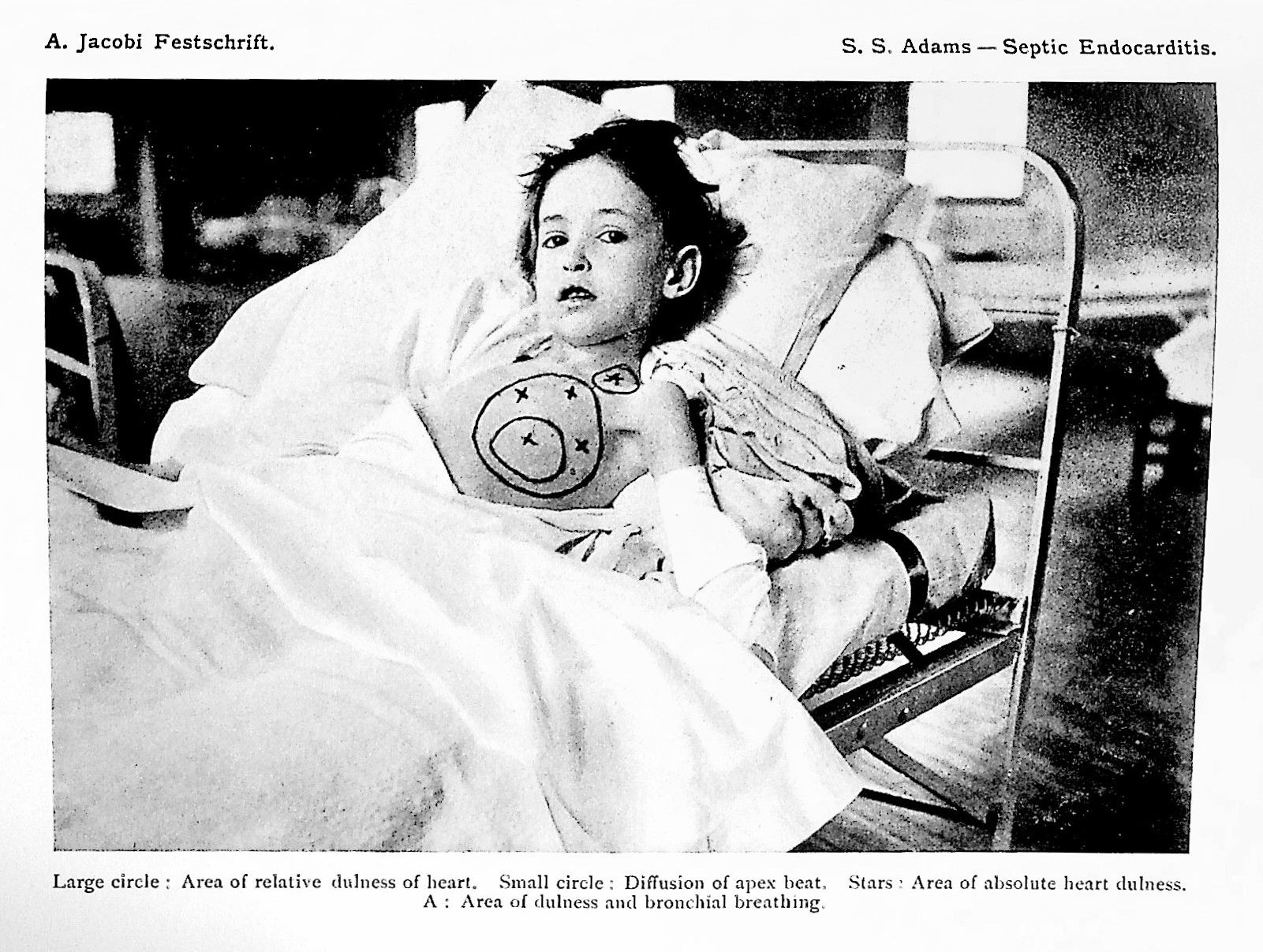
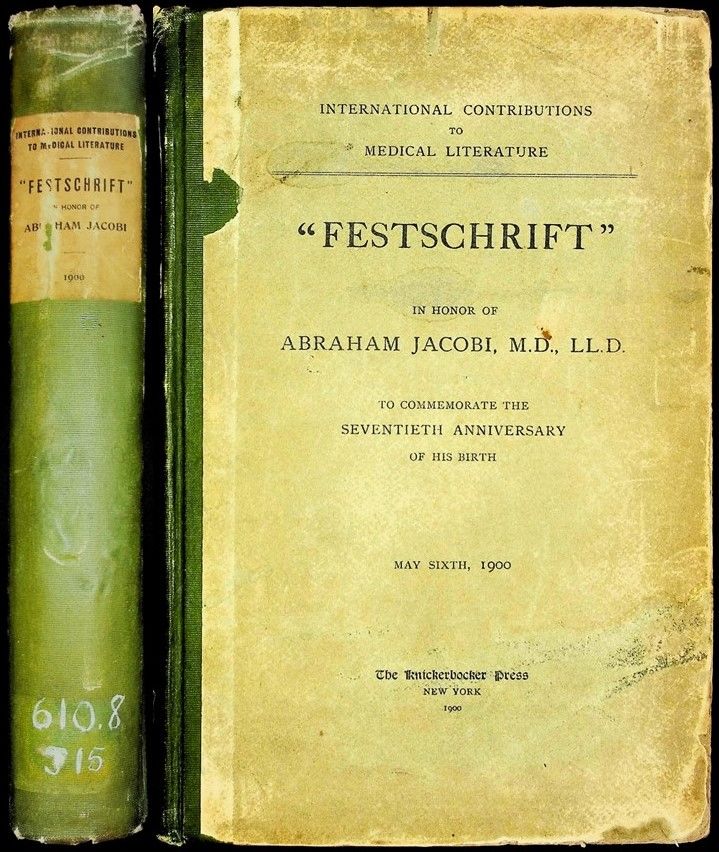
3) "Festschrift" in honor of Abraham Jacobi. To Commemorate the seventieth Anniversary of his Birth May Sixth, 1900. 16.5x16 cm hardcover, green cloth binding with printed gray paper covers, paper title label to spine, top edge gilt, institutional library bookplate to front paste-down, engraved frontispiece portrait of Jacobi with tissue guard, i-xiii, 496 pp, 12 plates, 2 folding charts. 55 contributions by 57 authors, including George Adami, Theodor Escherich, Eduard Henoch, Luther Emmett Holt, Henry Koplik, William Osler, Thomas Morgan Rotch, and William Henry Welch. Topics include infectious diease, cancer, neurology (seizures), metabolic disease, congenital heart disease, urology/nephrology, and toxicology. Most papers in English, several in German or French language. Covers worn, library numbers bottom of spine, front hinge split, offsetting of frontispiece to title page, browning to page edges. Binding tight, pages unmarked, good+ in custom archival mylar cover.
Details
Title
SIGNED BY 18 NOTABLES. Dinner in Honor of Doctor A. Jacobi on the Seventieth Anniversary of his birthday, Saturday, May the fifth,, nineteen hundred, at Delmonico's [original 3-leaf program/menu], TOGETHER WITH Proceedings and Addresses at the Complimentary Dinner Tendered to Dr. A. Jacobi on the Occasion of the Seventieth Anniversary of His Birthday, May 5, Nineteen Hundred, TOGETHER WITH "Festschrift" in Honor of Abraham Jacobi, M.D., LL.D., to Commemorate the Seventieth Anniversary of His Birth, May Sixth, 1900
Author
Jacobi, Abraham
Condition
Unknown
Publisher
Tiffany & Co. (program/menu), The Knickerbocker Press (Festschrift): New York
Date
1900
Edition
First editions