

He gong qi ju tu shuo 河工器具圖說 [Illustrations & Explanations of the Techniques of Water Conservancy and Civil Engineering]
- 1836
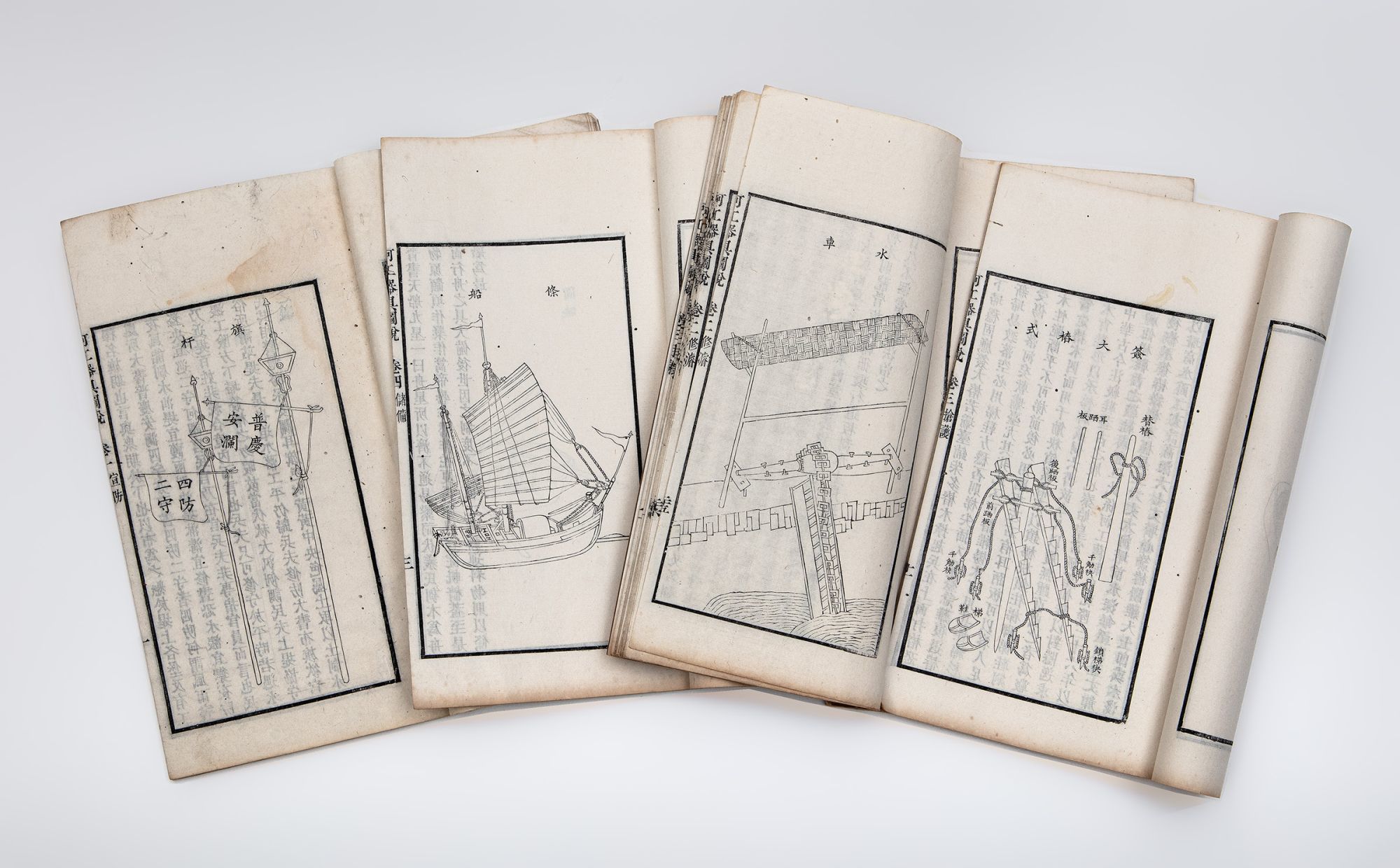
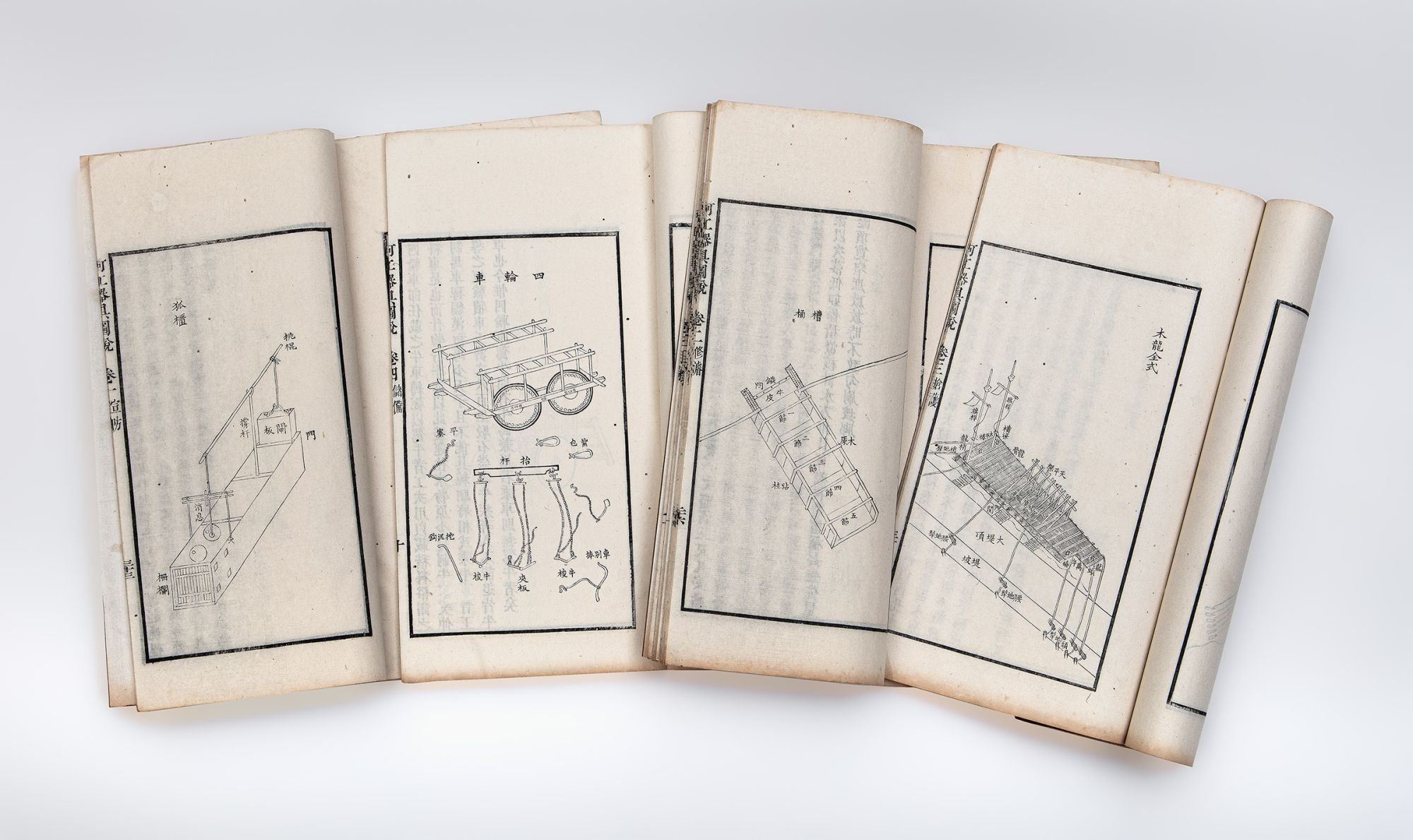
1836. 145 full-page woodcuts. Four juan bound in four vols. 8vo, later wrappers (some inoffensive worming in all vols.), stitched. Suzhou: Wu xue pu ju, Preface dated 1836.
First edition of this richly illustrated book; it is rare on the market. “The first [Chinese] handbook specialized in technical knowledge about hydraulics (that we know of). It is an extremely valuable work because of the precise descriptions of each tool, the accompanying illustration and the attention given to terminology” (Spicq, “Linqing”).
Wanggiyan Linking (1791–1846) — or, in the more common Chinese spelling, Wanyan Linqing — is one of the few Manchu bureaucrats recognized internationally today not for their activities within officialdom but for their accomplishments in the republic of letters. A descendant of the Jurchen emperors of the Jin state (1115–1234), Linking was born into the prestigious Bordered Yellow Banner and a lineage of eminent ministers in the imperial court. He attained the highest jinshi degree at the age of 17, and his career was distinguished and successful, reaching its apex with his appointment as the Viceroy of Liangjiang in 1839.
To Western readers, Linking is perhaps best known as the author of the finely illustrated and widely translated memoir A Wild Swan’s Trail (Hong xue yin yuan tu ji 鴻雪因緣圖記). The memoir’s wide range of contents, from the war against the British to the aboriginal peoples of Guizhou to the rock collections of Beijing’s literati gardens, attests to the incredibly fascinating and multidimensional life of the Sino-Manchu man of letters caught in an age of turbulence. Beyond his own compositions, Linking also played a part in the history of women’s literature in China, having reportedly encouraged his mother, Yun Zhu 惲珠 (1771–1833), to publish her expansive collection of women’s poetry, thereby initiating the project that was to become the widely known Anthology of Correct Beginnings by Women of This Dynasty (Guochao guixiu zhengshi ji 國朝閨秀正始集, 1831, sequel published 1836).
In light of his illustrious literary legacy, it is perhaps unsurprising that Linking’s expertise in the art of hydraulic engineering now occupies only a marginal position in his biography. For nearly a decade between 1833 and 1842, Linking’s most important professional duty as the Viceroy of the Southern Rivers was to oversee the management of some of China’s most strategically important and sometimes dangerous bodies of water: the Yellow River, the Hongze Lake, the Huai River, and the Grand Canal connecting southern China to the capital in the north. This professional responsibility led to Linking’s profound interest in and familiarity with the history and practice of hydraulics in China.
Our book “is supplied with pictures of coffer-dams, dykes, sluice -gates, gabions, ships, tools, and so on. Although of late date, the book is very little indebted to Western influences since so much of the technique was highly traditional.”–Needham et al., Science and Civilisation in China, Vol. 4, Part III, Civil Engineering and Nautics, pp. 327-29 (with illus.), & see p. 596, with an illustration from the fourth volume of our book of a “standard transport junk”; Needham states this is “the best traditional Chinese drawing which shows the system of battens, the multiple sheets with their euphroes, the halyards and the topping lifts.”
Our book reflects the depth of Linking’s practical knowledge and scholarly erudition on civil engineering. According to the postscript, the four-volume work contains 133 plates of illustrations representing 254 objects related to hydraulic engineering (in our count, there are 145 plates and around 300 objects). It is divided into four categories:
1. Xuanfang 宣防: tools for communication and defense, such as signal flags, weather vanes, various types of measuring instruments, announcement boards, etc.
2. Xiujun 修濬: tools for maintaining, repairing, dredging, constructing dikes, or directing waterways, such as pumps, spades, shovels, ramming stones, sieves, vessels, groovers, etc.
3. Qianghu 搶護: tools for emergency response, including specialized boats, horse-mounted plows, flood bags, and elaborate mechanisms known as “wooden dragons” (mulong 木龍).
4. Chubei 儲備: tools for transportation and storage, including land vehicles, specialized boats, tools for cutting, ropes and rope-making devices, frames, hooks, etc.
According to the Preface, during Linking’s patrols of the riverbanks, “whenever [he] saw an instrument, [he] always inquired about it in great detail and studied its history diligently. Some tools were invented anew for a specialized task, others were adapted for purposes different from their original ones; some are analogous to ancient tools but are in fact modern inventions, while others belong in the present while being identical to ancient tools.” Each full-page woodcut is thus accompanied by a succinct and learned essay on the history, technical purpose, and general significance of the instruments depicted, with frequent references to canonical texts such as the Confucian classics and dynastic histories.
Linking was firmly aware of the historical importance of his own undertaking, and in the Preface explicitly defends his choice to publish the first illustrated treatise dedicated to hydraulic technology by arguing for the inseparability of the cosmo-political Way (dao 道) and various worldly technologies (qi 器). The work’s postscript, written by Wang Guozuo 王國佐, emphasizes the historical significance of this unprecedented treatise by comparing its depth and scope to previously published works on waterways and hydraulics.
PROVENANCE: A collector’s red seal reads 泰和蕭敷政蒲邨氏珍藏, indicating our copy once belonged to the library of Xiao Fuzheng 蕭敷政 (d. 1924), a Republican-era book collector who lived in southern China.
A very good set, preserved in a hantao. The first three leaves of the first volume and the final three leaves of the last volume have been repaired, not touching text. Some faint dampstaining. Small characters on the last page of the postscript state that the woodblocks were carved at 姑蘇閶門外洞涇橋西吳學圃局, which, according to the Encyclopedia of China entry on this title, indicates that this is the first edition, printed at Suzhou in 1836. The rebinding is imperfect, as the tables of contents of Vols. 2-4 are bound at the end of their preceding volumes rather than the beginning of the volumes to which they belong.
❧ Hummel, Eminent Chinese of the Ch’ing Period, Vol. I, pp. 506-07. Li, Xiaorong, “Gender and Textual Politics during the Qing Dynasty: The Case of the Zhengshi ji” in HJAS 69, No. 1 (2009), pp. 75–107. Spicq, Delphine, “Linqing 麟慶 (1791-1846), official handbooks and the diffusion of knowledge about water conservancy in nineteenth century China,” Water History Conference, Montpellier, 28 June 2013. Van Hecken, J. L., & W. A. Grootears, “The Half-Acre Garden, Pan-Mou Yüan” in Monumenta Serica 18 (1959), pp. 360–87.
First edition of this richly illustrated book; it is rare on the market. “The first [Chinese] handbook specialized in technical knowledge about hydraulics (that we know of). It is an extremely valuable work because of the precise descriptions of each tool, the accompanying illustration and the attention given to terminology” (Spicq, “Linqing”).
Wanggiyan Linking (1791–1846) — or, in the more common Chinese spelling, Wanyan Linqing — is one of the few Manchu bureaucrats recognized internationally today not for their activities within officialdom but for their accomplishments in the republic of letters. A descendant of the Jurchen emperors of the Jin state (1115–1234), Linking was born into the prestigious Bordered Yellow Banner and a lineage of eminent ministers in the imperial court. He attained the highest jinshi degree at the age of 17, and his career was distinguished and successful, reaching its apex with his appointment as the Viceroy of Liangjiang in 1839.
To Western readers, Linking is perhaps best known as the author of the finely illustrated and widely translated memoir A Wild Swan’s Trail (Hong xue yin yuan tu ji 鴻雪因緣圖記). The memoir’s wide range of contents, from the war against the British to the aboriginal peoples of Guizhou to the rock collections of Beijing’s literati gardens, attests to the incredibly fascinating and multidimensional life of the Sino-Manchu man of letters caught in an age of turbulence. Beyond his own compositions, Linking also played a part in the history of women’s literature in China, having reportedly encouraged his mother, Yun Zhu 惲珠 (1771–1833), to publish her expansive collection of women’s poetry, thereby initiating the project that was to become the widely known Anthology of Correct Beginnings by Women of This Dynasty (Guochao guixiu zhengshi ji 國朝閨秀正始集, 1831, sequel published 1836).
In light of his illustrious literary legacy, it is perhaps unsurprising that Linking’s expertise in the art of hydraulic engineering now occupies only a marginal position in his biography. For nearly a decade between 1833 and 1842, Linking’s most important professional duty as the Viceroy of the Southern Rivers was to oversee the management of some of China’s most strategically important and sometimes dangerous bodies of water: the Yellow River, the Hongze Lake, the Huai River, and the Grand Canal connecting southern China to the capital in the north. This professional responsibility led to Linking’s profound interest in and familiarity with the history and practice of hydraulics in China.
Our book “is supplied with pictures of coffer-dams, dykes, sluice -gates, gabions, ships, tools, and so on. Although of late date, the book is very little indebted to Western influences since so much of the technique was highly traditional.”–Needham et al., Science and Civilisation in China, Vol. 4, Part III, Civil Engineering and Nautics, pp. 327-29 (with illus.), & see p. 596, with an illustration from the fourth volume of our book of a “standard transport junk”; Needham states this is “the best traditional Chinese drawing which shows the system of battens, the multiple sheets with their euphroes, the halyards and the topping lifts.”
Our book reflects the depth of Linking’s practical knowledge and scholarly erudition on civil engineering. According to the postscript, the four-volume work contains 133 plates of illustrations representing 254 objects related to hydraulic engineering (in our count, there are 145 plates and around 300 objects). It is divided into four categories:
1. Xuanfang 宣防: tools for communication and defense, such as signal flags, weather vanes, various types of measuring instruments, announcement boards, etc.
2. Xiujun 修濬: tools for maintaining, repairing, dredging, constructing dikes, or directing waterways, such as pumps, spades, shovels, ramming stones, sieves, vessels, groovers, etc.
3. Qianghu 搶護: tools for emergency response, including specialized boats, horse-mounted plows, flood bags, and elaborate mechanisms known as “wooden dragons” (mulong 木龍).
4. Chubei 儲備: tools for transportation and storage, including land vehicles, specialized boats, tools for cutting, ropes and rope-making devices, frames, hooks, etc.
According to the Preface, during Linking’s patrols of the riverbanks, “whenever [he] saw an instrument, [he] always inquired about it in great detail and studied its history diligently. Some tools were invented anew for a specialized task, others were adapted for purposes different from their original ones; some are analogous to ancient tools but are in fact modern inventions, while others belong in the present while being identical to ancient tools.” Each full-page woodcut is thus accompanied by a succinct and learned essay on the history, technical purpose, and general significance of the instruments depicted, with frequent references to canonical texts such as the Confucian classics and dynastic histories.
Linking was firmly aware of the historical importance of his own undertaking, and in the Preface explicitly defends his choice to publish the first illustrated treatise dedicated to hydraulic technology by arguing for the inseparability of the cosmo-political Way (dao 道) and various worldly technologies (qi 器). The work’s postscript, written by Wang Guozuo 王國佐, emphasizes the historical significance of this unprecedented treatise by comparing its depth and scope to previously published works on waterways and hydraulics.
PROVENANCE: A collector’s red seal reads 泰和蕭敷政蒲邨氏珍藏, indicating our copy once belonged to the library of Xiao Fuzheng 蕭敷政 (d. 1924), a Republican-era book collector who lived in southern China.
A very good set, preserved in a hantao. The first three leaves of the first volume and the final three leaves of the last volume have been repaired, not touching text. Some faint dampstaining. Small characters on the last page of the postscript state that the woodblocks were carved at 姑蘇閶門外洞涇橋西吳學圃局, which, according to the Encyclopedia of China entry on this title, indicates that this is the first edition, printed at Suzhou in 1836. The rebinding is imperfect, as the tables of contents of Vols. 2-4 are bound at the end of their preceding volumes rather than the beginning of the volumes to which they belong.
❧ Hummel, Eminent Chinese of the Ch’ing Period, Vol. I, pp. 506-07. Li, Xiaorong, “Gender and Textual Politics during the Qing Dynasty: The Case of the Zhengshi ji” in HJAS 69, No. 1 (2009), pp. 75–107. Spicq, Delphine, “Linqing 麟慶 (1791-1846), official handbooks and the diffusion of knowledge about water conservancy in nineteenth century China,” Water History Conference, Montpellier, 28 June 2013. Van Hecken, J. L., & W. A. Grootears, “The Half-Acre Garden, Pan-Mou Yüan” in Monumenta Serica 18 (1959), pp. 360–87.
Details
Title
He gong qi ju tu shuo 河工器具圖說 [Illustrations & Explanations of the Techniques of Water Conservancy and Civil Engineering]
Author
WANYAN, Linqing 完顏麟慶 (M.: WANGGIYAN Linking)
Condition
Unknown
Date
1836