

[Japanese School Children's Scrapbook Gifted to an Indiana School]
- Takino, Japan , 1950
Takino, Japan, 1950. Very good. 10 7/8” x 8¼”. 17 leaves, with 11 pieces of original artwork, 7 clippings, 8 photographs and 73 pieces of ephemera adhesive mounted both sides. Photos range from 2” x 2” to 4” x 6” and all but one are captioned. Very good: seemingly lacking covers and most of paper spine; light edgewear; mild scattered soiling and spotting; two items nearly detached and a handful seem to be lacking.
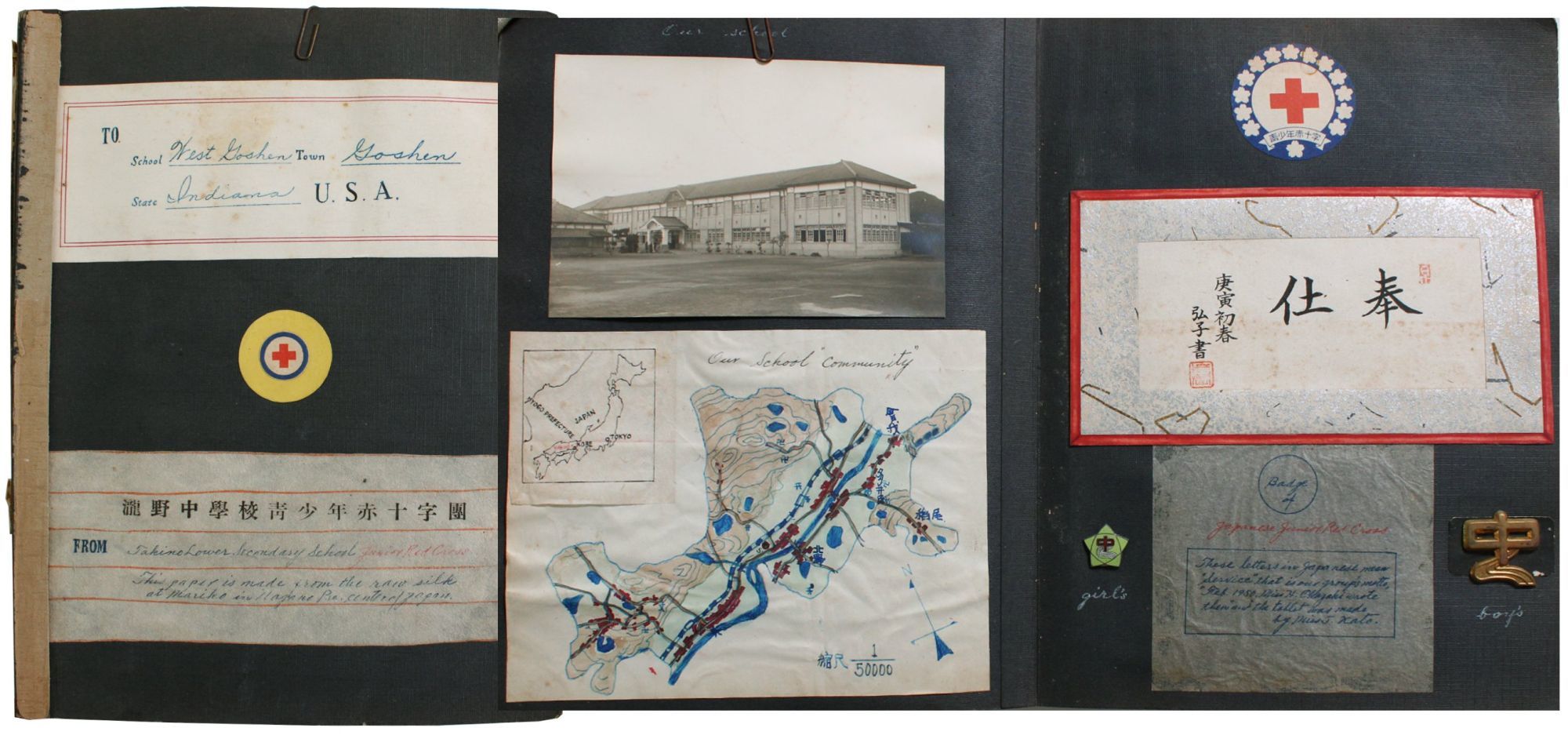
This is an incredible album created by the students of a Japanese Junior Red Cross organization as a gift for an American elementary school. Rich with original artwork, photographs, examples of Japanese textiles and educational materials, the album shares insight into the children's culture, school days and ways of life.
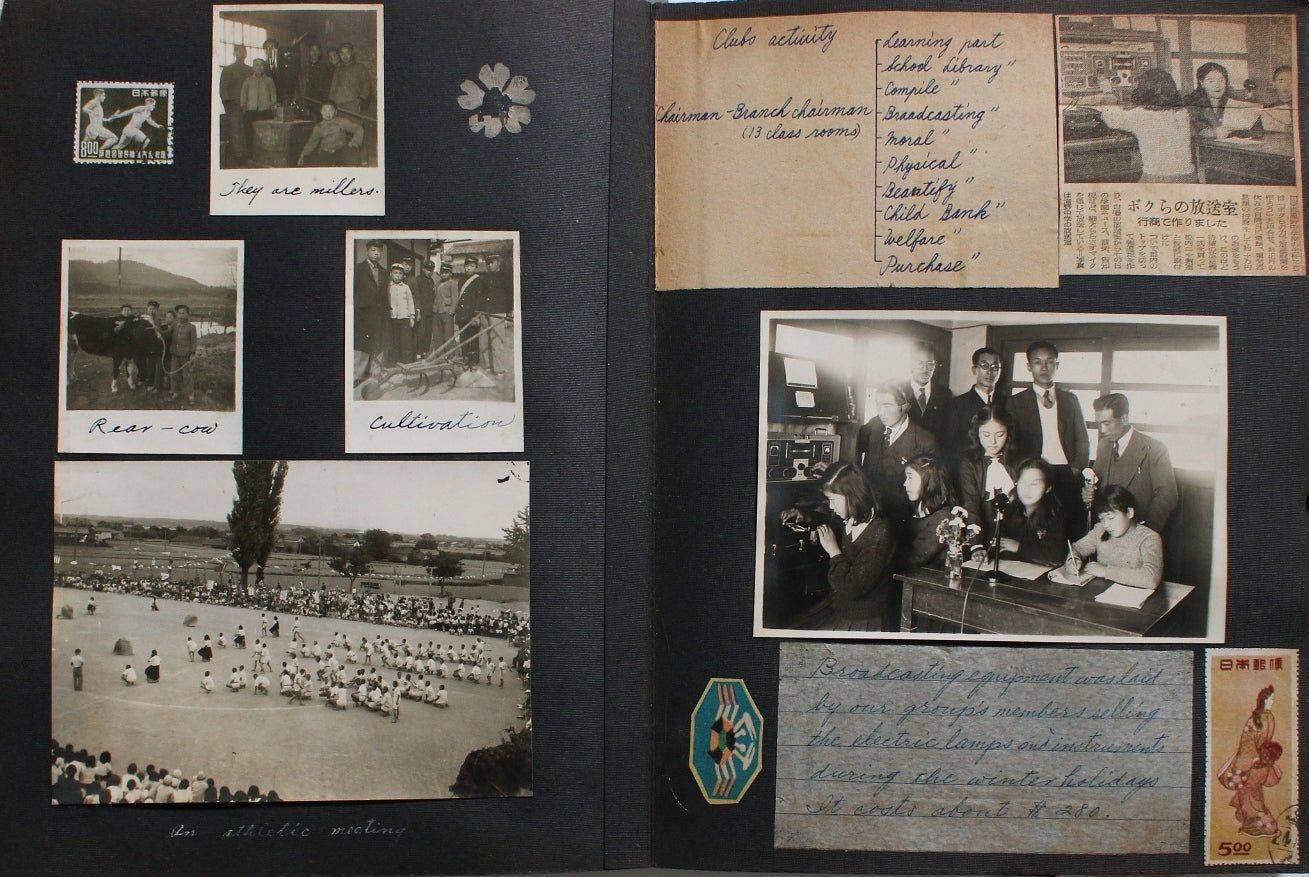
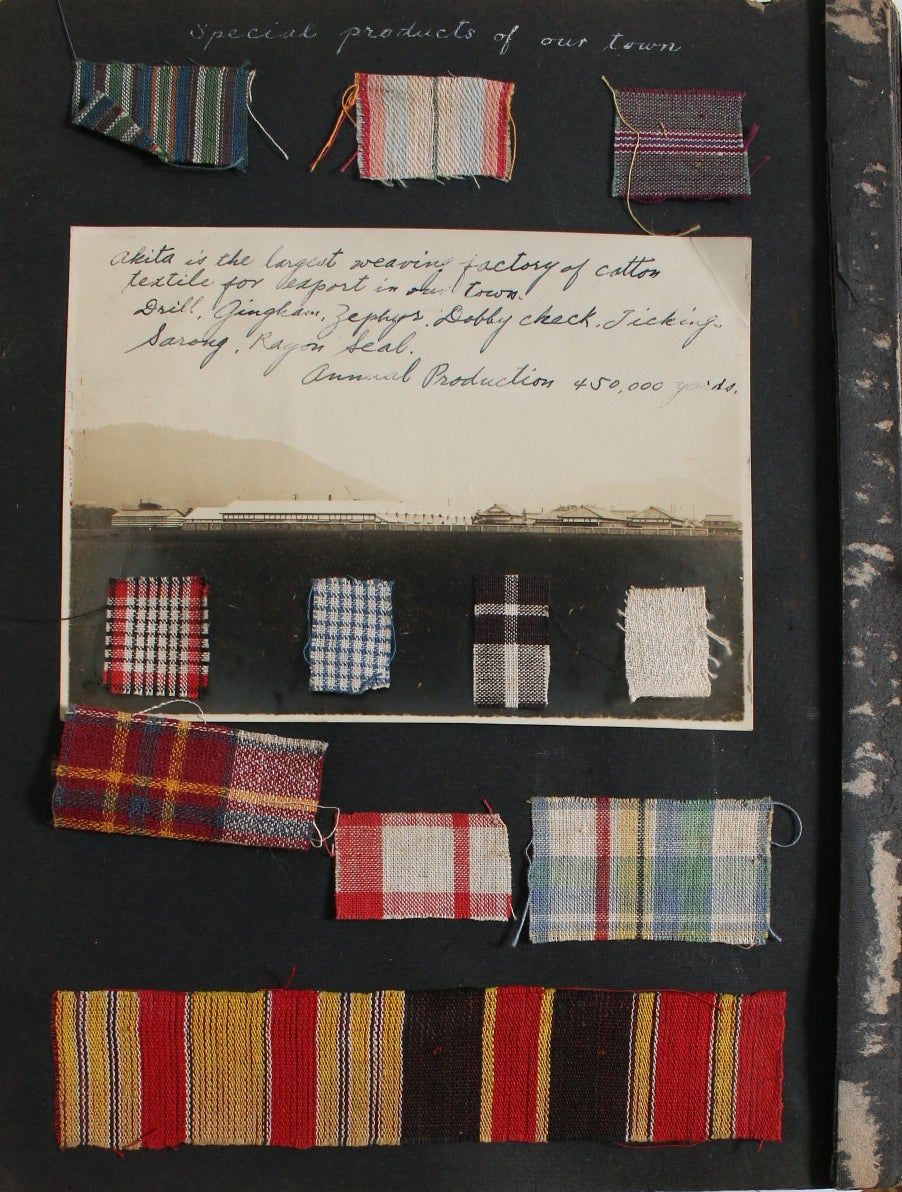
The front page of this book has labels signifying its presentation from the “Takino Lower Secondary School Junior Red Cross” to West Goshen elementary school in Goshen, Indiana. Japan's lower secondary schools cover grades seven through nine, with students typically aged 12 to 15. One label noted that “This paper is made from the raw silk at Mariko in Nagano Pre., center of Japan.” Dozens of fantastic items of ephemera include the group's badge (“These letters in Japanese mean 'Service' that is our group's motto, Feb. 1950”), as well as girls' and boys' insignia pins. There is a hand-drawn map of “Our School's Community,” with an inset showing the location of Takino in Japan, and an immaculate bilingual blueprint sketch of a Japanese home. The book also holds decorative stamps, printed ephemera on kimonos and eleven pieces of cotton textile, “special products of our town.” A few great photographs show an “athletic meeting,” children engaged in “cultivation” and in trade (“They are millers”), and operating “broadcasting equipment” funded by “members selling the electric lamps and instruments during the winter holidays. It costs about $280.”
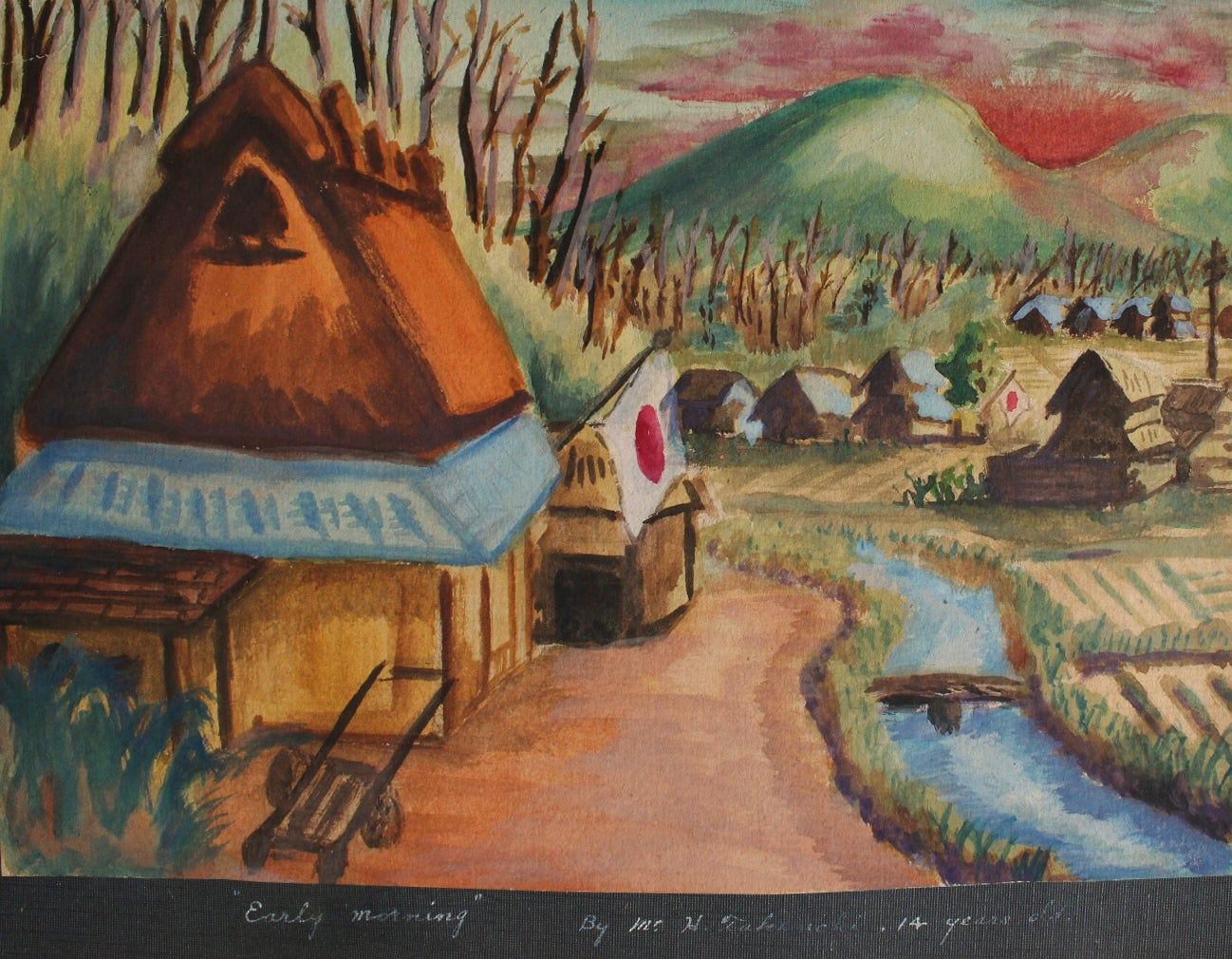
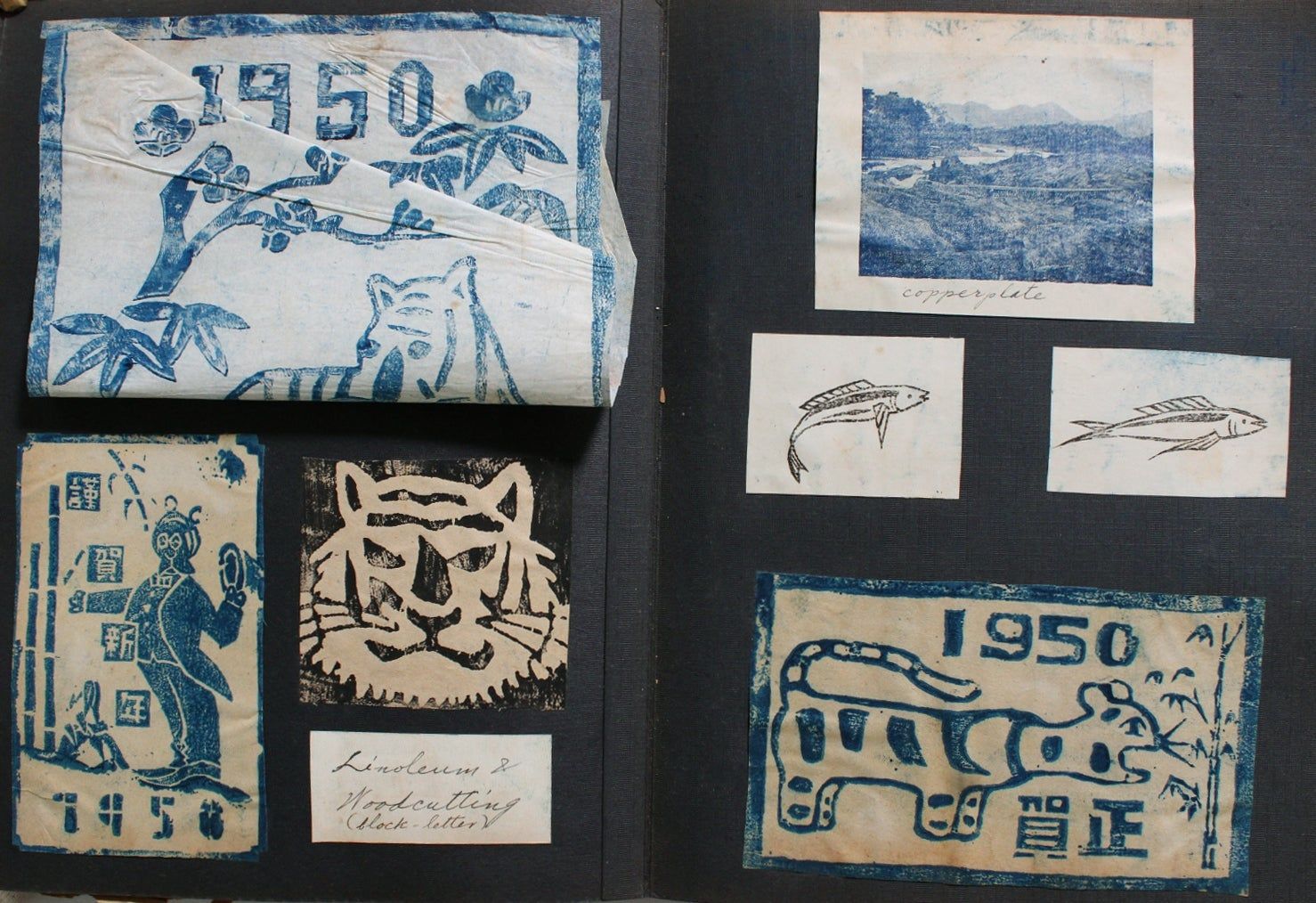
The book holds terrific works of original art, including “copperplate,” “linoleum and woodcutting” prints and a cover of the school's “monthly magazine.” There is a song in calligraphy with its English translation, a description of the game and “play instrument of the New Year's Day” shown in a 13-year-old girl's color sketch. It has a detailed handwritten school schedule and list of “Red Letter Days,” a student's graded “written examination” and a large, pristine clipping from the school newspaper. A clipped illustration of a culinary spread has a note describing “Hon-Zen” cuisine, and there are examples of decorative paper, needlework appliqué, a tatami mat and the haori himo, “fastened to the over-coat of Japanese dress . . . we change its color at the happy time or funeral.” There are also notes from bishops who visited the school, as well as a handwritten bible quote from Jacob DeShazer, dated 1949, and two pages from a book he wrote. DeShazer was a member of the 17th Bomb Group, a volunteer unit formed to attack Japan following Pearl Harbor. Captured and held as a prisoner of war for over three years, DeShazer became a devout Christian and in 1948 returned to Japan. He spent 30 years as a missionary there, even founding a Christian church in the city he had bombed.
A fantastic album, brimming with creative works and descriptions of Japanese school children's lives, presented to American youth.
This is an incredible album created by the students of a Japanese Junior Red Cross organization as a gift for an American elementary school. Rich with original artwork, photographs, examples of Japanese textiles and educational materials, the album shares insight into the children's culture, school days and ways of life.
The front page of this book has labels signifying its presentation from the “Takino Lower Secondary School Junior Red Cross” to West Goshen elementary school in Goshen, Indiana. Japan's lower secondary schools cover grades seven through nine, with students typically aged 12 to 15. One label noted that “This paper is made from the raw silk at Mariko in Nagano Pre., center of Japan.” Dozens of fantastic items of ephemera include the group's badge (“These letters in Japanese mean 'Service' that is our group's motto, Feb. 1950”), as well as girls' and boys' insignia pins. There is a hand-drawn map of “Our School's Community,” with an inset showing the location of Takino in Japan, and an immaculate bilingual blueprint sketch of a Japanese home. The book also holds decorative stamps, printed ephemera on kimonos and eleven pieces of cotton textile, “special products of our town.” A few great photographs show an “athletic meeting,” children engaged in “cultivation” and in trade (“They are millers”), and operating “broadcasting equipment” funded by “members selling the electric lamps and instruments during the winter holidays. It costs about $280.”
The book holds terrific works of original art, including “copperplate,” “linoleum and woodcutting” prints and a cover of the school's “monthly magazine.” There is a song in calligraphy with its English translation, a description of the game and “play instrument of the New Year's Day” shown in a 13-year-old girl's color sketch. It has a detailed handwritten school schedule and list of “Red Letter Days,” a student's graded “written examination” and a large, pristine clipping from the school newspaper. A clipped illustration of a culinary spread has a note describing “Hon-Zen” cuisine, and there are examples of decorative paper, needlework appliqué, a tatami mat and the haori himo, “fastened to the over-coat of Japanese dress . . . we change its color at the happy time or funeral.” There are also notes from bishops who visited the school, as well as a handwritten bible quote from Jacob DeShazer, dated 1949, and two pages from a book he wrote. DeShazer was a member of the 17th Bomb Group, a volunteer unit formed to attack Japan following Pearl Harbor. Captured and held as a prisoner of war for over three years, DeShazer became a devout Christian and in 1948 returned to Japan. He spent 30 years as a missionary there, even founding a Christian church in the city he had bombed.
A fantastic album, brimming with creative works and descriptions of Japanese school children's lives, presented to American youth.
Details
Title
[Japanese School Children's Scrapbook Gifted to an Indiana School]
Condition
Very Good
Publisher
Takino, Japan
Date
1950