

Circa 1857 – Mail sent from Quindaro, a ‘Free Port’ on the Missouri River that funneled abolitionist ‘free staters into the Kansas Territory and became a major stop on the Underground Railroad, later a thriving African-American city and home of one of the first colleges for freedmen
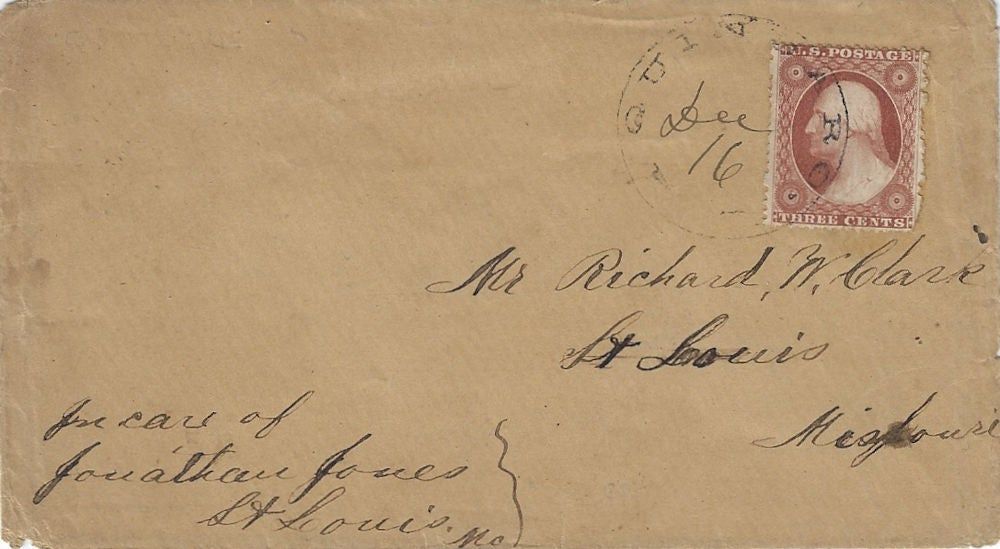
Although there are no contents, Clark was a member of a farming family in Quindaro who was likely attending Jonathan Jones Commercial College in St. Louis. Jones billed himself as a “Master of Accounts, Professor of the Theory and Practice of Bookkeeping, Commercial Correspondence, etc.”
When the Kansas was opened to settlement in 1854 abolitionists from the North flooded into the territory to counteract the slavery-supporters streaming in from Missouri. As the established river ports were in pro-slavery hands, the state’s illegal abolitionist governor, Charles Robinson, established one within the Wyandot Nation, who unlike most other Native American tribes were abolitionists and allowed the New England Emigrant Aid Company to purchase the site. Soon over 35 riverboats arrived daily.
Although the surrounding land was rugged and barely suitable for building a town, nonetheless, construction began, and the new town of Quindaro began to thrive as some abolitionists settled there, while others continued on into inland Kansas. It soon became a major hub on the Underground Railroad, although few escaped slaves settled there, preferring to move further north. When the savage fighting over Kansas’s slave status ended in 1858, the town quickly was abandoned as towns people moved on to more hospitable locations including nearby Wyandot (now Kansas) City. However, during the Civil War, many contraband slaves who had been freed by Union forces settled in the area, and Presbyterian minister, Eben Blachly and his wife Jane began to teach the freedmen to read. After the war as more blacks settled in Quindaro while the white population continued to move elsewhere, the Blachlys, with assistance from the state, founded Quindaro Freedmen’s School, one of the first high schools in the country for young black men. As the population continued to increase, Blachly received additional funding that allowed the school to transition in 1881 into Western University, the first college for African-Americans established west of the Mississippi. Never prosperous, the school suffered badly during the Great Depression, and as black men were drafted at the beginning of World War Two, the graduating class of 1942 had dwindled to only six women. The college closed in 1944, and the town fared no better. Today, only a few ruins, two cemeteries, a closed ramshackle museum, and a statue of John Brown remain.
. (For more information, See Hancks’s “Quindaro 1856-1862 and 1881-1948” at the Wyandot Nation of Kansas website, O’Bryan’s “Quindaro, Kansas” in the Civil War on the Western Border Encyclopedia, “The Old Quindaro Museum” at the Clio website, “Quindaro, Kansas – A Free-State Black Town” at the Legends of Kansas website, and Jones’ Commercial College in the online Sketchbook of St. Louis. . ..”)Mail from Quindaro is scarce, but it occasionally appears for sale on or in philatelic auctions, although never is the town’s historical significance recognized. For philatelists, it is only considered important as a now “dead post office” from which few examples of mail exist.
.Details
Title
Circa 1857 – Mail sent from Quindaro, a ‘Free Port’ on the Missouri River that funneled abolitionist ‘free staters into the Kansas Territory and became a major stop on the Underground Railroad, later a thriving African-American city and home of one of the first colleges for freedmen
Condition
Unknown