

Ch’ŏngbyŏk sŏnsaeng munjip 青壁先生文集 [Compendium of the Writings of the Blue Wall Teacher]
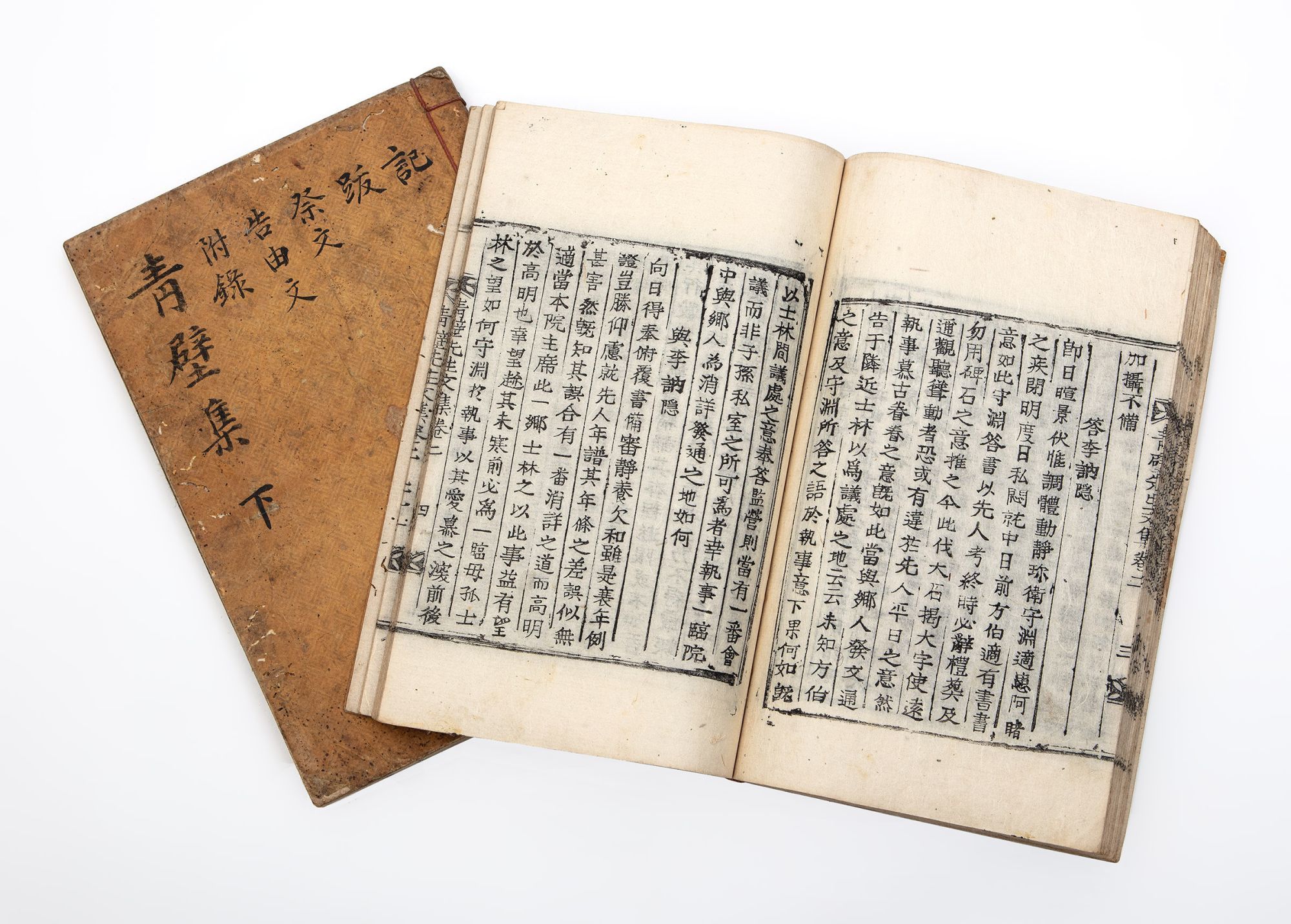
Compiled by Yi Jungrin 李中璘 & Afterword by Yi Man’in 李晩寅. Printed with wooden movable type. 60; 54 folding leaves. Four juan in two vols. Large 8vo, orig. semi-stiff wrappers, stitched. [Korea: 1898 or after 1890].
First edition of this collection of the writings of Yi Su-yŏn (1693–1748), a sixth-generation descendant of Yi Hwang 李滉 (1501–70), who was best known by his art name, T’oegye 退溪 (“Retreating Creek”). An intellectual admirer of Zhu Xi (1130–1200), the Chinese philosopher whose interpretation of Neo-Confucianism became the dominant ideological framework in late imperial China and Chosŏn Korea, T’oegye is widely regarded as the most influential philosopher of Korea. His Neo-Confucian teachings shaped Korean thought for centuries, and his portrait graces the 1,000-won banknote as a testament to his legacy. T’oegye’s influence extended beyond Korea, shaping the Kumamoto and Kimon schools of Tokugawa Japan.
Yi Su-yŏn, whose art name was the “Blue Wall” in the title, followed the archetypal path of a disciple of Toegye. After passing the lower-level civil service examination in 1723, he withdrew from official life to dedicate himself to the interpretation and annotation of Toegye’s works. The present work is an eclectic collection divided into four juan, each reflecting different facets of Yi Suy-ŏn’s intellectual activities.
Juan 1–2 contain 94 poems and 35 essays by the author, including his correspondence with leading scholars of his time, such as Yi Gwangjeong 李光庭, Jo Hyeonmyeong 趙顯命, Kim Sangseong 金尙星, and Gwon Sangil 權相日. These letters engage with topics such as Neo-Confucian metaphysics, the interpretation of the Classics, contemporary affairs, and ritual propriety. Ranging from the abstract to the everyday, they reveal the contemplative debates among the educated elite as they grappled with how to uphold a principled life in changing times.
Juan 3–4 are concerned with ritual manuals documenting disputed ceremonial practices of the period, along with detailed records of how Yi Su-yŏn compiled and preserved the collected works of T’oegye. This aspect of the manuscript may have piqued the interest of contemporary scholars and literati, who not only studied the classical Chinese canons but also relied on Yi Hwang’s analyses as supplementary guides. Yi Su-yŏn’s account of how Yi Hwang’s works came to be may have offered readers a rare glimpse behind the scenes — a compelling backstory to one of Korea’s most revered philosophical legacies.
The collection was assembled by Yi Su-yŏn’s sixth-generation descendant Yi Jungrin. An Afterword notes that Yi Man’in (1834-97), an 11th-generation descendant of Yi Hwang who might have been Jungrin’s distant uncle, praised Yi Su-yŏn’s dedication to implementing his ancestor’s teachings. In a sense, this book encapsulates a scholarly homage passed down through one of the most intellectually sophisticated pedigrees in Chosŏn history. Yi Su-yŏn devoted his life to studying Yi Hwang, only to be honored and commemorated in turn by his own descendants.
A very good set, printed with wooden movable type. Minor worming towards end of Vol. II.
First edition of this collection of the writings of Yi Su-yŏn (1693–1748), a sixth-generation descendant of Yi Hwang 李滉 (1501–70), who was best known by his art name, T’oegye 退溪 (“Retreating Creek”). An intellectual admirer of Zhu Xi (1130–1200), the Chinese philosopher whose interpretation of Neo-Confucianism became the dominant ideological framework in late imperial China and Chosŏn Korea, T’oegye is widely regarded as the most influential philosopher of Korea. His Neo-Confucian teachings shaped Korean thought for centuries, and his portrait graces the 1,000-won banknote as a testament to his legacy. T’oegye’s influence extended beyond Korea, shaping the Kumamoto and Kimon schools of Tokugawa Japan.
Yi Su-yŏn, whose art name was the “Blue Wall” in the title, followed the archetypal path of a disciple of Toegye. After passing the lower-level civil service examination in 1723, he withdrew from official life to dedicate himself to the interpretation and annotation of Toegye’s works. The present work is an eclectic collection divided into four juan, each reflecting different facets of Yi Suy-ŏn’s intellectual activities.
Juan 1–2 contain 94 poems and 35 essays by the author, including his correspondence with leading scholars of his time, such as Yi Gwangjeong 李光庭, Jo Hyeonmyeong 趙顯命, Kim Sangseong 金尙星, and Gwon Sangil 權相日. These letters engage with topics such as Neo-Confucian metaphysics, the interpretation of the Classics, contemporary affairs, and ritual propriety. Ranging from the abstract to the everyday, they reveal the contemplative debates among the educated elite as they grappled with how to uphold a principled life in changing times.
Juan 3–4 are concerned with ritual manuals documenting disputed ceremonial practices of the period, along with detailed records of how Yi Su-yŏn compiled and preserved the collected works of T’oegye. This aspect of the manuscript may have piqued the interest of contemporary scholars and literati, who not only studied the classical Chinese canons but also relied on Yi Hwang’s analyses as supplementary guides. Yi Su-yŏn’s account of how Yi Hwang’s works came to be may have offered readers a rare glimpse behind the scenes — a compelling backstory to one of Korea’s most revered philosophical legacies.
The collection was assembled by Yi Su-yŏn’s sixth-generation descendant Yi Jungrin. An Afterword notes that Yi Man’in (1834-97), an 11th-generation descendant of Yi Hwang who might have been Jungrin’s distant uncle, praised Yi Su-yŏn’s dedication to implementing his ancestor’s teachings. In a sense, this book encapsulates a scholarly homage passed down through one of the most intellectually sophisticated pedigrees in Chosŏn history. Yi Su-yŏn devoted his life to studying Yi Hwang, only to be honored and commemorated in turn by his own descendants.
A very good set, printed with wooden movable type. Minor worming towards end of Vol. II.
Details
Title
Ch’ŏngbyŏk sŏnsaeng munjip 青壁先生文集 [Compendium of the Writings of the Blue Wall Teacher]
Author
YI, Su-yŏn 李守淵
Condition
Unknown