

Two separately published works by the Reformer Johann Locher, addressed to the German folk hero "Karsthans
- Hardcover
Hardcover. Fine. Johann Locher was an Observant Franciscan at Ulm who later became a vociferous advocate of Luther’s program of reform. Persecuted for his reformist sympathies, he eventually took refuge in Zwickau, where he published extensively between 1523 and 1524, writing against the injustices visited upon the lower classes and the corruption of the Church. He left Zwickau for Munich in late 1524, just as the Peasants’ War was breaking out. He was arrested and executed in November 1524, becoming one of the first evangelical martyrs.
These two books, both extremely rare, are bound in modern, uniform quarter-vellum bindings. It is clear that they were previously bound together and so are now being offered as a pair.
The brief descriptions of the books presented below are followed by an in-depth discussion of the works.
I. LOCHER'S FIRST LETTER TO KARSTHANS:
Locher, Johann (d. 1524)
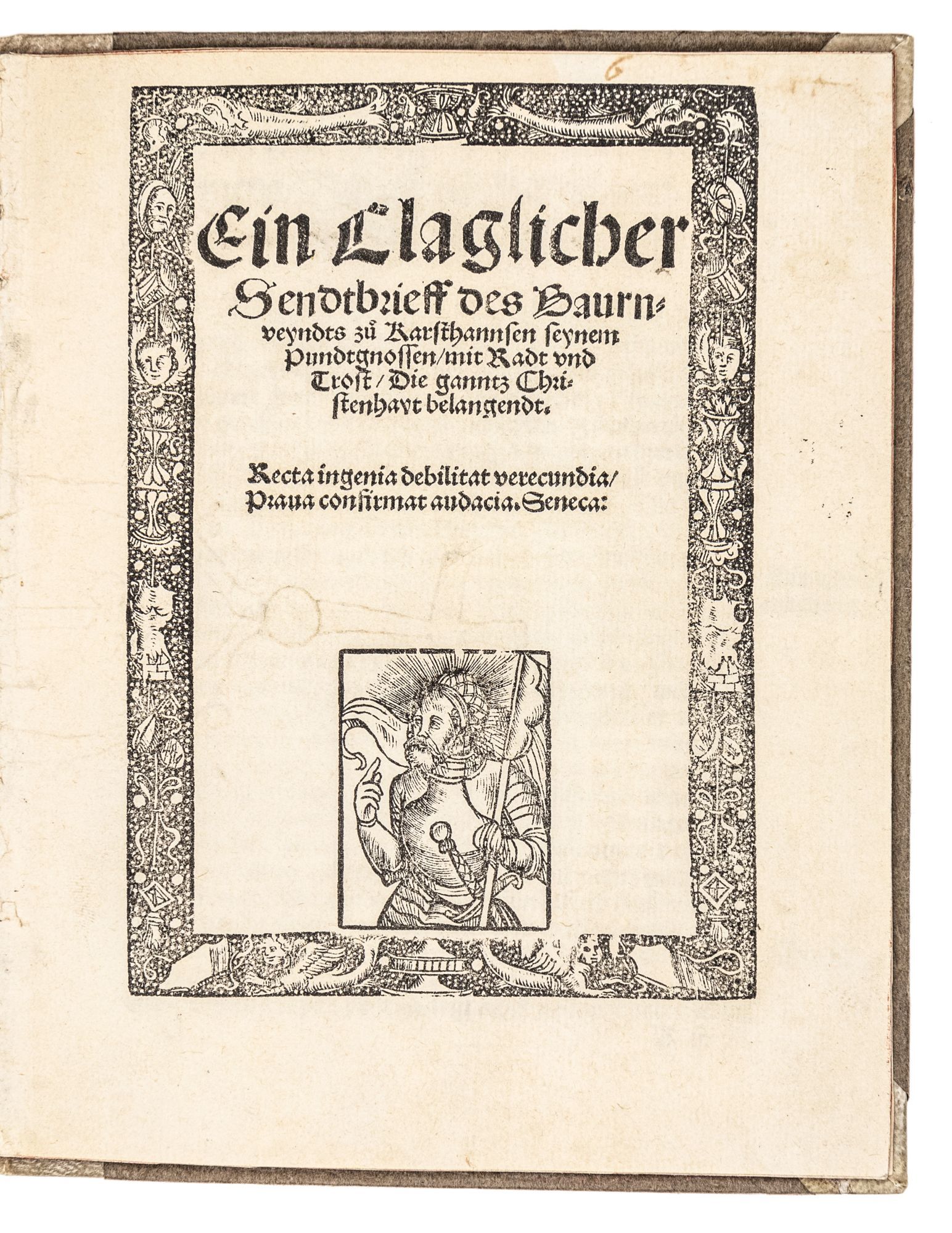
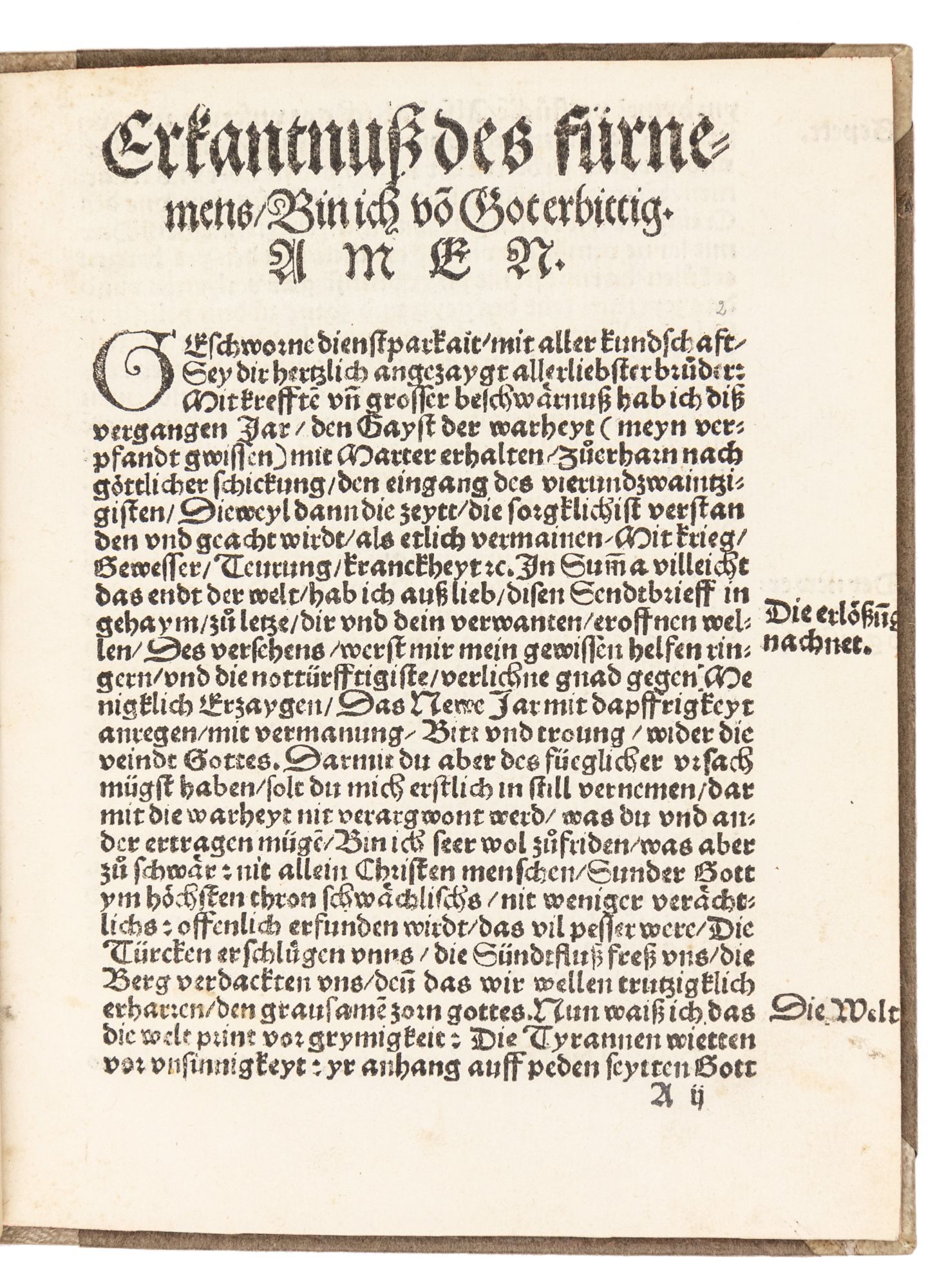
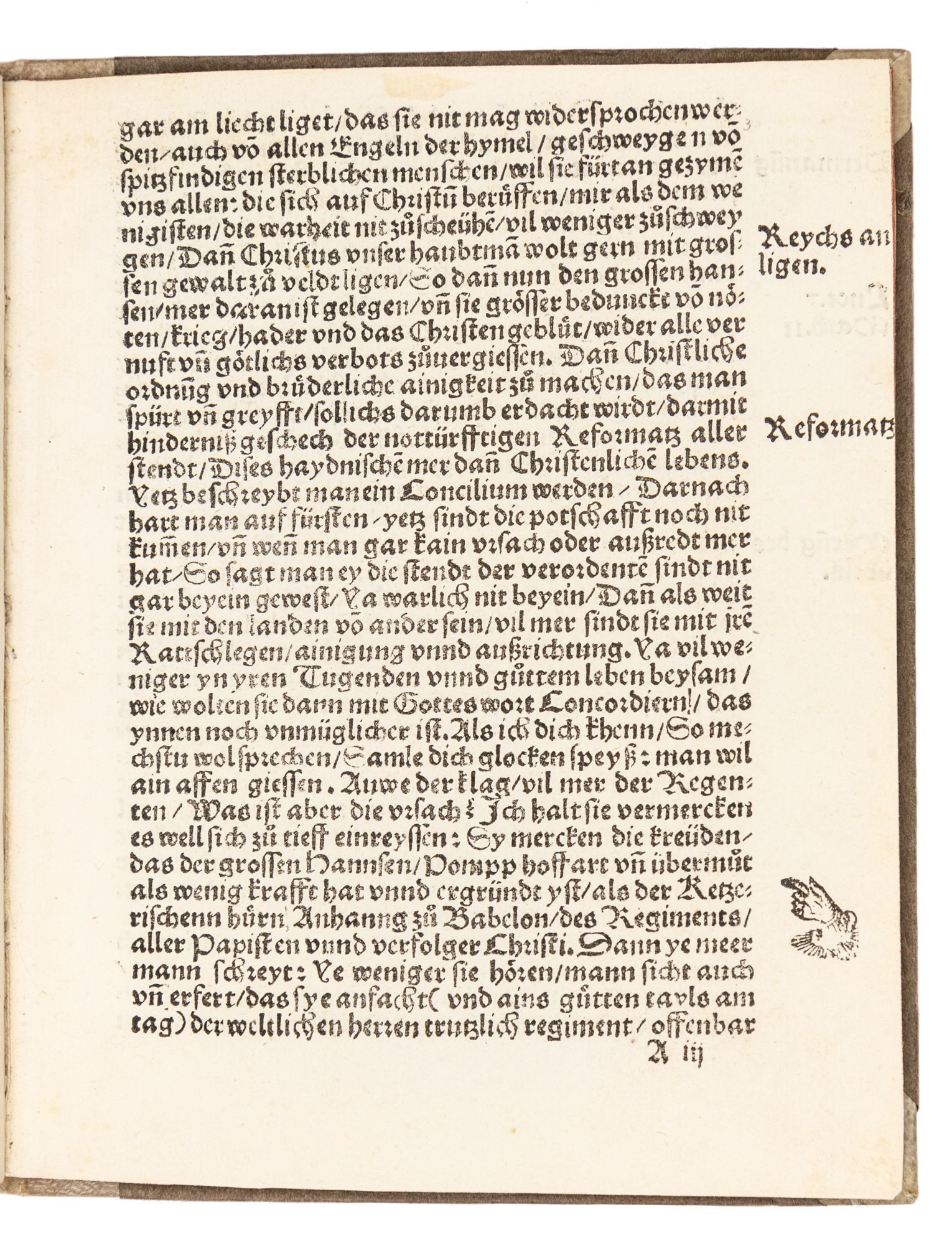
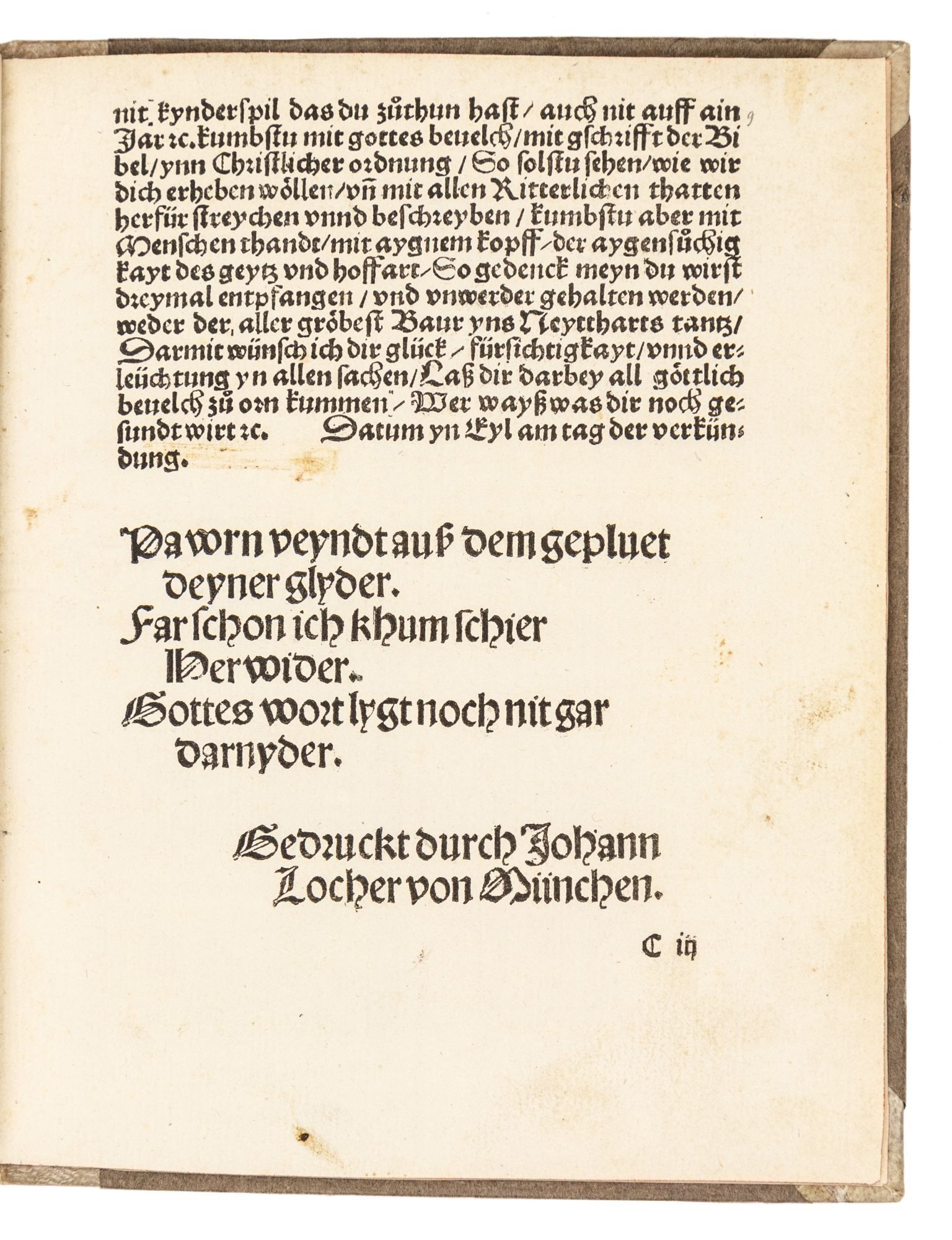
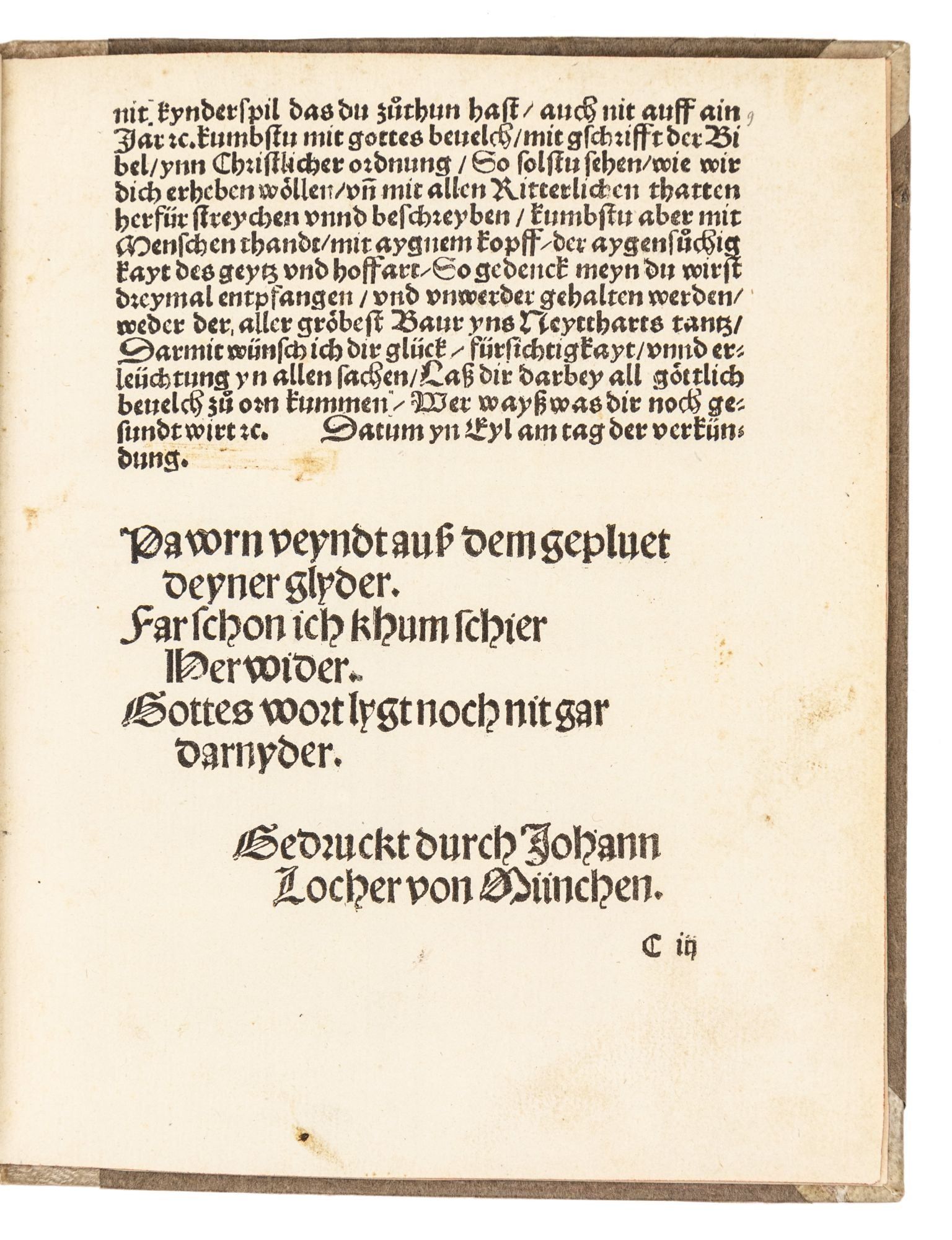
Ein Claglicher Sendtbrieff des Baurnveyndts zu Karsthannsen seynem Pundtgnossen, mit Radt vnd Trost, Die ganntz Christenhayt belangendt.
[Zwickau:] ‘Gedruckt durch Johann Locher von München’ [but Jörg Gastel for Johann Schönsperger the Younger], 1524
Quarto: 17.6 x 14.1 cm. [9] lvs. A4, B2, C4 (-blank C4)
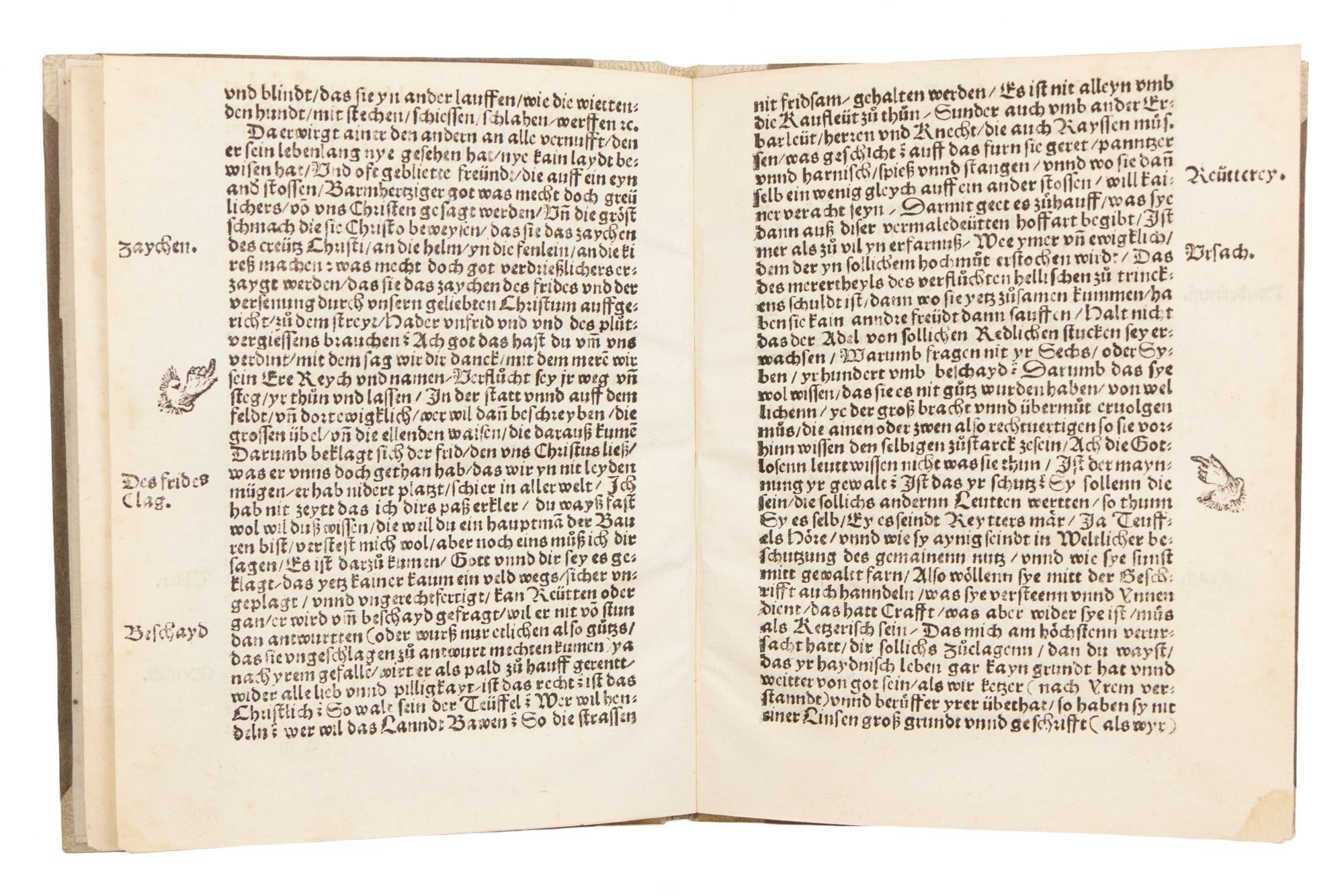
ONE OF TWO EDITIONS, both by Gastel for Schönsperger (see Reske/Benzing 1055.) Bound in modern uniform quarter parchment and drab boards. A very good, crisp copy with a few sidenotes lightly shaved and some light fraying in the inner margin of the title page. With a small woodcut of a Christian knight on the title within a decorative woodcut frame and printed manicules in the text. No copies traced in North America.
This is the first of two letters by Locher (writing under the pseudonym Hans Rott) addressed to “Karsthans”, “Hans of the Hoe”, the folk figure most closely associated with the plight of the German peasants who yearned for social justice and championed the cause of Church Reform. Originally a character of derision, Karsthans “became symbolic of the simple, hard-working, unsophisticated peasant whose common sense, simple trust in God, love of truth, and Biblical knowledge confounded trained theologians.”(Packull)
“The provocative words of abuse by Johann Locher against the conditions of his time reach their climax in his two epistles to Karsthans, in which he angrily calls for open resistance in both the secular and religious realms. On the title of the first incendiary letter, the author strangely describes himself as an 'enemy of the peasants', although throughout the text he proves himself to be their friend. The two epistles… are among the most passionate outbursts of the grumbling ‘little people’ of the cities and the agitated peasants of the countryside.” (Schottenloher, Wer ist Johann Locher von München?, in: Der Buchdrucker Hans Schobser, 1925, pp. 120 ff.).
"Locher's letters are among the loudest harbingers of the Peasants' War. The author uses the harshest language against the Emperor: ‘Oh, you poor Christian, what is your name? My name is, I thirst for human blood. I must increase the devil's kingdom by shedding blood, and that is why I am cursed by God and despised by men.’ He describes how bailiffs and henchmen seek the sweat of the poor day and night, exploiting and 'shaming' them. Wild game, created by God freely and for the benefit of all people, is more strictly forbidden to the peasants than adultery, brawling and fornication." (Rosen, Cat. Neufforge no. 91)
VD 16 3384; Panzer p. 382, no. 2777; Claus, Der deutsche Bauernkrieg im Druckschaffen der Jahre 1524-1526, no. 45; Claus, Die Zwickauer Drucke des 16. Jahrhunderts, Vol. I, no. 66.
II. LOCHER'S SECOND LETTER TO KARSTHANS:
Locher, Johann (d. 1524)
Ein vngewonlicher, vnd der Ander Sendtbrieff, deß Baurnfeyndts zu Karsthannsen, Der doch nit allein wider ynn Sunder der Gantzen Christenhayt entgegen ist.
[Zwickau]: [Jörg Gastel for Johann Schönsperger the Younger], 1524
Quarto: 17.6 x 14.1 cm. A4, B2, C4 (-blank leaf C4)
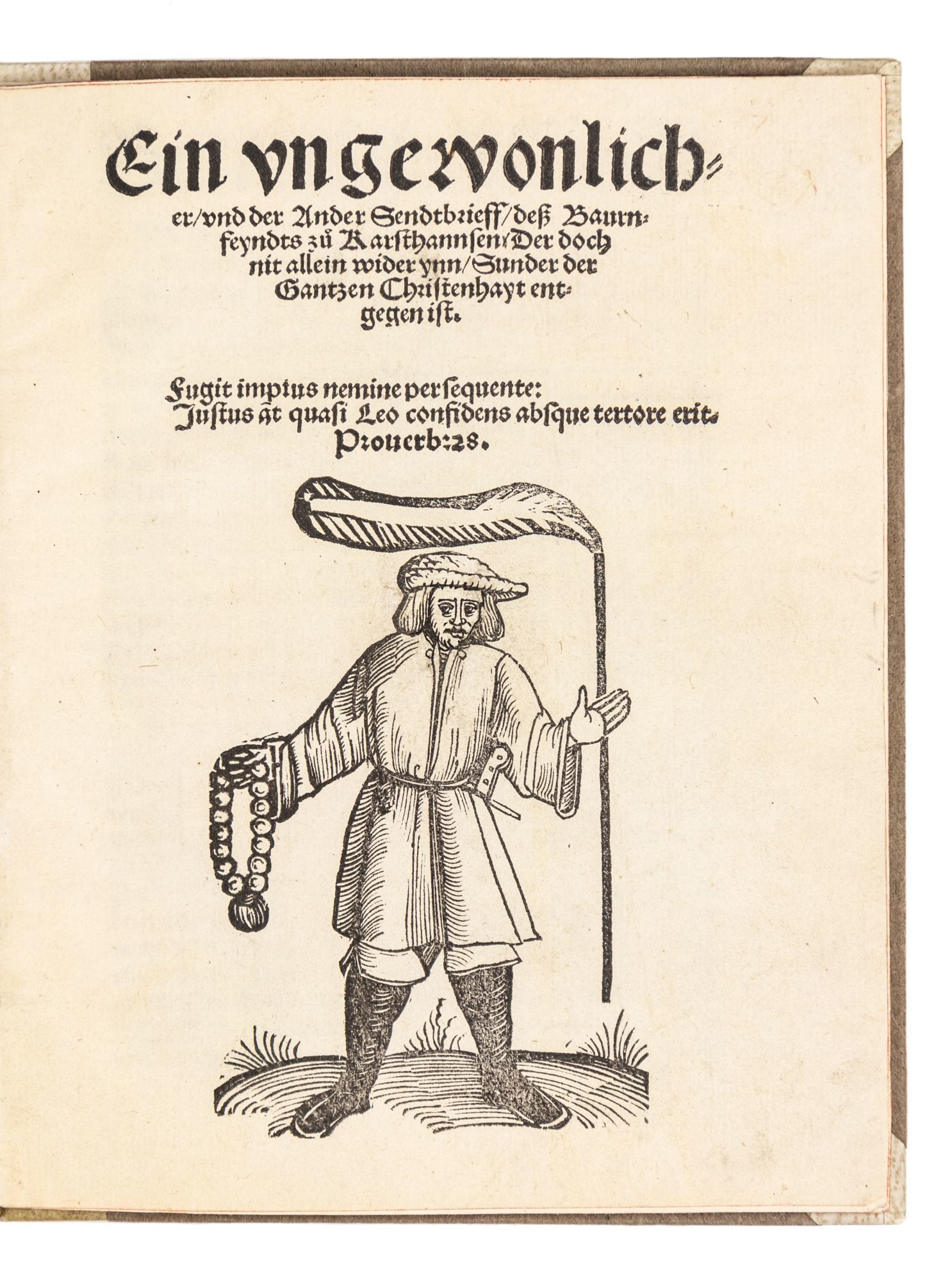
FIRST EDITION. Modern half vellum and drab boards. With a title woodcut of a German peasant with his threshing flail by Master HS is based on the work of Erhard Schön. The farmer's face has been cut out and carefully re-inserted almost imperceptibly, the transition added with pen strokes that are barely visible. One corner has water stains, otherwise very well preserved and fresh. One copy traced in North America (Harvard.)
In this second letter to Karsthans, Locher gives voice to the rage, grievances, and frustration of the German underclass. Revolution is inevitable. "Things cannot go on as they have done," writes Locher, "the game has been carried on long enough, and both citizens and peasants are tired of it. Everything will change.”
Locher laments the prevalence of senseless violence, even among blood relatives. The roads are perilous and one would do well to have a bodyguard. He decries the hypocrisy of Christian symbols being used in the context of warfare and bloodshed, which contradicts their intended meaning of peace and reconciliation. Locher argues that the ruling hierarchy, from the highest to the lowest, conspires to exploit and oppress the poor. He condemns the brutality inflicted upon peasants, including torture, mutilation, and execution, simply for defending their crops.
Free Hans and His Flail:
From 1521 to 1525, the woodcut of a peasant with his threshing flail was a popular emblem of the “common man” ready to champion the Reformation cause and to defend himself from social injustice. He was a figure closely related to the aforementioned “Karsthans”, “Hans of the Hoe”, whom Locher addresses in this letter.
In certain depictions, Karsthans was also depicted with a threshing flail, separating the wheat of Luther’s Reformed theology from the chaff of Catholic doctrines that have no basis in Scripture. (In this context, the presence of the rosary in the peasant’s other hand seems incongruous.)
With the success of Karsthans, a second figure emerged, “in a poem entitled Fryhans, ‘Free Hans,’ that suggested lower-class readiness to use the threshing flail against opponents of reform. Hereafter the Karst and Flegel, the two-pronged hoe and the threshing flail of the peasant, became symbols that underscored popular support for the Reformation.”(Packull) The image on the title page of this pamphlet, then, is an instance of the blurring of the two figures.
The Gathering Storm:
Locher’s letters to Karsthans appeared on the eve of the Peasants’ War, one of the bloodiest chapters in the turbulent early history of the German Reformation. The uprising began in upper Swabia in early 1524 and quickly spread to southern and western Germany, as well as to parts of Switzerland and Austria. By 1524, peasants had formed into territorial democratic groups (known as Haufen – bands) each with its own governing body (the Ring) which agreed on laws, maintained order, and directed the actions of the rest. The peasants were motivated by a number of factors: crushing taxation, lack of a voice in government, no recourse to the courts, crop failure, and helplessness in the face of their feudal masters’ demands. But whereas these conditions had resulted in smaller uprisings in the past, the massive rebellion of 1524-5 was also a result of the turbulent upheaval caused by the nascent Reformation. By the time the rebellion was crushed in late 1525, some 100,000 combatants and civilians had been killed. Reprisals were carried out for the next two years, and the peasants’ demands, as outlined in their Twelve Articles, came to nothing.
VD 16, R 3387; Claus, Der deutsche Bauernkrieg im Druckschaffen der Jahre 1524-1526, no. 46; and Die Zwickauer Drucke des 16. Jahrhunderts, Vol. I no. 67; Knaake 967; Panzer, DA 2377; Schottenloher, Schobser p. 123 ff.; Weller 2965; Laube, Bauernkriegzeit, 580
Overview:
“Of Locher's known publications… two were addressed directly to Karsthans, who reappears in these two missives as a symbolic leader of the peasants. Locher assumes the role of ally and advisor although by some strange logic he introduces the letters as the work of an enemy of the peasants. Thus the first open letter carried the title ‘A Woeful Missive of the Peasant Enemy to Karsthans, his Confederate, with Advice and Comfort Concerning the Whole of Christendom’ (Ein Claglicher Sendtbrieff des Baurnveyndts zu Karsthannsen seynem Pundtgnossen, mit Radt und Trost, Die ganntz Christenhayt belangendt).
“It was written with foreboding early in 1524. Astrologers and apocalyptical seers predicted floods, famine, war, insurrection, and even the end of the world for 1524. However, Locher's primary concern seemed to be with the retarded progress of the Reformation. The problem rested with the ‘grossen Hansen’ [prosperous and socially powerful individuals, often belonging to the upper middle class, such as wealthy merchants, well-off artisans, or influential burghers, i.e. citizens of free imperial cities] who instead of helping to erect a Christian order continued to support the kingdom of Antichrist. The reasons were not hard to find. The upper estates feared that religious reform could spill over into the social-political sphere. Locher wrote:
‘I suppose they think it will go too far. They see the handwriting on the wall that the pomp, pride and presumption of the ‘grossen Hansen’ has as little foundation and no better legitimacy than that of the heretical followers of the Whore of Babylon and her regiment.
“Thus Locher had come to the view that a Reformation as he envisaged it ran counter to the self-interests of the ‘grossen Hansen’, who abused their God-given office to enhance their own position while exploiting the poor. But Locher recognized that oppression was not a monopoly of the great. Even among peasants in small hamlets with no more than three residents, one sought to dominate the others. All this seemed unchristian and contrary to the claims of the gospel. The latter was understood as divine law normative for all relationships in a would-be Christian society. Fully aware of the potential implications should the common man adopt such a reading of the gospel, Locher feared bloodshed unless the authorities finally initiated appropriate reforms. Previous appeals had fallen on deaf ears and time was running out.
“Not that he advocated violence. He advised Karsthans against avarice, arrogance and selfish action. God's cause was not child's play. Divine favour could be expected only if the peasants made a true Christian order their priority. Otherwise Locher feared that Karsthans and his allies would find themselves once again the butt of ridicule... He admonished Karsthans to keep the ‘poor simple flock’ out of quarrels between the grossen Hansen; for he feared that the common man would become a scapegoat and his adversaries unite and ‘wash their hands in his blood.’
“These prophetic statements indicate that Locher's sympathies were decidedly on the side of the common man. His appeal to Karsthans constituted a qualified summons to the third estate. The Reformation he sought went beyond doctrinal and ecclesiastical matters to a reform of the whole society.
The Second Letter to Karsthans:
“This becomes clear in the second missive, entitled ‘An Unusual Missive of the Peasant Enemy to Karsthans’ (Ein ungewonlicher, vnd der Ander Sendtbrieff, deß Baurnfeyndts zu Karsthannsen, Der doch nit allein wider ynn Sunder der Gantzen Christenhayt entgegen ist). The letter constitutes a general indictment of wide spread violence in the existing order. As Locher described it, the roads were no longer safe unless one could afford a bodyguard:
‘One chokes the other without cause even though he has never met him before, and the victim has done him no harm. Even among blood relations it has become common to settle differences with violence....Merciful God, could there be anything more despicable said about us Christians? What greater insult to Christ than the sign of the cross on helmets, standards and armor? What could be more vexing to God than that the sign of peace and reconciliation of our beloved Christ has been raised for discord, quarrel, dissention and the shedding of blood?’
“Hardest hit by this unchristian disorder were the poor. It seemed that all from the highest to the lowest in the established hierarchy conspired day and night to exploit and grind the poor (schinden und schaben). On their behalf Locher registered specific protests that found an echo a few months later in the programs of rebellious peasants. Why were wild animals permitted to roam the fields from which peasants were expected to pay the tithe and rent? Why were the peasants not allowed to protect their livelihood? Was it not pitiful, yes, shameful and against all reason, Christian charity and Scriptures that peasants were tortured, had their eyes gouged out or even beheaded for protecting their crops? Was it Christian that two, four or ten consumed and squandered what could sustain ten to forty thousand? Thus for Locher the Christian mandate carried social implications. Engagement for the kingdom of Christ meant engagement for social and economic justice. The former Franciscan had become a spokesman for a reformation of the common man.
“Locher's sympathy for the common people, his outspoken critique of the grossen Hansen remain strikingly radical even by twentieth century standards:
‘(When) the lords and grossen Hansen pluck each other, the poor must lend the hair. / Only little thieves are hanged. The hat is tipped to the great. / But you, lords, whoever you may be, this will be your judgment: As you will have mercy on the poor,/ so also will God have mercy on you.’
“And yet the vision of this former Franciscan remained in some ways medieval. True, he no longer idealized poverty-seeking but instead the elimination of its cause-human exploitation. But Locher's ideal was informed by a medieval vision of a reformed Corpus Christianum. The modern separation of church and state advocated by some of the post-1525 radicals was alien to him. With a previous generation of humanists he shared an anachronistic dream of a revitalized Christian empire. The emperor was to retain his constitutional position. Territorial rulers were to be compensated for legitimate administrative expenses. A council or committee ruling with the consent of the estates, which presumably included representatives of the peasants (ausschuss des regiments durch gemeine tierwilligung der landtschajft), was to exercise real authority.
“Should these proposals go unheeded, Locher feared that ‘peasants in town and country would unite’ for the ‘game had gone too far. The cities as well as the peasants were weary of it.’ Revolution seemed inevitable. In part these predictions proved correct. Only a few months after Locher's execution peasants and townsmen shook the foundation of the empire in the Revolution of the Common Man.
“Locher's two last missives illustrate a shift in the Karsthans image from its religious, polemical function to a symbol of social agitation. To be sure, Locher admonished Karsthans not to reach for the flail, but that admonition stood in contrast to his own pessimistic conclusions. In his appeal to the common man, in his critique of society in general and of the grossen Hansen in particular, Locher with other radical pamphleteers contributed to the ideological mobilization of the common man. In this endeavor he became an unconscious ally of Thomas Müntzer, for it is in the writings of these two men, more so than elsewhere, that we find the erratic pulsebeat of the popular phase of the Reformation.”(Packull, The Image of the "Common Man" in the Early Pamphlets of the Reformation (1520- 1525), in Historical Reflections / Réflexions Historiques, Summer 1985, Vol. 12, No. 2 (Summer 1985), pp. 253-277).
These two books, both extremely rare, are bound in modern, uniform quarter-vellum bindings. It is clear that they were previously bound together and so are now being offered as a pair.
The brief descriptions of the books presented below are followed by an in-depth discussion of the works.
I. LOCHER'S FIRST LETTER TO KARSTHANS:
Locher, Johann (d. 1524)
Ein Claglicher Sendtbrieff des Baurnveyndts zu Karsthannsen seynem Pundtgnossen, mit Radt vnd Trost, Die ganntz Christenhayt belangendt.
[Zwickau:] ‘Gedruckt durch Johann Locher von München’ [but Jörg Gastel for Johann Schönsperger the Younger], 1524
Quarto: 17.6 x 14.1 cm. [9] lvs. A4, B2, C4 (-blank C4)
ONE OF TWO EDITIONS, both by Gastel for Schönsperger (see Reske/Benzing 1055.) Bound in modern uniform quarter parchment and drab boards. A very good, crisp copy with a few sidenotes lightly shaved and some light fraying in the inner margin of the title page. With a small woodcut of a Christian knight on the title within a decorative woodcut frame and printed manicules in the text. No copies traced in North America.
This is the first of two letters by Locher (writing under the pseudonym Hans Rott) addressed to “Karsthans”, “Hans of the Hoe”, the folk figure most closely associated with the plight of the German peasants who yearned for social justice and championed the cause of Church Reform. Originally a character of derision, Karsthans “became symbolic of the simple, hard-working, unsophisticated peasant whose common sense, simple trust in God, love of truth, and Biblical knowledge confounded trained theologians.”(Packull)
“The provocative words of abuse by Johann Locher against the conditions of his time reach their climax in his two epistles to Karsthans, in which he angrily calls for open resistance in both the secular and religious realms. On the title of the first incendiary letter, the author strangely describes himself as an 'enemy of the peasants', although throughout the text he proves himself to be their friend. The two epistles… are among the most passionate outbursts of the grumbling ‘little people’ of the cities and the agitated peasants of the countryside.” (Schottenloher, Wer ist Johann Locher von München?, in: Der Buchdrucker Hans Schobser, 1925, pp. 120 ff.).
"Locher's letters are among the loudest harbingers of the Peasants' War. The author uses the harshest language against the Emperor: ‘Oh, you poor Christian, what is your name? My name is, I thirst for human blood. I must increase the devil's kingdom by shedding blood, and that is why I am cursed by God and despised by men.’ He describes how bailiffs and henchmen seek the sweat of the poor day and night, exploiting and 'shaming' them. Wild game, created by God freely and for the benefit of all people, is more strictly forbidden to the peasants than adultery, brawling and fornication." (Rosen, Cat. Neufforge no. 91)
VD 16 3384; Panzer p. 382, no. 2777; Claus, Der deutsche Bauernkrieg im Druckschaffen der Jahre 1524-1526, no. 45; Claus, Die Zwickauer Drucke des 16. Jahrhunderts, Vol. I, no. 66.
II. LOCHER'S SECOND LETTER TO KARSTHANS:
Locher, Johann (d. 1524)
Ein vngewonlicher, vnd der Ander Sendtbrieff, deß Baurnfeyndts zu Karsthannsen, Der doch nit allein wider ynn Sunder der Gantzen Christenhayt entgegen ist.
[Zwickau]: [Jörg Gastel for Johann Schönsperger the Younger], 1524
Quarto: 17.6 x 14.1 cm. A4, B2, C4 (-blank leaf C4)
FIRST EDITION. Modern half vellum and drab boards. With a title woodcut of a German peasant with his threshing flail by Master HS is based on the work of Erhard Schön. The farmer's face has been cut out and carefully re-inserted almost imperceptibly, the transition added with pen strokes that are barely visible. One corner has water stains, otherwise very well preserved and fresh. One copy traced in North America (Harvard.)
In this second letter to Karsthans, Locher gives voice to the rage, grievances, and frustration of the German underclass. Revolution is inevitable. "Things cannot go on as they have done," writes Locher, "the game has been carried on long enough, and both citizens and peasants are tired of it. Everything will change.”
Locher laments the prevalence of senseless violence, even among blood relatives. The roads are perilous and one would do well to have a bodyguard. He decries the hypocrisy of Christian symbols being used in the context of warfare and bloodshed, which contradicts their intended meaning of peace and reconciliation. Locher argues that the ruling hierarchy, from the highest to the lowest, conspires to exploit and oppress the poor. He condemns the brutality inflicted upon peasants, including torture, mutilation, and execution, simply for defending their crops.
Free Hans and His Flail:
From 1521 to 1525, the woodcut of a peasant with his threshing flail was a popular emblem of the “common man” ready to champion the Reformation cause and to defend himself from social injustice. He was a figure closely related to the aforementioned “Karsthans”, “Hans of the Hoe”, whom Locher addresses in this letter.
In certain depictions, Karsthans was also depicted with a threshing flail, separating the wheat of Luther’s Reformed theology from the chaff of Catholic doctrines that have no basis in Scripture. (In this context, the presence of the rosary in the peasant’s other hand seems incongruous.)
With the success of Karsthans, a second figure emerged, “in a poem entitled Fryhans, ‘Free Hans,’ that suggested lower-class readiness to use the threshing flail against opponents of reform. Hereafter the Karst and Flegel, the two-pronged hoe and the threshing flail of the peasant, became symbols that underscored popular support for the Reformation.”(Packull) The image on the title page of this pamphlet, then, is an instance of the blurring of the two figures.
The Gathering Storm:
Locher’s letters to Karsthans appeared on the eve of the Peasants’ War, one of the bloodiest chapters in the turbulent early history of the German Reformation. The uprising began in upper Swabia in early 1524 and quickly spread to southern and western Germany, as well as to parts of Switzerland and Austria. By 1524, peasants had formed into territorial democratic groups (known as Haufen – bands) each with its own governing body (the Ring) which agreed on laws, maintained order, and directed the actions of the rest. The peasants were motivated by a number of factors: crushing taxation, lack of a voice in government, no recourse to the courts, crop failure, and helplessness in the face of their feudal masters’ demands. But whereas these conditions had resulted in smaller uprisings in the past, the massive rebellion of 1524-5 was also a result of the turbulent upheaval caused by the nascent Reformation. By the time the rebellion was crushed in late 1525, some 100,000 combatants and civilians had been killed. Reprisals were carried out for the next two years, and the peasants’ demands, as outlined in their Twelve Articles, came to nothing.
VD 16, R 3387; Claus, Der deutsche Bauernkrieg im Druckschaffen der Jahre 1524-1526, no. 46; and Die Zwickauer Drucke des 16. Jahrhunderts, Vol. I no. 67; Knaake 967; Panzer, DA 2377; Schottenloher, Schobser p. 123 ff.; Weller 2965; Laube, Bauernkriegzeit, 580
Overview:
“Of Locher's known publications… two were addressed directly to Karsthans, who reappears in these two missives as a symbolic leader of the peasants. Locher assumes the role of ally and advisor although by some strange logic he introduces the letters as the work of an enemy of the peasants. Thus the first open letter carried the title ‘A Woeful Missive of the Peasant Enemy to Karsthans, his Confederate, with Advice and Comfort Concerning the Whole of Christendom’ (Ein Claglicher Sendtbrieff des Baurnveyndts zu Karsthannsen seynem Pundtgnossen, mit Radt und Trost, Die ganntz Christenhayt belangendt).
“It was written with foreboding early in 1524. Astrologers and apocalyptical seers predicted floods, famine, war, insurrection, and even the end of the world for 1524. However, Locher's primary concern seemed to be with the retarded progress of the Reformation. The problem rested with the ‘grossen Hansen’ [prosperous and socially powerful individuals, often belonging to the upper middle class, such as wealthy merchants, well-off artisans, or influential burghers, i.e. citizens of free imperial cities] who instead of helping to erect a Christian order continued to support the kingdom of Antichrist. The reasons were not hard to find. The upper estates feared that religious reform could spill over into the social-political sphere. Locher wrote:
‘I suppose they think it will go too far. They see the handwriting on the wall that the pomp, pride and presumption of the ‘grossen Hansen’ has as little foundation and no better legitimacy than that of the heretical followers of the Whore of Babylon and her regiment.
“Thus Locher had come to the view that a Reformation as he envisaged it ran counter to the self-interests of the ‘grossen Hansen’, who abused their God-given office to enhance their own position while exploiting the poor. But Locher recognized that oppression was not a monopoly of the great. Even among peasants in small hamlets with no more than three residents, one sought to dominate the others. All this seemed unchristian and contrary to the claims of the gospel. The latter was understood as divine law normative for all relationships in a would-be Christian society. Fully aware of the potential implications should the common man adopt such a reading of the gospel, Locher feared bloodshed unless the authorities finally initiated appropriate reforms. Previous appeals had fallen on deaf ears and time was running out.
“Not that he advocated violence. He advised Karsthans against avarice, arrogance and selfish action. God's cause was not child's play. Divine favour could be expected only if the peasants made a true Christian order their priority. Otherwise Locher feared that Karsthans and his allies would find themselves once again the butt of ridicule... He admonished Karsthans to keep the ‘poor simple flock’ out of quarrels between the grossen Hansen; for he feared that the common man would become a scapegoat and his adversaries unite and ‘wash their hands in his blood.’
“These prophetic statements indicate that Locher's sympathies were decidedly on the side of the common man. His appeal to Karsthans constituted a qualified summons to the third estate. The Reformation he sought went beyond doctrinal and ecclesiastical matters to a reform of the whole society.
The Second Letter to Karsthans:
“This becomes clear in the second missive, entitled ‘An Unusual Missive of the Peasant Enemy to Karsthans’ (Ein ungewonlicher, vnd der Ander Sendtbrieff, deß Baurnfeyndts zu Karsthannsen, Der doch nit allein wider ynn Sunder der Gantzen Christenhayt entgegen ist). The letter constitutes a general indictment of wide spread violence in the existing order. As Locher described it, the roads were no longer safe unless one could afford a bodyguard:
‘One chokes the other without cause even though he has never met him before, and the victim has done him no harm. Even among blood relations it has become common to settle differences with violence....Merciful God, could there be anything more despicable said about us Christians? What greater insult to Christ than the sign of the cross on helmets, standards and armor? What could be more vexing to God than that the sign of peace and reconciliation of our beloved Christ has been raised for discord, quarrel, dissention and the shedding of blood?’
“Hardest hit by this unchristian disorder were the poor. It seemed that all from the highest to the lowest in the established hierarchy conspired day and night to exploit and grind the poor (schinden und schaben). On their behalf Locher registered specific protests that found an echo a few months later in the programs of rebellious peasants. Why were wild animals permitted to roam the fields from which peasants were expected to pay the tithe and rent? Why were the peasants not allowed to protect their livelihood? Was it not pitiful, yes, shameful and against all reason, Christian charity and Scriptures that peasants were tortured, had their eyes gouged out or even beheaded for protecting their crops? Was it Christian that two, four or ten consumed and squandered what could sustain ten to forty thousand? Thus for Locher the Christian mandate carried social implications. Engagement for the kingdom of Christ meant engagement for social and economic justice. The former Franciscan had become a spokesman for a reformation of the common man.
“Locher's sympathy for the common people, his outspoken critique of the grossen Hansen remain strikingly radical even by twentieth century standards:
‘(When) the lords and grossen Hansen pluck each other, the poor must lend the hair. / Only little thieves are hanged. The hat is tipped to the great. / But you, lords, whoever you may be, this will be your judgment: As you will have mercy on the poor,/ so also will God have mercy on you.’
“And yet the vision of this former Franciscan remained in some ways medieval. True, he no longer idealized poverty-seeking but instead the elimination of its cause-human exploitation. But Locher's ideal was informed by a medieval vision of a reformed Corpus Christianum. The modern separation of church and state advocated by some of the post-1525 radicals was alien to him. With a previous generation of humanists he shared an anachronistic dream of a revitalized Christian empire. The emperor was to retain his constitutional position. Territorial rulers were to be compensated for legitimate administrative expenses. A council or committee ruling with the consent of the estates, which presumably included representatives of the peasants (ausschuss des regiments durch gemeine tierwilligung der landtschajft), was to exercise real authority.
“Should these proposals go unheeded, Locher feared that ‘peasants in town and country would unite’ for the ‘game had gone too far. The cities as well as the peasants were weary of it.’ Revolution seemed inevitable. In part these predictions proved correct. Only a few months after Locher's execution peasants and townsmen shook the foundation of the empire in the Revolution of the Common Man.
“Locher's two last missives illustrate a shift in the Karsthans image from its religious, polemical function to a symbol of social agitation. To be sure, Locher admonished Karsthans not to reach for the flail, but that admonition stood in contrast to his own pessimistic conclusions. In his appeal to the common man, in his critique of society in general and of the grossen Hansen in particular, Locher with other radical pamphleteers contributed to the ideological mobilization of the common man. In this endeavor he became an unconscious ally of Thomas Müntzer, for it is in the writings of these two men, more so than elsewhere, that we find the erratic pulsebeat of the popular phase of the Reformation.”(Packull, The Image of the "Common Man" in the Early Pamphlets of the Reformation (1520- 1525), in Historical Reflections / Réflexions Historiques, Summer 1985, Vol. 12, No. 2 (Summer 1985), pp. 253-277).
Details
Title
Two separately published works by the Reformer Johann Locher, addressed to the German folk hero "Karsthans
Author
Locher, Johann (d. 1524) [writing under the pseudonym Hans Rott]
Binding
Hardcover
Condition
Fine