

[Galley Proof of John A. McClernand's Speech Assailing President Ulysses S. Grant's Use of the Military in Enforcing Reconstruction Laws, Deploring the Installation of William Pitt Kellogg as Governor of Louisiana, Castigating Radical Republican Policies, and Denouncing Plans to Throw the Presidential Election to Hayes Rather Than Tilden]
- [N.p., likely Springfield, Il: ca. January 8, 1877
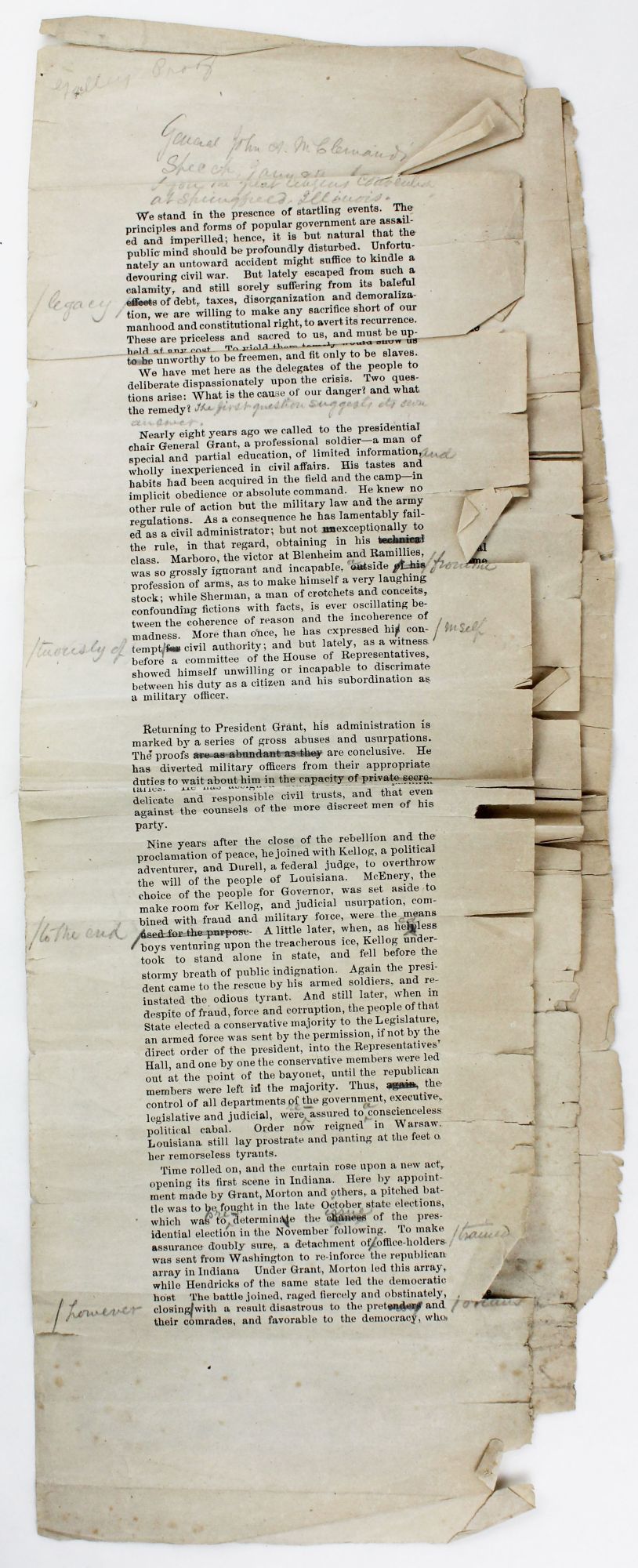
[N.p., likely Springfield, Il: ca. January 8, 1877. Good.. Three long galley leaves, each approximately 6.5 x 19 inches and printed on rectos only, with numerous pencil emendations. Old folds and creases, numerous chips and tears to margins, pervasive wrinkling, making reading a bit challenging at times, but with no loss to text. Small portion of third leaf containing the last eight lines of text detached but present. Not in great shape, but seemingly unique. A galley proof of a speech by General John A. McClernand in the midst of the contentious Election of 1876 which was, so far as we can determine, neither delivered nor published. A pencil note at top reveals his authorship and notes the speech was intended to be delivered January 8 at the “Great Citizens Convention” in Springfield, Illinois, almost certainly in 1877, following the recent election in the Fall of 1876. McClernand was an Illinois contemporary of Lincoln's, a Democratic Congressman, and War Democrat. He was also an ally of another Illinois politician, and Lincoln adversary, Stephen A. Douglas. He was appointed a general during the Civil War, largely through political maneuvering, and was generally considered incompetent. McClernand greatly resented the authority of Grant, who finally relieved him of command in June 1863. Following the war, McClernand became a leading critic of Congressional Reconstruction as well as the Grant Administration in general. He also chaired the 1876 Democratic National Convention which nominated Tilden for the presidency.
Here, McClernand bitterly attacks Grant, his presidential Administration, and Reconstruction. According to McClernand, Grant's "tastes and habits had been acquired in the field and the camp -- in implicit obedience or absolute command. He knew no other rule of action but the military law and army regulations. As a consequence he has lamentably failed as a civil administrator." As President, fraudulently and illegally, Grant "joined with Kellog, a political adventurer, and Durell, a federal judge, to overthrow the will of the people of Louisiana." Law and order, says McClernand, "lay prostrate and panting at the feet of her remorseless tyrants." McClernand also assails Grant's highhanded tactics in the other Southern States.
Now, says McClernand, "the president and his accomplices have now applied themselves to defeat the will of the people by a parliamentary device. They claimed for the President of the Senate the right and power to count the electoral votes and to declare the result, and, by implication, that that right and power would be so exercised as to count Tilden out of his election, and to count Hayes into one." He wasn't wrong. In one of the closest, most hotly-contested, and highly-controversial elections in American history, to put it simply, Hayes effectively stole the election by agreeing to remove northern soldiers from the South and end Reconstruction. It would be interesting to know what McClernand thought of the ultimate result -- he didn't get Tilden, but he did get the end of Reconstruction.
"Yet another prominent Illinoian who played a role in the Civil War, John Alexander McClernand was born in Breckinridge County, Kentucky, before moving to Shawneetown, Illinois, at a young age. Similar to fellow Illinoian Abraham Lincoln, McClernand was a largely self-taught lawyer, who began practicing in Shawneetown in 1835. Also like Lincoln, McClernand served in the Black Hawk War. However, McClernand was a staunch Democrat. In 1835, he established the newspaper Shawneetown Democrat. He was active in Democratic politics at both the state and federal level, serving in the Illinois House of Representatives and eventually Congress. In Congress, McClernand was a stalwart Jacksonian Democrat who strongly disliked abolitionists. He strongly opposed the Wilmot Proviso, which banned slavery in the territory gained after the Mexican-American War. He became a key ally of fellow Democrat and Illinoian Stephen A. Douglas, helping him pass the Compromise of 1850. As tensions rose approaching the election of 1860, McClernand campaigned for Douglas’s presidency and became a Unionist. After war broke out in the following April, McClernand helped raise volunteers for the Union Army. Because Lincoln needed to retain a wide base of support and retain connections with Democrats in Illinois, he appointed McClernand a brigadier general on May 17, 1861. McClernand’s military career would be defined by an ongoing clash with fellow Illinoian General Ulysses S. Grant. Grant, a seasoned West Pointer who served in Mexico, was irritated by McClernand, a political general with little military experience. Further exacerbating relations was McClernand’s tendency to boast about his exploits and diminish the achievements of other commanders" - American Battlefield Trust's entry on John A. McClernand.
Here, McClernand bitterly attacks Grant, his presidential Administration, and Reconstruction. According to McClernand, Grant's "tastes and habits had been acquired in the field and the camp -- in implicit obedience or absolute command. He knew no other rule of action but the military law and army regulations. As a consequence he has lamentably failed as a civil administrator." As President, fraudulently and illegally, Grant "joined with Kellog, a political adventurer, and Durell, a federal judge, to overthrow the will of the people of Louisiana." Law and order, says McClernand, "lay prostrate and panting at the feet of her remorseless tyrants." McClernand also assails Grant's highhanded tactics in the other Southern States.
Now, says McClernand, "the president and his accomplices have now applied themselves to defeat the will of the people by a parliamentary device. They claimed for the President of the Senate the right and power to count the electoral votes and to declare the result, and, by implication, that that right and power would be so exercised as to count Tilden out of his election, and to count Hayes into one." He wasn't wrong. In one of the closest, most hotly-contested, and highly-controversial elections in American history, to put it simply, Hayes effectively stole the election by agreeing to remove northern soldiers from the South and end Reconstruction. It would be interesting to know what McClernand thought of the ultimate result -- he didn't get Tilden, but he did get the end of Reconstruction.
"Yet another prominent Illinoian who played a role in the Civil War, John Alexander McClernand was born in Breckinridge County, Kentucky, before moving to Shawneetown, Illinois, at a young age. Similar to fellow Illinoian Abraham Lincoln, McClernand was a largely self-taught lawyer, who began practicing in Shawneetown in 1835. Also like Lincoln, McClernand served in the Black Hawk War. However, McClernand was a staunch Democrat. In 1835, he established the newspaper Shawneetown Democrat. He was active in Democratic politics at both the state and federal level, serving in the Illinois House of Representatives and eventually Congress. In Congress, McClernand was a stalwart Jacksonian Democrat who strongly disliked abolitionists. He strongly opposed the Wilmot Proviso, which banned slavery in the territory gained after the Mexican-American War. He became a key ally of fellow Democrat and Illinoian Stephen A. Douglas, helping him pass the Compromise of 1850. As tensions rose approaching the election of 1860, McClernand campaigned for Douglas’s presidency and became a Unionist. After war broke out in the following April, McClernand helped raise volunteers for the Union Army. Because Lincoln needed to retain a wide base of support and retain connections with Democrats in Illinois, he appointed McClernand a brigadier general on May 17, 1861. McClernand’s military career would be defined by an ongoing clash with fellow Illinoian General Ulysses S. Grant. Grant, a seasoned West Pointer who served in Mexico, was irritated by McClernand, a political general with little military experience. Further exacerbating relations was McClernand’s tendency to boast about his exploits and diminish the achievements of other commanders" - American Battlefield Trust's entry on John A. McClernand.
Details
Title
[Galley Proof of John A. McClernand's Speech Assailing President Ulysses S. Grant's Use of the Military in Enforcing Reconstruction Laws, Deploring the Installation of William Pitt Kellogg as Governor of Louisiana, Castigating Radical Republican Policies, and Denouncing Plans to Throw the Presidential Election to Hayes Rather Than Tilden]
Author
[Election of 1876]. [Reconstruction]. McClernand, John A.
Condition
Good
Publisher
ca. January 8: [N.p., likely Springfield, Il
Date
1877