

An Original Manuscript Constitution
- SIGNED
- 1606
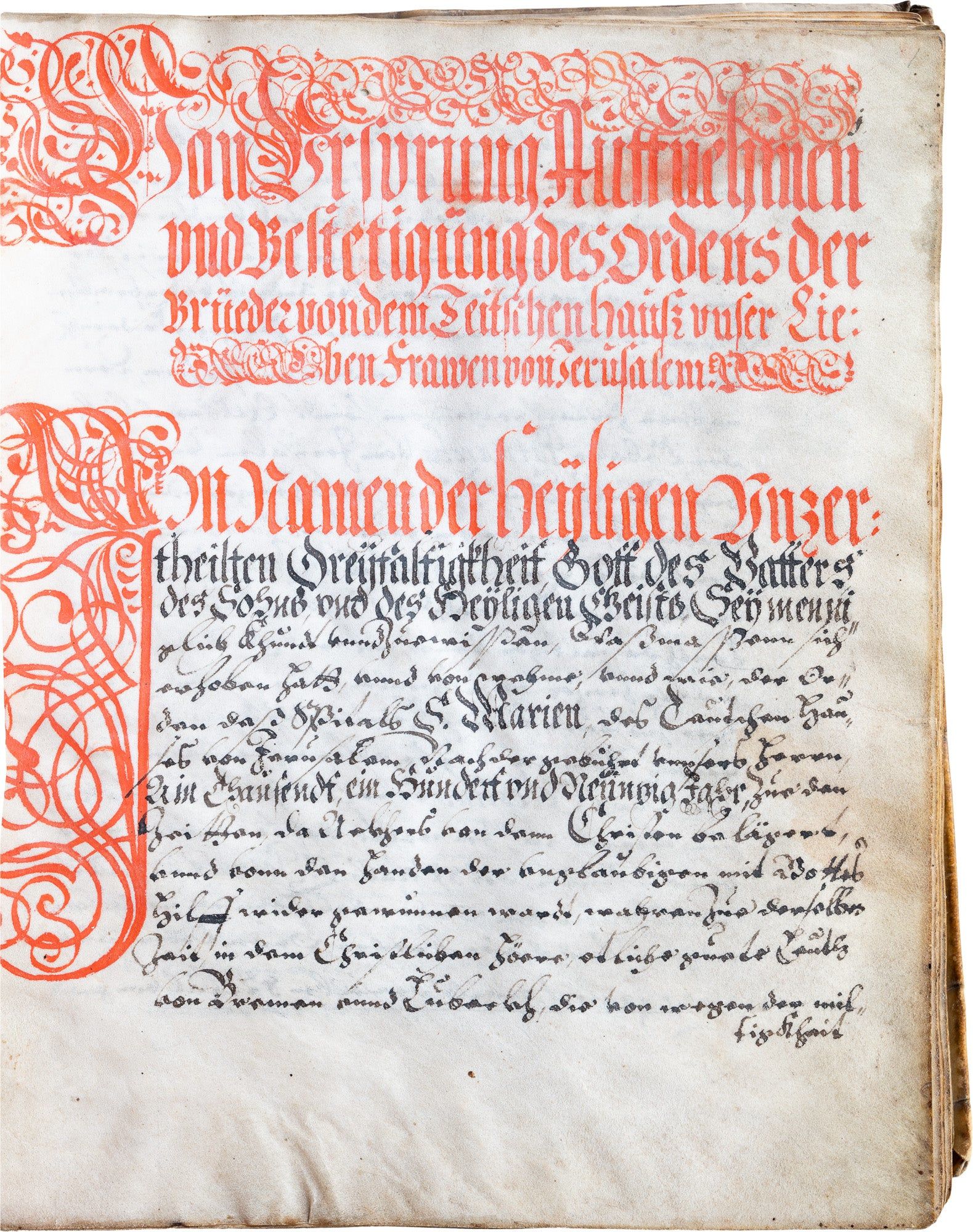
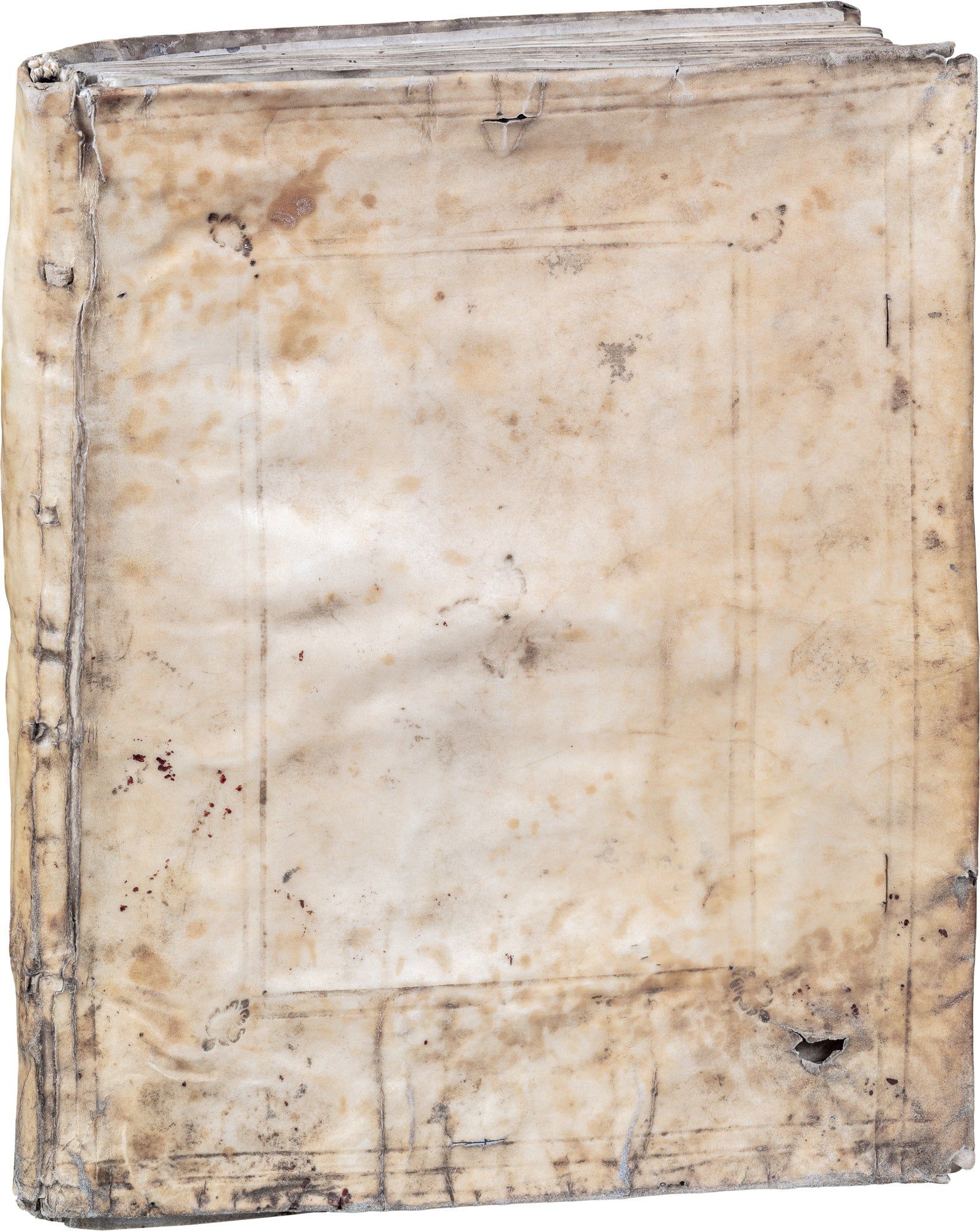
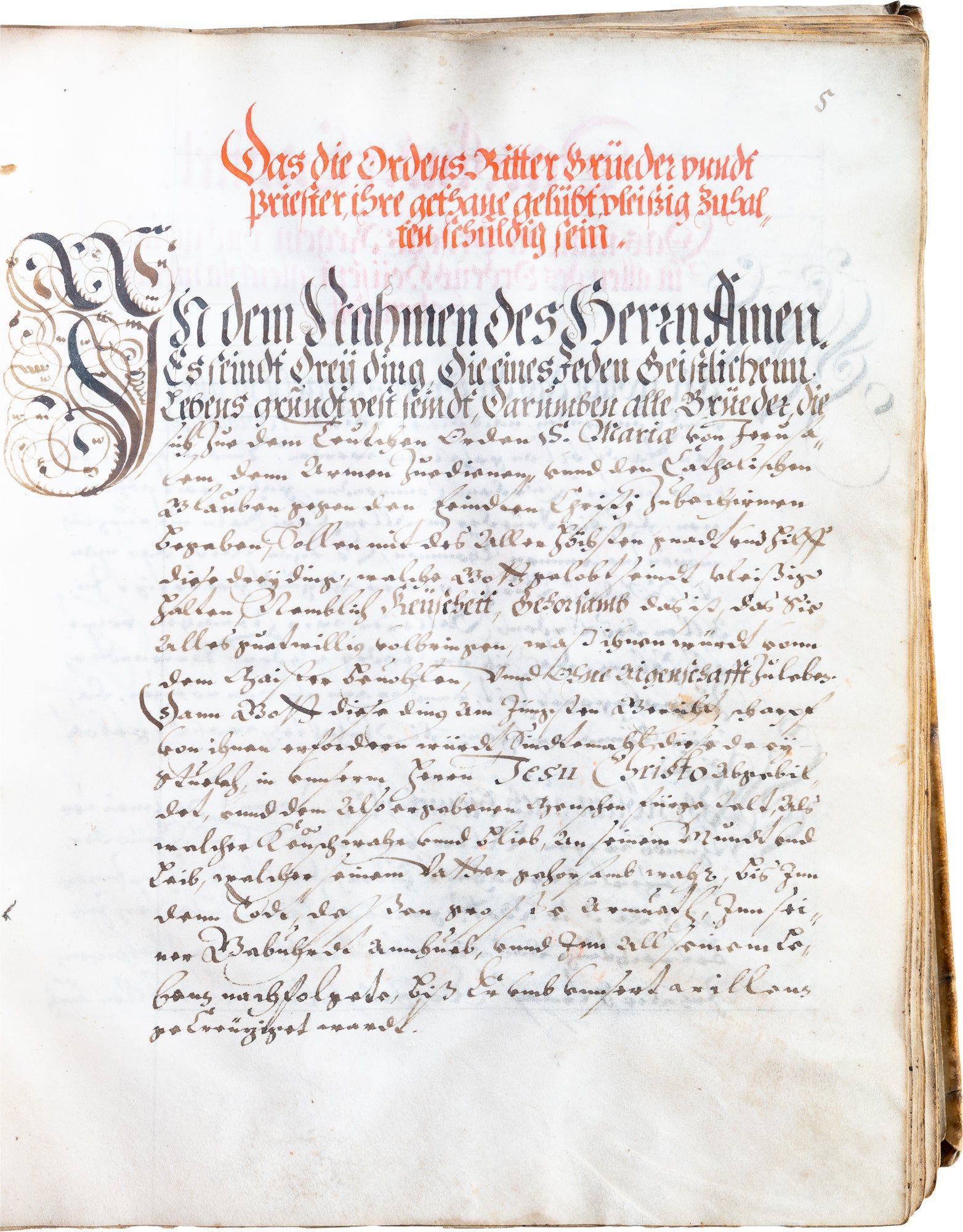
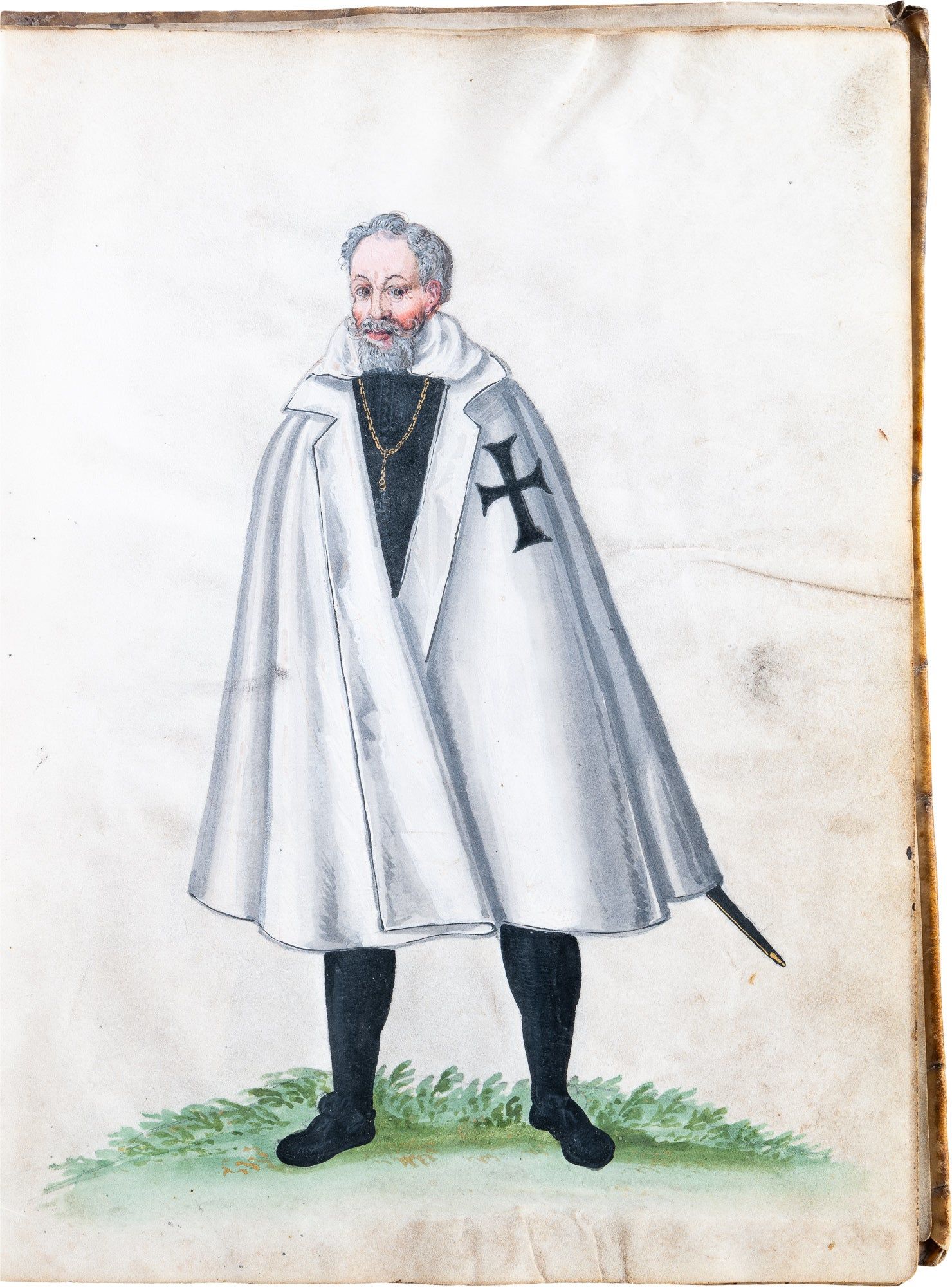
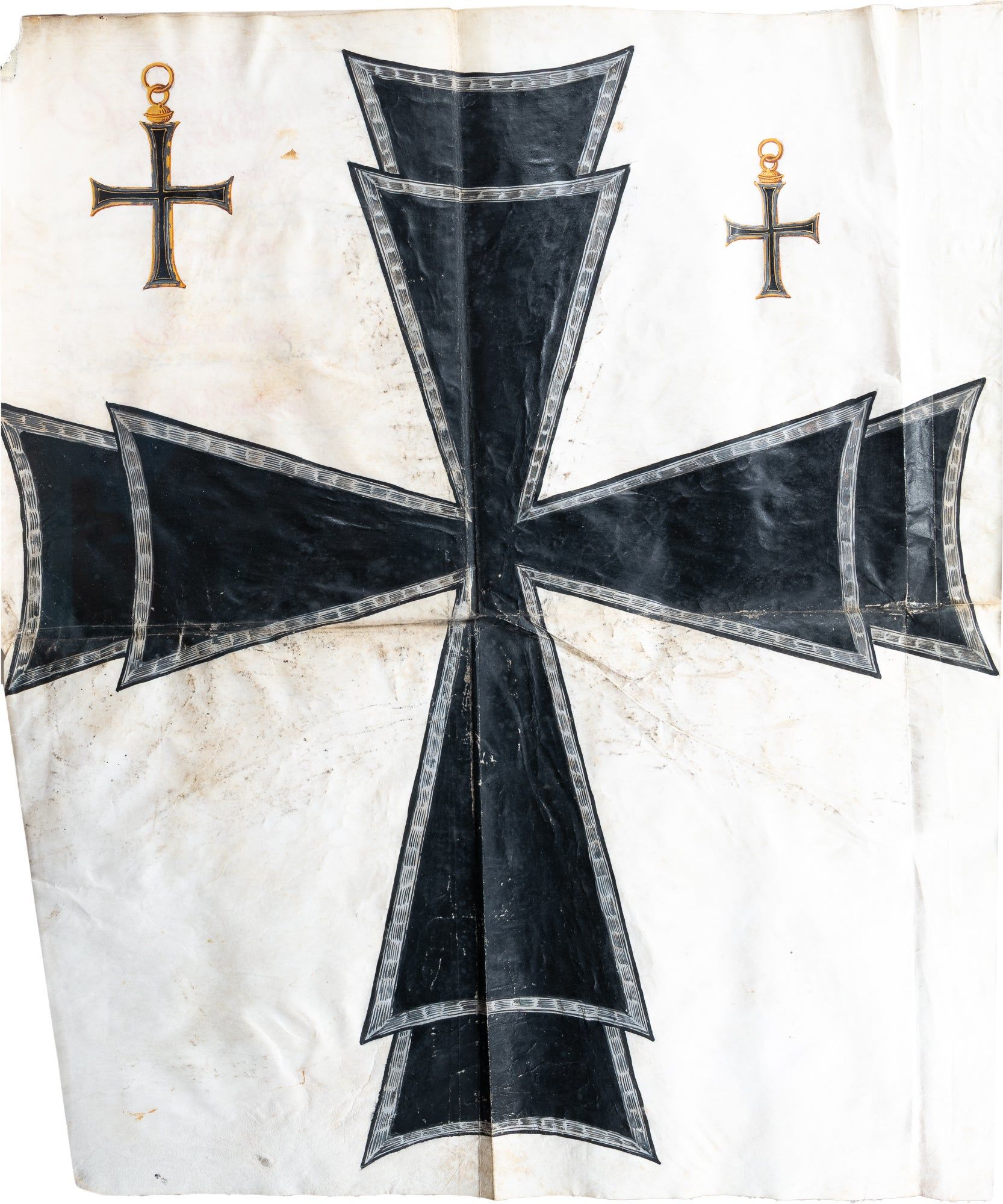
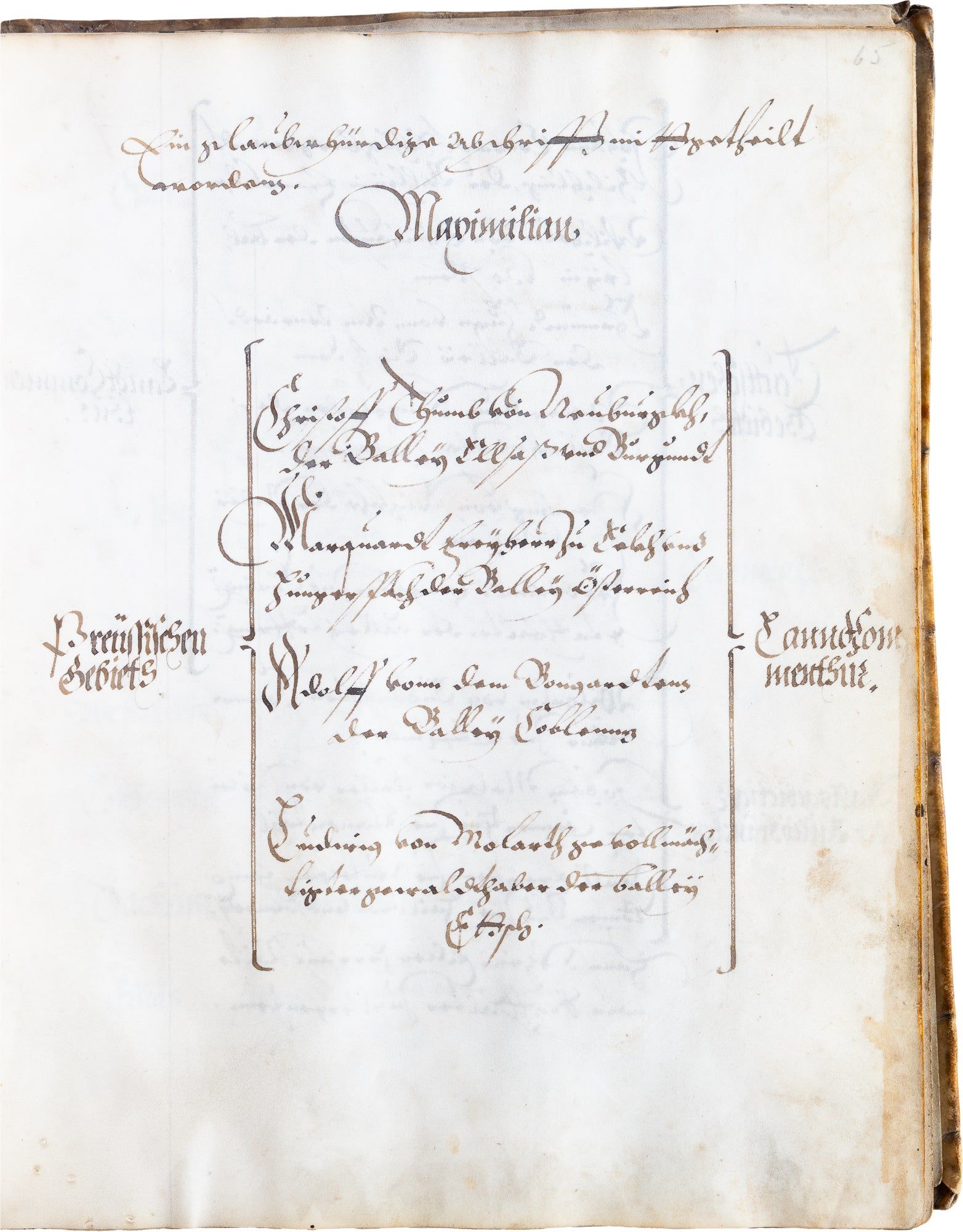
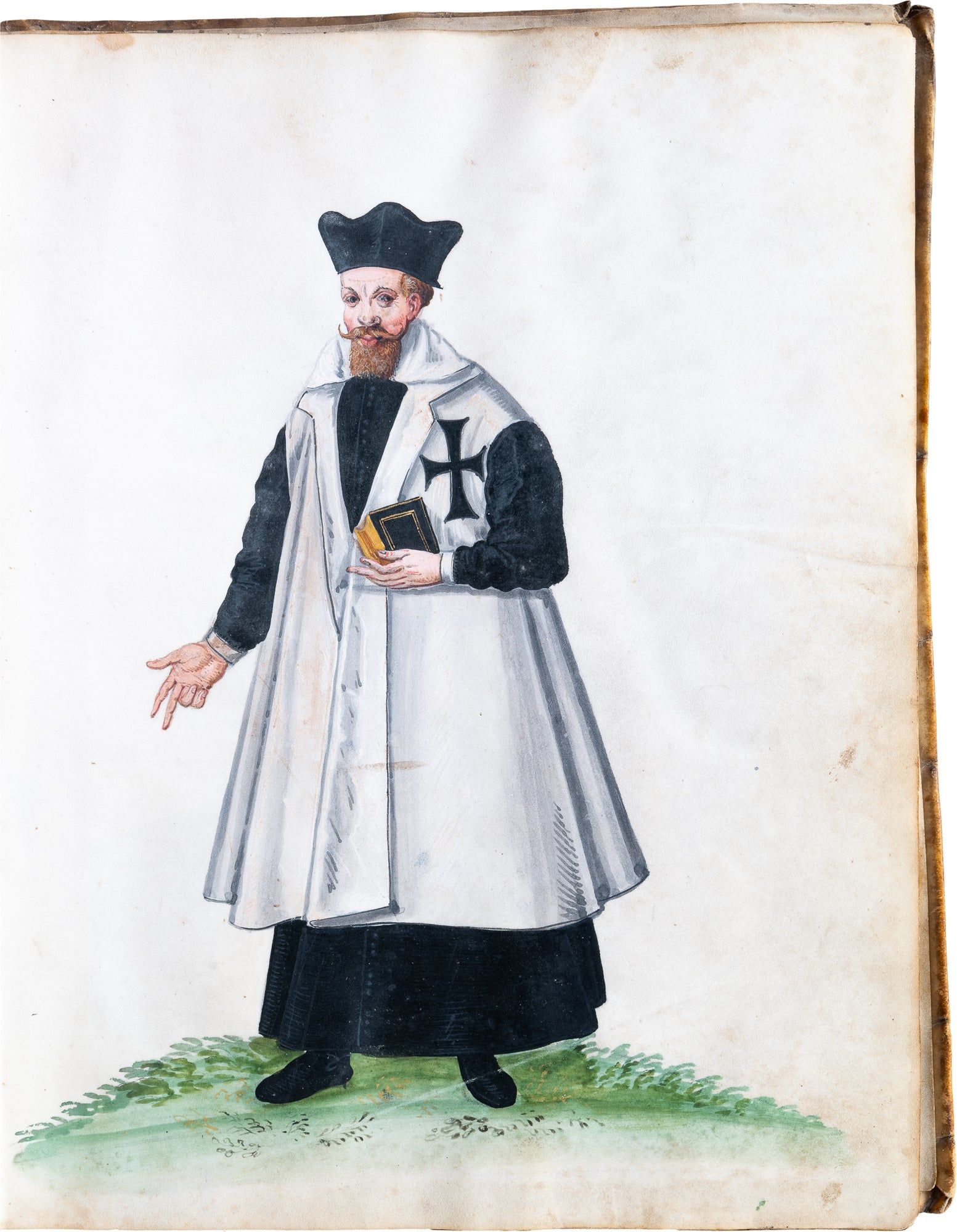
1606. Original handwritten document (in German and Latin), on vellum (parchment) in red and black ink, of the new charter of structure and re–organization for The Teutonic Knights. 2 parts, each halved, in 34 chapters (19 and 15), with 3 hand-colored plates, and decorative initials in red and black throughout. Original stitched vellum, warped and soiled, text with a few stains, bookplate (Hamilton College), else good condition. Collation: Manuscript. 4to. 66, (1), 3, 4, leaves, i.e. 148 pages. Laid in is a 17th century handwritten manuscript of 4 double–sided paper leaves (”Ermahnung so der Landt–Commenthür den jungen Ritter vorhaltet”), a 2 1/2” X 3” chip from the bottom portion of the last leaf missing, not affecting text, else very good. Comparison suggests that our manuscript is the prime one (the only complete one), unique for its content. At least 2 other examples (Riant, and Archivalie: Ordensbuch) are recorded. The Riant manuscript copy is also written in red and black ink, and also contains 3 color illustrations corresponding to ours, however, its pagination of 133 pages (plus a blank page?) is 7 leaves or 14 pages shorter than our work. In our copy the last 7 leaves are a list headed by Maximilian and containing the names of members of the order organized by locale (3 leaves), and the Registers for both the first and second parts of the work (4 leaves). The Archivalie: Ordensbuch manuscript (Dominica Oculi zu Mergentheim 1606) is called “Das Deutschordensbuch von 1606” (Hess. StA MR H 83). Their copy contains only 55 leaves and lacks the fold–out plate.
The first Crusade conquered Jerusalem in 1099 and the Knights Hospitallers (the Order of St. John) were charged with the city’s care and defense. In 1129 the Knights Templar were sanctioned, and in 1143 the Pope instructed the Hospitallers to let Germans be the prior and brothers of the German hospital in Jerusalem, the first seed of the Teutonic Knights. All three Orders helped hold Crusader territory until Acre and Jerusalem were lost in 1187. In 1191 the 3rd Crusade recaptured both Acre and Jerusalem and the Teutonics were given a permanent site in Acre. Pope Clement III confirmed them as the “fratrum Theutonicorum ecclesiae S. Mariae Hiersolymitanae” in 1191 and, within a few years, the Order had developed as a Religious/Military institution comparable to the Knights Hospitallers and Knights Templars. The distinct German character of the Teutonics and the protection given to them by the Emperor and German rulers, enabled them to gradually assert a de facto independence from the 2 other Orders. It was Master Heinrich von Walpot (died 1200), who led the knights in their first decade. He began by drawing up the Order’s first statutes, ready by 1199, which were confirmed by Innocent III in the Bull Sacrosancta romana of February 19, 1199, and the Teutonics numbers began to grow geometrically. The knights of the new confraternity had to be of German birth (although this rule was occasionally relaxed), a unique requirement among the Crusader Orders founded in the Holy Land. Their blue mantle, charged with a black cross, was worn over a white tunic, a uniform recognized by the Patriarch of Jerusalem and confirmed by the Pope in 1211. The first Imperial grant came from Otto IV, who gave the Order his protection in 1213, followed a year later by a further confirmation from Frederick II. These Imperial confirmations each treated the Teutonic Knights as independent from the Templars and Hospitallers and by the middle of the 14th century their independence was acknowledged by the Holy See.
The waves of German knights and pilgrims who followed the Third Crusade brought the Teutonics considerable wealth, and new recruits, to the German Hospital. Never as numerous in the Holy Land as either the Hospitaller or Templar Orders, the Teutonic knights were nonetheless a formidable power. Walpot’s successor, Otto von Kerpen, came from Bremen and the 3rd Master, Herman Bart, from Holstein, illustrating the broad distribution of the early knights. The most important early Master was the 4th, Herman von Salza (1209–1239), from near Meissen who, through his own efforts as a diplomat, considerably enhanced the prestige of the Order. His intercessions in the conflicts between Pope and Emperor earned him the favor of both, augmenting the knight’s expanding wealth and possessions. By the middle of Salza’s Magistery the Orders properties extended from Slovenia (then Styria), through Saxony (Thuringia), Hesse, Franconia, Bavaria and the Tyrol, with houses in Prague and Vienna. At his death the Orders estates extended as far as the Netherlands in the northwest of the Empire, southwest to France and Switzerland, further south in Spain and Sicily, and east to Prussia. Salza received a gold cross from the King of Jerusalem as the mark of his Mastership, following the distinguished conduct of the knights at the siege of Damietta in 1219. By an Imperial act of January 23, 1214, the Grand Master and his successors were granted membership of the Imperial Court, and as possessors of immediate fiefs they enjoyed a seat in the Imperial Diet with Princely rank. Immediate Princely rank was subsequently conferred on the Master of Germany.
The Teutonic Knights now had a presence across mediaeval Europe enabling them to heavily influence local political events. Despite the limitation of membership to the German nobility, the spread of German rule into Italy, notably in Sicily under Henry VI and Frederick II Barbarossa, led to the establishment of the Order’s convents in places far distant from Germany. The Saracens had ruled in Sicily until the Normans conquered it under the Hautevilles, but their dynasty collapsed and was replaced by the German Hohenstaufens. Sicilian property grants to the 3 great crusader Orders in the period 1190–1220 indicate that the Teutonic knights were greater beneficiaries of imperial favor than either the Templars or Hospitallers. They now were a force in Europe, fought in Hungary and then conquered Prussia, and when Acre (the final Crusader stronghold, and by now largely abandoned by the Europeans) fell again in 1291, the Teutonic Knights barely noticed.
For 250 years their strength, influence, and authority grew, so a proposal in 1545 to unite the Teutonic Knights with the Knights of Saint John (the Hospitallers) came to nothing. This transfer was formally ratified by the latter’s brother, the Emperor, on August 18, 1591 and Maximilian received oaths of loyalty from the members and subjects of the Order.
On February 27, 1606, Grand Master Maximilian gave the Order new statutes (the document offered here, their revised governing charter), which were to administer the Order until the 19th century. It is composed of 2 parts. The general part, in fifteen chapters, was concerned with the ceremonial for arming and receiving knights, noble proofs, the obligations to fight the Infidel (on the Hungarian frontier and elsewhere), the conduct of each member, the administration and enjoyment of commanderies, the rites due to deceased members including the Grand Master himself, the election of his successor, and the circumstances in which a knight could leave the Order. The religious part dealt, in 19 chapters, with the obligations, communion, the feast days, the habit, the maintenance of the sick brothers, the conduct of the Order’s priests, the regulation of their parishes, and the relations between the members. The document reestablished the Order’s central mission of fighting the pagans and, for the Catholic members, restored its spiritual dimension. The 15th century fall of Constantinople to the Ottoman’s inhibited any thoughts of further Crusades, and by the 18th century, the great powers had completely abandoned the concept of reconquering Jerusalem. Stripped of its historic mission and most of its military functions, the Order henceforth limited itself to providing a regiment for the service of the Archdukes of Austria, Holy Roman Emperors, and a living for the professed knights and priests. After 1923, only priests headed the Teutonic Knights, and in 1929 it became a purely spiritual, Roman Catholic religious order.
This 1606 manuscript represents a crucial historical document marking the transition of the Teutonic Knights from a medieval military-religious order to a primarily spiritual institution adapted to early modern European realities. The detailed statutes, ceremonial instructions, and membership records provide scholars with invaluable insights into how religious orders maintained continuity while evolving through changing political landscapes. The meticulous calligraphy, illuminated initials, and hand-colored plates exemplify the continuing tradition of medieval manuscript production into the 17th century, preserving techniques that were rapidly being replaced by printing technology. As one of only three known copies, with this being potentially the most complete example, the manuscript constitutes an irreplaceable primary source for understanding both the Teutonic Order's internal governance and the broader transformation of chivalric institutions following the Reformation and Counter-Reformation periods.
The first Crusade conquered Jerusalem in 1099 and the Knights Hospitallers (the Order of St. John) were charged with the city’s care and defense. In 1129 the Knights Templar were sanctioned, and in 1143 the Pope instructed the Hospitallers to let Germans be the prior and brothers of the German hospital in Jerusalem, the first seed of the Teutonic Knights. All three Orders helped hold Crusader territory until Acre and Jerusalem were lost in 1187. In 1191 the 3rd Crusade recaptured both Acre and Jerusalem and the Teutonics were given a permanent site in Acre. Pope Clement III confirmed them as the “fratrum Theutonicorum ecclesiae S. Mariae Hiersolymitanae” in 1191 and, within a few years, the Order had developed as a Religious/Military institution comparable to the Knights Hospitallers and Knights Templars. The distinct German character of the Teutonics and the protection given to them by the Emperor and German rulers, enabled them to gradually assert a de facto independence from the 2 other Orders. It was Master Heinrich von Walpot (died 1200), who led the knights in their first decade. He began by drawing up the Order’s first statutes, ready by 1199, which were confirmed by Innocent III in the Bull Sacrosancta romana of February 19, 1199, and the Teutonics numbers began to grow geometrically. The knights of the new confraternity had to be of German birth (although this rule was occasionally relaxed), a unique requirement among the Crusader Orders founded in the Holy Land. Their blue mantle, charged with a black cross, was worn over a white tunic, a uniform recognized by the Patriarch of Jerusalem and confirmed by the Pope in 1211. The first Imperial grant came from Otto IV, who gave the Order his protection in 1213, followed a year later by a further confirmation from Frederick II. These Imperial confirmations each treated the Teutonic Knights as independent from the Templars and Hospitallers and by the middle of the 14th century their independence was acknowledged by the Holy See.
The waves of German knights and pilgrims who followed the Third Crusade brought the Teutonics considerable wealth, and new recruits, to the German Hospital. Never as numerous in the Holy Land as either the Hospitaller or Templar Orders, the Teutonic knights were nonetheless a formidable power. Walpot’s successor, Otto von Kerpen, came from Bremen and the 3rd Master, Herman Bart, from Holstein, illustrating the broad distribution of the early knights. The most important early Master was the 4th, Herman von Salza (1209–1239), from near Meissen who, through his own efforts as a diplomat, considerably enhanced the prestige of the Order. His intercessions in the conflicts between Pope and Emperor earned him the favor of both, augmenting the knight’s expanding wealth and possessions. By the middle of Salza’s Magistery the Orders properties extended from Slovenia (then Styria), through Saxony (Thuringia), Hesse, Franconia, Bavaria and the Tyrol, with houses in Prague and Vienna. At his death the Orders estates extended as far as the Netherlands in the northwest of the Empire, southwest to France and Switzerland, further south in Spain and Sicily, and east to Prussia. Salza received a gold cross from the King of Jerusalem as the mark of his Mastership, following the distinguished conduct of the knights at the siege of Damietta in 1219. By an Imperial act of January 23, 1214, the Grand Master and his successors were granted membership of the Imperial Court, and as possessors of immediate fiefs they enjoyed a seat in the Imperial Diet with Princely rank. Immediate Princely rank was subsequently conferred on the Master of Germany.
The Teutonic Knights now had a presence across mediaeval Europe enabling them to heavily influence local political events. Despite the limitation of membership to the German nobility, the spread of German rule into Italy, notably in Sicily under Henry VI and Frederick II Barbarossa, led to the establishment of the Order’s convents in places far distant from Germany. The Saracens had ruled in Sicily until the Normans conquered it under the Hautevilles, but their dynasty collapsed and was replaced by the German Hohenstaufens. Sicilian property grants to the 3 great crusader Orders in the period 1190–1220 indicate that the Teutonic knights were greater beneficiaries of imperial favor than either the Templars or Hospitallers. They now were a force in Europe, fought in Hungary and then conquered Prussia, and when Acre (the final Crusader stronghold, and by now largely abandoned by the Europeans) fell again in 1291, the Teutonic Knights barely noticed.
For 250 years their strength, influence, and authority grew, so a proposal in 1545 to unite the Teutonic Knights with the Knights of Saint John (the Hospitallers) came to nothing. This transfer was formally ratified by the latter’s brother, the Emperor, on August 18, 1591 and Maximilian received oaths of loyalty from the members and subjects of the Order.
On February 27, 1606, Grand Master Maximilian gave the Order new statutes (the document offered here, their revised governing charter), which were to administer the Order until the 19th century. It is composed of 2 parts. The general part, in fifteen chapters, was concerned with the ceremonial for arming and receiving knights, noble proofs, the obligations to fight the Infidel (on the Hungarian frontier and elsewhere), the conduct of each member, the administration and enjoyment of commanderies, the rites due to deceased members including the Grand Master himself, the election of his successor, and the circumstances in which a knight could leave the Order. The religious part dealt, in 19 chapters, with the obligations, communion, the feast days, the habit, the maintenance of the sick brothers, the conduct of the Order’s priests, the regulation of their parishes, and the relations between the members. The document reestablished the Order’s central mission of fighting the pagans and, for the Catholic members, restored its spiritual dimension. The 15th century fall of Constantinople to the Ottoman’s inhibited any thoughts of further Crusades, and by the 18th century, the great powers had completely abandoned the concept of reconquering Jerusalem. Stripped of its historic mission and most of its military functions, the Order henceforth limited itself to providing a regiment for the service of the Archdukes of Austria, Holy Roman Emperors, and a living for the professed knights and priests. After 1923, only priests headed the Teutonic Knights, and in 1929 it became a purely spiritual, Roman Catholic religious order.
This 1606 manuscript represents a crucial historical document marking the transition of the Teutonic Knights from a medieval military-religious order to a primarily spiritual institution adapted to early modern European realities. The detailed statutes, ceremonial instructions, and membership records provide scholars with invaluable insights into how religious orders maintained continuity while evolving through changing political landscapes. The meticulous calligraphy, illuminated initials, and hand-colored plates exemplify the continuing tradition of medieval manuscript production into the 17th century, preserving techniques that were rapidly being replaced by printing technology. As one of only three known copies, with this being potentially the most complete example, the manuscript constitutes an irreplaceable primary source for understanding both the Teutonic Order's internal governance and the broader transformation of chivalric institutions following the Reformation and Counter-Reformation periods.
Details
Title
An Original Manuscript Constitution
Author
[Teutonic Knights]
Condition
Unknown
Date
1606