

African American Civil War History. Stereoviews Showing Black Union Soldier and United States Colored Troops Presence on the James River, circa 1865
- 1865
1865. Civil War military activity along the James River in Virginia documented in stereoscopic photographs produced near the end of the conflict. The images record Union engineering operations at Dutch Gap Canal and naval patrol activity along the James River while also capturing the presence of African American servicemen within Union forces. Following the authorization of the United States Colored Troops in 1863, thousands of Black soldiers served in the Union Army and participated in labor, engineering, and combat roles that supported military operations across the Confederacy. Photographs depicting African American soldiers in operational settings provide visual evidence of Black military service during the final years of the Civil War.
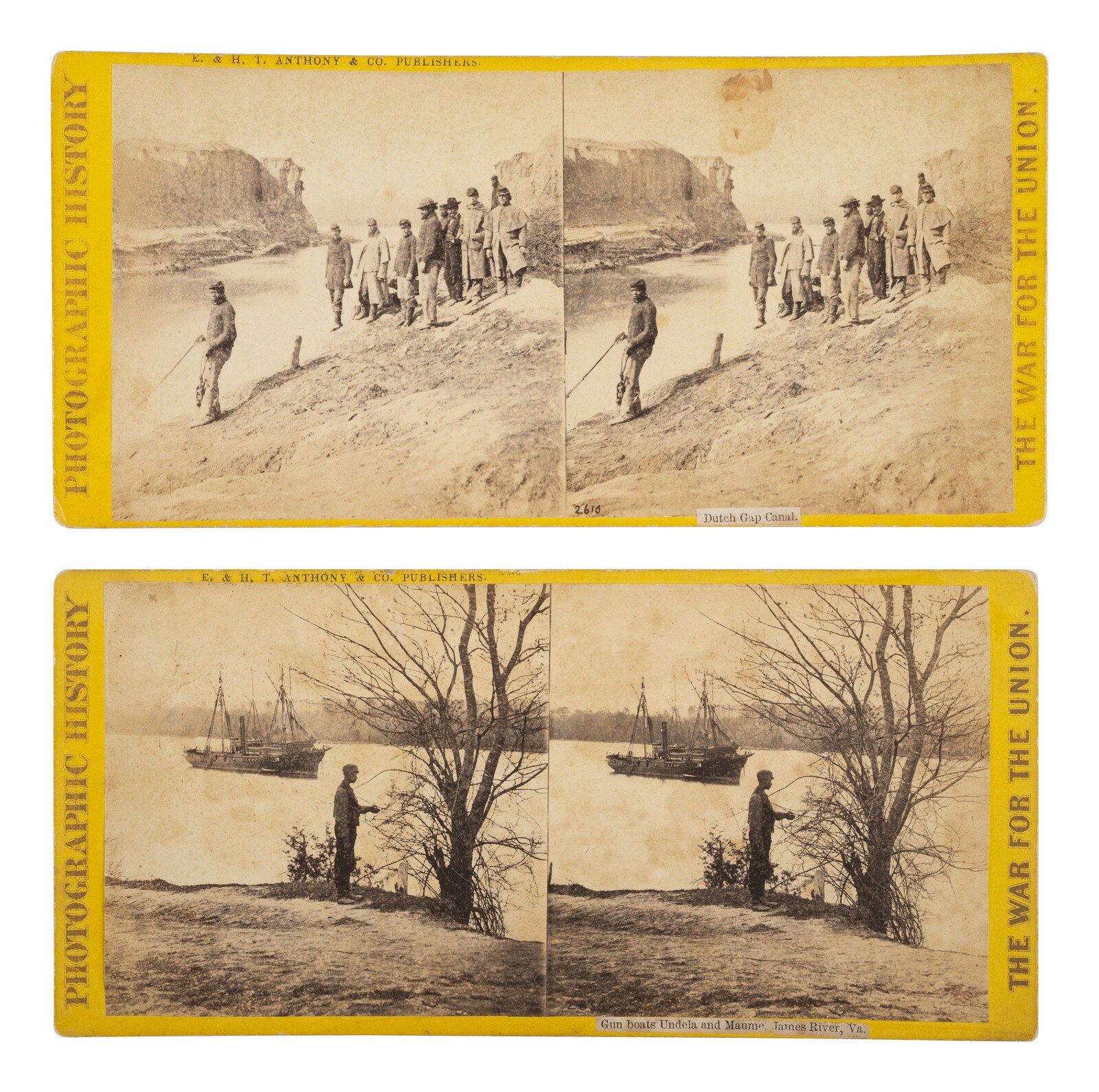
Anthony, E. & H. T. The War for the Union. New York: E. & H. T. Anthony & Co., circa 1865. Pair of stereoview photographs mounted on yellow cardstock with printed series title and descriptive captions on recto and additional text on verso. The first stereoview titled "Dutch Gap Canal and Group of Soldiers. Taken after the bank was blown out" shows Union soldiers standing along the banks of the Dutch Gap Canal in Virginia. The canal project was ordered by Union General Benjamin Butler in 1864 as an engineering attempt to bypass Confederate artillery positions along the James River. Among the soldiers visible in the photograph is an African American serviceman positioned near the water holding a mooring line. Black soldiers frequently participated in engineering and labor details connected to Union fortification and canal construction projects during the war. The remaining bank formation in the image reportedly resembled the profile of Confederate President Jefferson Davis, a feature referenced in the printed caption. The second stereoview titled "Gun boats Undela and Maume, James River, Va." depicts two Union vessels anchored along the river while an African American soldier or sailor stands in the foreground observing the scene. The USS Maumee, a wooden steam powered gunboat commissioned in 1864, served in river patrol and blockade operations that helped maintain Union control of strategic waterways.
During the later years of the Civil War the James River became a focal point for Union engineering projects and naval operations intended to secure transportation routes and weaken Confederate defenses around Richmond. The Dutch Gap Canal project represented one of the Union Army's largest wartime engineering efforts in Virginia, while naval patrols along the river protected supply routes and supported ground operations. Photographs from the War for the Union stereoview series circulated widely in the postwar period and provided visual documentation of military operations and landscapes associated with the conflict. Each stereoview measures approximately 7 x 3.25 inches and remains mounted on the original cardstock mounts with publisher imprint. Light toning, scattered discoloration, and minor wear to mounts visible with clear photographic detail retained. Overall very good condition. The pair preserves photographic evidence of Union engineering work and African American military presence during the final phase of the Civil War.
Anthony, E. & H. T. The War for the Union. New York: E. & H. T. Anthony & Co., circa 1865. Pair of stereoview photographs mounted on yellow cardstock with printed series title and descriptive captions on recto and additional text on verso. The first stereoview titled "Dutch Gap Canal and Group of Soldiers. Taken after the bank was blown out" shows Union soldiers standing along the banks of the Dutch Gap Canal in Virginia. The canal project was ordered by Union General Benjamin Butler in 1864 as an engineering attempt to bypass Confederate artillery positions along the James River. Among the soldiers visible in the photograph is an African American serviceman positioned near the water holding a mooring line. Black soldiers frequently participated in engineering and labor details connected to Union fortification and canal construction projects during the war. The remaining bank formation in the image reportedly resembled the profile of Confederate President Jefferson Davis, a feature referenced in the printed caption. The second stereoview titled "Gun boats Undela and Maume, James River, Va." depicts two Union vessels anchored along the river while an African American soldier or sailor stands in the foreground observing the scene. The USS Maumee, a wooden steam powered gunboat commissioned in 1864, served in river patrol and blockade operations that helped maintain Union control of strategic waterways.
During the later years of the Civil War the James River became a focal point for Union engineering projects and naval operations intended to secure transportation routes and weaken Confederate defenses around Richmond. The Dutch Gap Canal project represented one of the Union Army's largest wartime engineering efforts in Virginia, while naval patrols along the river protected supply routes and supported ground operations. Photographs from the War for the Union stereoview series circulated widely in the postwar period and provided visual documentation of military operations and landscapes associated with the conflict. Each stereoview measures approximately 7 x 3.25 inches and remains mounted on the original cardstock mounts with publisher imprint. Light toning, scattered discoloration, and minor wear to mounts visible with clear photographic detail retained. Overall very good condition. The pair preserves photographic evidence of Union engineering work and African American military presence during the final phase of the Civil War.
Details
Title
African American Civil War History. Stereoviews Showing Black Union Soldier and United States Colored Troops Presence on the James River, circa 1865
Author
United States Colored Troops (USCT)
Condition
Unknown
Date
1865