

The System of the World
- London: Richard Phillips, 1809
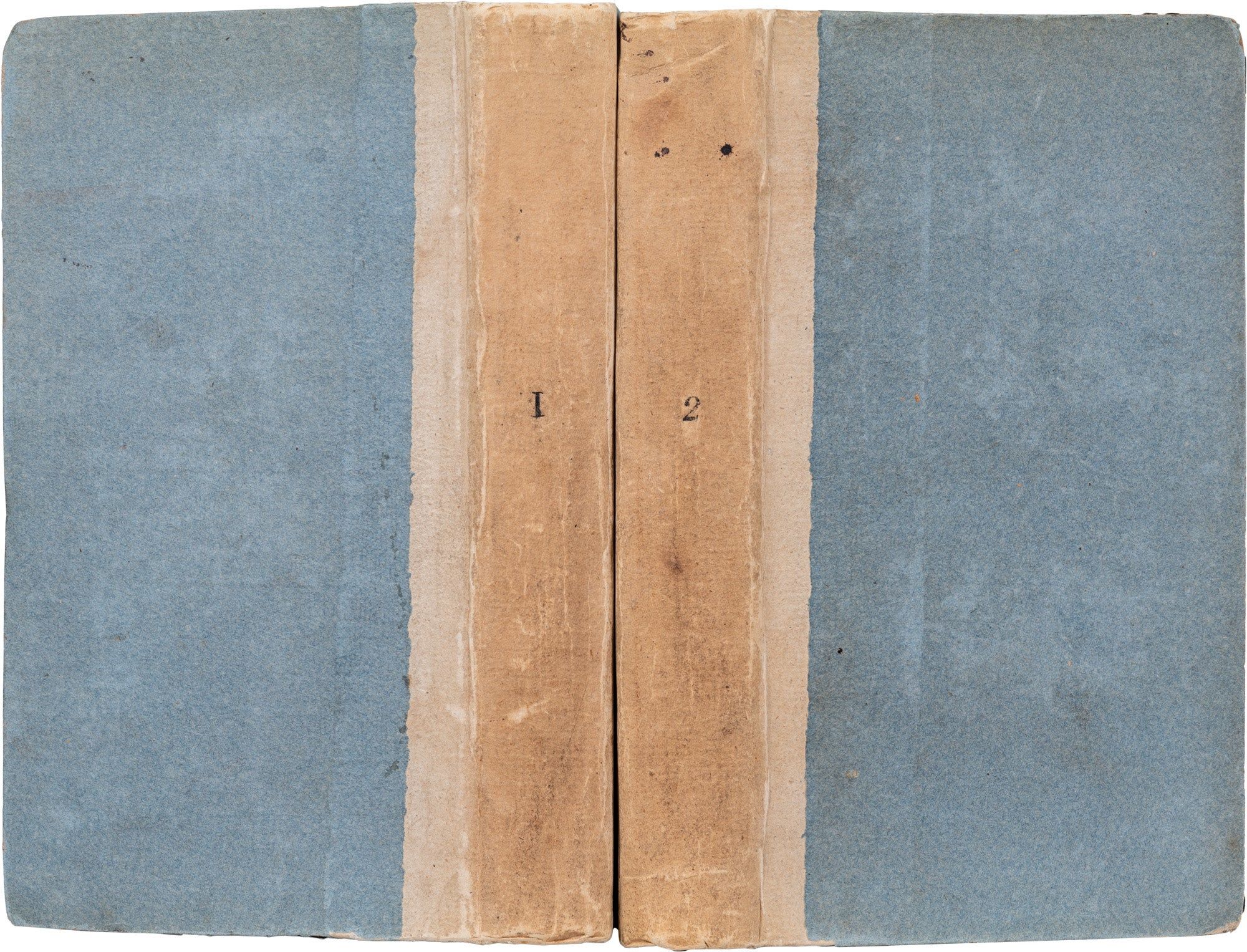
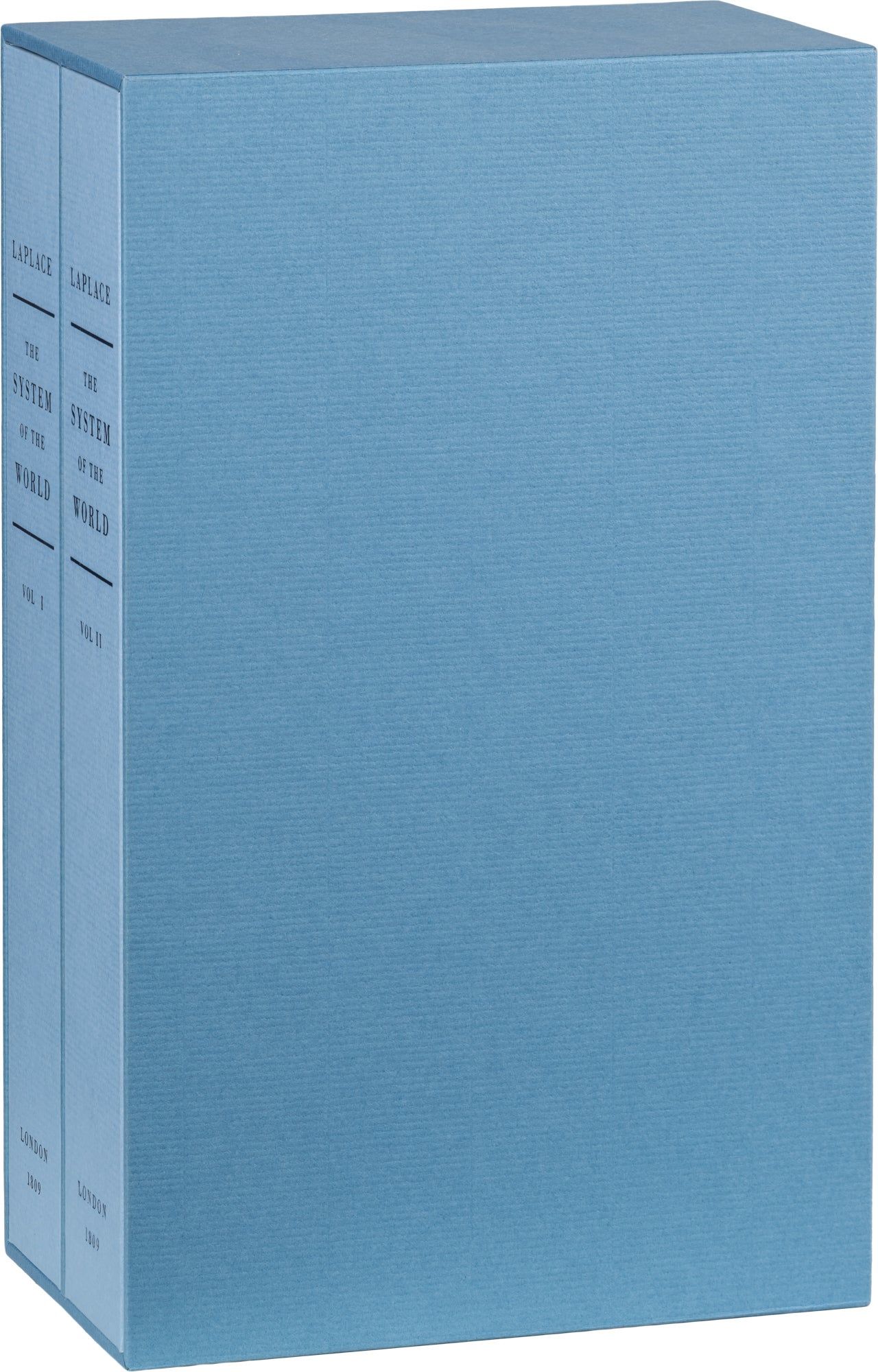
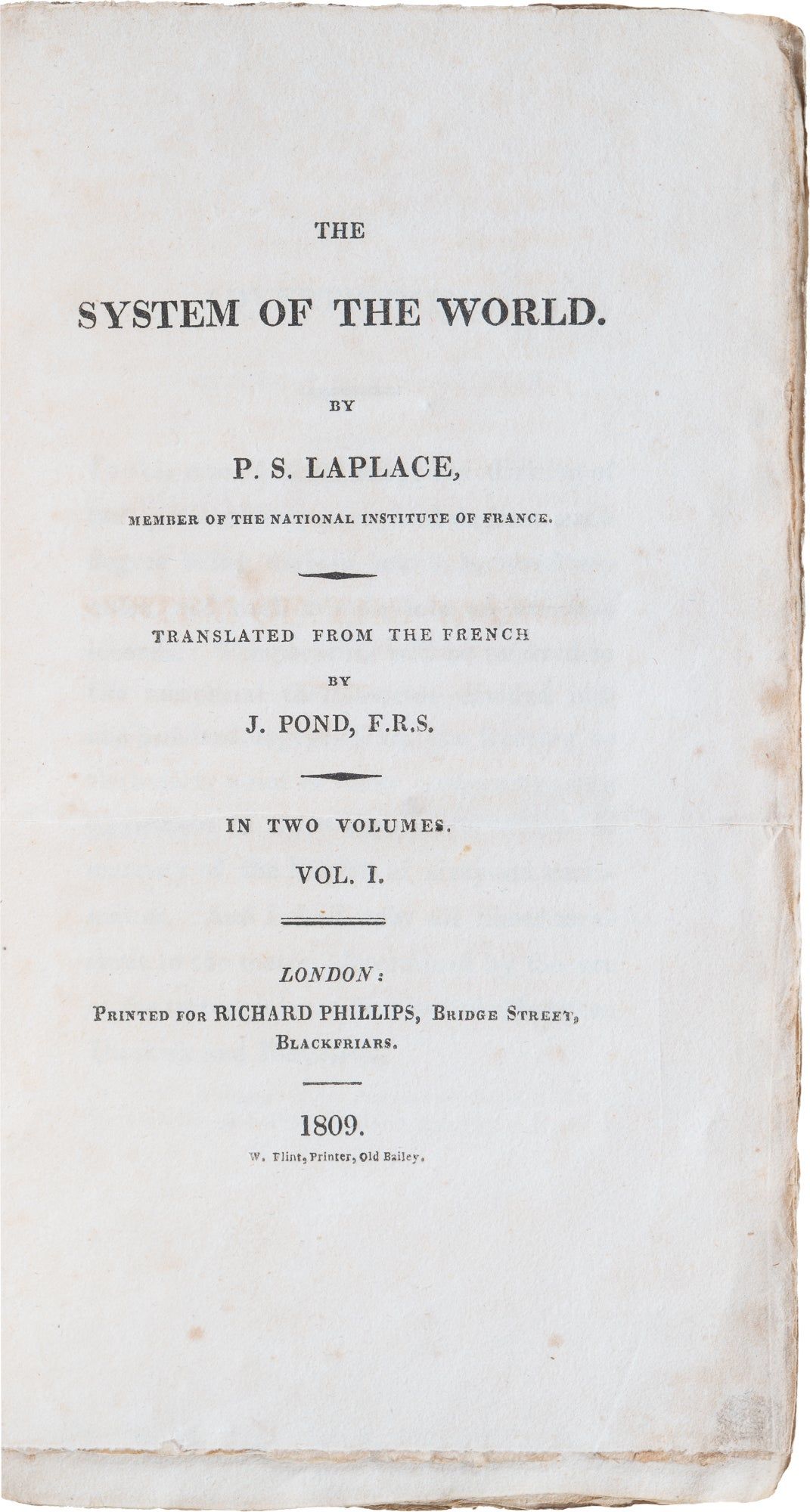
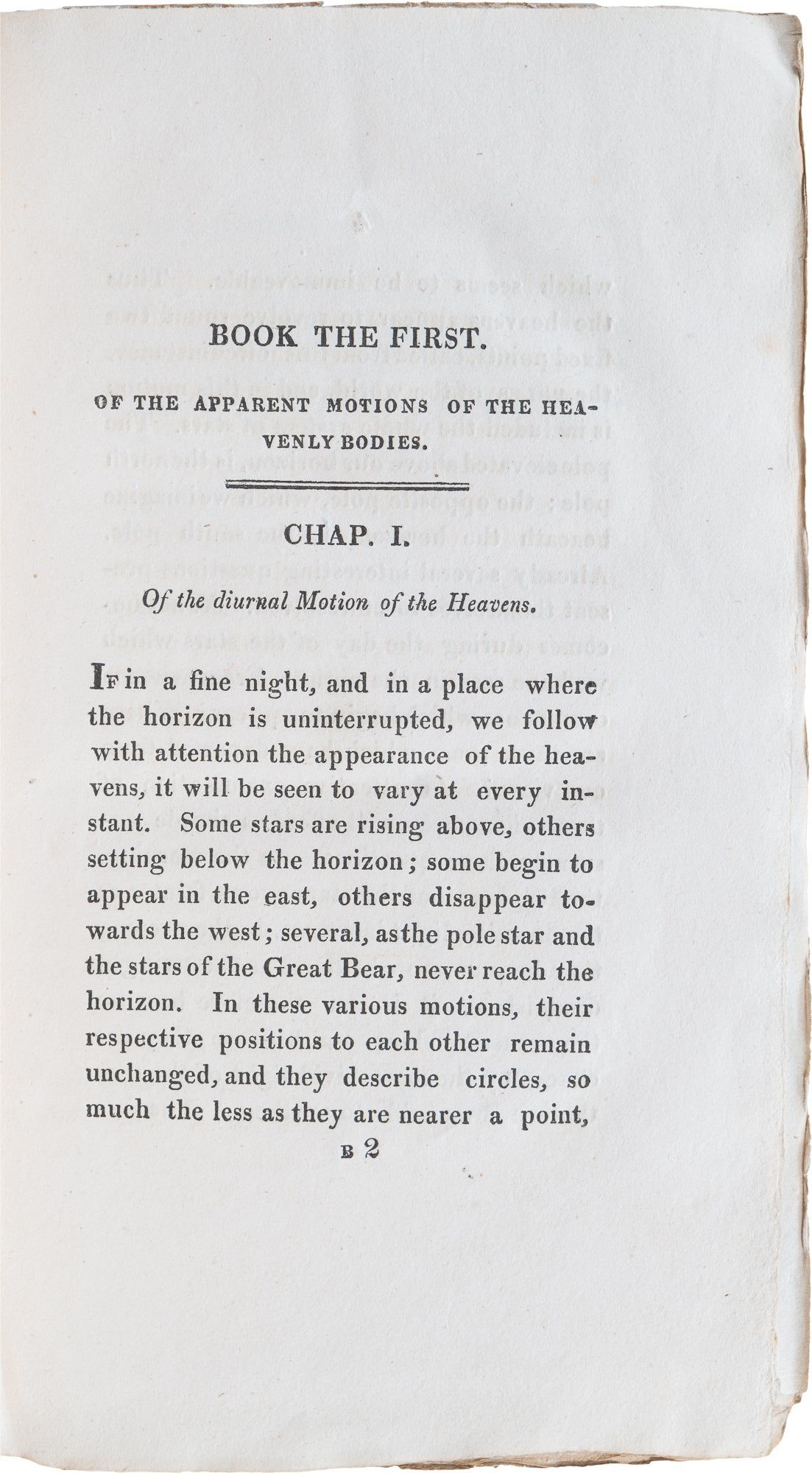
London: Richard Phillips, 1809. First Edition. First edition in English. 2 vols., large 12mo (218 x 130mm), pp. [4], viii, 379, [1]; [4], iii, [1], 380. Original paper-backed boards, with half-titles and all the ads present in both volumes. Pages uncut, with some toning to the page edges and light rubbing to the extremities, else fine, with no repairs. A notably well-preserved copy, fresh and unrestored. Translated from the French, first published in 1796 as "Exposition du système du monde," by J. Pond. A more generally accessible companion to Laplace’s "Traité de mécanique céleste" (PMM 252). Custom box. Conceived in the aftermath of the French Revolution and first published in French as "Exposition du système du monde," this work offers a non-technical exposition of the principles of celestial mechanics and the structure of the Newtonian universe. Addressed to educated general readers rather than to professional mathematicians, Laplace’s text distills the results of eighteenth-century mathematical astronomy into clear, continuous prose, minimizing formal derivations in favor of physical interpretation and narrative coherence. In doing so, it participates in the broader Enlightenment and post-Revolutionary project of naturalizing scientific explanation, presenting phenomena such as planetary motion, tides, and comets as intelligible consequences of universal gravitation rather than as manifestations of divine intervention.
"The System of the World" is particularly significant for the way it mediates between advanced theoretical work and a non-specialist public. By recasting the abstract machinery of celestial dynamics in accessible language, Laplace both broadened the audience for contemporary astronomy and modeled a mode of scientific communication in which empirically grounded, mathematical theories could inform lay understandings of the natural world. The English translation by J. Pond, Astronomer Royal, further extended this mediating role, introducing Anglophone readers to Laplace’s synthesis at a time when celestial mechanics was reshaping navigation, timekeeping, and geodesy as well as philosophical conceptions of causality and determinism.
Although often described as a popularization of the later "Traité de mécanique céleste," "The System of the World" is better understood as a parallel, programmatic statement of Laplace’s cosmological vision. Here he articulates, in conceptual and qualitative terms, the stability of the solar system, the long-term consequences of gravitational perturbations, and the methodological commitment to explaining celestial phenomena by invariant physical laws. This prose exposition provided a conceptual framework and pedagogical structure that both foreshadow and help organize the more rigorous analytic treatment of the "Mécanique céleste." As such, it occupies an important place not only in the history of mathematical astronomy but also in the history of scientific readership, exemplifying how advanced science could be made intellectually available to non-specialists without sacrificing clarity, coherence, or philosophical ambition.
"The System of the World" is particularly significant for the way it mediates between advanced theoretical work and a non-specialist public. By recasting the abstract machinery of celestial dynamics in accessible language, Laplace both broadened the audience for contemporary astronomy and modeled a mode of scientific communication in which empirically grounded, mathematical theories could inform lay understandings of the natural world. The English translation by J. Pond, Astronomer Royal, further extended this mediating role, introducing Anglophone readers to Laplace’s synthesis at a time when celestial mechanics was reshaping navigation, timekeeping, and geodesy as well as philosophical conceptions of causality and determinism.
Although often described as a popularization of the later "Traité de mécanique céleste," "The System of the World" is better understood as a parallel, programmatic statement of Laplace’s cosmological vision. Here he articulates, in conceptual and qualitative terms, the stability of the solar system, the long-term consequences of gravitational perturbations, and the methodological commitment to explaining celestial phenomena by invariant physical laws. This prose exposition provided a conceptual framework and pedagogical structure that both foreshadow and help organize the more rigorous analytic treatment of the "Mécanique céleste." As such, it occupies an important place not only in the history of mathematical astronomy but also in the history of scientific readership, exemplifying how advanced science could be made intellectually available to non-specialists without sacrificing clarity, coherence, or philosophical ambition.
Details
Title
The System of the World
Author
Laplace, Pierre-Simon
Condition
Unknown
Publisher
Richard Phillips: London
Date
1809
Edition
First Edition