

African American Intellectual History Carter G. Woodson Journal of Negro History Issues on Black Military Service Reconstruction and Race Law 1942 to 1949
- 1942
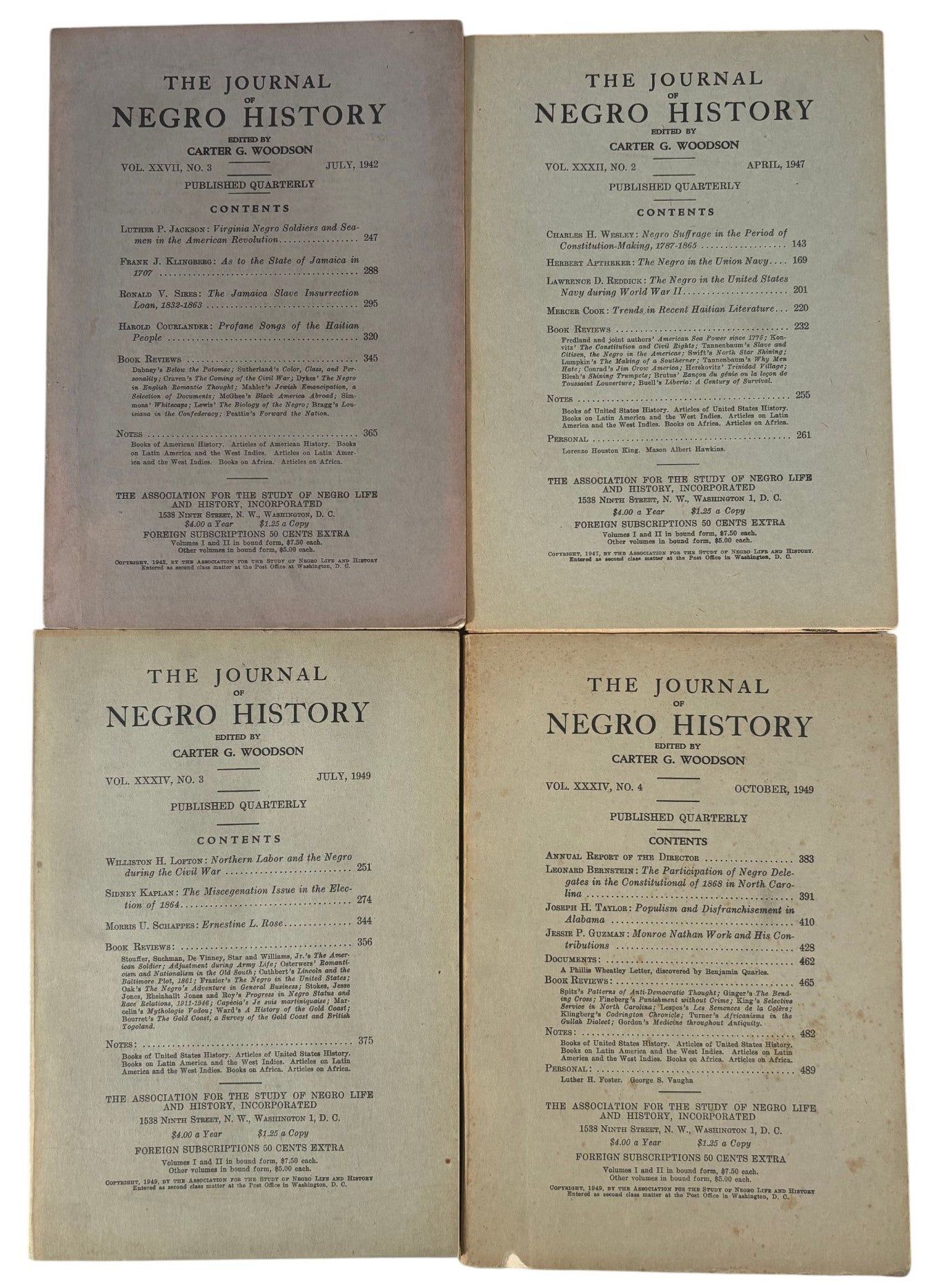
1942. Woodson, Carter Godwin. The Journal of Negro History. 1942-1949. Foundational issues of the journal established by Carter G. Woodson, documenting the institutionalization of Black historical scholarship in the United States and advancing early academic study of African American military service, political rights, and diaspora culture. Issued by the Association for the Study of Negro Life and History, which Woodson co-founded in 1915, these volumes situate Black experience within national and Atlantic frameworks, including Revolutionary War service, Reconstruction governance, and twentieth-century military participation. The selection highlights how mid-century scholars constructed a documentary record of African American life in direct response to exclusion from mainstream historiography, with particular emphasis on suffrage, labor, naval service, and racial legislation.
Woodson, Carter Godwin (ed.). The Journal of Negro History. Washington, D.C.: Association for the Study of Negro Life and History, 1942, 1947, 1949. Four issues.
[1] Jackson, Luther P. "Virginia Negro Soldiers and Seamen in the American Revolution." The Journal of Negro History. Vol. XXVII, No. 3. Washington, D.C.: ASNLH, 1942. Establishes early documentation of African American military participation in the Revolutionary War. Additional contents include Frank J. Klingberg's study of Jamaican legislation (1837), Ronald V. Sires's analysis of the Jamaica Slave Insurrection Loan (1832-1863), and Harold Courlander's "Profane Songs of the Haitian People," presenting vernacular cultural material from Haiti.
[2] Wesley, Charles H. "Negro Suffrage in the Period of Constitution-Making, 1787-1865." The Journal of Negro History. Vol. XXXII, No. 2. Washington, D.C.: ASNLH, 1947. Examines the development of Black political rights before the Civil War. Herbert Aptheker's "The Negro in the Union Navy" and Lawrence D. Reddick's "The Negro in the United States Navy during World War II" connect nineteenth-century and contemporary military service, while Mercer Cook's essay surveys modern Haitian literature.
[3] Lofton, Williston H. "Northern Labor and the Negro during the Civil War." The Journal of Negro History. Vol. XXXIV, No. 3. Washington, D.C.: ASNLH, 1949. Traces relationships between African American workers and Northern labor movements. Sidney Kaplan's "The Miscegenation Issue in the Election of 1864" analyzes race in wartime political discourse, and Morris U. Schappes reprints Ernestine L. Rose's address on West Indian emancipation, preserving a nineteenth-century abolitionist voice.
[4] Bernstein, Leonard. "The Participation of Negro Delegates in the Constitutional Convention of 1868 in North Carolina." The Journal of Negro History. Vol. XXXIV, No. 4. Washington, D.C.: ASNLH, 1949. Documents Black political participation in Reconstruction governance. Additional contributions include Joseph H. Taylor on disfranchisement in Alabama, Jessie P. Guzman on Monroe Nathan Work's scholarly contributions, and a reprinted 1774 letter by Phillis Wheatley identified by Benjamin Quarles.
These issues were published during World War II and the early Cold War, when African American military service abroad and civil rights struggles at home intensified scholarly and political attention to Black history. Articles on the Union Navy and World War II naval service align with wartime debates over segregation and citizenship, while studies of suffrage, Reconstruction conventions, and disfranchisement reflect renewed examination of constitutional rights in the context of emerging civil rights activism. Four issues in publisher's printed wrappers, each approximately 108 to 118 pages. Light wear, occasional foxing and minor soiling to wrappers; overall very good to near fine. A cohesive grouping illustrating how Black historians and intellectuals built an evidentiary foundation for African American history as a formal academic discipline in the mid twentieth century.
Woodson, Carter Godwin (ed.). The Journal of Negro History. Washington, D.C.: Association for the Study of Negro Life and History, 1942, 1947, 1949. Four issues.
[1] Jackson, Luther P. "Virginia Negro Soldiers and Seamen in the American Revolution." The Journal of Negro History. Vol. XXVII, No. 3. Washington, D.C.: ASNLH, 1942. Establishes early documentation of African American military participation in the Revolutionary War. Additional contents include Frank J. Klingberg's study of Jamaican legislation (1837), Ronald V. Sires's analysis of the Jamaica Slave Insurrection Loan (1832-1863), and Harold Courlander's "Profane Songs of the Haitian People," presenting vernacular cultural material from Haiti.
[2] Wesley, Charles H. "Negro Suffrage in the Period of Constitution-Making, 1787-1865." The Journal of Negro History. Vol. XXXII, No. 2. Washington, D.C.: ASNLH, 1947. Examines the development of Black political rights before the Civil War. Herbert Aptheker's "The Negro in the Union Navy" and Lawrence D. Reddick's "The Negro in the United States Navy during World War II" connect nineteenth-century and contemporary military service, while Mercer Cook's essay surveys modern Haitian literature.
[3] Lofton, Williston H. "Northern Labor and the Negro during the Civil War." The Journal of Negro History. Vol. XXXIV, No. 3. Washington, D.C.: ASNLH, 1949. Traces relationships between African American workers and Northern labor movements. Sidney Kaplan's "The Miscegenation Issue in the Election of 1864" analyzes race in wartime political discourse, and Morris U. Schappes reprints Ernestine L. Rose's address on West Indian emancipation, preserving a nineteenth-century abolitionist voice.
[4] Bernstein, Leonard. "The Participation of Negro Delegates in the Constitutional Convention of 1868 in North Carolina." The Journal of Negro History. Vol. XXXIV, No. 4. Washington, D.C.: ASNLH, 1949. Documents Black political participation in Reconstruction governance. Additional contributions include Joseph H. Taylor on disfranchisement in Alabama, Jessie P. Guzman on Monroe Nathan Work's scholarly contributions, and a reprinted 1774 letter by Phillis Wheatley identified by Benjamin Quarles.
These issues were published during World War II and the early Cold War, when African American military service abroad and civil rights struggles at home intensified scholarly and political attention to Black history. Articles on the Union Navy and World War II naval service align with wartime debates over segregation and citizenship, while studies of suffrage, Reconstruction conventions, and disfranchisement reflect renewed examination of constitutional rights in the context of emerging civil rights activism. Four issues in publisher's printed wrappers, each approximately 108 to 118 pages. Light wear, occasional foxing and minor soiling to wrappers; overall very good to near fine. A cohesive grouping illustrating how Black historians and intellectuals built an evidentiary foundation for African American history as a formal academic discipline in the mid twentieth century.
Details
Title
African American Intellectual History Carter G. Woodson Journal of Negro History Issues on Black Military Service Reconstruction and Race Law 1942 to 1949
Author
C.G. Woodson
Condition
Unknown
Date
1942