

LGBTQ+ Activism and AIDS Crisis Response in San Francisco Pride Publications, 1981-1987
- 1981
1981. Various authors and issuers, group of LGBTQ+ publications, 1981-1987, documenting community organizing, political advocacy, and public health response during the early years of the AIDS crisis in the United States. The material operates in Cultural/Representational Mode, illustrating how LGBTQ+ communities articulated identity, protest, and survival strategies through print media, and providing insight into the shift from liberation-focused discourse to urgent health and civil rights advocacy. Centered on San Francisco's Lesbian/Gay Freedom Day events alongside a federal publication, the archive reflects both grassroots and governmental perspectives on the epidemic and its social consequences.
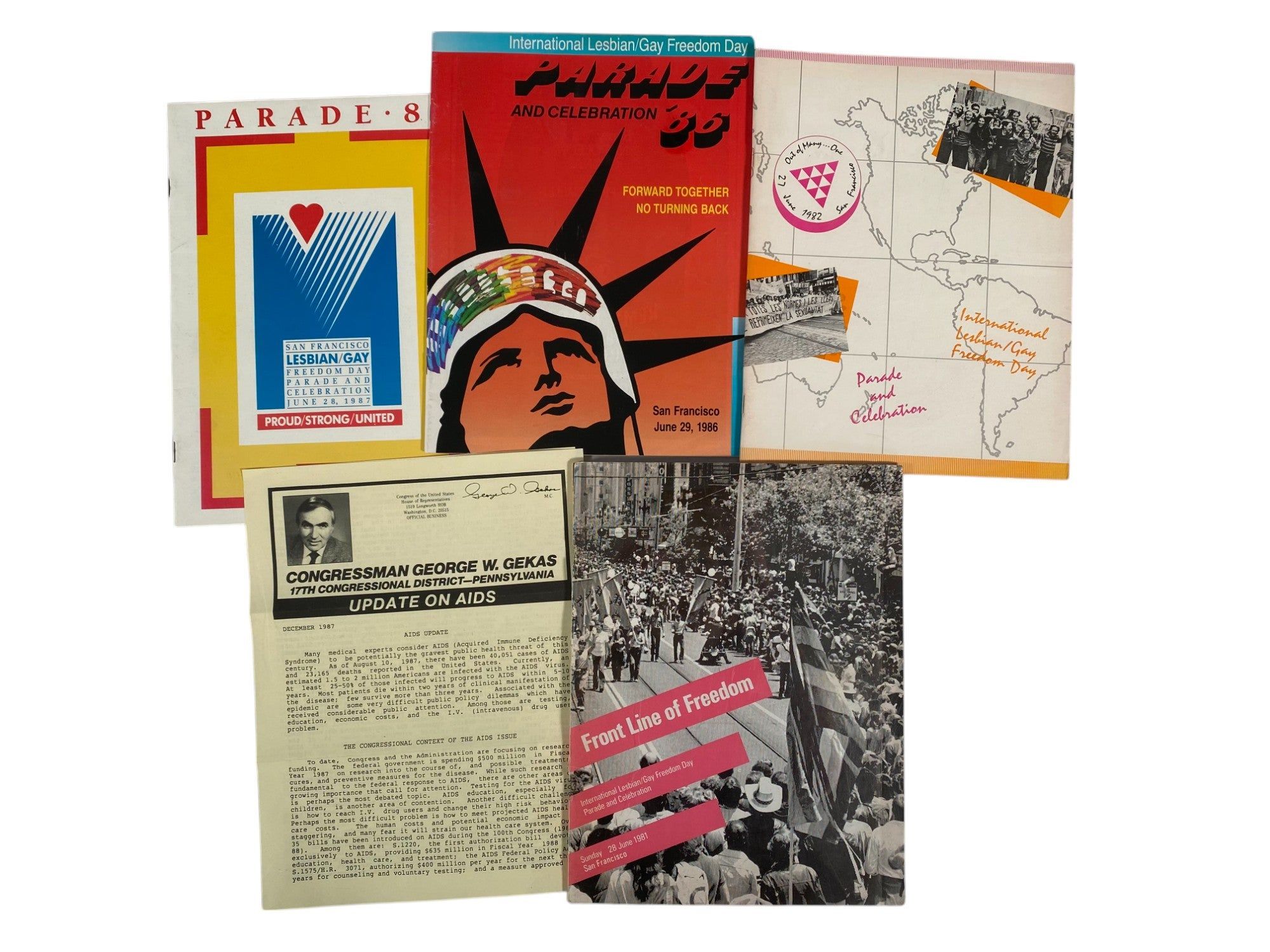
Various authors. Group of five publications. San Francisco and Washington, D.C.: Lesbian/Gay Freedom Day Committee and U.S. Congress, 1981-1987. Archive includes: [1] Front Line of Freedom (1981), 104 pages, official program for the International Lesbian/Gay Freedom Day held June 28, containing essays on Black queer visibility, disability, policing, immigration, and a memorial to murdered Black children in Atlanta, with contributions including activist David Macias; [2] International Lesbian/Gay Freedom Day: Parade and Celebration (1982), 120 pages, including statements by public officials and early discussions of "Gay Men's Health," reflecting emerging awareness of AIDS; [3] Parade and Celebration '86: Forward Together, No Turning Back (1986), 40 pages, emphasizing AIDS activism through visual design and messaging, including imagery linking civil liberties and queer rights; [4] Update on AIDS (1987), a four-page newsletter issued by Congressman George W. Gekas, summarizing federal policy, statistical projections, and legislative responses to the epidemic; [5] Parade '87: Proud / Strong / United (1987), 48 pages, including editorials, advocacy materials, and an interview with Christopher Isherwood conducted by Armistead Maupin, alongside promotion of the 1987 March on Washington for Lesbian and Gay Rights. Across the archive, content includes essays, health information, political statements, interviews, and event programming.
These publications span a critical period in LGBTQ+ history marked by the emergence and escalation of the AIDS crisis, documenting how community institutions adapted to address widespread illness, stigma, and government inaction. Early materials reflect a continuation of pride and coalition politics, while later issues demonstrate a pronounced shift toward health advocacy, memorialization, and direct political engagement. The inclusion of both grassroots publications and a federal report highlights contrasting approaches to the epidemic, offering a multidimensional record of response and discourse. Light wear with minor handling marks; overall very good to near fine condition. A cohesive grouping illustrating LGBTQ+ resilience, activism, and community transformation during the first decade of the AIDS crisis.
Various authors. Group of five publications. San Francisco and Washington, D.C.: Lesbian/Gay Freedom Day Committee and U.S. Congress, 1981-1987. Archive includes: [1] Front Line of Freedom (1981), 104 pages, official program for the International Lesbian/Gay Freedom Day held June 28, containing essays on Black queer visibility, disability, policing, immigration, and a memorial to murdered Black children in Atlanta, with contributions including activist David Macias; [2] International Lesbian/Gay Freedom Day: Parade and Celebration (1982), 120 pages, including statements by public officials and early discussions of "Gay Men's Health," reflecting emerging awareness of AIDS; [3] Parade and Celebration '86: Forward Together, No Turning Back (1986), 40 pages, emphasizing AIDS activism through visual design and messaging, including imagery linking civil liberties and queer rights; [4] Update on AIDS (1987), a four-page newsletter issued by Congressman George W. Gekas, summarizing federal policy, statistical projections, and legislative responses to the epidemic; [5] Parade '87: Proud / Strong / United (1987), 48 pages, including editorials, advocacy materials, and an interview with Christopher Isherwood conducted by Armistead Maupin, alongside promotion of the 1987 March on Washington for Lesbian and Gay Rights. Across the archive, content includes essays, health information, political statements, interviews, and event programming.
These publications span a critical period in LGBTQ+ history marked by the emergence and escalation of the AIDS crisis, documenting how community institutions adapted to address widespread illness, stigma, and government inaction. Early materials reflect a continuation of pride and coalition politics, while later issues demonstrate a pronounced shift toward health advocacy, memorialization, and direct political engagement. The inclusion of both grassroots publications and a federal report highlights contrasting approaches to the epidemic, offering a multidimensional record of response and discourse. Light wear with minor handling marks; overall very good to near fine condition. A cohesive grouping illustrating LGBTQ+ resilience, activism, and community transformation during the first decade of the AIDS crisis.
Details
Title
LGBTQ+ Activism and AIDS Crisis Response in San Francisco Pride Publications, 1981-1987
Author
AIDS Crisis LGBTQ Activism
Condition
Unknown
Date
1981