

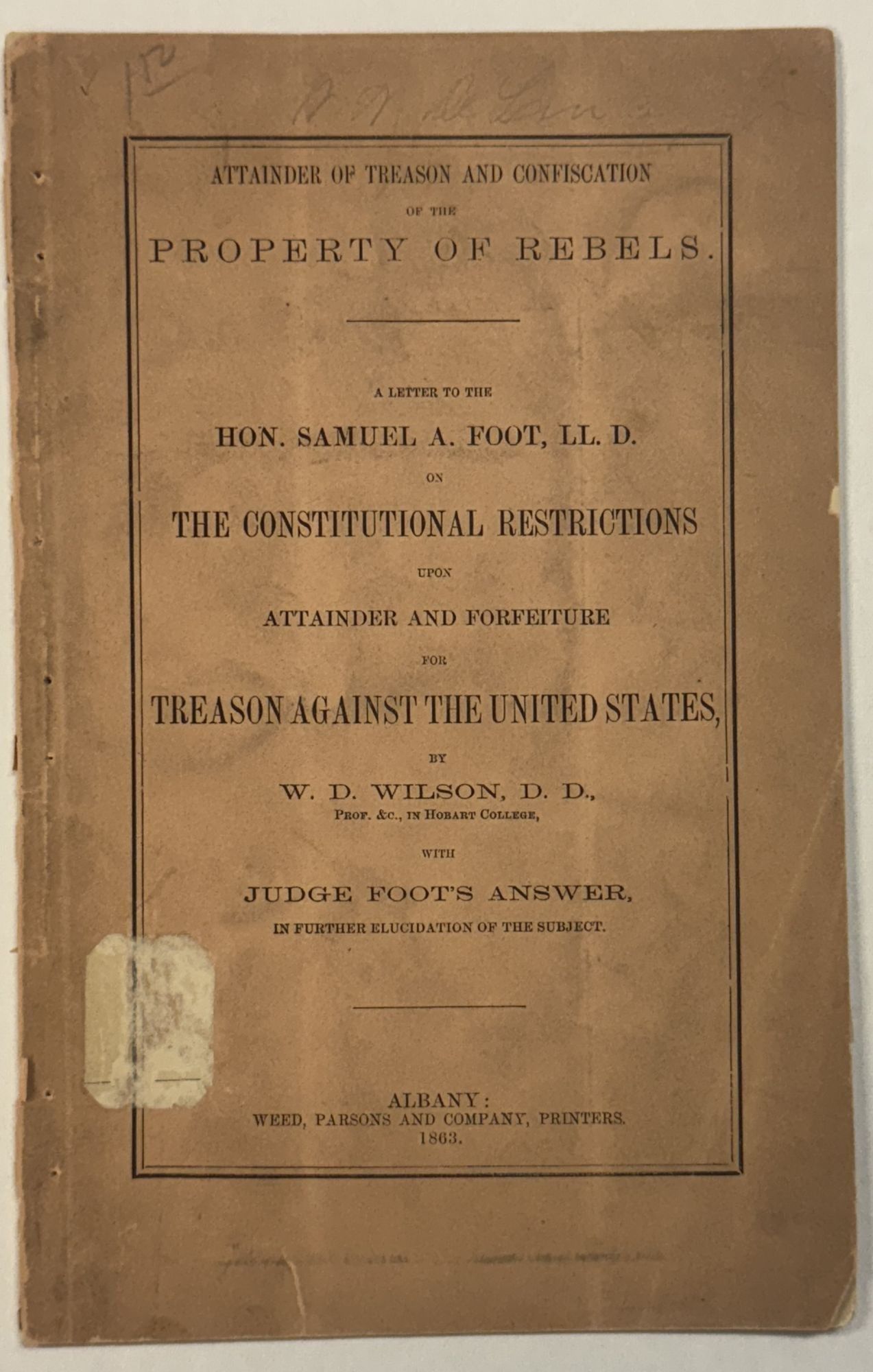
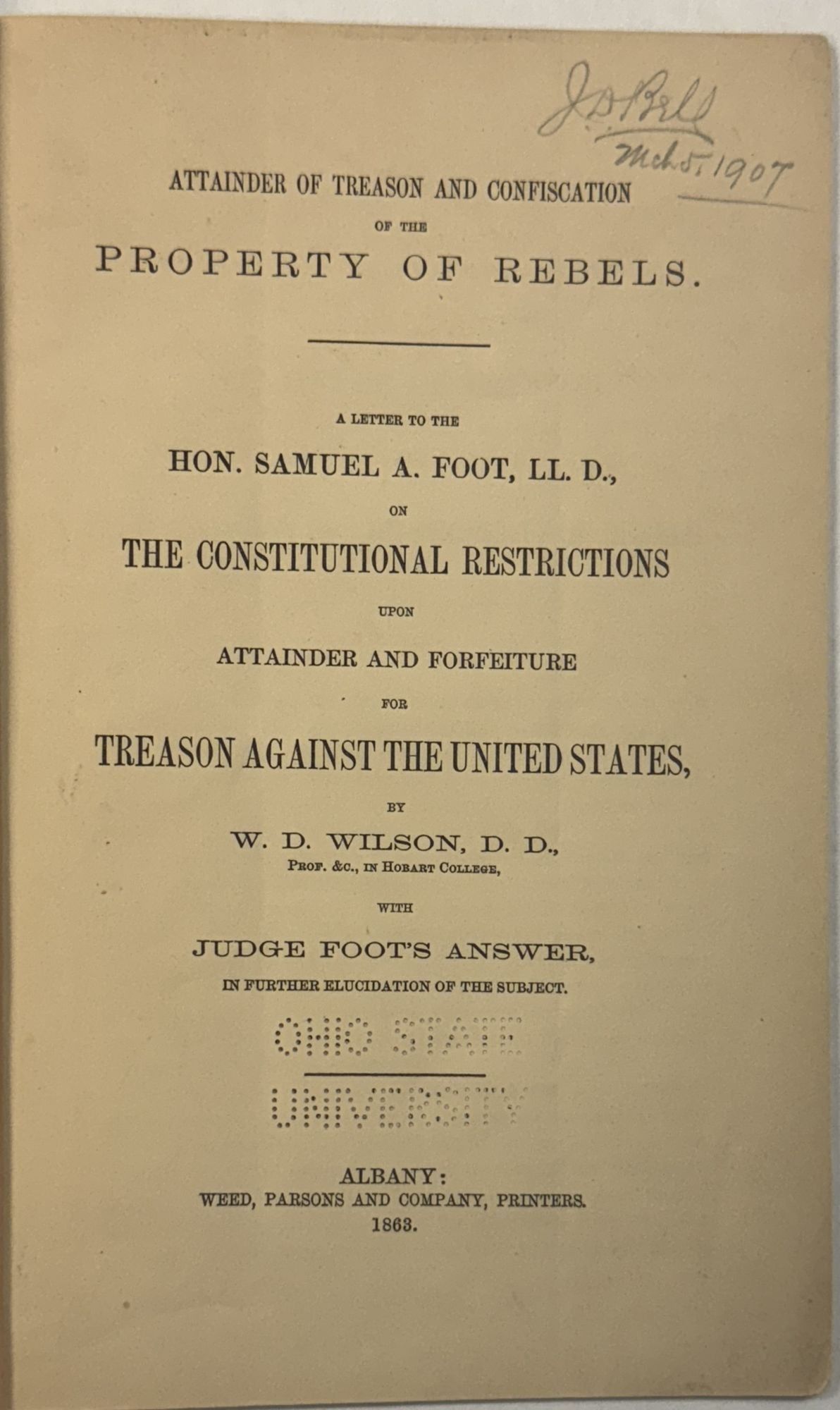
ATTAINDER OF TREASON AND CONFISCATION OF THE PROPERTY OF REBELS. A LETTER TO THE HON. SAMUEL A. FOOT, LL.D. ON THE CONSTITUTIONAL RESTRICTIONS UPON ATTAINDER AND FORFEITURE FOR TREASON AGAINST THE UNITED STATES. WITH JUDGE FOOT'S ANSWER, IN FURTHER ELABORATION OF THE SUBJECT
- Albany: Weed, Parsons and Company, 1863
Albany: Weed, Parsons and Company, 1863. Original printed front wrapper [rear wrap lacking; gum label remnant, light dusting]. Stitched. 27, [1 blank] pp. Perforation stamp and rubberstamp number. Good+.
"A careful constitutional analysis in advocacy of the proposition that the property of 'Southern Rebels' might be confiscated and applied toward payment of the debt incurred by the War" [Eberstadt].
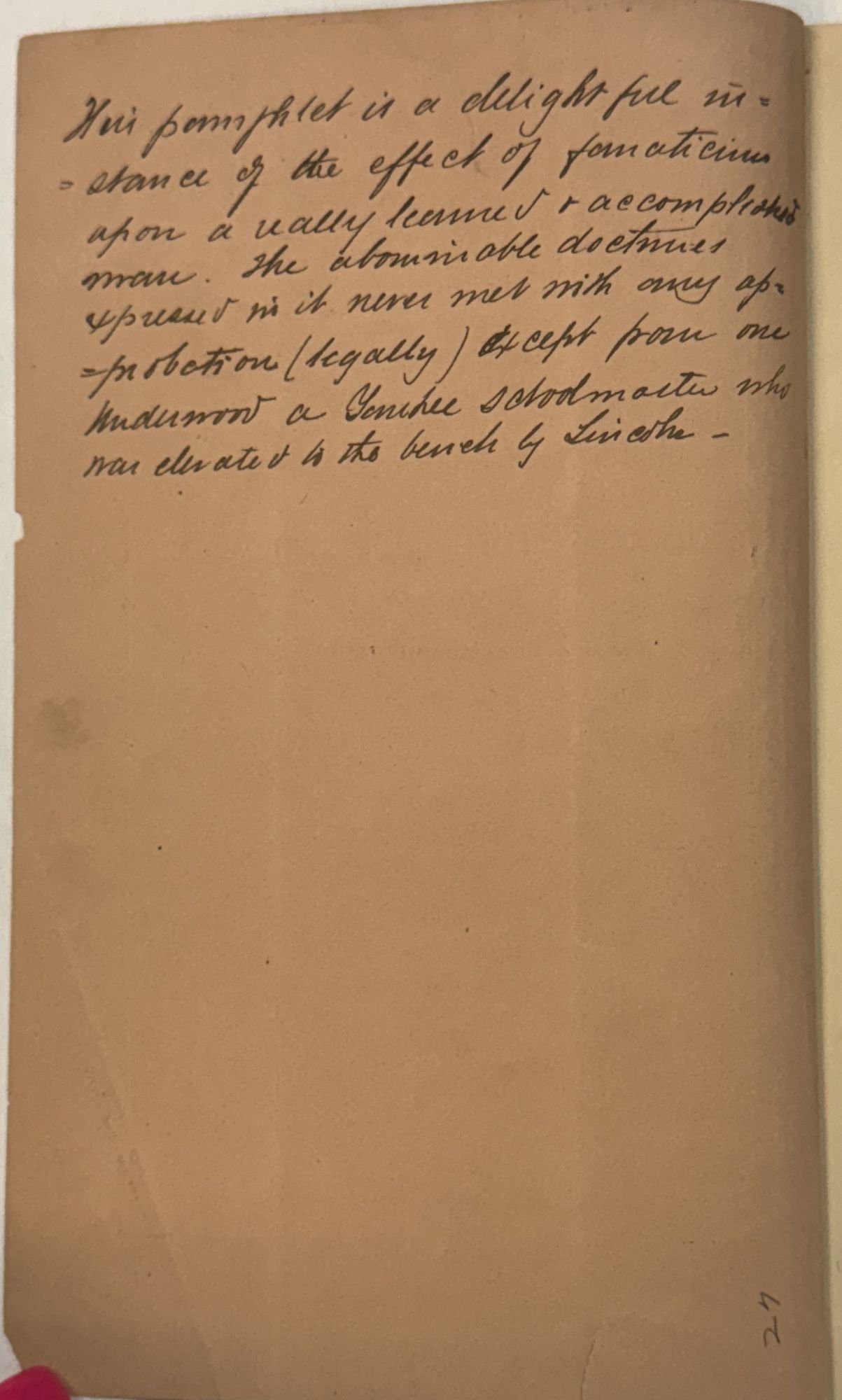
With a different opinion, an early owner of this pamphlet has written on the verso of the front wrapper: "This pamphlet is a delightful instance of the effect of fanaticism upon a really learned & accomplished man. The abominable doctrines expressed in it never met with any approbation [legally] except from one Underwood a Yankee schoolmaster who was elevated to the bench by Lincoln." Underwood is John C. Underwood, "one of the most conspicuous antislavery activists in Virginia during the 1850s, one of the first members of the Republican Party in Virginia, a federal judge from 1863 to 1873, and the president of the Constitutional Convention of 1867-1868" [Encyclopedia of Virginia].
In the absence of any significant constitutional history of the prohibition on bills of attainder-- legislative rather than judicial determinations of guilt, tainting the rights of the traitor's heirs-- Wilson resorts to English practice and considers the way in which the language of the prohibition was understood by the Founders. He and Foot laud the care with which the Founders protected individual rights, and conclude that the Confiscation Act is constitutional.
109 Eberstadt 31. Bartlett 5884.
"A careful constitutional analysis in advocacy of the proposition that the property of 'Southern Rebels' might be confiscated and applied toward payment of the debt incurred by the War" [Eberstadt].
With a different opinion, an early owner of this pamphlet has written on the verso of the front wrapper: "This pamphlet is a delightful instance of the effect of fanaticism upon a really learned & accomplished man. The abominable doctrines expressed in it never met with any approbation [legally] except from one Underwood a Yankee schoolmaster who was elevated to the bench by Lincoln." Underwood is John C. Underwood, "one of the most conspicuous antislavery activists in Virginia during the 1850s, one of the first members of the Republican Party in Virginia, a federal judge from 1863 to 1873, and the president of the Constitutional Convention of 1867-1868" [Encyclopedia of Virginia].
In the absence of any significant constitutional history of the prohibition on bills of attainder-- legislative rather than judicial determinations of guilt, tainting the rights of the traitor's heirs-- Wilson resorts to English practice and considers the way in which the language of the prohibition was understood by the Founders. He and Foot laud the care with which the Founders protected individual rights, and conclude that the Confiscation Act is constitutional.
109 Eberstadt 31. Bartlett 5884.
Details
Title
ATTAINDER OF TREASON AND CONFISCATION OF THE PROPERTY OF REBELS. A LETTER TO THE HON. SAMUEL A. FOOT, LL.D. ON THE CONSTITUTIONAL RESTRICTIONS UPON ATTAINDER AND FORFEITURE FOR TREASON AGAINST THE UNITED STATES. WITH JUDGE FOOT'S ANSWER, IN FURTHER ELABORATION OF THE SUBJECT
Author
Wilson, W.D.
Condition
Unknown
Publisher
Weed, Parsons and Company: Albany
Date
1863