

Đại bảo tích kinh 大寶積經
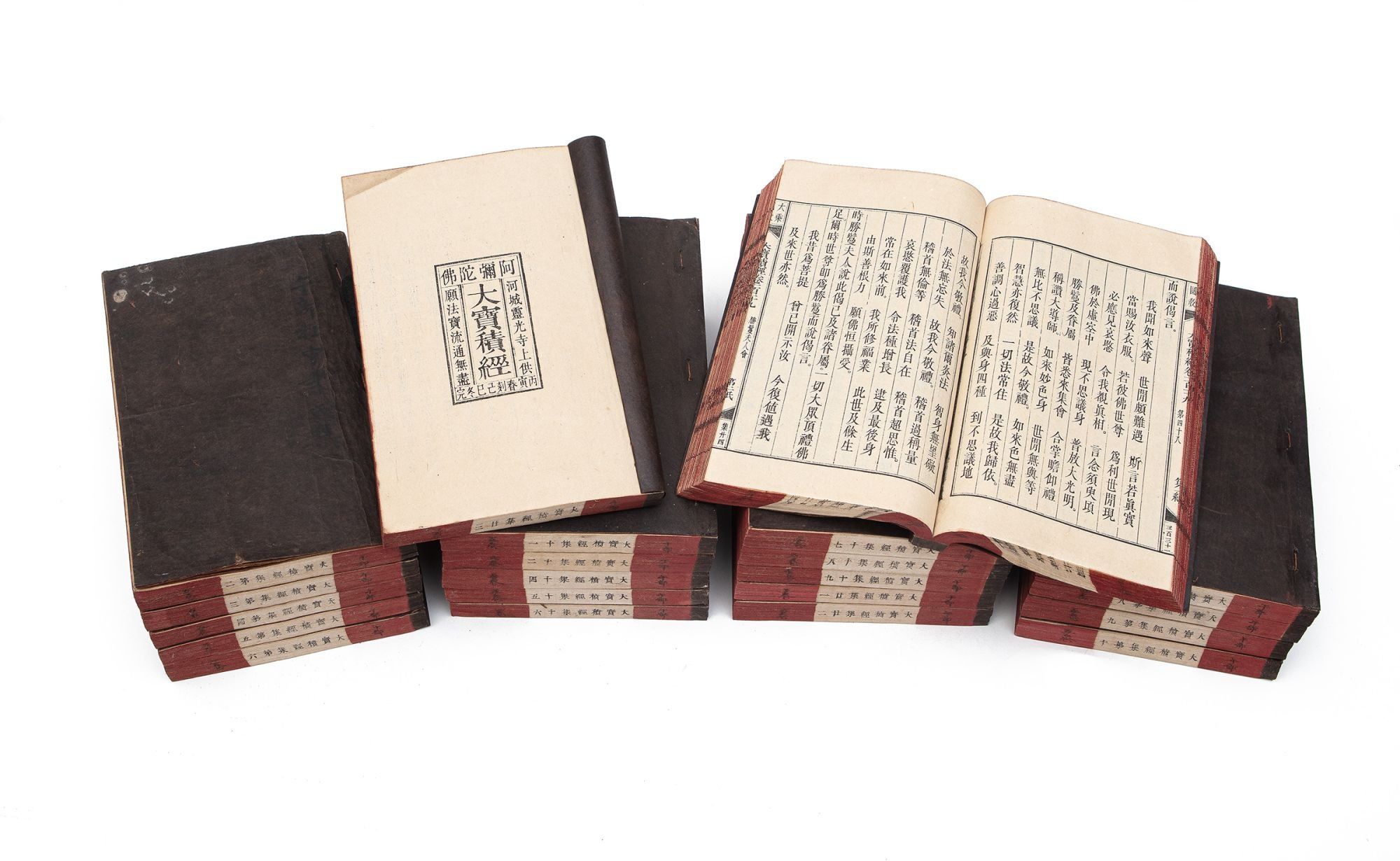
21 vols. (of 24; see below). Small folio (305 x 197 mm.), orig. dark brown wrappers, edges dyed red, lower fore-edges with titles, volume numbers, & number of parts in manuscript, stitched. Hà Nội: Linh Quang Tự (Bà Đá), 1929.
A very rare set of the woodblock-printed Sutra of the Heap of Jewels (Skt. Mahāratnakūṭa Sūtra, T. 0310) from northern Vietnam, here in 21 volumes (our set lacks Vols. 1, 13, & 20). We identify only one other surviving copy, in the Institute of Sino-Nôm Studies in Hanoi (Viện nghiên cứu Hán Nôm AC.666/1-24). We do not know if that set is complete.
“The Mahāratnakūṭa Sūtra is not a single Buddhist work, but a large collection of forty-nine works [which] in its present Chinese form was compiled in the T’ang dynasty by Bodhiruci, a South Indian Brahman and illustrious Tripiṭaka master who arrived in China in 693” (K. Priscilla Pedersen, “Notes on the Ratnakūṭa Collection,” Journal of the International Association of Buddhist Studies 3.2 (1980), p. 60).
In 1926, the first year of the Bảo Đại reign, a meeting was held among the high-ranking monks of modern-day Hanoi to continue a project left behind in 1917 by the deceased abbot of the Linh Quang Tự 靈光寺 temple, which was to carve a set of woodblocks for printing the Mahāratnakūṭa Sūtra, or the Sutra of the Heap of Jewels. Led by Bhikṣu Thông Mệnh 通命 of the Đào Xuyên tự 桃川寺 temple and Bhikṣu Thanh Thứ 清恕 of the Linh Sóc tự 靈朔寺 temple, the project was very much a product of its time. Rather than merely reprinting the Sutra as it was already known to Vietnamese Buddhists, the monks were delighted to discover — and incorporate into their edition — two further versions of the text, one being from the Japanese Buddhist Canon held at the colonial Bác cổ trường 博古場 (i.e., l’École française d’Extrême-Orient) in Hanoi, the other being a Chinese copy brought by Bhikṣu Tâm Trí 心智. The three versions — referred to as the “southern version” (nam bổn 南本), the “northern version” (bắc bổn 北本), and the “Japanese version” (nhật bổn 日本) — were carefully compared and collated by the editors, whose notes at the end of each chapter list all textual variants down to the page and line numbers (Preface transcribed in Phạm Lê Huy, “Nihon no kanyaku Daizōkyō” 日本の漢訳大蔵経, Riterashī shi kenkyū リテラシー史研究 14 (2021), p. 97).
The resulting edition of the Sutra of the Heap of Jewels, despite the traditional-seeming xylographic form and the use of Sinographs (which were being quickly replaced by the Latin-based quốc ngữ after the abolition of the civil service exams in 1919), is therefore a product of its time, enabled by the forces of colonial modernity and partaking in the Buddhist revival movements that were to unfold, over the next few decades, across the Asiatic world.
The carving of the 1300 woodblocks for this Sutra was an expensive affair, and the final volume ends by listing the names, affiliations, and contributions of over 100 donors (mostly monks and nuns of various temples) who had contributed to its making. Their donations ranged from 300 Indochinese piastre (from Bhikṣu Tâm Trí himself) to one piastre, the contribution of many nuns placed at the end of the list. The woodblocks were kept — and might still be kept — at the Linh Quang Tự temple in Hanoi, which based on a recent count, preserves about 2600 woodblocks to this day (Nguyễn Tuấn Cường et al., “Buddhist Print Culture in Nineteenth-Century Northern Vietnam,” Journal of Vietnamese Studies 13.3 (2018), pp. 74–75).
Finally, a note on Vietnamese books in general. Despite the country’s long history of Buddhist and Confucian learning, woodblock-printed books published within Vietnam are far fewer in number than their Chinese or Japanese counterparts. This scarcity was due to the high cost of domestic production. According to the estimate of Kathlene Baldanza, as late as the 19th century, “the labor cost of printing in Vietnam was five to ten times higher than in China. Even ink and brushes were more expensive to produce in Vietnam.” Extensive international trade between northern Vietnam and southern China — where plentiful numbers of books were printed at very low costs — meant that “it was generally cheaper to purchase books from China than to buy them locally” (“Publishing, Book Culture, and Reading Practices in Vietnam,” Journal of Vietnamese Studies 13.3 (2018), pp. 10–11). Beyond the limited cases of official and temple-based publishing, Vietnamese publishers were pushed toward niche genres such as Sino-Vietnamese dictionaries, ritual manuals, or morality books. Regardless of genre, woodblock-printed books from Vietnam are very difficult to find today outside a few major collections, such as the Institute of Sino-Nôm Studies in Hanoi and l’École française d’Extrême-Orient in Paris. We will not focus on the massive destruction of the nation’s cultural heritage during its long war of independence in the post World War II period.
Fine and fresh set.
❧ Yuenan Hannan wenxian ziliaoku 越南漢喃文獻資料庫, Academia Sinica.
A very rare set of the woodblock-printed Sutra of the Heap of Jewels (Skt. Mahāratnakūṭa Sūtra, T. 0310) from northern Vietnam, here in 21 volumes (our set lacks Vols. 1, 13, & 20). We identify only one other surviving copy, in the Institute of Sino-Nôm Studies in Hanoi (Viện nghiên cứu Hán Nôm AC.666/1-24). We do not know if that set is complete.
“The Mahāratnakūṭa Sūtra is not a single Buddhist work, but a large collection of forty-nine works [which] in its present Chinese form was compiled in the T’ang dynasty by Bodhiruci, a South Indian Brahman and illustrious Tripiṭaka master who arrived in China in 693” (K. Priscilla Pedersen, “Notes on the Ratnakūṭa Collection,” Journal of the International Association of Buddhist Studies 3.2 (1980), p. 60).
In 1926, the first year of the Bảo Đại reign, a meeting was held among the high-ranking monks of modern-day Hanoi to continue a project left behind in 1917 by the deceased abbot of the Linh Quang Tự 靈光寺 temple, which was to carve a set of woodblocks for printing the Mahāratnakūṭa Sūtra, or the Sutra of the Heap of Jewels. Led by Bhikṣu Thông Mệnh 通命 of the Đào Xuyên tự 桃川寺 temple and Bhikṣu Thanh Thứ 清恕 of the Linh Sóc tự 靈朔寺 temple, the project was very much a product of its time. Rather than merely reprinting the Sutra as it was already known to Vietnamese Buddhists, the monks were delighted to discover — and incorporate into their edition — two further versions of the text, one being from the Japanese Buddhist Canon held at the colonial Bác cổ trường 博古場 (i.e., l’École française d’Extrême-Orient) in Hanoi, the other being a Chinese copy brought by Bhikṣu Tâm Trí 心智. The three versions — referred to as the “southern version” (nam bổn 南本), the “northern version” (bắc bổn 北本), and the “Japanese version” (nhật bổn 日本) — were carefully compared and collated by the editors, whose notes at the end of each chapter list all textual variants down to the page and line numbers (Preface transcribed in Phạm Lê Huy, “Nihon no kanyaku Daizōkyō” 日本の漢訳大蔵経, Riterashī shi kenkyū リテラシー史研究 14 (2021), p. 97).
The resulting edition of the Sutra of the Heap of Jewels, despite the traditional-seeming xylographic form and the use of Sinographs (which were being quickly replaced by the Latin-based quốc ngữ after the abolition of the civil service exams in 1919), is therefore a product of its time, enabled by the forces of colonial modernity and partaking in the Buddhist revival movements that were to unfold, over the next few decades, across the Asiatic world.
The carving of the 1300 woodblocks for this Sutra was an expensive affair, and the final volume ends by listing the names, affiliations, and contributions of over 100 donors (mostly monks and nuns of various temples) who had contributed to its making. Their donations ranged from 300 Indochinese piastre (from Bhikṣu Tâm Trí himself) to one piastre, the contribution of many nuns placed at the end of the list. The woodblocks were kept — and might still be kept — at the Linh Quang Tự temple in Hanoi, which based on a recent count, preserves about 2600 woodblocks to this day (Nguyễn Tuấn Cường et al., “Buddhist Print Culture in Nineteenth-Century Northern Vietnam,” Journal of Vietnamese Studies 13.3 (2018), pp. 74–75).
Finally, a note on Vietnamese books in general. Despite the country’s long history of Buddhist and Confucian learning, woodblock-printed books published within Vietnam are far fewer in number than their Chinese or Japanese counterparts. This scarcity was due to the high cost of domestic production. According to the estimate of Kathlene Baldanza, as late as the 19th century, “the labor cost of printing in Vietnam was five to ten times higher than in China. Even ink and brushes were more expensive to produce in Vietnam.” Extensive international trade between northern Vietnam and southern China — where plentiful numbers of books were printed at very low costs — meant that “it was generally cheaper to purchase books from China than to buy them locally” (“Publishing, Book Culture, and Reading Practices in Vietnam,” Journal of Vietnamese Studies 13.3 (2018), pp. 10–11). Beyond the limited cases of official and temple-based publishing, Vietnamese publishers were pushed toward niche genres such as Sino-Vietnamese dictionaries, ritual manuals, or morality books. Regardless of genre, woodblock-printed books from Vietnam are very difficult to find today outside a few major collections, such as the Institute of Sino-Nôm Studies in Hanoi and l’École française d’Extrême-Orient in Paris. We will not focus on the massive destruction of the nation’s cultural heritage during its long war of independence in the post World War II period.
Fine and fresh set.
❧ Yuenan Hannan wenxian ziliaoku 越南漢喃文獻資料庫, Academia Sinica.
Details
Title
Đại bảo tích kinh 大寶積經
Author
SUTRA OF THE HEAP OF JEWELS
Condition
Unknown