

A Collection of Songs of various kinds, and for Different Voices ... Price 10/6
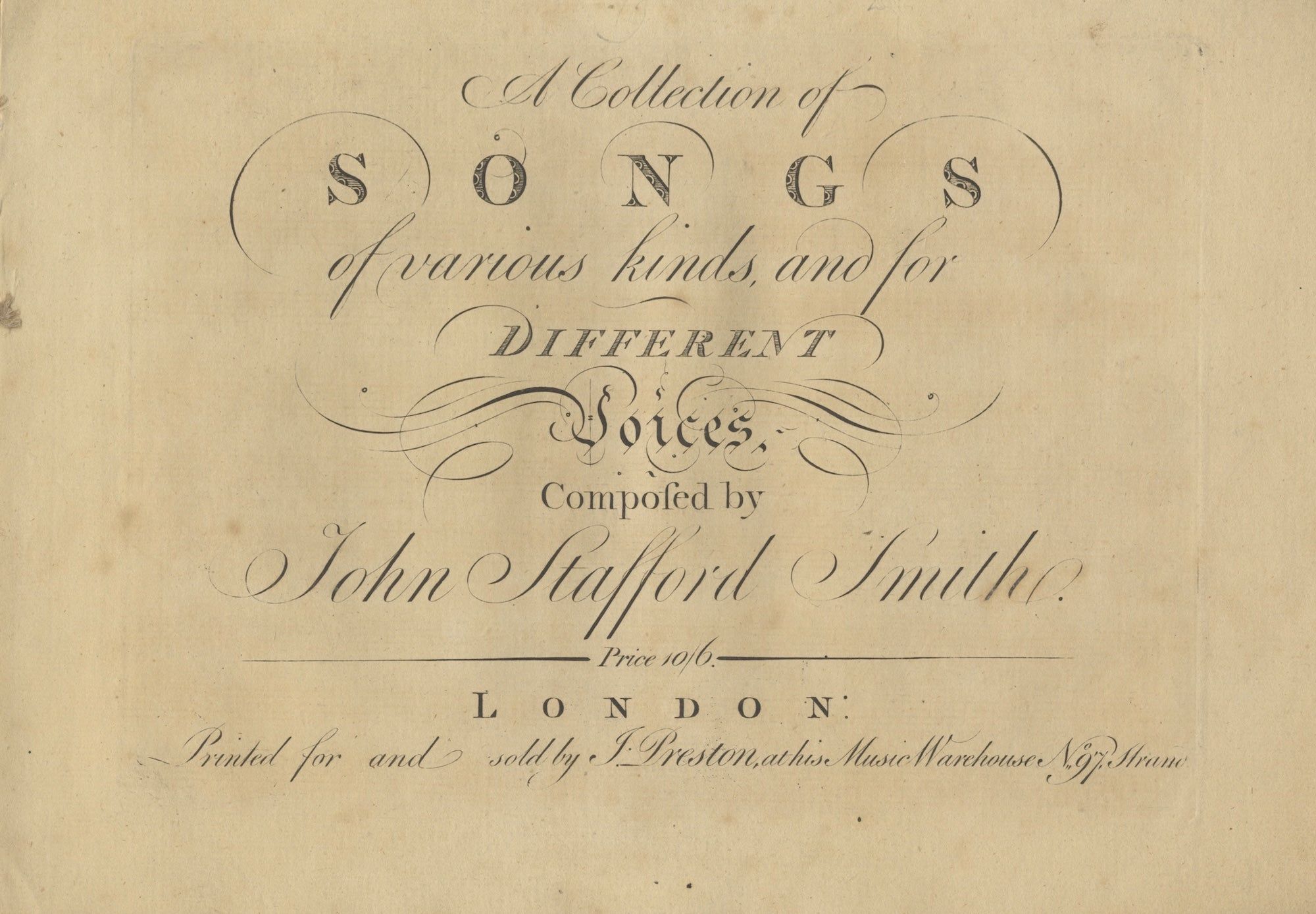
- London: Printed for and sold by J. Preston, at his Music Warehouse No. 97, Strand, 1785
London: Printed for and sold by J. Preston, at his Music Warehouse No. 97, Strand, 1785. Oblong folio. Disbound. 1f. (recto title, verso blank), 1f. (recto dedication with coat of arts incorporating a shield, three unicorns, and Latin motto "Pro Rege et Populo," verso blank), [i] (blank), 40 pp. Engraved throughout.
With secondary pagination in contemporary manuscript to head of pages.
Slightly browned, soiled, and foxed. BUC p. 959. RISM S3687and SS3687.
The songs are for 1-4 voices, all a cappella with the exception of the solo song "The Lunatic Lover." After Purcell's style with a keyboard accompaniment, the keyboard part often doubles the vocal part, but sometimes diverges into its own textures and melodies. In a striking example of word-painting, after the lines "Distraction I see is my Doom / of this I am now too sure / a Rival is got in my room / while torments I do endure," the keyboard plays a "Sy.[mphony]" consisting of ten measures of music with the right hand in 10/8 time in moto perpetuo quintuplets, and the left hand accompanying in common time, all notated in three staves (two for the left hand and one for the right). The lyrics for the 3-part glee, pp. 3-4, are drawn from Shakespeare's The Winter's Tale.
Smith, an English musicologist and composer, "gained an early reputation as a glee composer, winning two prizes from the Catch Club in 1773 and several more during the next few years. He published five collections of glees as well as several separate pieces; many others appeared in Warren's collection and other anthologies of the time. The later glees are strikingly original; one, Sweet poet of the woods, uses quarter-tones. He also produced a madrigal, Flora now calleth forth each flower, which is a genuine essay in the old madrigal idiom. He published a collection of songs, and a set of 20 anthems, besides composing a number of hymn tunes and chants. His anthems, too, display unusual boldness, both in the choice and treatment of texts: Horton regards him as a pioneer in this respect. He became a member of the Anacreontic Society in 1766. His song, To Anacreon in Heaven, was composed for this drinking and singing club; he published a harmonized version (A,T,B) in his 5th Book of Canzonets, Catches, Canons and Glees (1799). In a slightly altered form, this was later adapted to The Star-Spangled Banner, now the national anthem of the USA. ... He is now chiefly remembered for his pioneering work as a musical antiquary. ... One might go further and say he was the first musicologist of any nationality, since England was in the forefront of musical antiquarianism." Nicholas Temperley in Grove Music Online.
With secondary pagination in contemporary manuscript to head of pages.
Slightly browned, soiled, and foxed. BUC p. 959. RISM S3687and SS3687.
The songs are for 1-4 voices, all a cappella with the exception of the solo song "The Lunatic Lover." After Purcell's style with a keyboard accompaniment, the keyboard part often doubles the vocal part, but sometimes diverges into its own textures and melodies. In a striking example of word-painting, after the lines "Distraction I see is my Doom / of this I am now too sure / a Rival is got in my room / while torments I do endure," the keyboard plays a "Sy.[mphony]" consisting of ten measures of music with the right hand in 10/8 time in moto perpetuo quintuplets, and the left hand accompanying in common time, all notated in three staves (two for the left hand and one for the right). The lyrics for the 3-part glee, pp. 3-4, are drawn from Shakespeare's The Winter's Tale.
Smith, an English musicologist and composer, "gained an early reputation as a glee composer, winning two prizes from the Catch Club in 1773 and several more during the next few years. He published five collections of glees as well as several separate pieces; many others appeared in Warren's collection and other anthologies of the time. The later glees are strikingly original; one, Sweet poet of the woods, uses quarter-tones. He also produced a madrigal, Flora now calleth forth each flower, which is a genuine essay in the old madrigal idiom. He published a collection of songs, and a set of 20 anthems, besides composing a number of hymn tunes and chants. His anthems, too, display unusual boldness, both in the choice and treatment of texts: Horton regards him as a pioneer in this respect. He became a member of the Anacreontic Society in 1766. His song, To Anacreon in Heaven, was composed for this drinking and singing club; he published a harmonized version (A,T,B) in his 5th Book of Canzonets, Catches, Canons and Glees (1799). In a slightly altered form, this was later adapted to The Star-Spangled Banner, now the national anthem of the USA. ... He is now chiefly remembered for his pioneering work as a musical antiquary. ... One might go further and say he was the first musicologist of any nationality, since England was in the forefront of musical antiquarianism." Nicholas Temperley in Grove Music Online.
Details
Title
A Collection of Songs of various kinds, and for Different Voices ... Price 10/6
Author
SMITH, John Stafford 1750-1836
Condition
Unknown
Publisher
Printed for and sold by J. Preston, at his Music Warehouse No. 97, Strand: London
Date
1785