

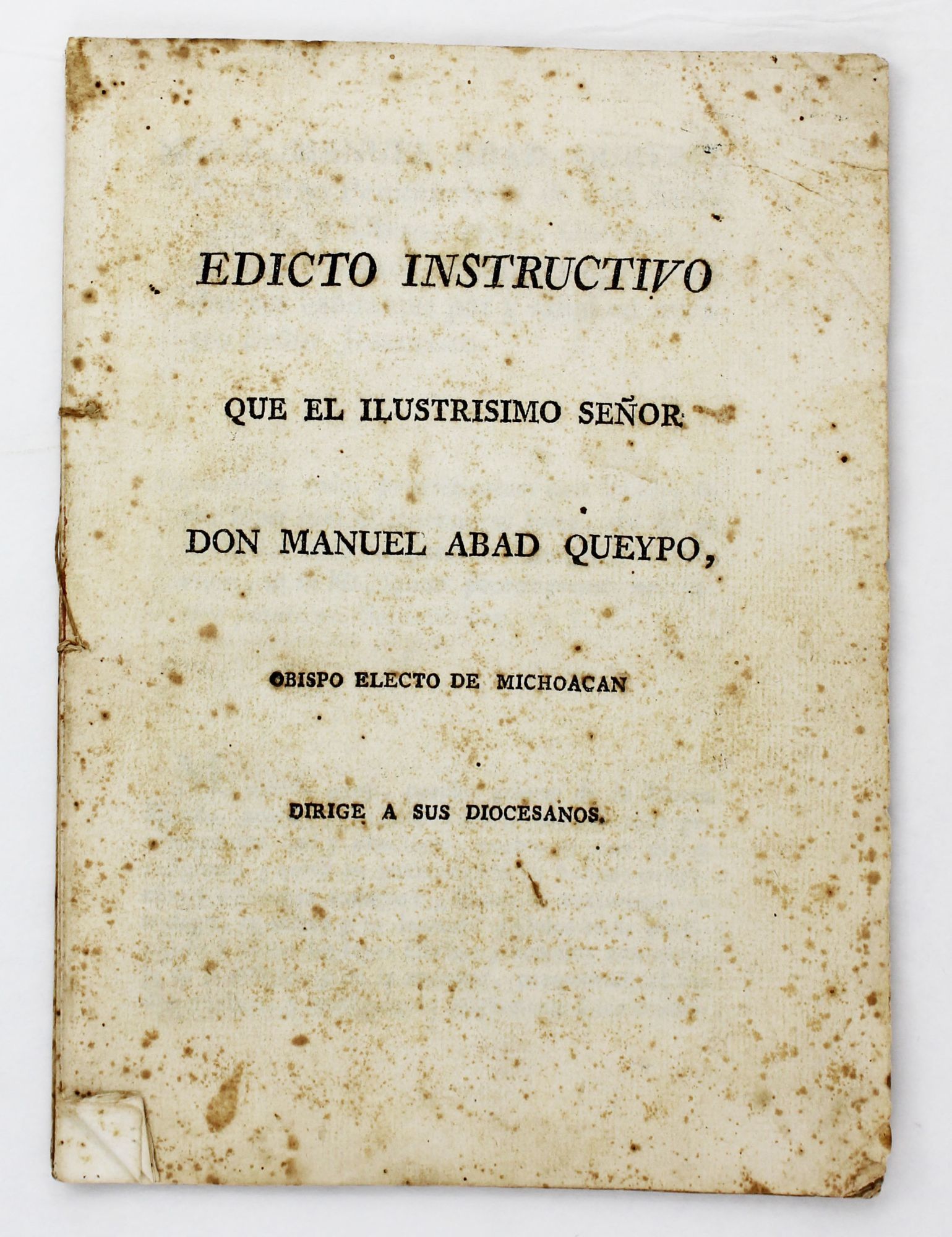
Edicto Instructivo Que el Ilustrimo Señor Don Manuel Abad Queypo, Obispo Electo de Michoacan Dirige a Sus Diocesanos [wrapper title]
- [Mexico , 1810
[Mexico, 1810. Good plus.. [24]pp. Small quarto. Stitched as issued. Moderate foxing to outer leaves, even toning throughout. Minor wear and creasing. "A pastoral letter, in which the Bishop of Michoacan reproves his flock for having joined the insurgents under Hidalgo" -- Sabin. The author, Manuel Abad y Queipo, was an interesting figure in the history of Mexico's struggle for independence. He first came to Guatemala, where he was officially ordained, in the 1770s, and went to Morelia (then, Valladolid) in 1784, where he was made a judge of canon law, and was eventually named bishop there in 1810. His strong support of social causes and the indigenous population, as well as his prior friendship with many of the insurgent priests, including Hidalgo himself, made him suspicious to authorities. Even though he excommunicated Hidalgo and other clergy who participated in the uprising and issued the present letter six days later, he was denounced to the Inquisition and had to return to Spain in 1815 to plead his case with the King.
Much of this work is a vehement denunciation of Father Hidalgo and the violence of the rebellion combined with an appeal to the proposition that the status quo, with its attendant drawbacks and injustices, is preferable to imminent anarchy:
"El cura Hidalgo no puede tampoco alterar ni la fuerza, ni la santidad de las leyes de nuestro Criador y Redentor. El será un seductor como Mahoma, que sin negar la ley escrita, ni la ley de gracia, engañ à la mitad del mundo....Así pues, este nuevo seductor, conduciendos à la la violacion de las leyes Divinas por la rebelion, por el robo y latrocinio, por la opresion de los innocentes, por el desamparo y ruina de sus mugeres, de sus hijos de sus familias, y por la infraccion de la immunidad personal del clero, tratando de persuadiros que con estos crimenes sosteneis la religion y honrais à nuestramadre santisima de Guadalupe...."
Abad y Queipo continues much in a similar vein until the coda, in which he pleads with the clergy to use their voice and power to coax the people back to the true church and the crown. The whole is a vivid composition and a fascinating document of the alarmed reaction to the outbreak of violence in colonial Mexico led in good part by erstwhile clergymen. OCLC locates three copies, from which only one in a U.S. institution, at Berkeley.
Sabin 67080. Medina, Mexico 10501.
Much of this work is a vehement denunciation of Father Hidalgo and the violence of the rebellion combined with an appeal to the proposition that the status quo, with its attendant drawbacks and injustices, is preferable to imminent anarchy:
"El cura Hidalgo no puede tampoco alterar ni la fuerza, ni la santidad de las leyes de nuestro Criador y Redentor. El será un seductor como Mahoma, que sin negar la ley escrita, ni la ley de gracia, engañ à la mitad del mundo....Así pues, este nuevo seductor, conduciendos à la la violacion de las leyes Divinas por la rebelion, por el robo y latrocinio, por la opresion de los innocentes, por el desamparo y ruina de sus mugeres, de sus hijos de sus familias, y por la infraccion de la immunidad personal del clero, tratando de persuadiros que con estos crimenes sosteneis la religion y honrais à nuestramadre santisima de Guadalupe...."
Abad y Queipo continues much in a similar vein until the coda, in which he pleads with the clergy to use their voice and power to coax the people back to the true church and the crown. The whole is a vivid composition and a fascinating document of the alarmed reaction to the outbreak of violence in colonial Mexico led in good part by erstwhile clergymen. OCLC locates three copies, from which only one in a U.S. institution, at Berkeley.
Sabin 67080. Medina, Mexico 10501.
Details
Title
Edicto Instructivo Que el Ilustrimo Señor Don Manuel Abad Queypo, Obispo Electo de Michoacan Dirige a Sus Diocesanos [wrapper title]
Author
Abad y Queipo, Manuel
Condition
Good
Publisher
[Mexico
Date
1810