

L'Europe Galante, Ballet en Musique. Troisième Edition Revûë & Corrigée. [Short score]
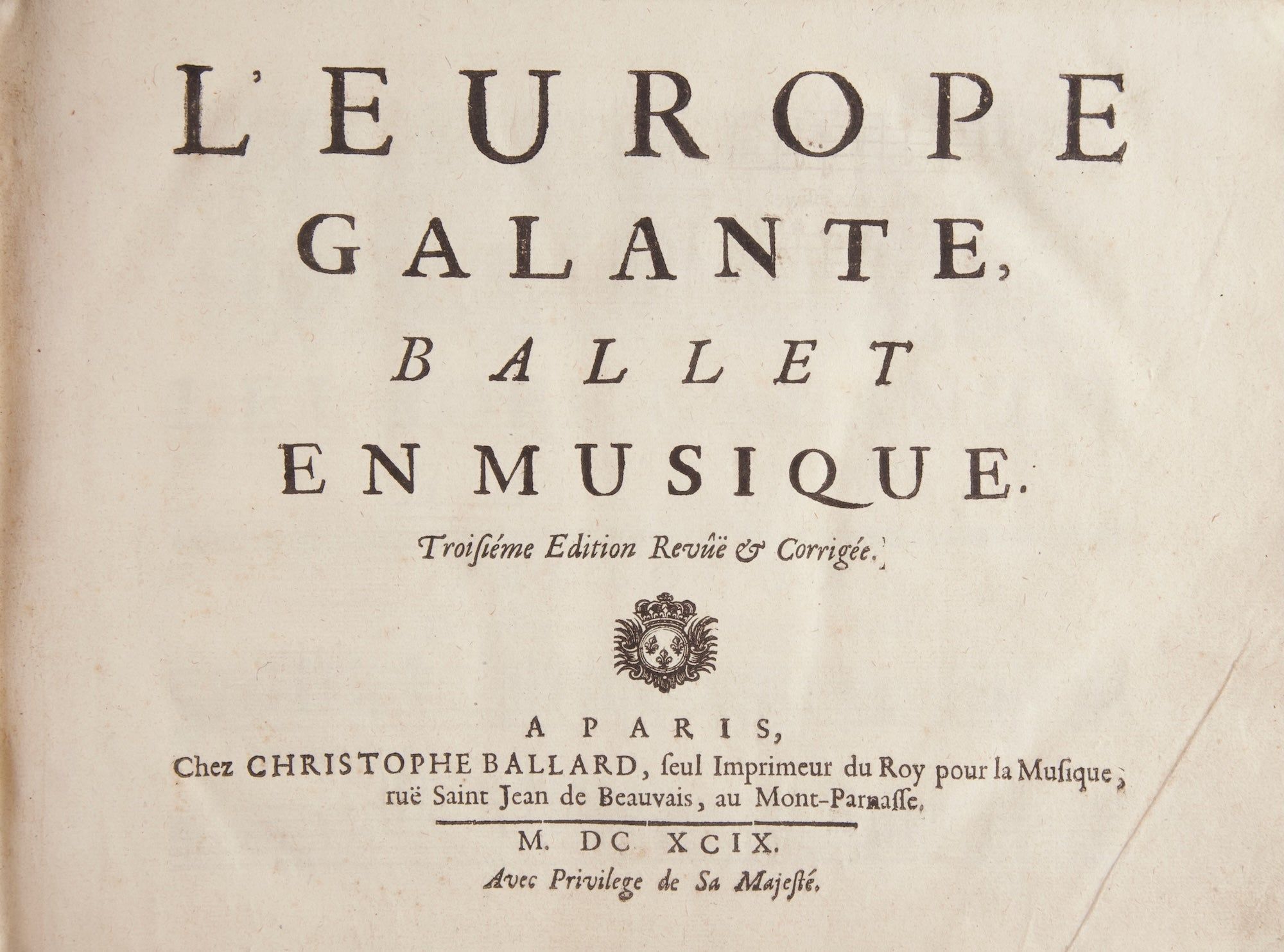
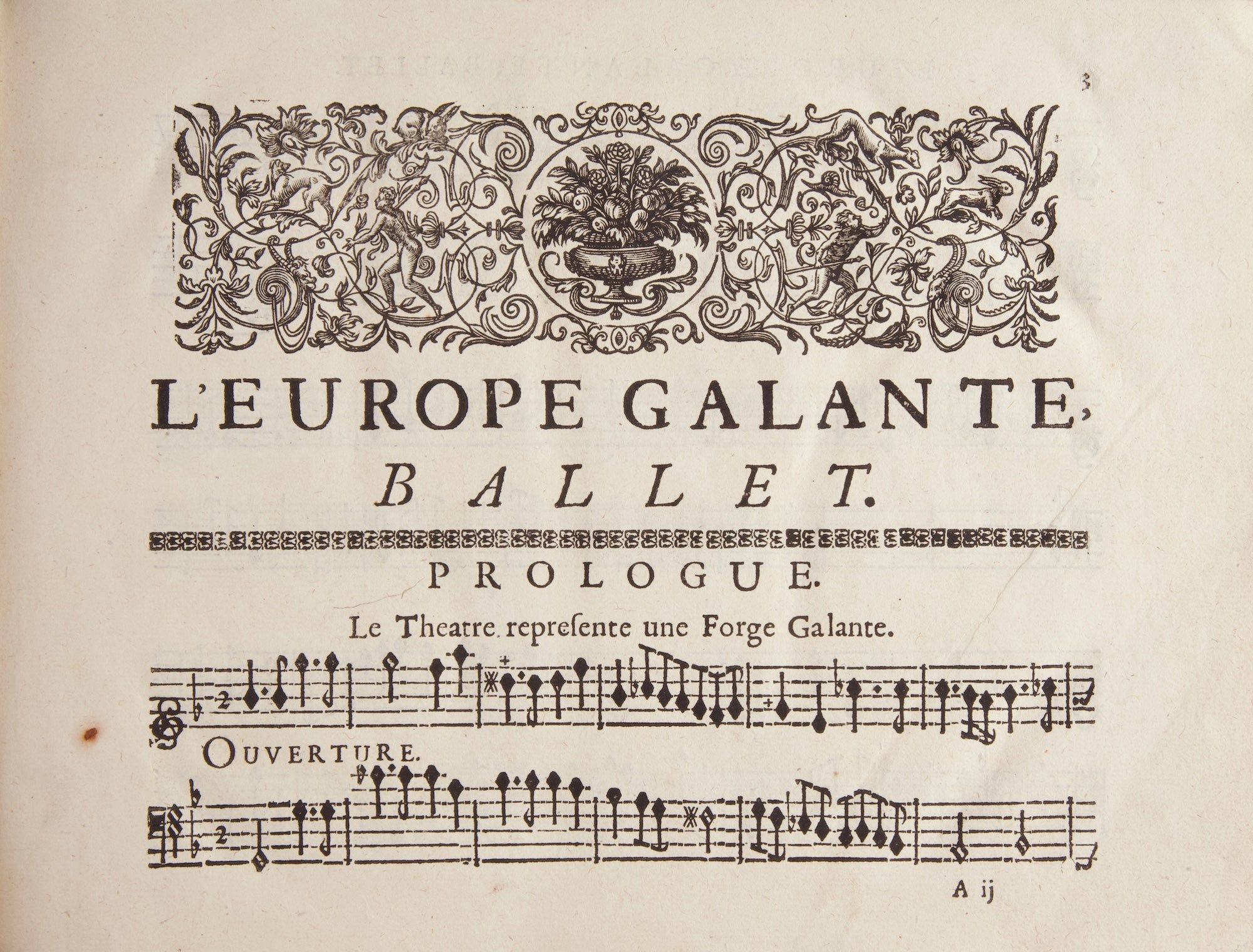
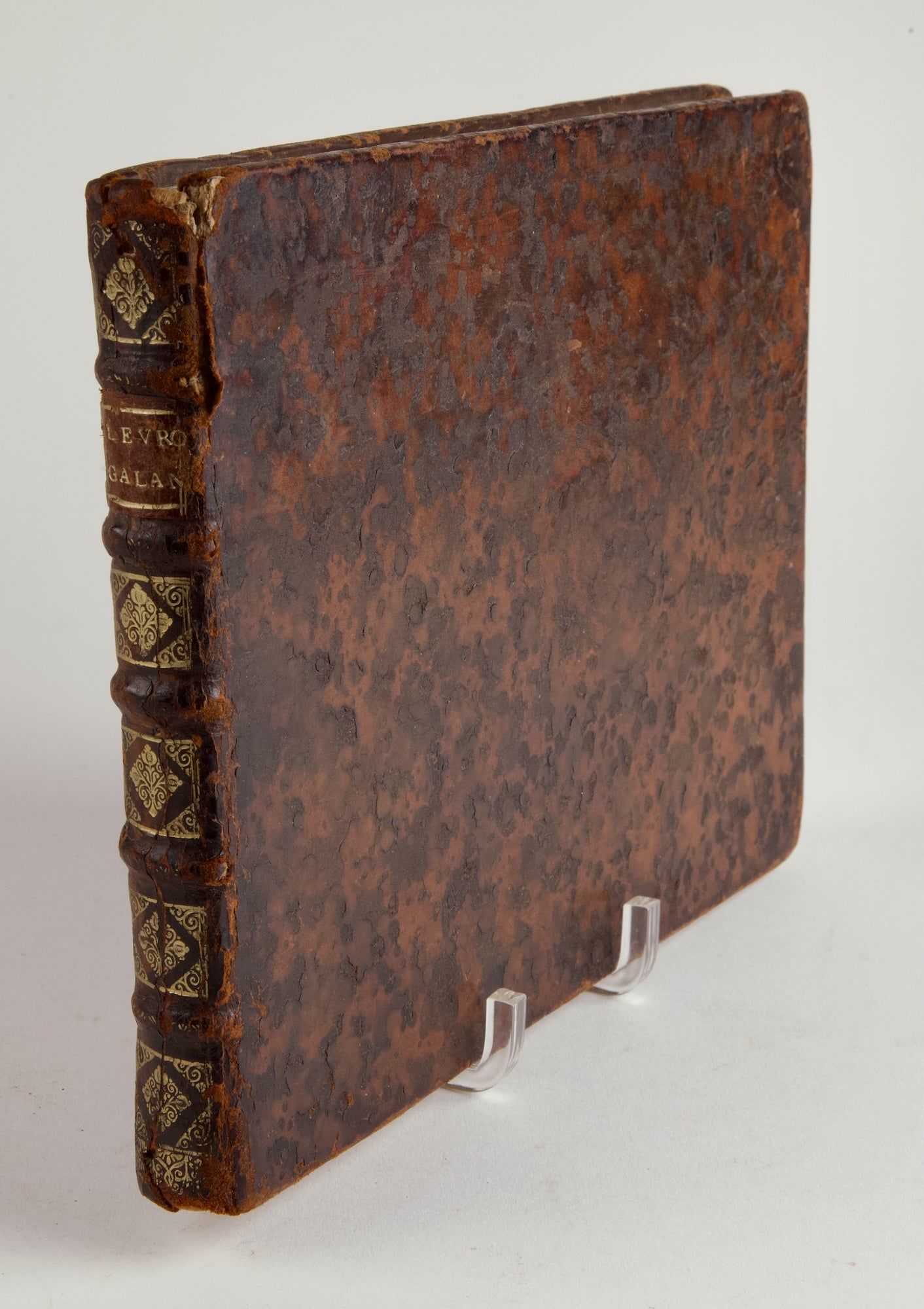
- Paris: Chez Christophe Ballard, seul Imprimeur du Roy pour la Musique, ruë Saint Jean de Beauvais, au Mont-Parnasse ... Avec Privilege, 1699
Paris: Chez Christophe Ballard, seul Imprimeur du Roy pour la Musique, ruë Saint Jean de Beauvais, au Mont-Parnasse ... Avec Privilege de Sa Majesté, 1699. Oblong quarto. Full contemporary dark brown mottled calf with spine in decorative compartments gilt with titling gilt, edges decoratively tooled, marbled endpapers. 1f. (recto title, verso blank), 3-279, [i] ("Table Des Airs qui peuvent se détacher"] pp. With decorative woodcut headpieces.
With small embossed armorial stamp to free front endpaper. With "huit livres" in contemporary manuscript to free rear endpaper.
Binding slightly worn, rubbed, and bumped; endpapers worn. Slightly worn and browned; very occasional minor stains and foxing, primarily to blank margins. In quite good condition overall. Barthélemy p. 179. Loewenberg 101. Lesure p. 95. RISM C712.
First performed 24 October 1697, the text by de la Motte.
Campra is credited with the creation of the "opera-ballet;" the present work was one of his most successful compositions. "Mellers observed that Campra was perhaps the most enchanting of dance composers. ... [He] was the most catholic of the generation of composers which flourished between Lully's death (1687) and Rameau's debut as an opera composer (1733). It is no longer possible to sustain the argument that Campra and his contemporaries were mere `imitators of Lully.' With his sense of orchestral colour, his gift for melody, his awareness of the expressive possibilities of harmony and the kaleidoscopic brilliance with which he used the dance, Campra greatly expanded the Lullian musical vocabulary. In his operas-ballets he introduced a considerable degree of verisimilitude to the French lyric stage long before the opera comique. On his limited scale he was a poet who, at his best, like Watteau, created a world half real, half fantasy." TNG Vol. 3, pp. 663-664.
With small embossed armorial stamp to free front endpaper. With "huit livres" in contemporary manuscript to free rear endpaper.
Binding slightly worn, rubbed, and bumped; endpapers worn. Slightly worn and browned; very occasional minor stains and foxing, primarily to blank margins. In quite good condition overall. Barthélemy p. 179. Loewenberg 101. Lesure p. 95. RISM C712.
First performed 24 October 1697, the text by de la Motte.
Campra is credited with the creation of the "opera-ballet;" the present work was one of his most successful compositions. "Mellers observed that Campra was perhaps the most enchanting of dance composers. ... [He] was the most catholic of the generation of composers which flourished between Lully's death (1687) and Rameau's debut as an opera composer (1733). It is no longer possible to sustain the argument that Campra and his contemporaries were mere `imitators of Lully.' With his sense of orchestral colour, his gift for melody, his awareness of the expressive possibilities of harmony and the kaleidoscopic brilliance with which he used the dance, Campra greatly expanded the Lullian musical vocabulary. In his operas-ballets he introduced a considerable degree of verisimilitude to the French lyric stage long before the opera comique. On his limited scale he was a poet who, at his best, like Watteau, created a world half real, half fantasy." TNG Vol. 3, pp. 663-664.
Details
Title
L'Europe Galante, Ballet en Musique. Troisième Edition Revûë & Corrigée. [Short score]
Author
CAMPRA, Andre 1660-1744
Condition
Unknown
Publisher
Chez Christophe Ballard, seul Imprimeur du Roy pour la Musique, ruë Saint Jean de Beauvais, au Mont-Parnasse ... Avec Privilege: Paris
Date
1699