

Arethuse ou La Vengeance de l'Amour, Ballet Mis en Musique ... Representé pour la première fois par l'Academie Royale de Musique Le quatorziéme jour de Juillet 1701. [Vocal score]
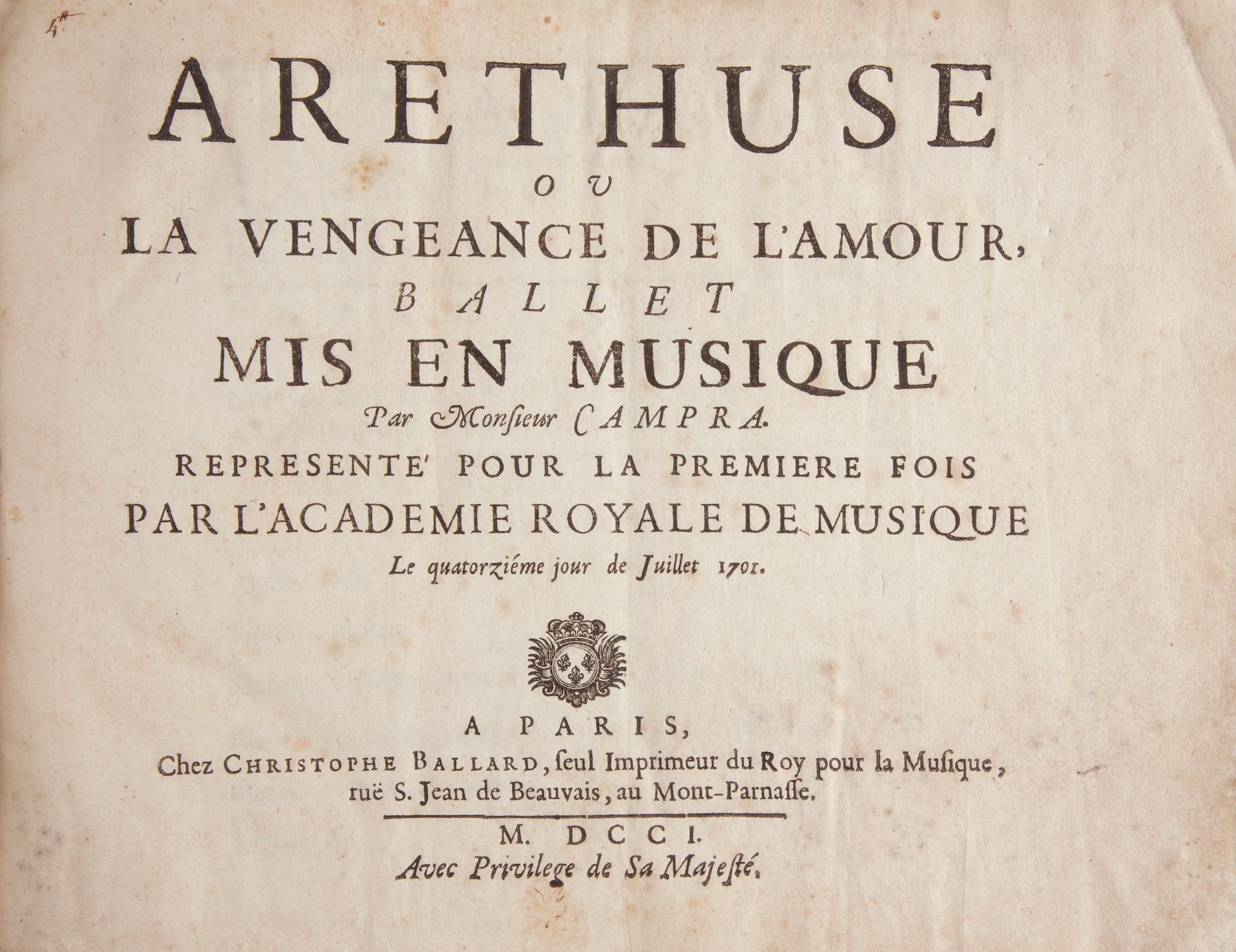
- Paris: Chez Christophe Ballard, seul Imprimeur du Roy pour la Musique, ruë S Jean de Beauvais, au Mont-Parnasse ... Avec Privilege de, 1701
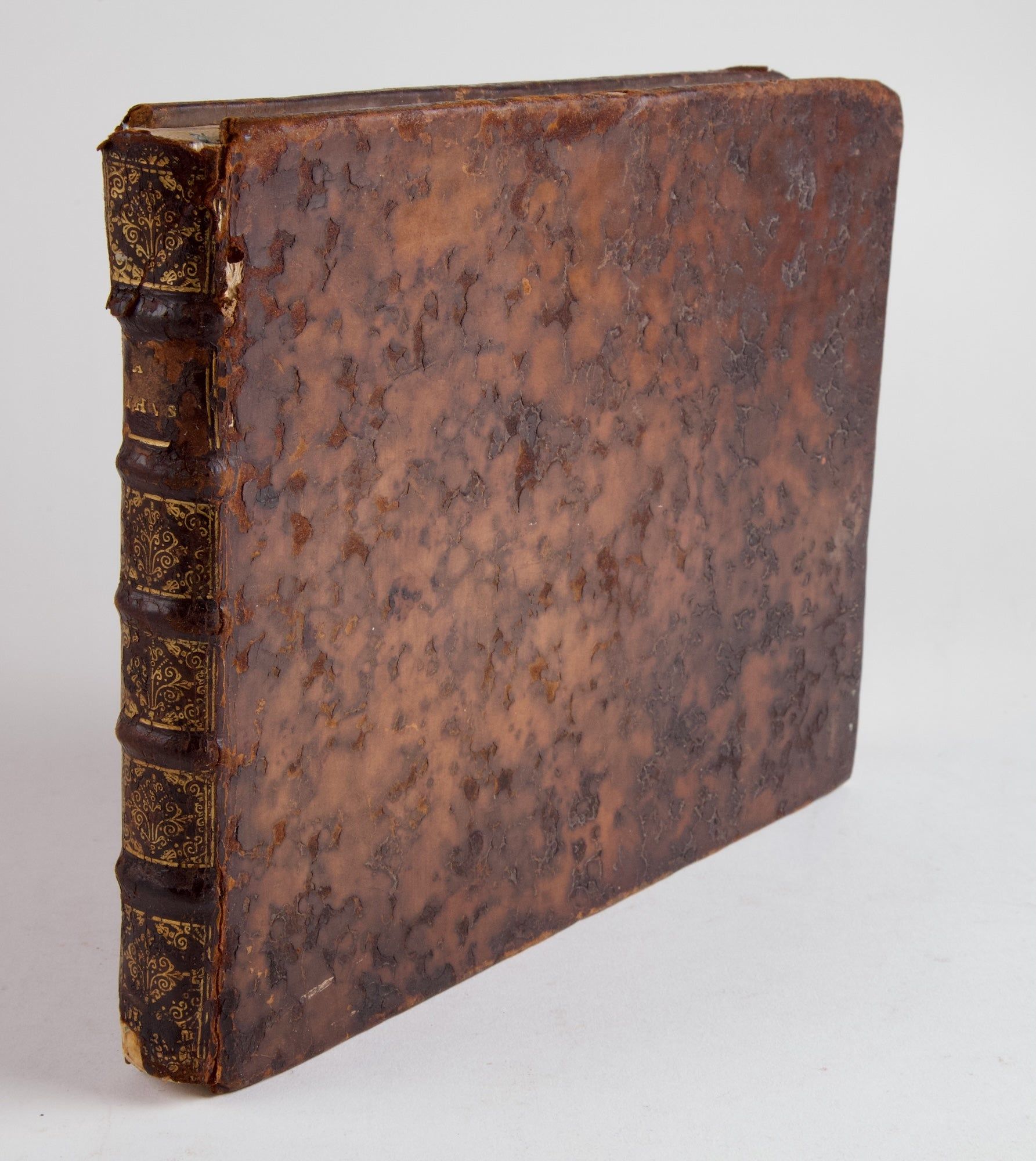
Paris: Chez Christophe Ballard, seul Imprimeur du Roy pour la Musique, ruë S Jean de Beauvais, au Mont-Parnasse ... Avec Privilege de Sa Majesté, 1701. Oblong quarto. Full contemporary dark brown mottled calf with spine in decorative compartments gilt, dark red leather title label gilt, decorative gilt tooling to edges, marbled edges and endpapers. 1f. (recto title, verso blank), 1f. ("Table"), [iii] ("Airs a jouer"), [i] ("Memoire des Oeuvres de Monsieur Campra"), i-lvi (prologue), 231, [i] ("Extrait du Privilege") pp.
Binding worn, rubbed, and bumped; free front endpaper lacking. Moderate browning; occasional, mostly marginal staining and soiling; title foxed; minor loss to blank upper margin of "Airs a jouer" and page i of prologue; occasional dampstaining, small tears, and other minor defects. First Edition. Very scarce. BUC p. 157. Lesure p. 94. RISM C707. No copies recorded by RBH at auction since 1947.
Arethuse was first performed on 14 July 1701.
Campra "was a leading figure in French theatrical and sacred music in the early 18th century. ... [His] musical style is seen at its best in his opéras-ballets. As he himself stated, it is a mixture of French 'delicatesse' and Italian 'vivacité'. The syllabic airs with short symmetrical phrases, a delicate sense of orchestral colour and an expressive and organic use of vocal ornamentation are characteristically French, as is the five-part texture inherited from Lully, which prevails in many symphonies. The complex vocalises of the ariettes and da capo airs, the concerto-like rhythms of certain ritournelles and the use of rapid modulations all come from Italy.
Mellers observed that Campra was 'perhaps the most enchanting of dance composers'. He is borne out by the gestic directness of the minuets, with their almost Haydn-like triadic melodies, the carefree humour of the rigaudons in Les âges, with their unabashed parallel 5ths, suggesting the rustic dances of his meridional homeland, and the kinetic energy of the contredanses and forlane, which have an extra measure thrown in here and there to avoid symmetrical phrase groupings. ...
Campra was the most catholic of the generation of composers that flourished between Lully's death (1687) and Rameau's début as an opera composer (1733). It is no longer possible to sustain the argument that Campra and his contemporaries were mere 'imitators of Lully'. With his delicate sense of orchestral colour, the kaleidoscopic brilliance with which he used the dance, his gift for melody and his sensitivity to the expressive possibilities of harmony, Campra greatly expanded the musical vocabulary of Lully. Through his opéras-ballets he introduced a degree of verisimilitude to the French lyric stage. On his limited scale and at his best, he was a poet who, like the painter Antoine Watteau, created a world half real, half fantasy. His awareness of the primary role of the musician in opera was not shared by most contemporaneous French aestheticians, but it enabled him to turn to the Prince of Conti after the first performances of Rameau's Hippolyte et Aricie in 1733 and prophesy: 'There is enough music in this opera for ten operas; this man will eclipse us all'." James R. Anthony in Grove Music Online.
Binding worn, rubbed, and bumped; free front endpaper lacking. Moderate browning; occasional, mostly marginal staining and soiling; title foxed; minor loss to blank upper margin of "Airs a jouer" and page i of prologue; occasional dampstaining, small tears, and other minor defects. First Edition. Very scarce. BUC p. 157. Lesure p. 94. RISM C707. No copies recorded by RBH at auction since 1947.
Arethuse was first performed on 14 July 1701.
Campra "was a leading figure in French theatrical and sacred music in the early 18th century. ... [His] musical style is seen at its best in his opéras-ballets. As he himself stated, it is a mixture of French 'delicatesse' and Italian 'vivacité'. The syllabic airs with short symmetrical phrases, a delicate sense of orchestral colour and an expressive and organic use of vocal ornamentation are characteristically French, as is the five-part texture inherited from Lully, which prevails in many symphonies. The complex vocalises of the ariettes and da capo airs, the concerto-like rhythms of certain ritournelles and the use of rapid modulations all come from Italy.
Mellers observed that Campra was 'perhaps the most enchanting of dance composers'. He is borne out by the gestic directness of the minuets, with their almost Haydn-like triadic melodies, the carefree humour of the rigaudons in Les âges, with their unabashed parallel 5ths, suggesting the rustic dances of his meridional homeland, and the kinetic energy of the contredanses and forlane, which have an extra measure thrown in here and there to avoid symmetrical phrase groupings. ...
Campra was the most catholic of the generation of composers that flourished between Lully's death (1687) and Rameau's début as an opera composer (1733). It is no longer possible to sustain the argument that Campra and his contemporaries were mere 'imitators of Lully'. With his delicate sense of orchestral colour, the kaleidoscopic brilliance with which he used the dance, his gift for melody and his sensitivity to the expressive possibilities of harmony, Campra greatly expanded the musical vocabulary of Lully. Through his opéras-ballets he introduced a degree of verisimilitude to the French lyric stage. On his limited scale and at his best, he was a poet who, like the painter Antoine Watteau, created a world half real, half fantasy. His awareness of the primary role of the musician in opera was not shared by most contemporaneous French aestheticians, but it enabled him to turn to the Prince of Conti after the first performances of Rameau's Hippolyte et Aricie in 1733 and prophesy: 'There is enough music in this opera for ten operas; this man will eclipse us all'." James R. Anthony in Grove Music Online.
Details
Title
Arethuse ou La Vengeance de l'Amour, Ballet Mis en Musique ... Representé pour la première fois par l'Academie Royale de Musique Le quatorziéme jour de Juillet 1701. [Vocal score]
Author
CAMPRA, André 1660-1774
Condition
Unknown
Publisher
Chez Christophe Ballard, seul Imprimeur du Roy pour la Musique, ruë S Jean de Beauvais, au Mont-Parnasse ... Avec Privilege de: Paris
Date
1701