

Cantate. [Cantatas for voice and basso continuo]. [Copyist manuscript]
![Cantate. [Cantatas for voice and basso continuo].](https://d3525k1ryd2155.cloudfront.net/h/490/426/1687426490.0.x.jpg)
- Italy , 1770
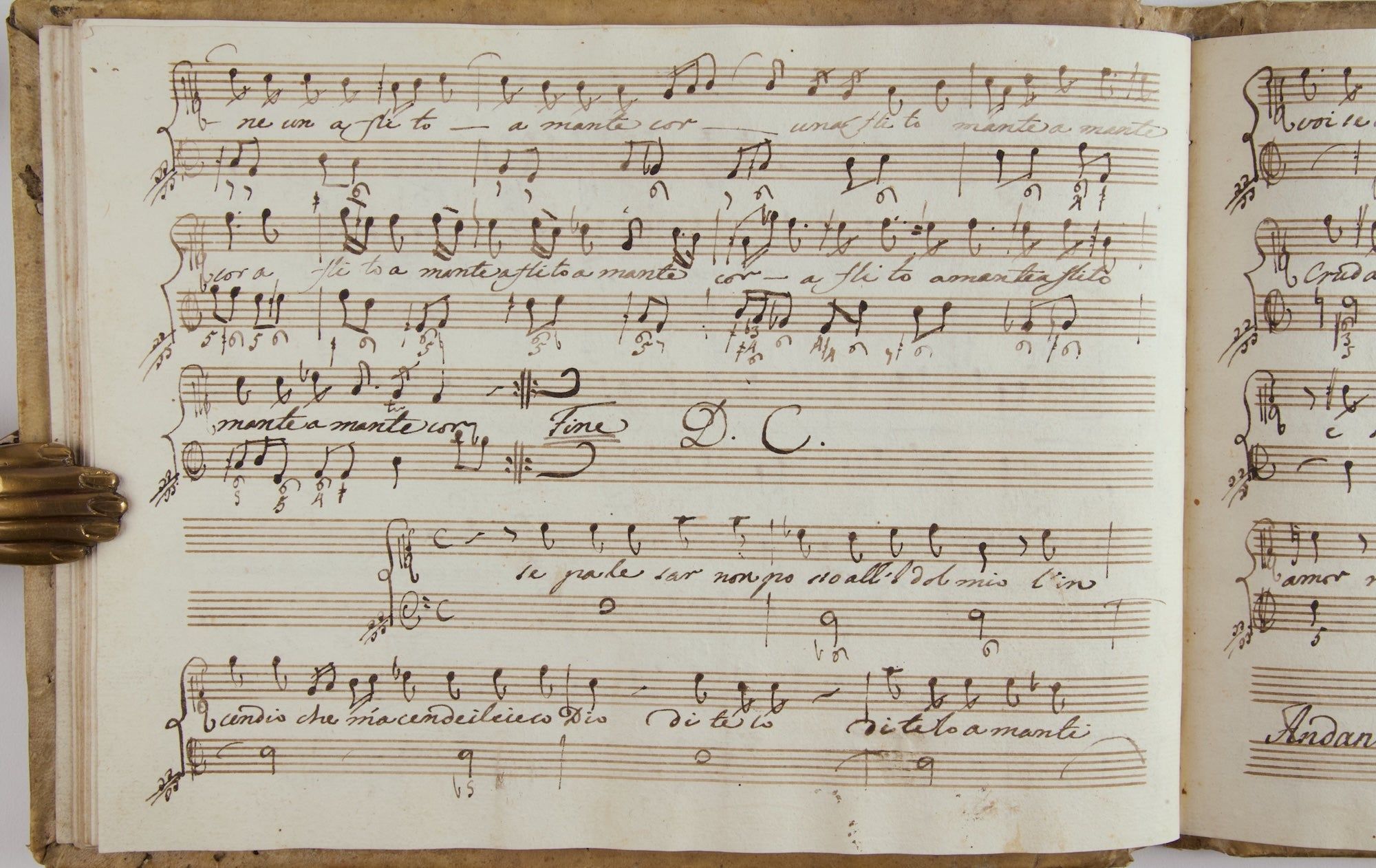
Italy, 1770. Oblong folio (228 x 286 mm). Full contemporary vellum. [i] (title), 92, [i] (blank) pp. Notated in black ink on 10-stave rastrum-ruled paper in a single hand. Watermark of a crest, countermark three half moons.
Although the title identifies Domenico Scarlatti as the composer; the pieces in the present compilation are, in fact, by Domenico's father, Alessandro.
Contains eleven cantatas, with Hanley numbers noted (Hanley: Alessandro Scarlatti's Cantate de Camera: A Bibliographical Study. Doctoral dissertation, Yale University, 1963):
1) "Andate, o miei sospiri." H 53. 10 pp.
2) "Andate, o miei sospiri." H 54. 11 pp.
3) "Cruda Irene." H 133. 9 pp.
4) "Fiero acerbo destin." H 262. 7 pp.
5) "Sono un alma tormentata." [Pagano/Bianchi, p. 477, attribution uncertain]. 10 pp.
6) "Alme voi che provaste non pur." H 35. 12 pp.
7) "Qui dove alfin m'assido." H 618. 11 pp.
8) "O pace del mio cor." H 495. 6 pp.
9) "La pace del mio core." 13 pp.
10) "Tenebrose foreste." [Pagano/Bianchi, p. 482]. 6 pp.
11) "O voi di queste selve abitatrici." H 501. 3 pp. Incomplete.
Provenance
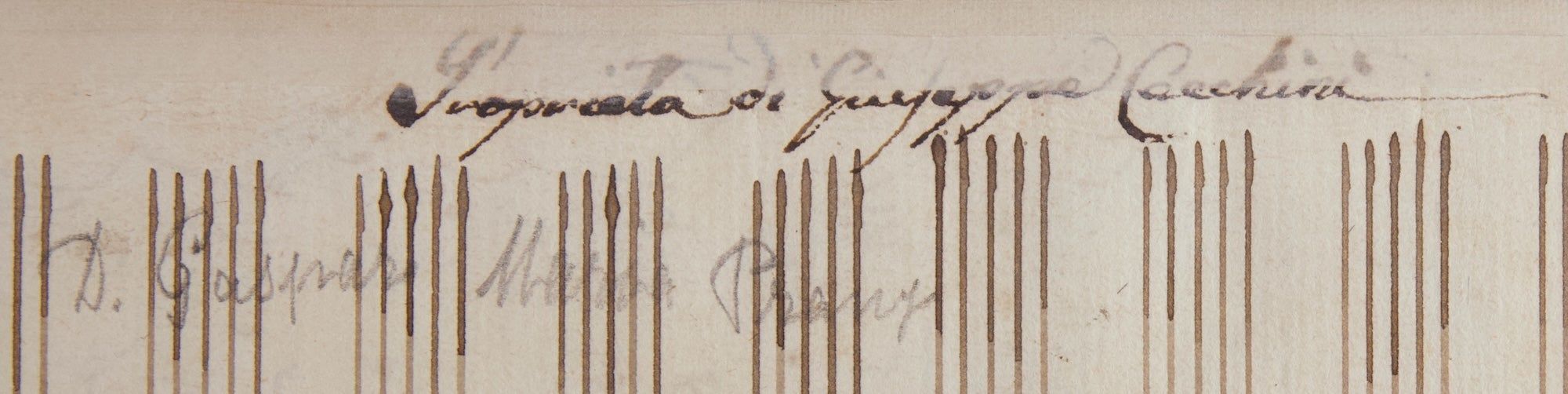
Giuseppe Cecchini Pacchierotti, adoptive son of celebrated castrato Gasparo Pacchierotti (1740-1821), with "Proprieta di Giuseppe Cecchini" in contemporary manuscript to inner margin of final blank page and "D. Gasparo ]?]Maria Preny" in another hand in pencil, and with "Paolo Bellucci Roma 1889" in pencil to lower outer corner of title.
Binding slightly worn and stained. Minor wear; occasional small stains and soiling; some minor foxing. Pacchierotti "trained at either Forlì Cathedral, or with Bertoni at S Marco, Venice (where he was principal soloist for three years from 28 February 1765), he remained in Venice until 1770, taking a minor operatic role at the Teatro S Giovanni Grisostomo (1766) and singing in Galuppi's Il re pastore in 1769. After an appointment as primo uomo at Palermo he sang in Naples as the partner of Anna de Amicis, beginning in 1771 with Jommelli's Ifigenia in Tauride and performing frequently at S Carlo up to Carnival 1776. He also sang in Bologna in Carnival 1773 (Bertoni's Olimpiade) and at the Naples court theatre in Carnival 1774 (Gluck's Orfeo), and for Carnival 1775 he was engaged at the Regio Ducal Teatro, Milan.
In spring 1776 he left Naples permanently, passing through Rome, Florence and Forlì (where his singing in Bertoni's Artaserse provoked the famous incident reported by Stendhal - the orchestra were unable to continue for the tears in their eyes). He was engaged by the theatres of Milan, Genoa, Lucca, Turin and Padua, at each singing in an opera by Bertoni. For two years (1778-80) he sang regularly at the King's Theatre in London, where Bertoni was resident composer. In July 1780 he left for Italy, singing at Lucca in Bertoni's Quinto Fabio (1780); at the Teatro S Benedetto, Venice, in the première of Bertoni's Armida abbandonata (Carnival 1780-81); and at Mantua, in Luigi Gatti's Olimpiade (1781). Persuaded by William Beckford, an English admirer and patron, he returned to the King's Theatre, where Bertoni was again composer, singing there with consistent success (1781-4); the London Public Advertiser called him 'superior to any Singer heard in this country since Farinelli'. In September 1781 Pacchierotti performed a Rauzzini cantata with Tenducci and the composer for Beckford's coming-of-age party at his Fonthill estate.
Pacchierotti then appeared as primo uomo nearly every season at the Teatro S Benedetto, Venice, and sang at Trieste (1785), Genoa and Crema (1788), Padua, Milan and Bergamo (1789), faithfully promoting Bertoni's operas each season and remaining in Italy until his last London visit, in 1791, where he sang at many concerts as well as in opera. Haydn first heard him on 7 February at a Professional Concert, and little more than a week later had him perform his cantata Arianna a Naxos, himself accompanying at the harpsichord. At Venice in 1792 Pacchierotti sang Bertoni's Requiem for Angelo Emo, the Dies irae of which he made famous. The inauguration and first Carnival season of the Teatro La Fenice, Venice (1792-3), were his last operatic appearances. Pacchierotti retired to Padua a wealthy man, living in the house of Cardinal Bembo surrounded by furniture from London, an English garden and many famous visitors including Goldoni, Stendhal and Rossini. He spent the last 28 years of his life studying Italian and English literature, and concentrating his musical interests particularly on Marcello's psalms. He sang in public at least twice: in 1796 in Padua before Napoleon (unwillingly), and on 28 June 1814 at S Marco for Bertoni's funeral.
By all accounts the greatest of the late 18th-century castratos, Pacchierotti was last in the line of the finest male sopranos. Both Mount Edgcumbe ('the most perfect singer it ever fell to my lot to hear') and Burney devoted more space to describing his genius than they accorded any other performer of the era. He was able to sing with facility from B♭ to c‴, had a command of many different styles, was a considerable actor and moved even casual listeners by his rendition of pathetic airs. He was the principal author of the anachronistic vocal treatise Modi generali del canto premessi alle maniere parziali onde adornare o rifiorire le nude o semplici melodie o cantilene giusta il metodo di Gasparo Pacchiarotti (Milan, 1836), published under the name of his friend Antonio Calegari." Kathleen Kuzmick Hansell in Grove Music Online
Giovani: Dalla collezione di Giuseppe Cecchini Pacchierotti, un'ignota fonte scarlattiana. Il manoscritto di cantate della Fondazione Giorgio Cini, Venezia. In La cantata da camera e lo stile galante. Sviluppi e diffusione della "nuova musica" tra il 1720 e il 1760 (pp. 1-26). Amsterdam: Stile Galante Publishing.
A substantial collection of Scarlatti cantatas with a distinguished provenance, the present manuscript could shed new light on Scarlatti reception in Italy in the decades immediately following the composer's death.
Although the title identifies Domenico Scarlatti as the composer; the pieces in the present compilation are, in fact, by Domenico's father, Alessandro.
Contains eleven cantatas, with Hanley numbers noted (Hanley: Alessandro Scarlatti's Cantate de Camera: A Bibliographical Study. Doctoral dissertation, Yale University, 1963):
1) "Andate, o miei sospiri." H 53. 10 pp.
2) "Andate, o miei sospiri." H 54. 11 pp.
3) "Cruda Irene." H 133. 9 pp.
4) "Fiero acerbo destin." H 262. 7 pp.
5) "Sono un alma tormentata." [Pagano/Bianchi, p. 477, attribution uncertain]. 10 pp.
6) "Alme voi che provaste non pur." H 35. 12 pp.
7) "Qui dove alfin m'assido." H 618. 11 pp.
8) "O pace del mio cor." H 495. 6 pp.
9) "La pace del mio core." 13 pp.
10) "Tenebrose foreste." [Pagano/Bianchi, p. 482]. 6 pp.
11) "O voi di queste selve abitatrici." H 501. 3 pp. Incomplete.
Provenance
Giuseppe Cecchini Pacchierotti, adoptive son of celebrated castrato Gasparo Pacchierotti (1740-1821), with "Proprieta di Giuseppe Cecchini" in contemporary manuscript to inner margin of final blank page and "D. Gasparo ]?]Maria Preny" in another hand in pencil, and with "Paolo Bellucci Roma 1889" in pencil to lower outer corner of title.
Binding slightly worn and stained. Minor wear; occasional small stains and soiling; some minor foxing. Pacchierotti "trained at either Forlì Cathedral, or with Bertoni at S Marco, Venice (where he was principal soloist for three years from 28 February 1765), he remained in Venice until 1770, taking a minor operatic role at the Teatro S Giovanni Grisostomo (1766) and singing in Galuppi's Il re pastore in 1769. After an appointment as primo uomo at Palermo he sang in Naples as the partner of Anna de Amicis, beginning in 1771 with Jommelli's Ifigenia in Tauride and performing frequently at S Carlo up to Carnival 1776. He also sang in Bologna in Carnival 1773 (Bertoni's Olimpiade) and at the Naples court theatre in Carnival 1774 (Gluck's Orfeo), and for Carnival 1775 he was engaged at the Regio Ducal Teatro, Milan.
In spring 1776 he left Naples permanently, passing through Rome, Florence and Forlì (where his singing in Bertoni's Artaserse provoked the famous incident reported by Stendhal - the orchestra were unable to continue for the tears in their eyes). He was engaged by the theatres of Milan, Genoa, Lucca, Turin and Padua, at each singing in an opera by Bertoni. For two years (1778-80) he sang regularly at the King's Theatre in London, where Bertoni was resident composer. In July 1780 he left for Italy, singing at Lucca in Bertoni's Quinto Fabio (1780); at the Teatro S Benedetto, Venice, in the première of Bertoni's Armida abbandonata (Carnival 1780-81); and at Mantua, in Luigi Gatti's Olimpiade (1781). Persuaded by William Beckford, an English admirer and patron, he returned to the King's Theatre, where Bertoni was again composer, singing there with consistent success (1781-4); the London Public Advertiser called him 'superior to any Singer heard in this country since Farinelli'. In September 1781 Pacchierotti performed a Rauzzini cantata with Tenducci and the composer for Beckford's coming-of-age party at his Fonthill estate.
Pacchierotti then appeared as primo uomo nearly every season at the Teatro S Benedetto, Venice, and sang at Trieste (1785), Genoa and Crema (1788), Padua, Milan and Bergamo (1789), faithfully promoting Bertoni's operas each season and remaining in Italy until his last London visit, in 1791, where he sang at many concerts as well as in opera. Haydn first heard him on 7 February at a Professional Concert, and little more than a week later had him perform his cantata Arianna a Naxos, himself accompanying at the harpsichord. At Venice in 1792 Pacchierotti sang Bertoni's Requiem for Angelo Emo, the Dies irae of which he made famous. The inauguration and first Carnival season of the Teatro La Fenice, Venice (1792-3), were his last operatic appearances. Pacchierotti retired to Padua a wealthy man, living in the house of Cardinal Bembo surrounded by furniture from London, an English garden and many famous visitors including Goldoni, Stendhal and Rossini. He spent the last 28 years of his life studying Italian and English literature, and concentrating his musical interests particularly on Marcello's psalms. He sang in public at least twice: in 1796 in Padua before Napoleon (unwillingly), and on 28 June 1814 at S Marco for Bertoni's funeral.
By all accounts the greatest of the late 18th-century castratos, Pacchierotti was last in the line of the finest male sopranos. Both Mount Edgcumbe ('the most perfect singer it ever fell to my lot to hear') and Burney devoted more space to describing his genius than they accorded any other performer of the era. He was able to sing with facility from B♭ to c‴, had a command of many different styles, was a considerable actor and moved even casual listeners by his rendition of pathetic airs. He was the principal author of the anachronistic vocal treatise Modi generali del canto premessi alle maniere parziali onde adornare o rifiorire le nude o semplici melodie o cantilene giusta il metodo di Gasparo Pacchiarotti (Milan, 1836), published under the name of his friend Antonio Calegari." Kathleen Kuzmick Hansell in Grove Music Online
Giovani: Dalla collezione di Giuseppe Cecchini Pacchierotti, un'ignota fonte scarlattiana. Il manoscritto di cantate della Fondazione Giorgio Cini, Venezia. In La cantata da camera e lo stile galante. Sviluppi e diffusione della "nuova musica" tra il 1720 e il 1760 (pp. 1-26). Amsterdam: Stile Galante Publishing.
A substantial collection of Scarlatti cantatas with a distinguished provenance, the present manuscript could shed new light on Scarlatti reception in Italy in the decades immediately following the composer's death.
Details
Title
Cantate. [Cantatas for voice and basso continuo]. [Copyist manuscript]
Author
SCARLATTI, Alessandro 1660-1725
Condition
Unknown
Publisher
Italy
Date
1770