

Autograph Letter Signed on Women’s Suffrage
- SIGNED custom folder
- Avignon: np, 1867
Avignon: np, 1867. First edition. custom folder. Very Good. JOHN STUART MILL CHAMPIONS WOMEN’S RIGHTS ON BOTH SIDES OF THE ATLANTIC, REVEALING HIS PASSION FOR EQUAL RIGHTS AND HIS DESIRE TO FIGHT FOR THEM “BY EVERY… INFLUENCE I POSSESS.”. John Stuart Mill, one of the most influential 19th-century philosophers of the English language, sought to combine the best of 18th-century Enlightenment thinking with new movements such as Romanticism and Historical Philosophy.
This intellectual pioneering extended to Mill’s social views—drawing on principles of associationist psychology, Mill believed that human character was entirely shaped by upbringing, advocating for an early type of feminism. Mill critiqued the prevailing view that women were inherently different from men and better suited to the gendered, apolitical roles common in 19th-century Europe and North America. He viewed the dismantling of oppressive structures—such as the denial of women’s suffrage and property rights—as essential for their social and political liberation. Only once women were granted these rights, Mill believed, could western political institutions truly represent all constituents and fulfill the Enlightenment promise of access to a good and happy life. [1]
This ideology was realized in Mill’s philosophy. His 1869 work The Subjection of Women—written in collaboration with English philosopher, suffrage activist, and his wife, Harriet Taylor Mill—argues (in brief) that women’s legal disabilities reflect their degraded social and economic positions. The text champions an early feminist vision: that women and men would be found to possess equal ability, if only granted equal opportunity. [2]
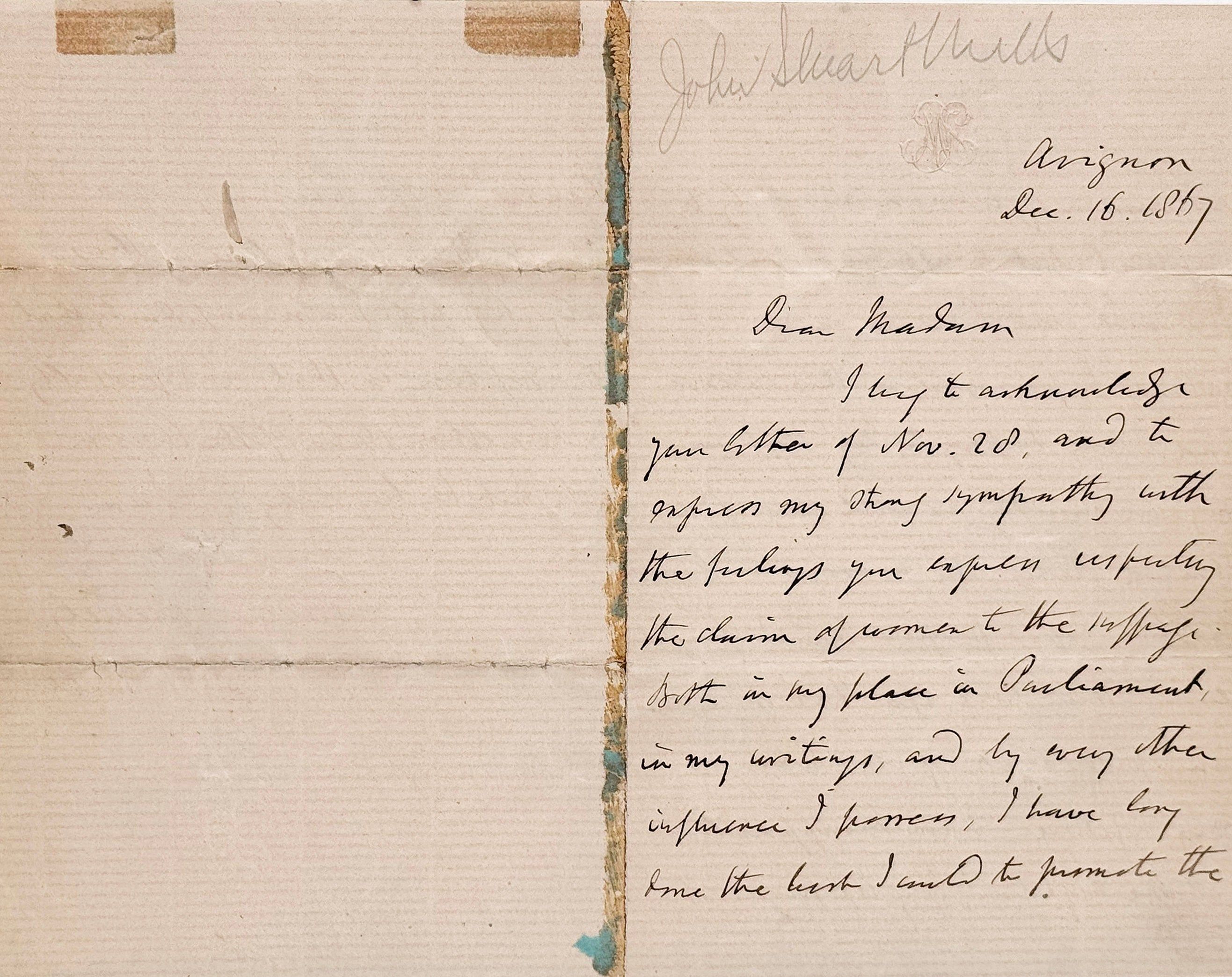
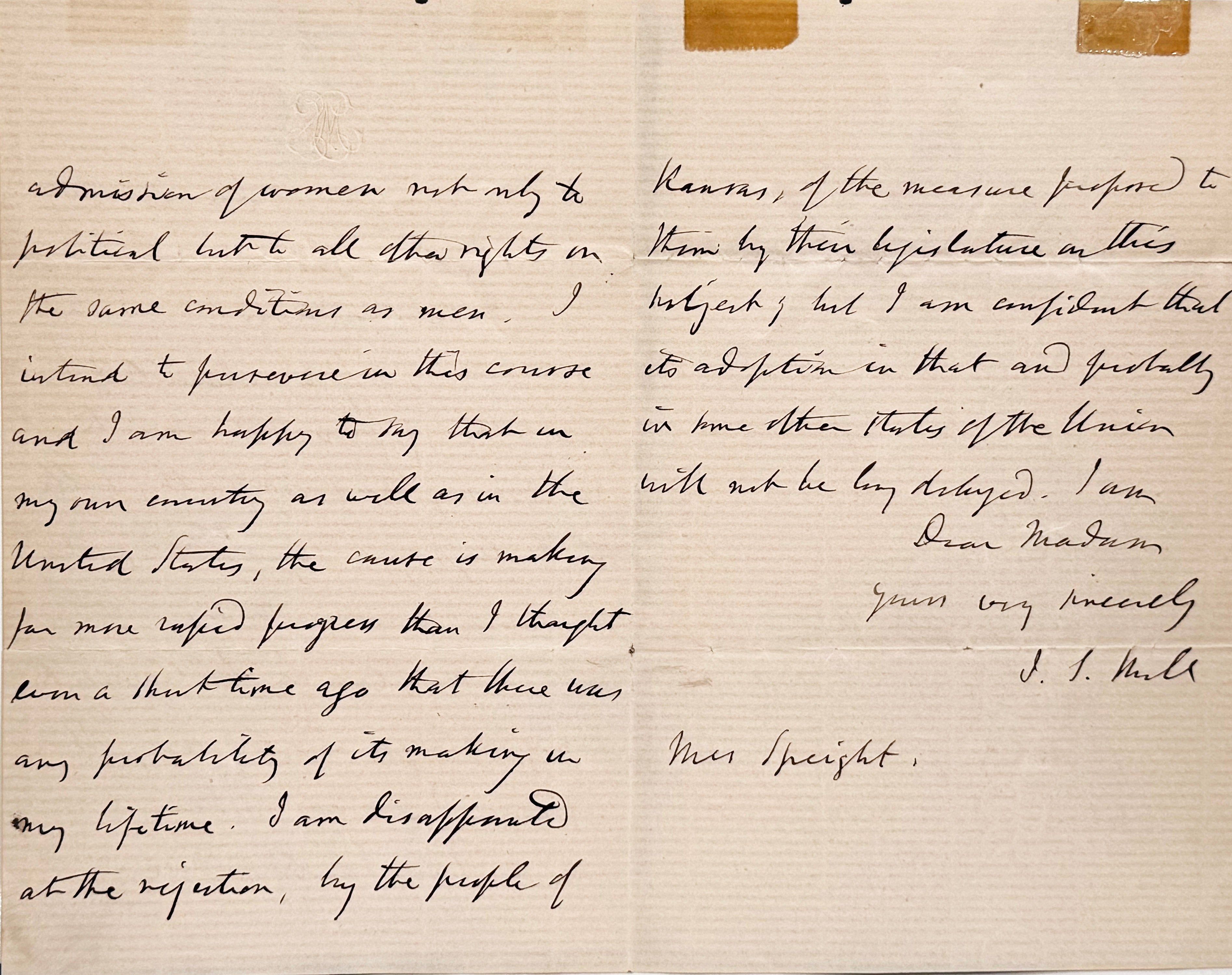
Mill’s beliefs were mirrored in his political actions as a member of the English parliament and public thinker. In this 1867 letter, Mill writes to a Kansas Suffragist vocalizing his disappointment, that a Kansas bill which had attempted to extend to women the right to vote, had been defeated, but claiming faith that this bill will one day be passed.
He then commits to further writing on the subject of suffrage (perhaps alluding to the forthcoming book The Subjection of Women), and expresses faith in the progress of the movement for equal rights. The letter, written on Mill’s monogrammed stationery, reads in full:
Avignon
Dec. 16. 1867
Dear Madam
“I beg to acknowledge your letter of Nov. 20. and to express my strong sympathy with the feelings you express respecting the claim of women to the suffrage. Both in my place in Parliament, in my writings, and by every other influence I possess, I have long done the best I could to promote the admission of women not only to political but to all other rights in the same conditions as men.
I intend to persevere in this course and I am happy to say that in my own country as well as in the United States, the cause is making far more rapid progress than I thought even a short time ago that there was any probability of its making in my lifetime.
I am disappointed at the rejection, by the people of Kansas, of the measure proposed to them by their legislature on this subject; I am confident that its adoption in that and probably in some other states of the Union will not be long delayed.
I am
Dear Madam
Yours very sincerely
[signed]J.S. Mill
Mrs. Speight.
This letter identifies Mill as an individual deeply interested in lived experience connected to his political thought—remaining committed to the cause of feminism even when separated by an ocean, even in defeat.
The recipient, apparently the “Mrs. Speight” written at the end, is possibly the British suffragist Ellen (Swaine) Speight, although Speight worked and lived in England and New Zealand, not the United States (though that wouldn’t of course preclude her watching with interest the developments for women’s suffrage in the States).
Avignon: 16 December, 1867. One sheet, 8 ⅝ x 6 ⅝ inches (218x170mm), folded to create four pages, with Mill’s text on three pages, stationary embossed with Mill’s monogram at top of first page. Usual mailing folds; apparently once framed, with remnants of cello tape at upper edge of third page and remnants of mounting along center vertical fold. “John Stuart Mills” written lightly in pencil at top of first page in a later unknown hand. Mill’s text (in ink) fine, strong, and crisp. Housed in custom presentation folder.
J.S. MILL LETTERS WITH SUCH OUTSTANDING CONTENT ARE EXCEPTIONALLY RARE.
References:
[1]Macleod, Christopher, "John Stuart Mill", The Stanford Encyclopedia of Philosophy (Summer 2020 Edition), Edward N. Zalta (ed.).
[2] Annas, Julia. “Mill and the Subjection of Women.” Philosophy 52, no. 200 (1977): 179–94.
This intellectual pioneering extended to Mill’s social views—drawing on principles of associationist psychology, Mill believed that human character was entirely shaped by upbringing, advocating for an early type of feminism. Mill critiqued the prevailing view that women were inherently different from men and better suited to the gendered, apolitical roles common in 19th-century Europe and North America. He viewed the dismantling of oppressive structures—such as the denial of women’s suffrage and property rights—as essential for their social and political liberation. Only once women were granted these rights, Mill believed, could western political institutions truly represent all constituents and fulfill the Enlightenment promise of access to a good and happy life. [1]
This ideology was realized in Mill’s philosophy. His 1869 work The Subjection of Women—written in collaboration with English philosopher, suffrage activist, and his wife, Harriet Taylor Mill—argues (in brief) that women’s legal disabilities reflect their degraded social and economic positions. The text champions an early feminist vision: that women and men would be found to possess equal ability, if only granted equal opportunity. [2]
Mill’s beliefs were mirrored in his political actions as a member of the English parliament and public thinker. In this 1867 letter, Mill writes to a Kansas Suffragist vocalizing his disappointment, that a Kansas bill which had attempted to extend to women the right to vote, had been defeated, but claiming faith that this bill will one day be passed.
He then commits to further writing on the subject of suffrage (perhaps alluding to the forthcoming book The Subjection of Women), and expresses faith in the progress of the movement for equal rights. The letter, written on Mill’s monogrammed stationery, reads in full:
Avignon
Dec. 16. 1867
Dear Madam
“I beg to acknowledge your letter of Nov. 20. and to express my strong sympathy with the feelings you express respecting the claim of women to the suffrage. Both in my place in Parliament, in my writings, and by every other influence I possess, I have long done the best I could to promote the admission of women not only to political but to all other rights in the same conditions as men.
I intend to persevere in this course and I am happy to say that in my own country as well as in the United States, the cause is making far more rapid progress than I thought even a short time ago that there was any probability of its making in my lifetime.
I am disappointed at the rejection, by the people of Kansas, of the measure proposed to them by their legislature on this subject; I am confident that its adoption in that and probably in some other states of the Union will not be long delayed.
I am
Dear Madam
Yours very sincerely
[signed]J.S. Mill
Mrs. Speight.
This letter identifies Mill as an individual deeply interested in lived experience connected to his political thought—remaining committed to the cause of feminism even when separated by an ocean, even in defeat.
The recipient, apparently the “Mrs. Speight” written at the end, is possibly the British suffragist Ellen (Swaine) Speight, although Speight worked and lived in England and New Zealand, not the United States (though that wouldn’t of course preclude her watching with interest the developments for women’s suffrage in the States).
Avignon: 16 December, 1867. One sheet, 8 ⅝ x 6 ⅝ inches (218x170mm), folded to create four pages, with Mill’s text on three pages, stationary embossed with Mill’s monogram at top of first page. Usual mailing folds; apparently once framed, with remnants of cello tape at upper edge of third page and remnants of mounting along center vertical fold. “John Stuart Mills” written lightly in pencil at top of first page in a later unknown hand. Mill’s text (in ink) fine, strong, and crisp. Housed in custom presentation folder.
J.S. MILL LETTERS WITH SUCH OUTSTANDING CONTENT ARE EXCEPTIONALLY RARE.
References:
[1]Macleod, Christopher, "John Stuart Mill", The Stanford Encyclopedia of Philosophy (Summer 2020 Edition), Edward N. Zalta (ed.).
[2] Annas, Julia. “Mill and the Subjection of Women.” Philosophy 52, no. 200 (1977): 179–94.
Details
Title
Autograph Letter Signed on Women’s Suffrage
Author
MILL, JOHN STUART
Binding
custom folder
Condition
Very Good
Publisher
np: Avignon
Date
1867
Edition
First edition