

USE OF PARIS
- Northern France (probably Paris) , third quarter of 15th century
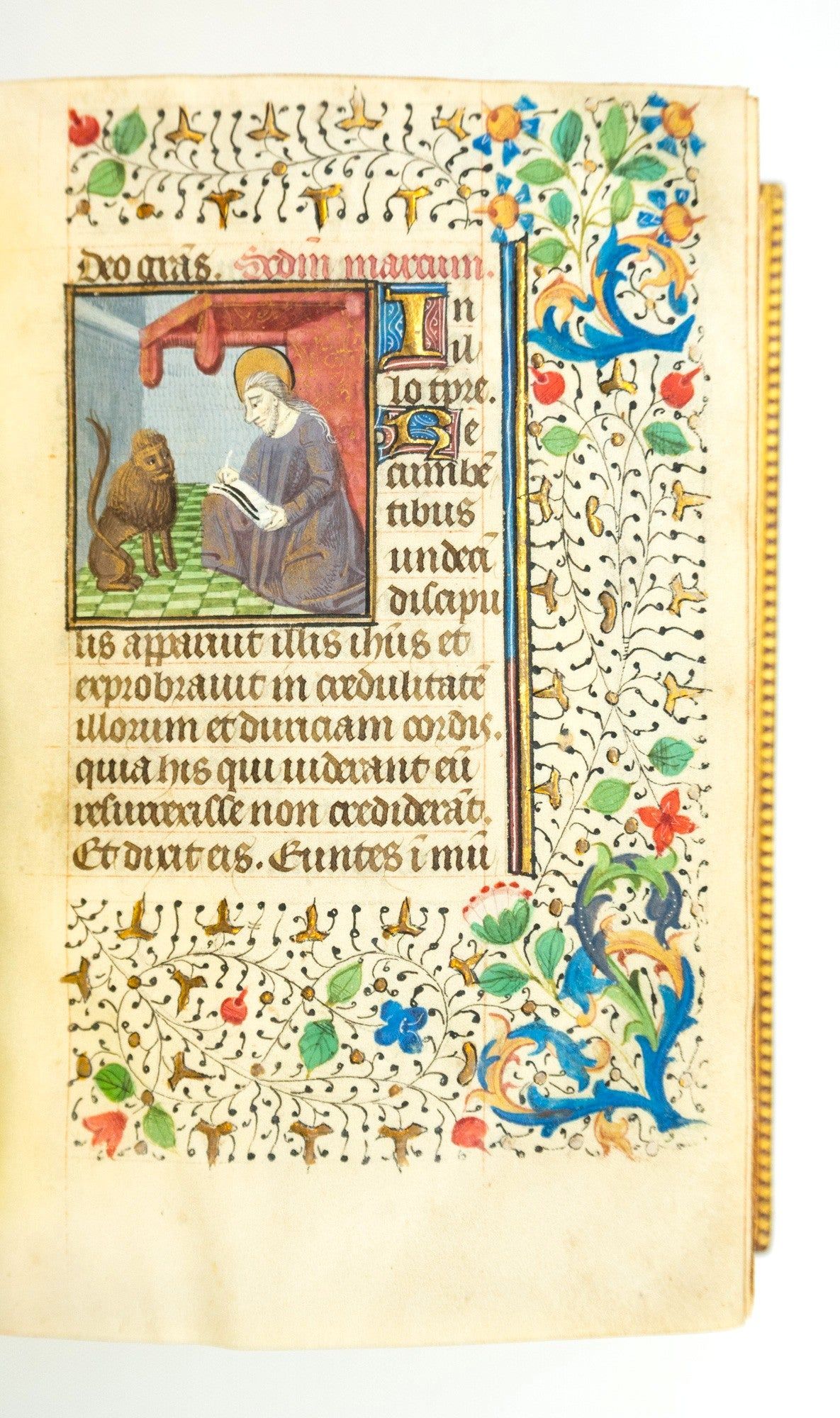
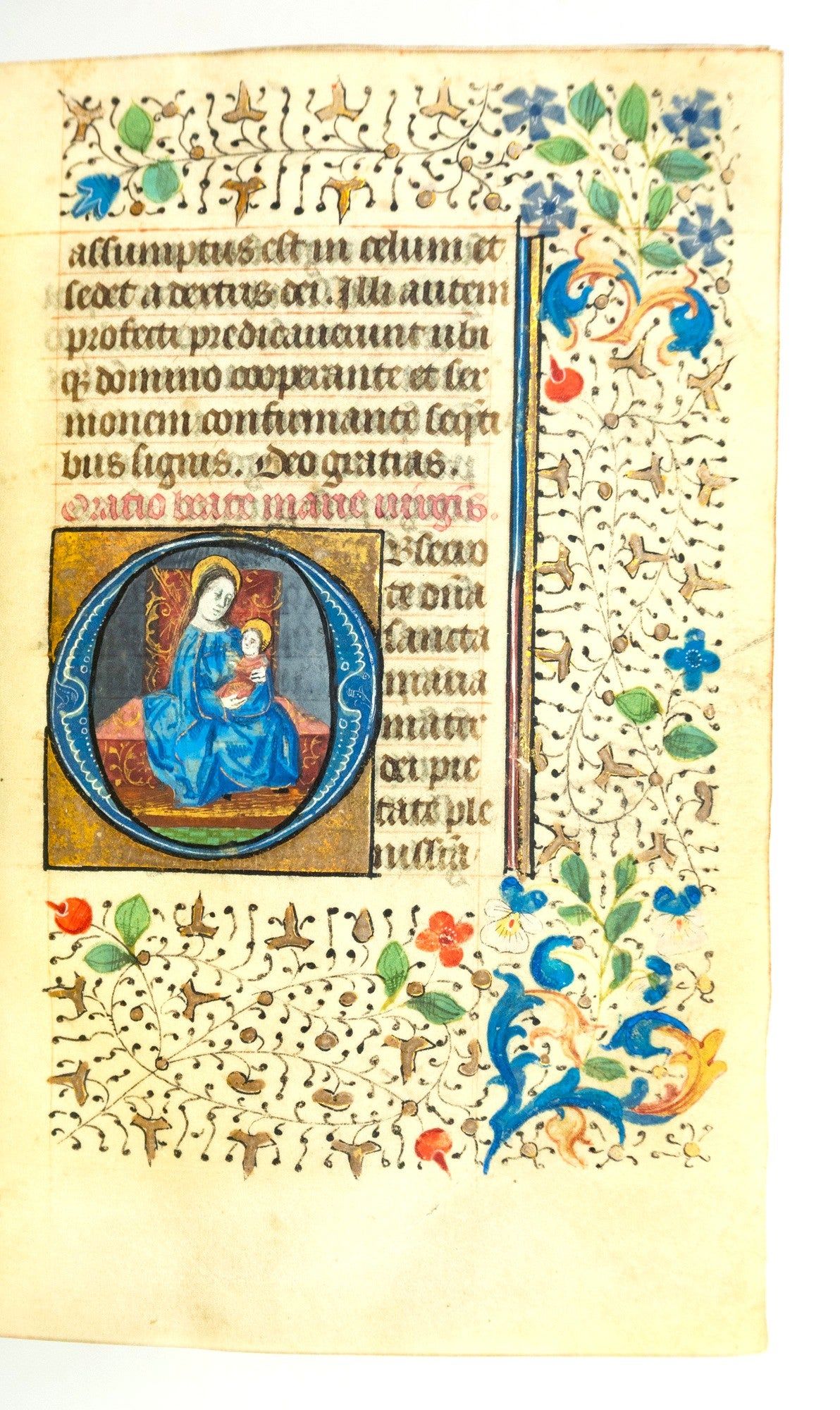
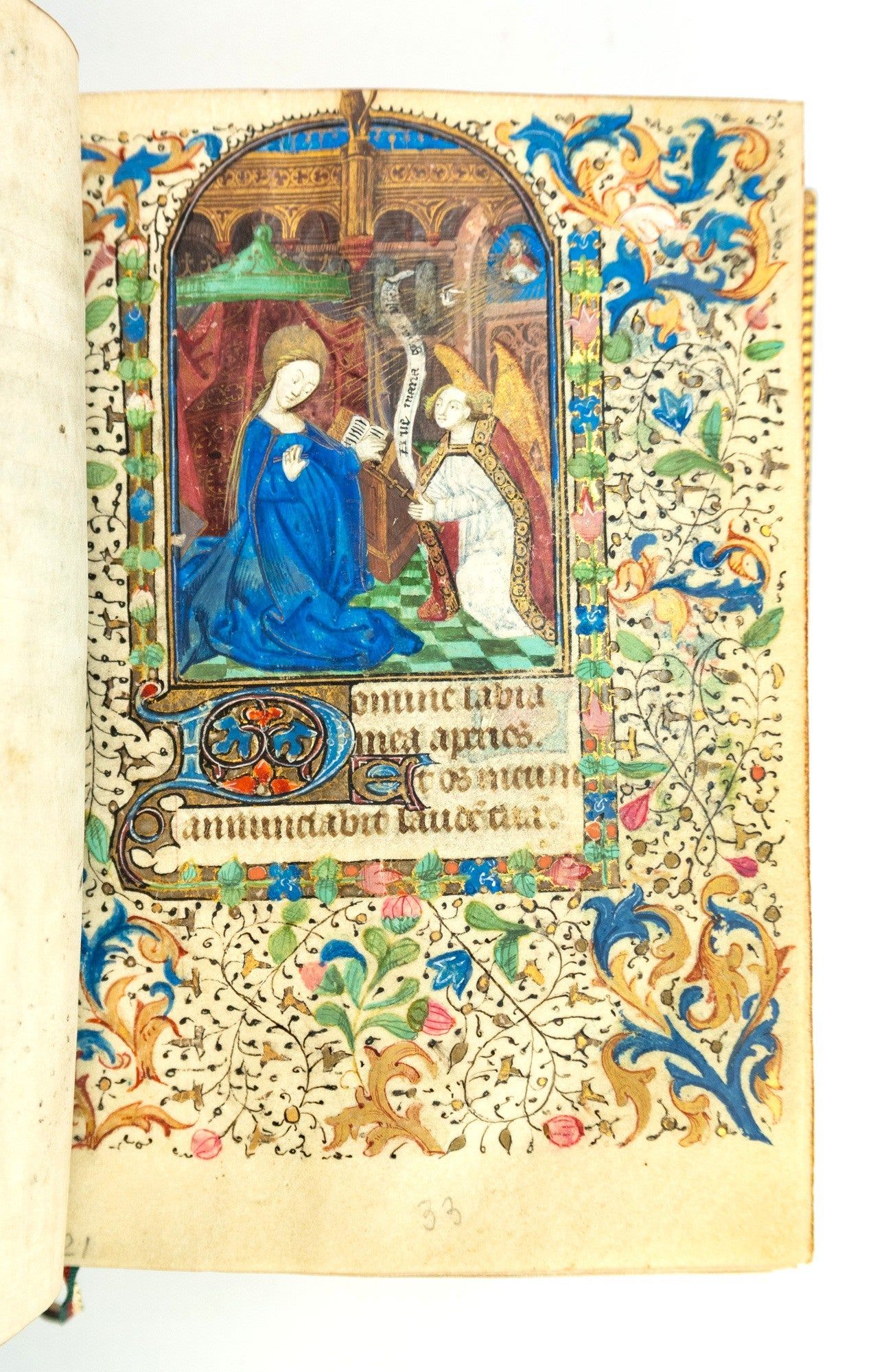
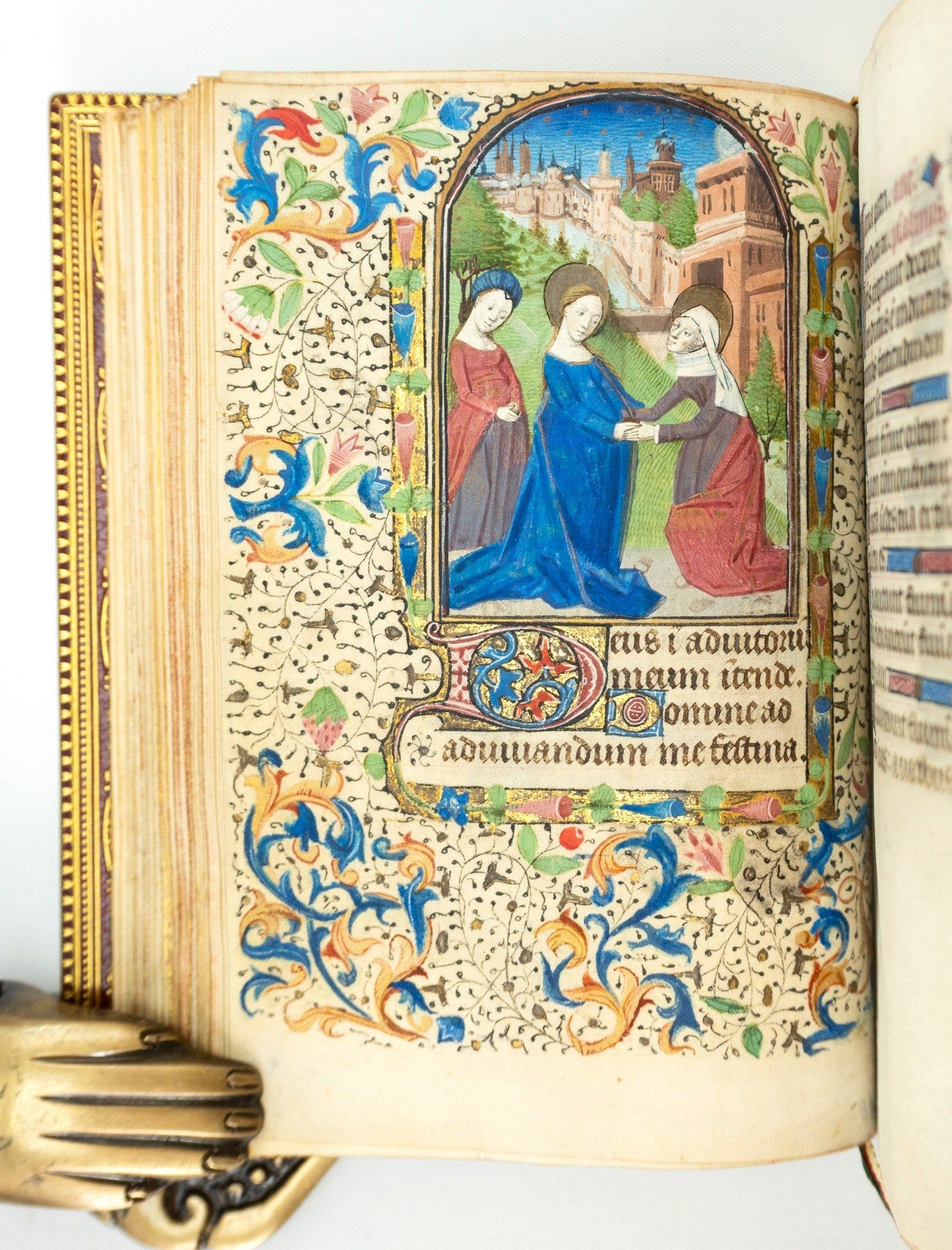
Northern France (probably Paris), third quarter of 15th century. 130 x 100 mm. (5 1/8 x 3 7/8"). Single column, 15 lines in an elegant gothic book hand. 280 leaves. First four leaves misbound, lacking at least seven leaves, five of which probably contained miniatures. Contents: Devotion to the Passion (f. 1r); blank (f. 4); Calendar (f. 5r); Gospel Lessons (f. 17r); "Obsecro te" and "O intemerata" (f. 23r); blank (f. 23); Hours of the Virgin (lacking opening leaves for Terce, Nones, and Vespers) (f. 33r); Penitential Psalms and Litany (f. 100r); Hours of the Cross (lacking preliminary leaf) (f. 120r); Hours of the Holy Spirit (p. 123r); Office of the Dead (lacking preliminary leaf) (f. 127r); "Sept Vers de Saint Bernard" and Suffrages (f. 176v); series of devotional prayers in Latin and French, including the Hours of the Conception, an indulgence, devotional poems in French, prayers for specific occasions (such as when facing tribulations, going to confession, protection against storms, and for friends abroad), the Stabat Mater, the Seven Joys of the Virgin, Gospel sequences, "Le chemin de paradis," and many others (f. 199r); blank (f. 280).
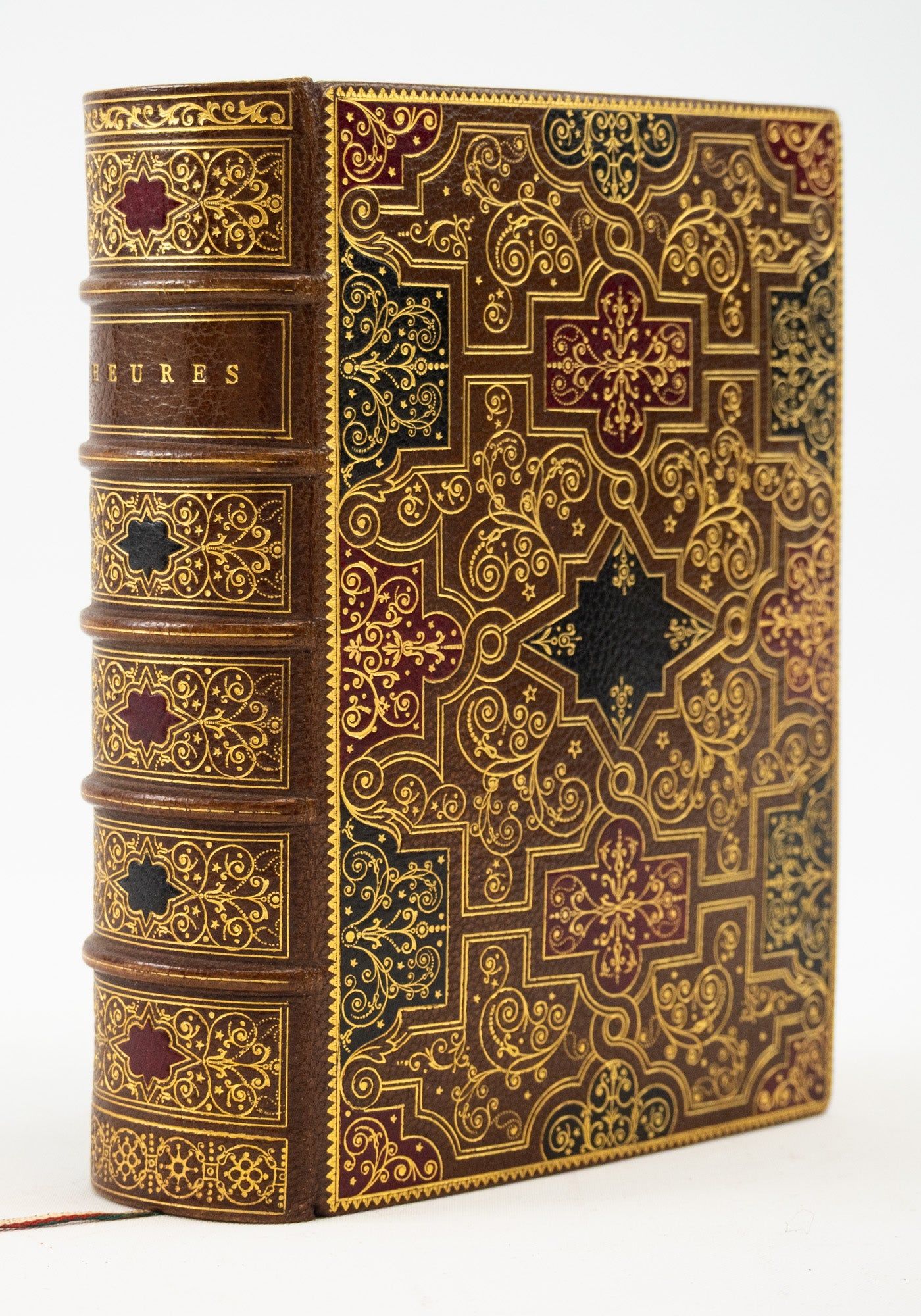
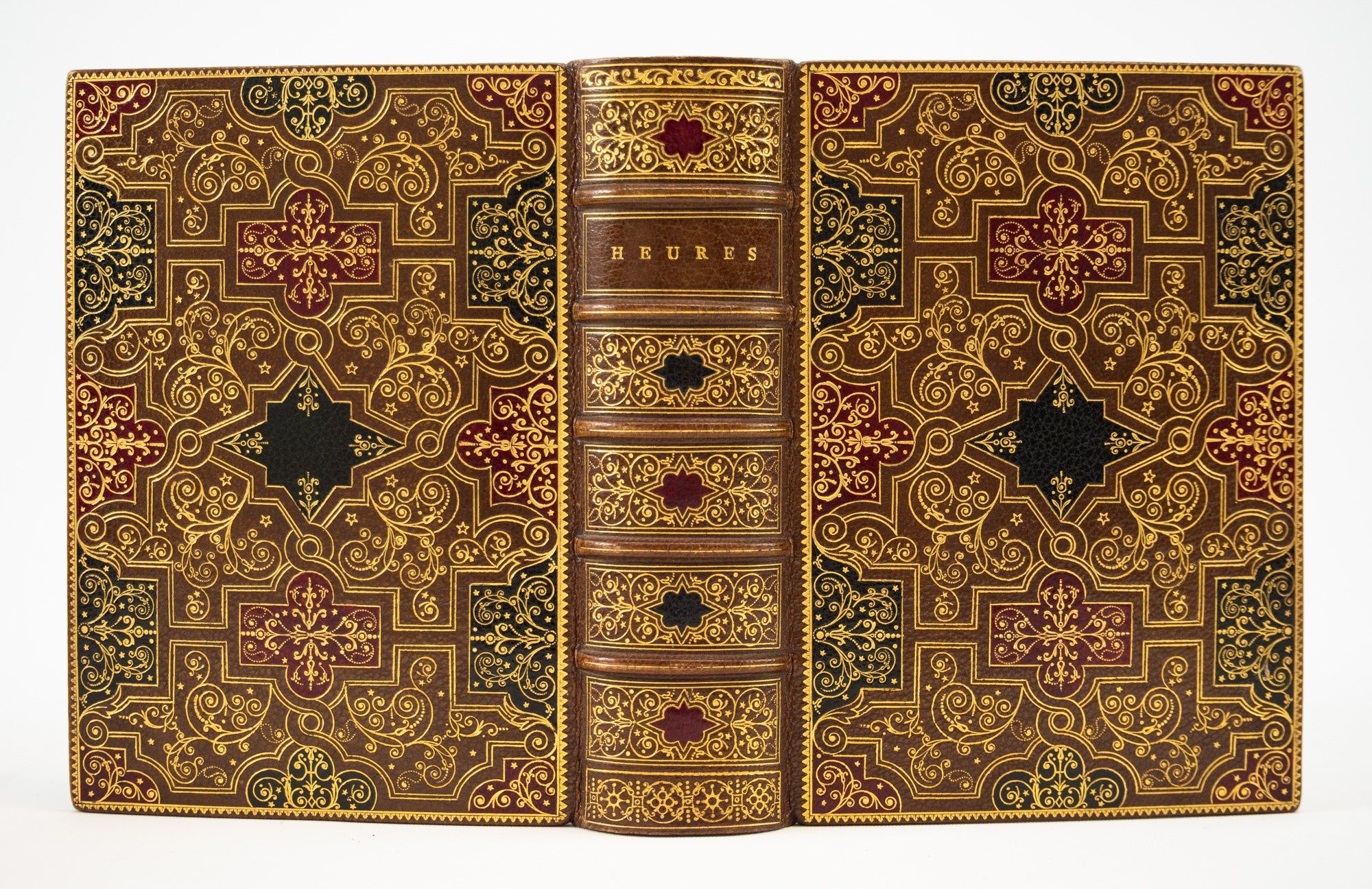
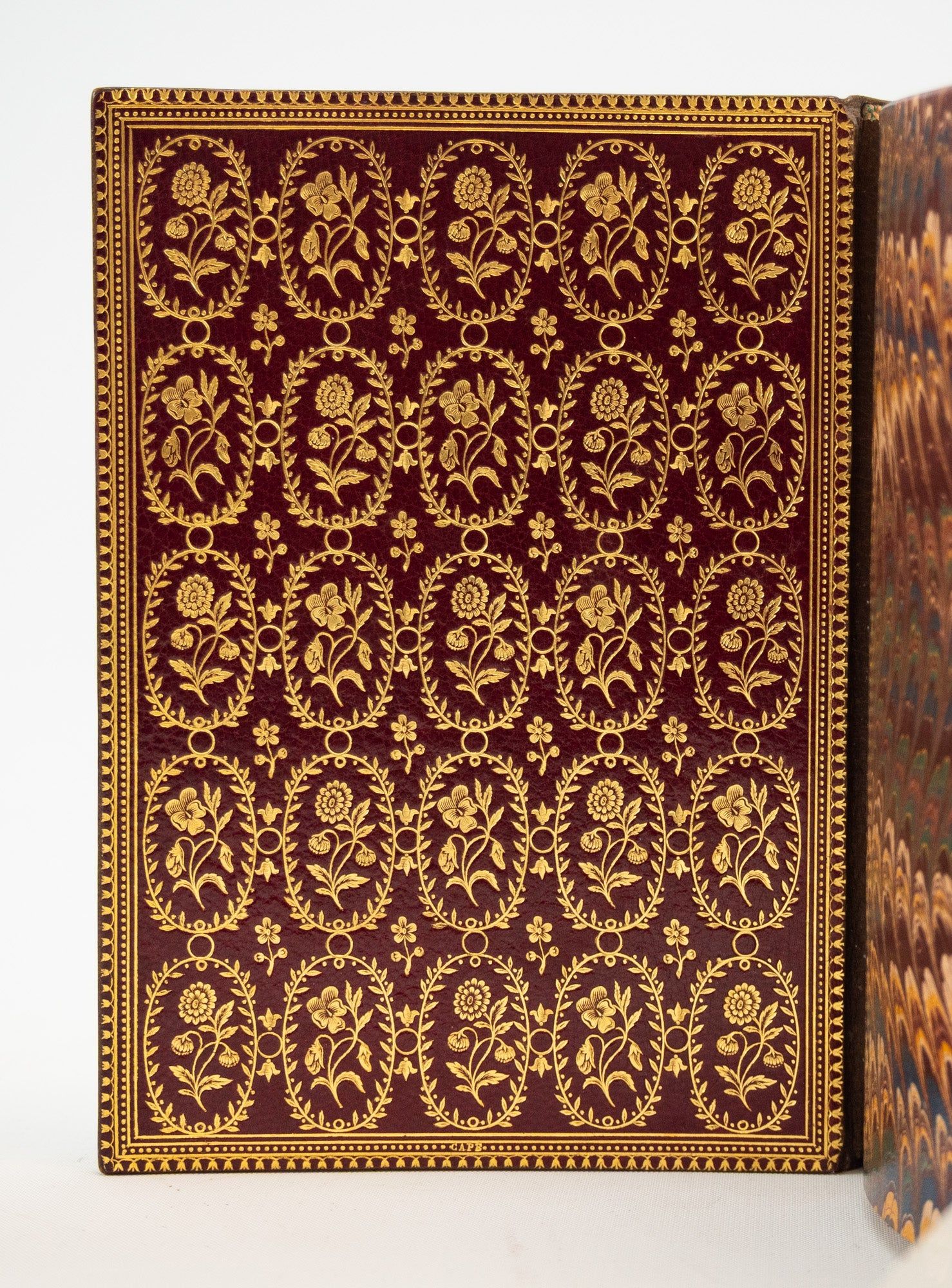
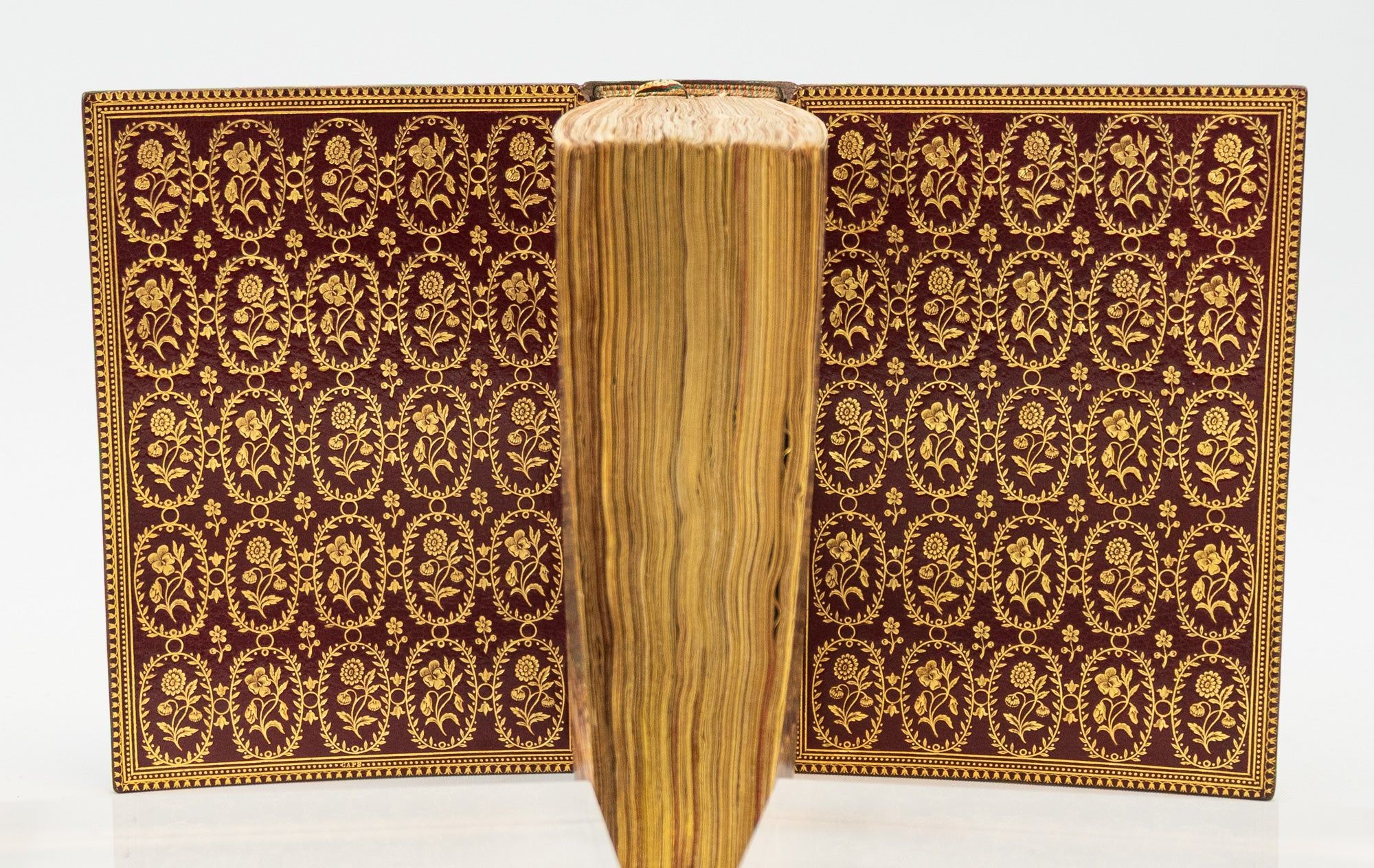
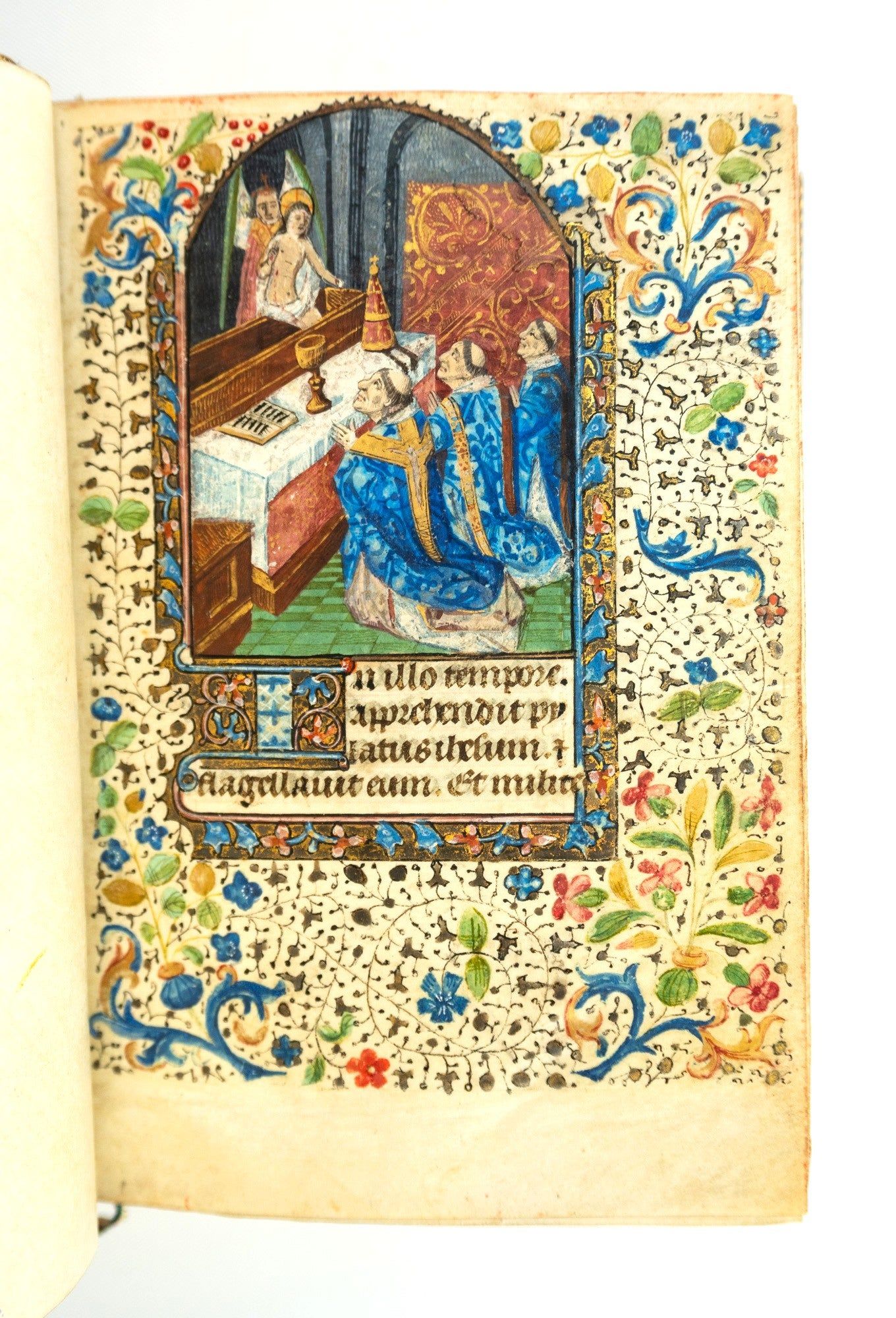
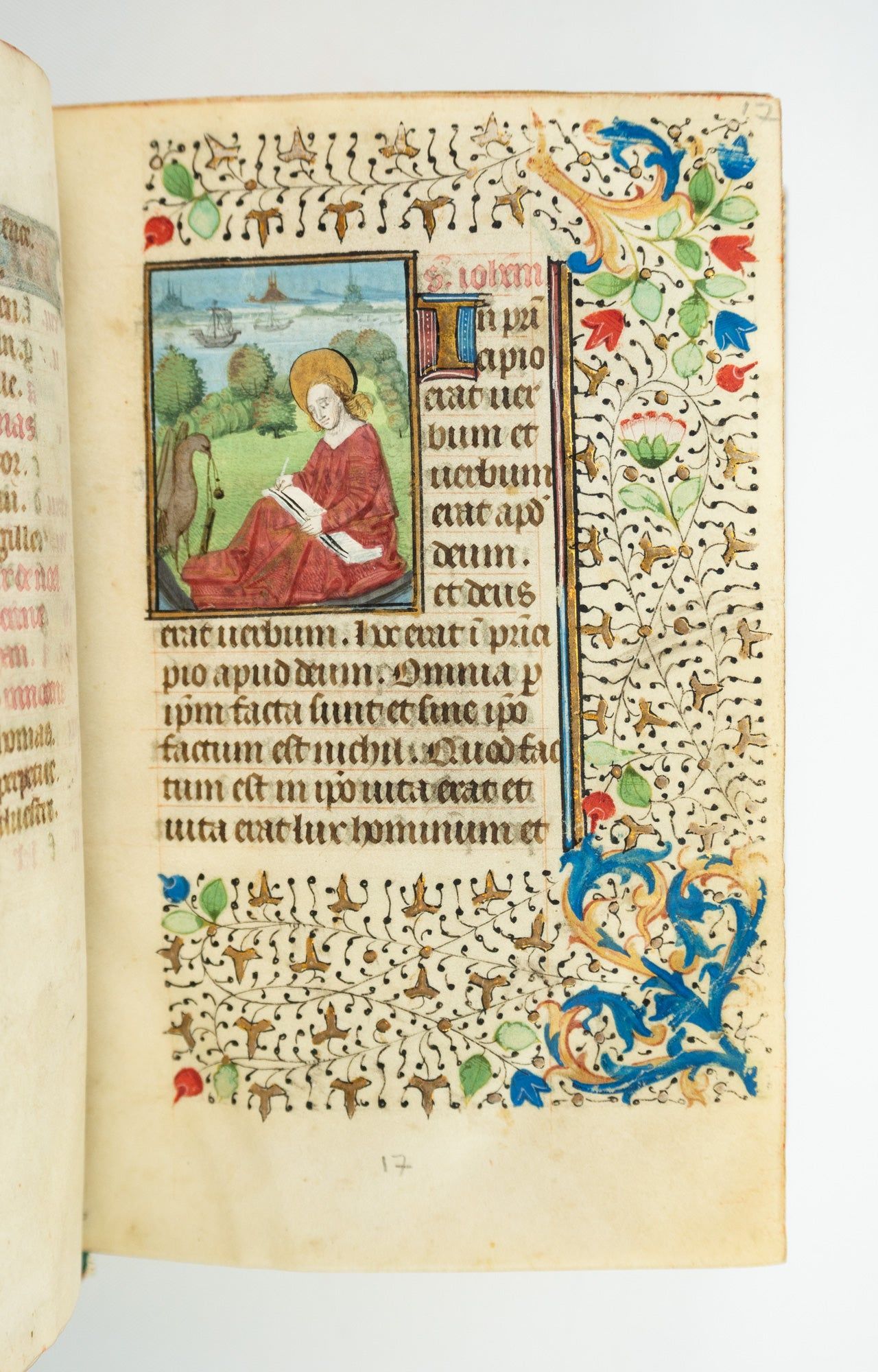
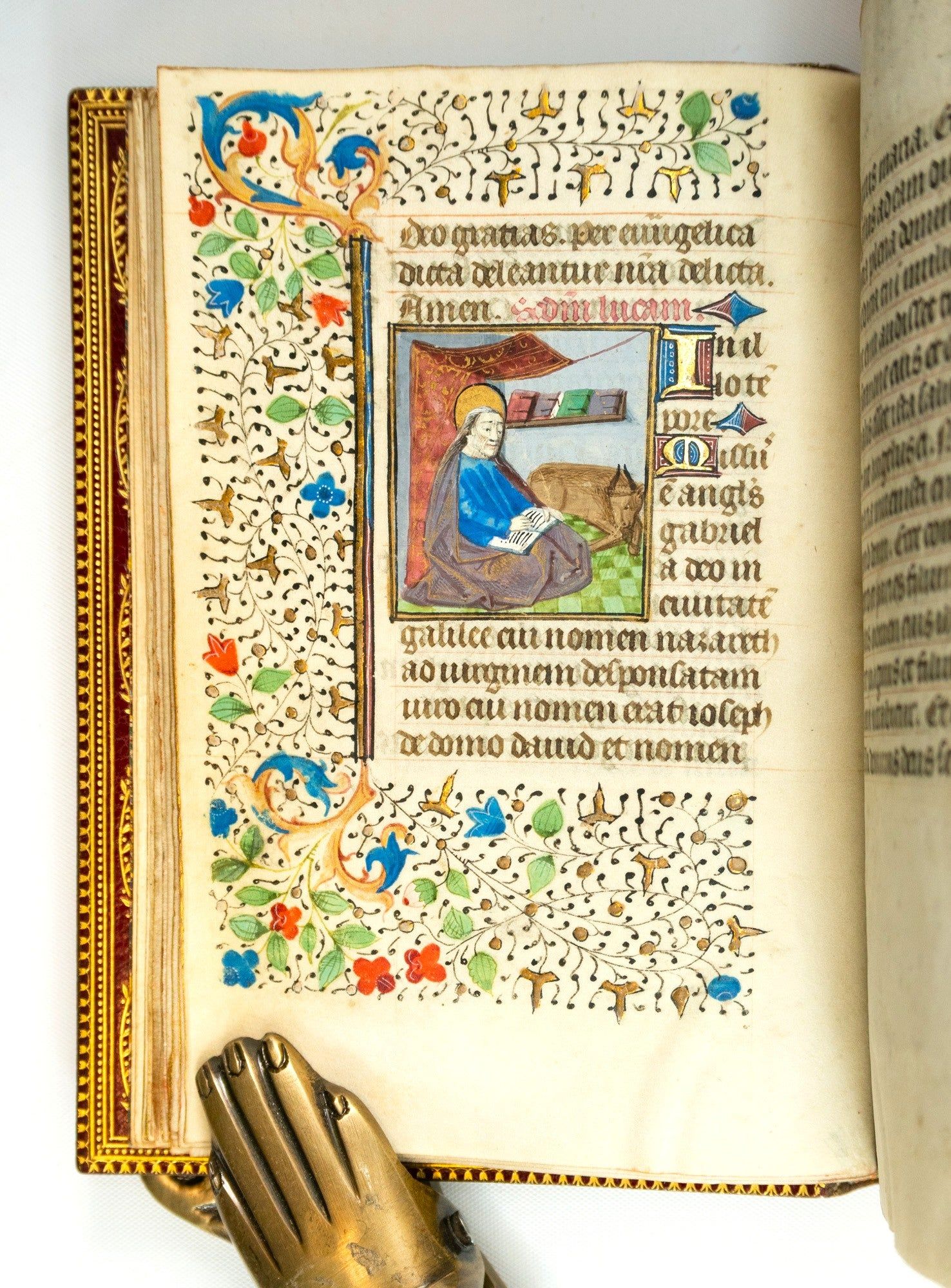
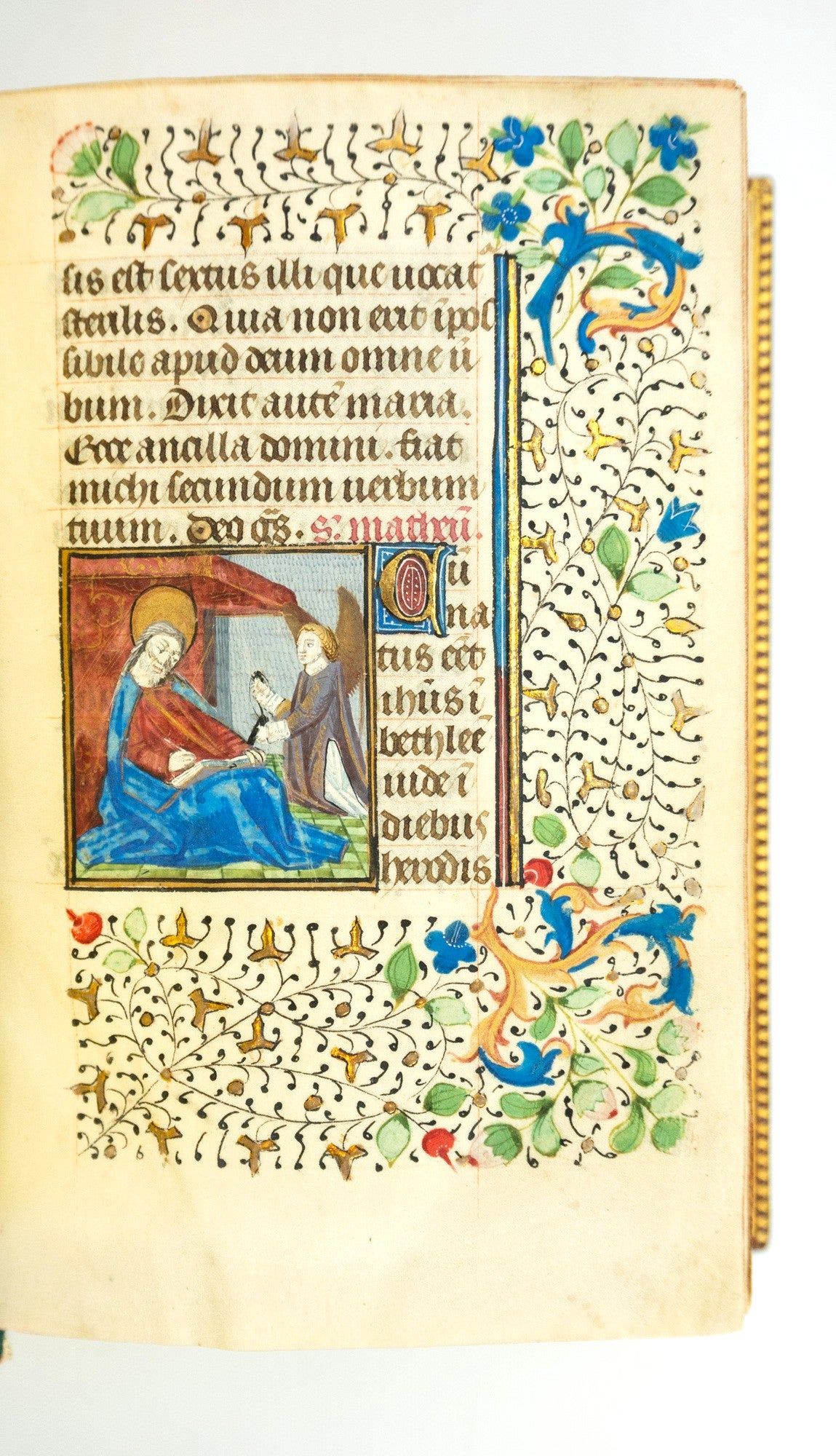
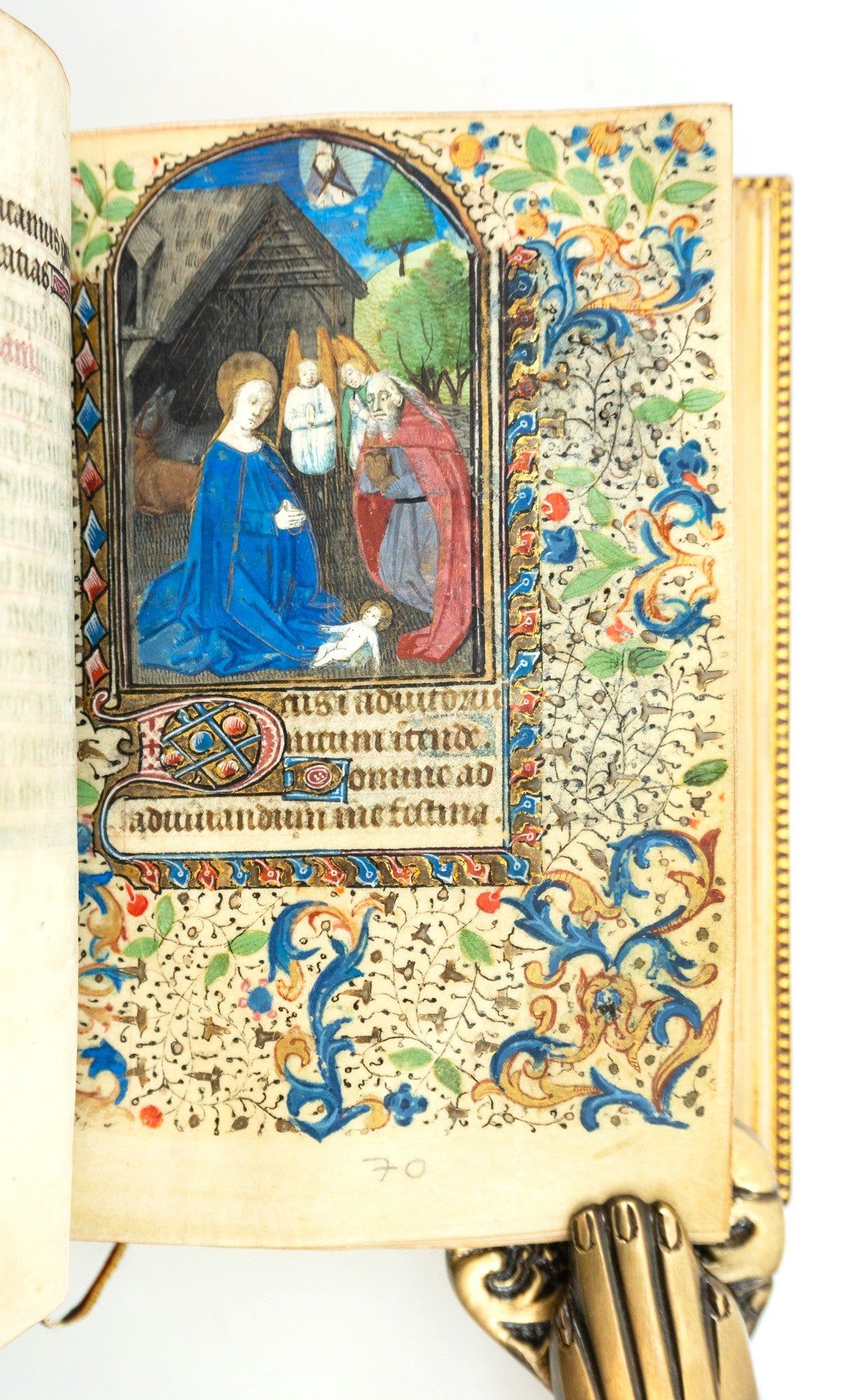
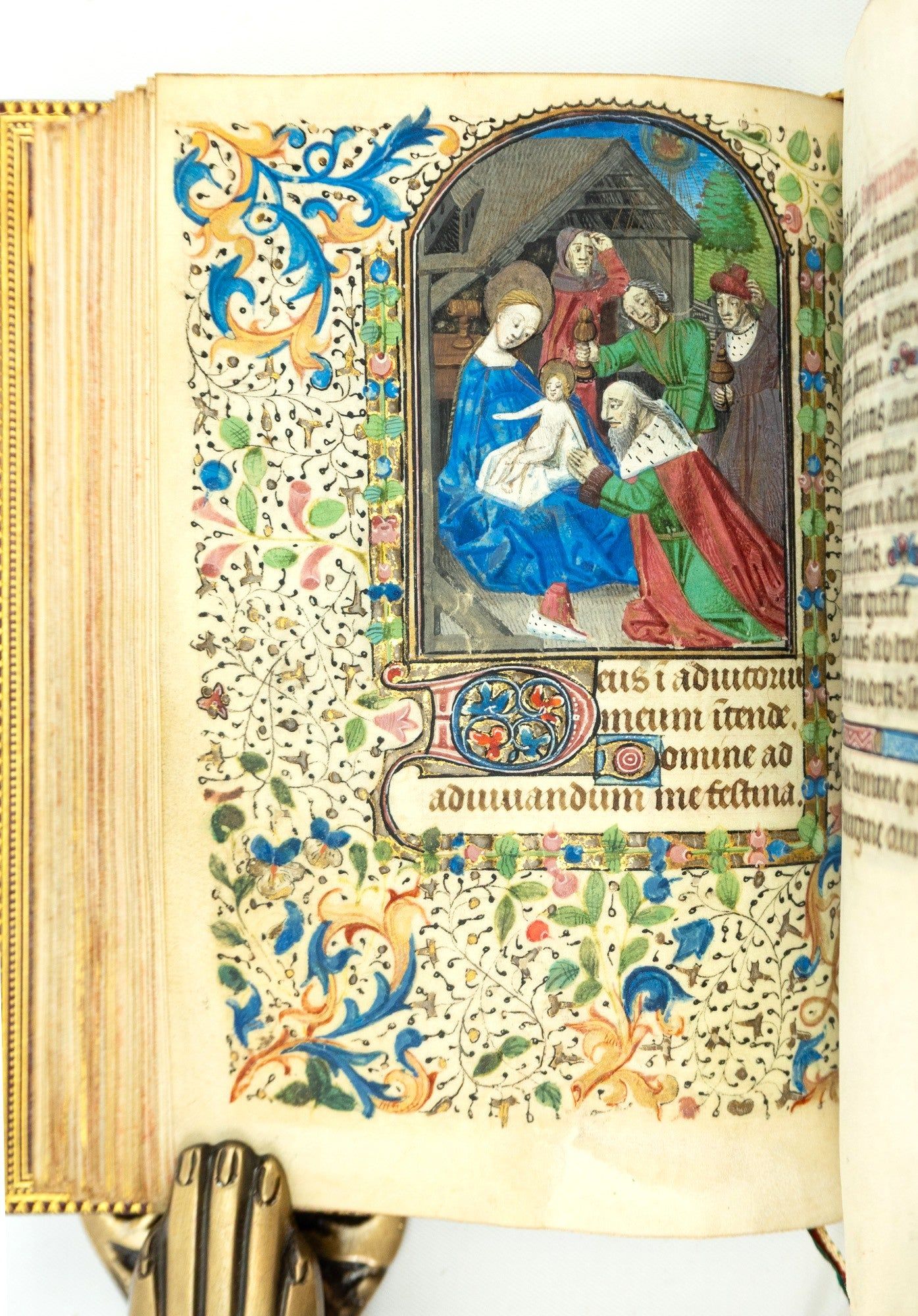
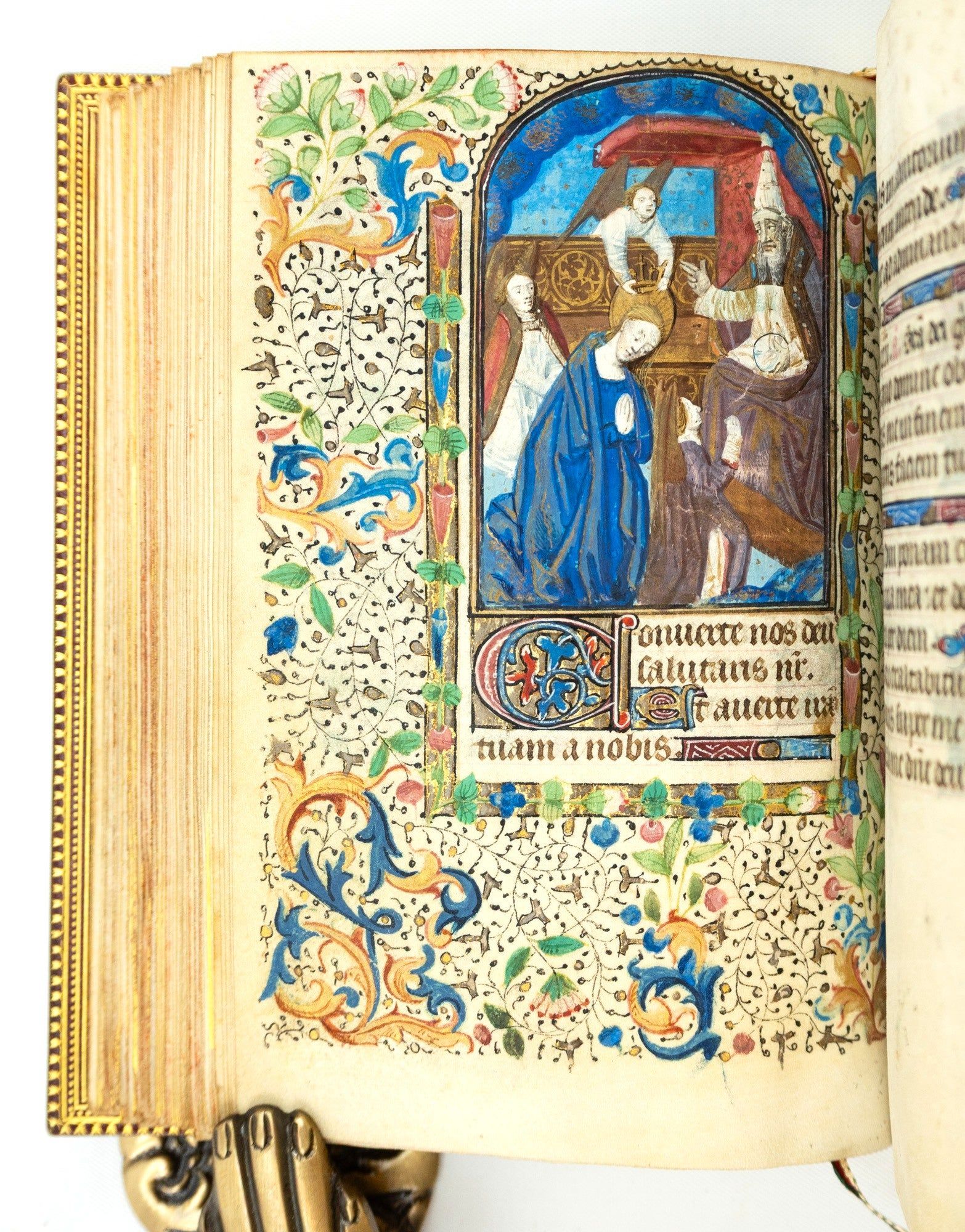
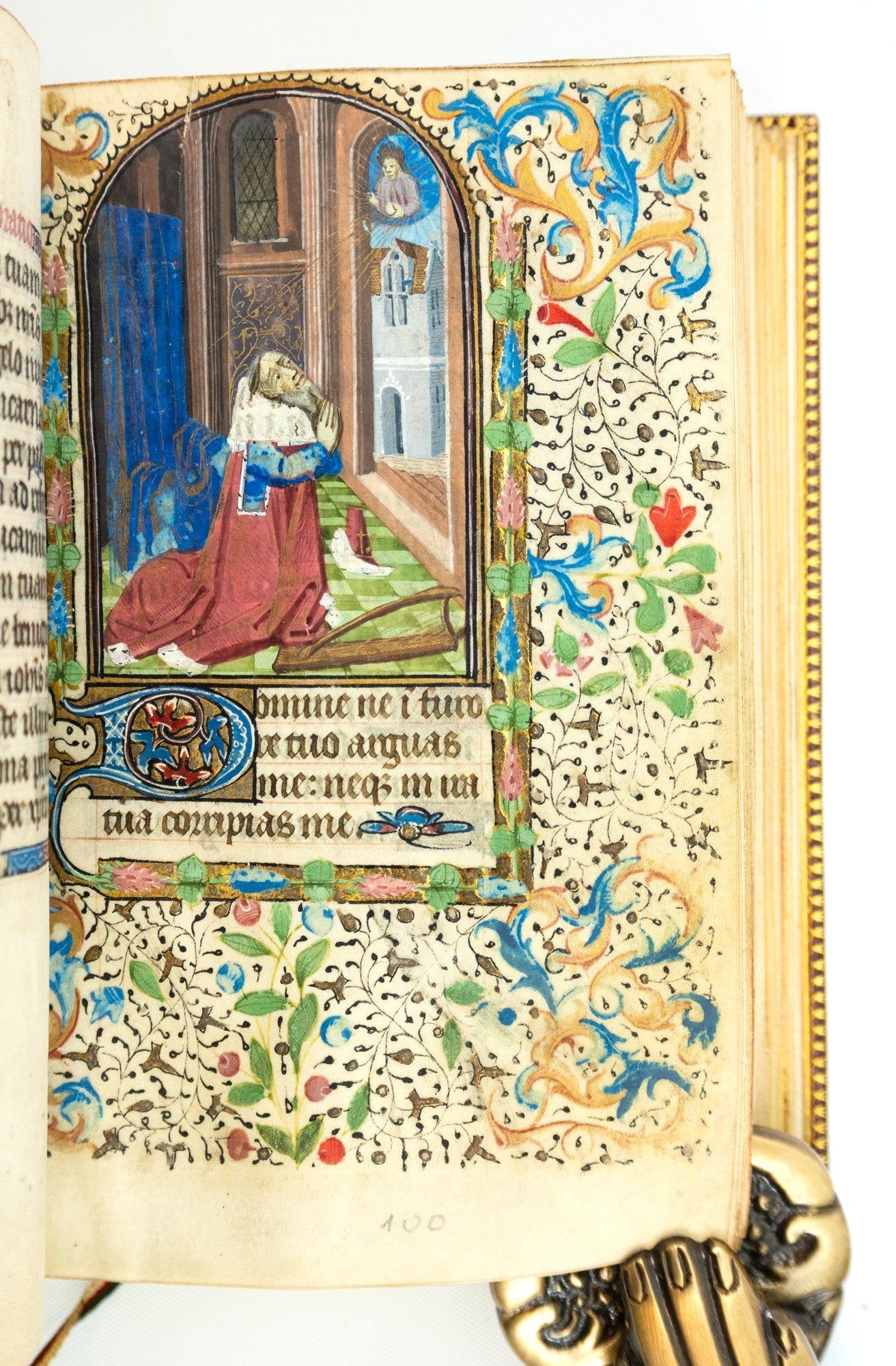
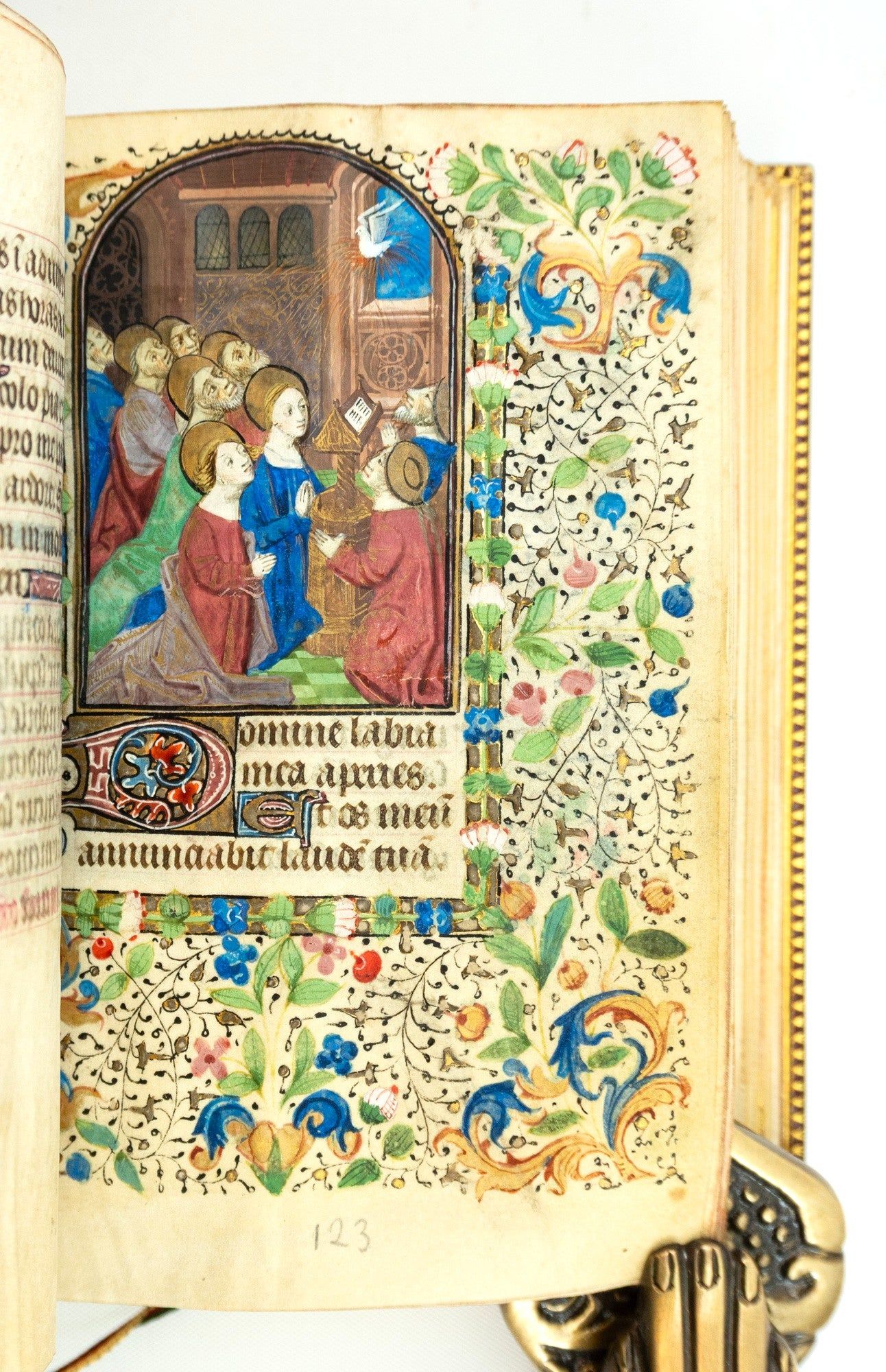
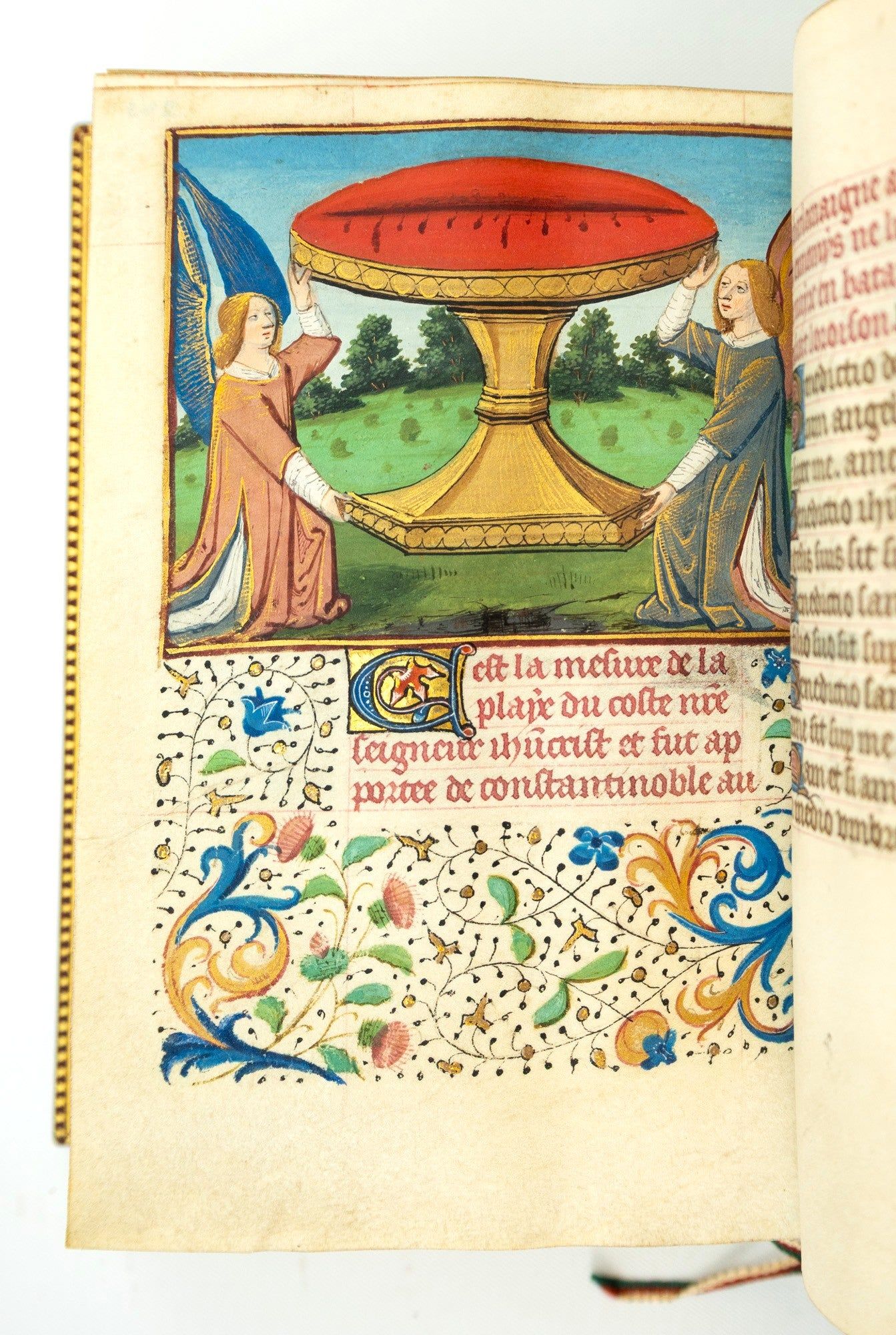
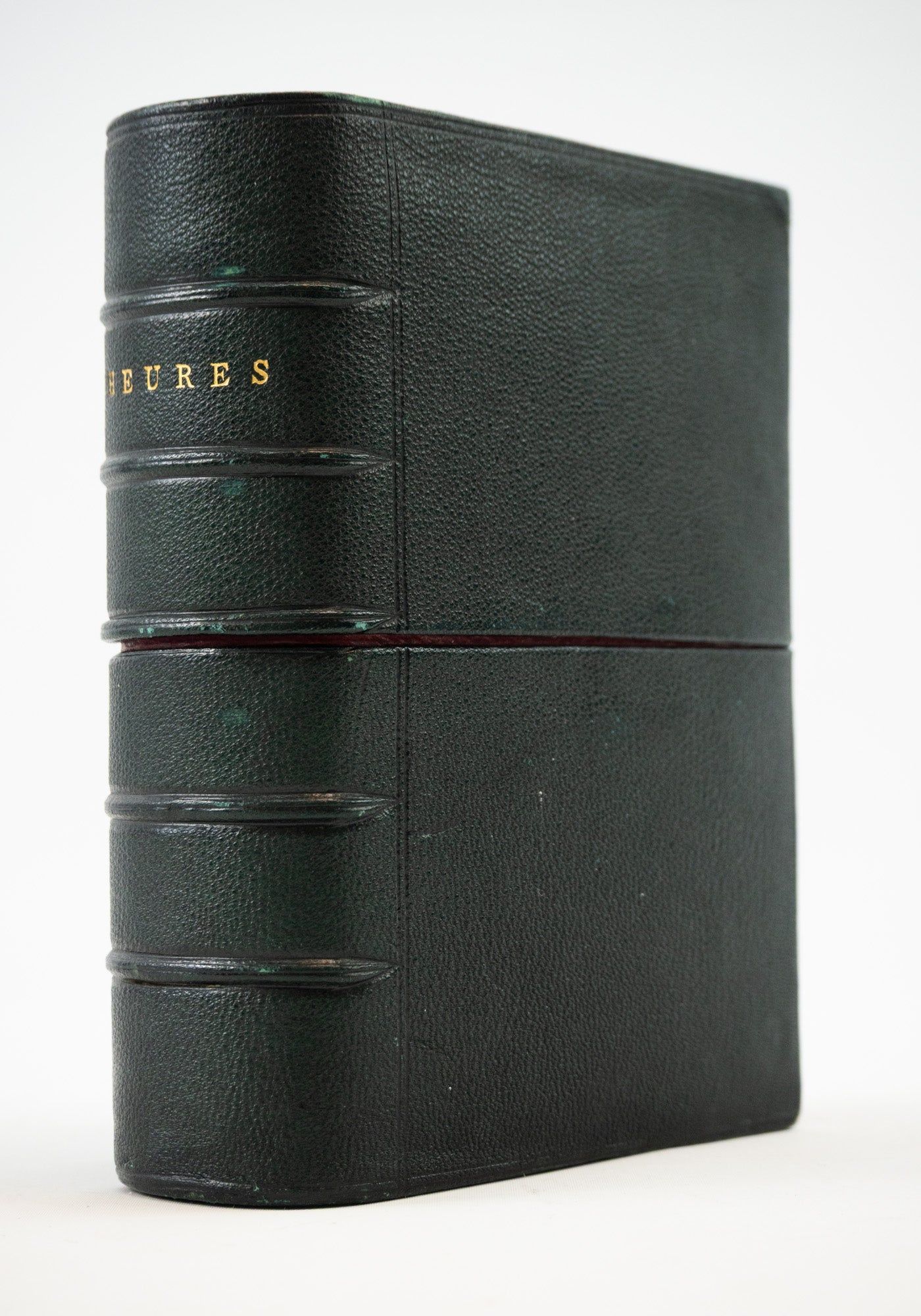
ESPECIALLY BEAUTIFUL MID-19TH CENTURY LIGHT BROWN MOROCCO, LAVISHLY GILT IN THE "FANFARE" STYLE, BY CAPÉ (stamp-signed in gilt on front turn-in), covers with large green and red morocco inlaid panels, gilt strapwork, scrolling, and small star tools, raised bands, spine compartments with red or green morocco inlay surrounded by gilt scrolling embellishments, gilt lettering, RED MOROCCO DOUBLURES gilt in the style of Duodo with repeating pattern of flowers encircled by vines, marbled endleaves, modern paper and vellum flyleaves, all edges gilt. Housed in a fine suede-lined pebble-grained leather pull-off case with gilt lettering on spine. Light red ruling and rubrics, numerous line-fillers in blue and pink with gilt embellishments, many one- and two-line initials in burnished gold on pink and blue ground, three four-line initials in pink or blue, filled with ivy leaves on a burnished gold ground, two of these with a gilt and painted baguette along the outer edge of text, and all with a three-quarter border of hairline vines, flowers, acanthus, and gold leaves, the majority of the leaves with a panel border of hairline vines and flowers on one side, one historiated initial painted blue on a burnished gold ground depicting the Virgin accompanied by a gilt and painted baguette and three-quarter border, FOUR SMALL MINIATURES DEPICTING THE APOSTLES, each with a gilt and painted baguette and surrounded by a three-quarter border, and EIGHT LARGE ARCH-TOPPED MINIATURES above a three-line initial painted blue or pink on gold ground, a gilt "L" shaped bar border incorporating colorful flowers, and a full border of border of hairline vines, flowers, acanthus, and gold leaves, and A HALF-PAGE RECTANGULAR MINIATURE with a border along the lower half. The subjects of the large miniatures include: the Mass of St. Gregory (f. 1r); Annunciation (f. 33r); Visitation (f. 57r); Nativity (f. 70r); Adoration of the Magi (f. 80v); Crowning of the Virgin (f. 94v); David in Prayer (f. 100r); Pentecost (f. 123r); and a rectangular miniature of the Holy Wound (or perhaps the Bleeding Host of Dijon) (f. 241v). Isolated light rubbing and negligible chips to miniatures, the dark blue paint appearing slightly worn in places (as is often the case), occasional faint smudges to borders and other imperfections, but all of these trivial. IN THOROUGHLY FINE CONDITION INTERNALLY--the paint fresh, the vellum clean, and the margins quite comfortable--AND THE EXTRAORDINARILY FINE BINDING FLAWLESS.
In a spectacular 19th century binding, this lovely, thick little Book of Hours was executed by a talented follower of Maître François and the Master of Jean Rolin, and contains a large number of prayers and devotional texts, many of them in French. The manuscript includes a fine array of large and small miniatures executed with a colorful palette and careful attention to detail. Particularly noteworthy is the excellent molding of faces. Each figure--no matter their station or importance to the scene--displays unique characteristics that give us a sense of their age, sentiments, and demeanor. This is an impressive feat, given the small scale of the compositions, and this individualization adds a great deal of value to the miniatures, as well as the viewer's emotional experience connecting to the images. Our artist owes much to the work of the so-called Maître François and (slightly before him) the Master of Jean Rolin, the latter an eponym attached to the illuminator of missals done for Rolin, cardinal-bishop of Autun (d. 1483). Perhaps of Burgundian origin, the Master of Jean Rolin completed his artistic education in Paris, probably in the workshop of the Bedford Master, and afterward established his own atelier in Burgundy. There, he played a key role in the transition from the Bedford Master's slightly more gothic style to the more thoroughly Renaissance style of Maître François, who ran the most successful Parisian workshop during the years between 1460 and 1480, producing illuminated manuscripts small and large, sacred and secular. Characteristic of Maître François's style are richly colored scenes, interiors depicted with considerable detail, women and children with pale, porcelain complexions, and male figures with darker, weathered flesh tones--all of which can be seen in the present work. The final miniature present in this work, however, seems to have been executed by a different artist altogether, being rather more flat in appearance, and without the detailed facial molding noted earlier. About two-thirds of the manuscript follows fairly regular arrangement of texts (with the exception of the Mass of St. Gregory, which is misbound at the beginning of the volume). Then, following the Suffrages, are approximately 80 leaves of devotional texts in Latin and French, including popular verses such as the "Seven Joys of the Virgin" and the "Stabat Mater," as well as more unusual texts such as the Hours of the Conception, prayers for specific occasions or protections--for example, against storms ("Contre tempeste") and when one passes over water ("Quant on passe par eaue")--indulgences, and other related texts. Two of the more interesting passages are "Le chemin de paradis," a French prayer beginning "Qui en paradis veult aller," and a series of Latin poems that claim to be copied from originals found at the church of St. Paul in Rome. These copious additional prayers suggest a high degree of customization for a client who may have been particularly religious (or at least very concerned with self-preservation!), and they present intriguing possibilities for further study. The manuscript was rebound sometime in the middle years of the 19th century by Capé (d. 1867), one of the most distinguished binders in France in his day. He was especially well known for the delicacy of his work, which can be observed to great effect in the present example. He was the binder to the Empress Eugenie, and Béraldi calls him "the Bozérian of the second Empire." His work has always been highly sought after, and it resides in all of the great collections where bindings are considered important. This volume seems to have been sold to bookseller Francis Edwards as lot no. 95 at Sotheby's sale on 3 April 1957, and has been in private hands ever since. The manuscript is a little jewel inside and out, and has obviously been a treasured vessel of prayer and art for generations of owners..
ESPECIALLY BEAUTIFUL MID-19TH CENTURY LIGHT BROWN MOROCCO, LAVISHLY GILT IN THE "FANFARE" STYLE, BY CAPÉ (stamp-signed in gilt on front turn-in), covers with large green and red morocco inlaid panels, gilt strapwork, scrolling, and small star tools, raised bands, spine compartments with red or green morocco inlay surrounded by gilt scrolling embellishments, gilt lettering, RED MOROCCO DOUBLURES gilt in the style of Duodo with repeating pattern of flowers encircled by vines, marbled endleaves, modern paper and vellum flyleaves, all edges gilt. Housed in a fine suede-lined pebble-grained leather pull-off case with gilt lettering on spine. Light red ruling and rubrics, numerous line-fillers in blue and pink with gilt embellishments, many one- and two-line initials in burnished gold on pink and blue ground, three four-line initials in pink or blue, filled with ivy leaves on a burnished gold ground, two of these with a gilt and painted baguette along the outer edge of text, and all with a three-quarter border of hairline vines, flowers, acanthus, and gold leaves, the majority of the leaves with a panel border of hairline vines and flowers on one side, one historiated initial painted blue on a burnished gold ground depicting the Virgin accompanied by a gilt and painted baguette and three-quarter border, FOUR SMALL MINIATURES DEPICTING THE APOSTLES, each with a gilt and painted baguette and surrounded by a three-quarter border, and EIGHT LARGE ARCH-TOPPED MINIATURES above a three-line initial painted blue or pink on gold ground, a gilt "L" shaped bar border incorporating colorful flowers, and a full border of border of hairline vines, flowers, acanthus, and gold leaves, and A HALF-PAGE RECTANGULAR MINIATURE with a border along the lower half. The subjects of the large miniatures include: the Mass of St. Gregory (f. 1r); Annunciation (f. 33r); Visitation (f. 57r); Nativity (f. 70r); Adoration of the Magi (f. 80v); Crowning of the Virgin (f. 94v); David in Prayer (f. 100r); Pentecost (f. 123r); and a rectangular miniature of the Holy Wound (or perhaps the Bleeding Host of Dijon) (f. 241v). Isolated light rubbing and negligible chips to miniatures, the dark blue paint appearing slightly worn in places (as is often the case), occasional faint smudges to borders and other imperfections, but all of these trivial. IN THOROUGHLY FINE CONDITION INTERNALLY--the paint fresh, the vellum clean, and the margins quite comfortable--AND THE EXTRAORDINARILY FINE BINDING FLAWLESS.
In a spectacular 19th century binding, this lovely, thick little Book of Hours was executed by a talented follower of Maître François and the Master of Jean Rolin, and contains a large number of prayers and devotional texts, many of them in French. The manuscript includes a fine array of large and small miniatures executed with a colorful palette and careful attention to detail. Particularly noteworthy is the excellent molding of faces. Each figure--no matter their station or importance to the scene--displays unique characteristics that give us a sense of their age, sentiments, and demeanor. This is an impressive feat, given the small scale of the compositions, and this individualization adds a great deal of value to the miniatures, as well as the viewer's emotional experience connecting to the images. Our artist owes much to the work of the so-called Maître François and (slightly before him) the Master of Jean Rolin, the latter an eponym attached to the illuminator of missals done for Rolin, cardinal-bishop of Autun (d. 1483). Perhaps of Burgundian origin, the Master of Jean Rolin completed his artistic education in Paris, probably in the workshop of the Bedford Master, and afterward established his own atelier in Burgundy. There, he played a key role in the transition from the Bedford Master's slightly more gothic style to the more thoroughly Renaissance style of Maître François, who ran the most successful Parisian workshop during the years between 1460 and 1480, producing illuminated manuscripts small and large, sacred and secular. Characteristic of Maître François's style are richly colored scenes, interiors depicted with considerable detail, women and children with pale, porcelain complexions, and male figures with darker, weathered flesh tones--all of which can be seen in the present work. The final miniature present in this work, however, seems to have been executed by a different artist altogether, being rather more flat in appearance, and without the detailed facial molding noted earlier. About two-thirds of the manuscript follows fairly regular arrangement of texts (with the exception of the Mass of St. Gregory, which is misbound at the beginning of the volume). Then, following the Suffrages, are approximately 80 leaves of devotional texts in Latin and French, including popular verses such as the "Seven Joys of the Virgin" and the "Stabat Mater," as well as more unusual texts such as the Hours of the Conception, prayers for specific occasions or protections--for example, against storms ("Contre tempeste") and when one passes over water ("Quant on passe par eaue")--indulgences, and other related texts. Two of the more interesting passages are "Le chemin de paradis," a French prayer beginning "Qui en paradis veult aller," and a series of Latin poems that claim to be copied from originals found at the church of St. Paul in Rome. These copious additional prayers suggest a high degree of customization for a client who may have been particularly religious (or at least very concerned with self-preservation!), and they present intriguing possibilities for further study. The manuscript was rebound sometime in the middle years of the 19th century by Capé (d. 1867), one of the most distinguished binders in France in his day. He was especially well known for the delicacy of his work, which can be observed to great effect in the present example. He was the binder to the Empress Eugenie, and Béraldi calls him "the Bozérian of the second Empire." His work has always been highly sought after, and it resides in all of the great collections where bindings are considered important. This volume seems to have been sold to bookseller Francis Edwards as lot no. 95 at Sotheby's sale on 3 April 1957, and has been in private hands ever since. The manuscript is a little jewel inside and out, and has obviously been a treasured vessel of prayer and art for generations of owners..
Details
Title
USE OF PARIS
Author
A MEDIEVAL ILLUMINATED VELLUM MANUSCRIPT BOOK OF HOURS IN LATIN AND FRENCH, WITH A TOTAL OF 13 LARGE AND SMALL MINIATURES
Condition
Unknown
Publisher
Northern France (probably Paris)
Date
third quarter of 15th century