

A VIEW OF THE ELEMENTARY PRINCIPLES OF EDUCATION, FOUNDED ON THE STUDY OF THE NATURE OF MAN
- Edinburgh: Printed for Arch[ibal]d Constable & Co.; London: Hurst, Robinson & Co, 1821
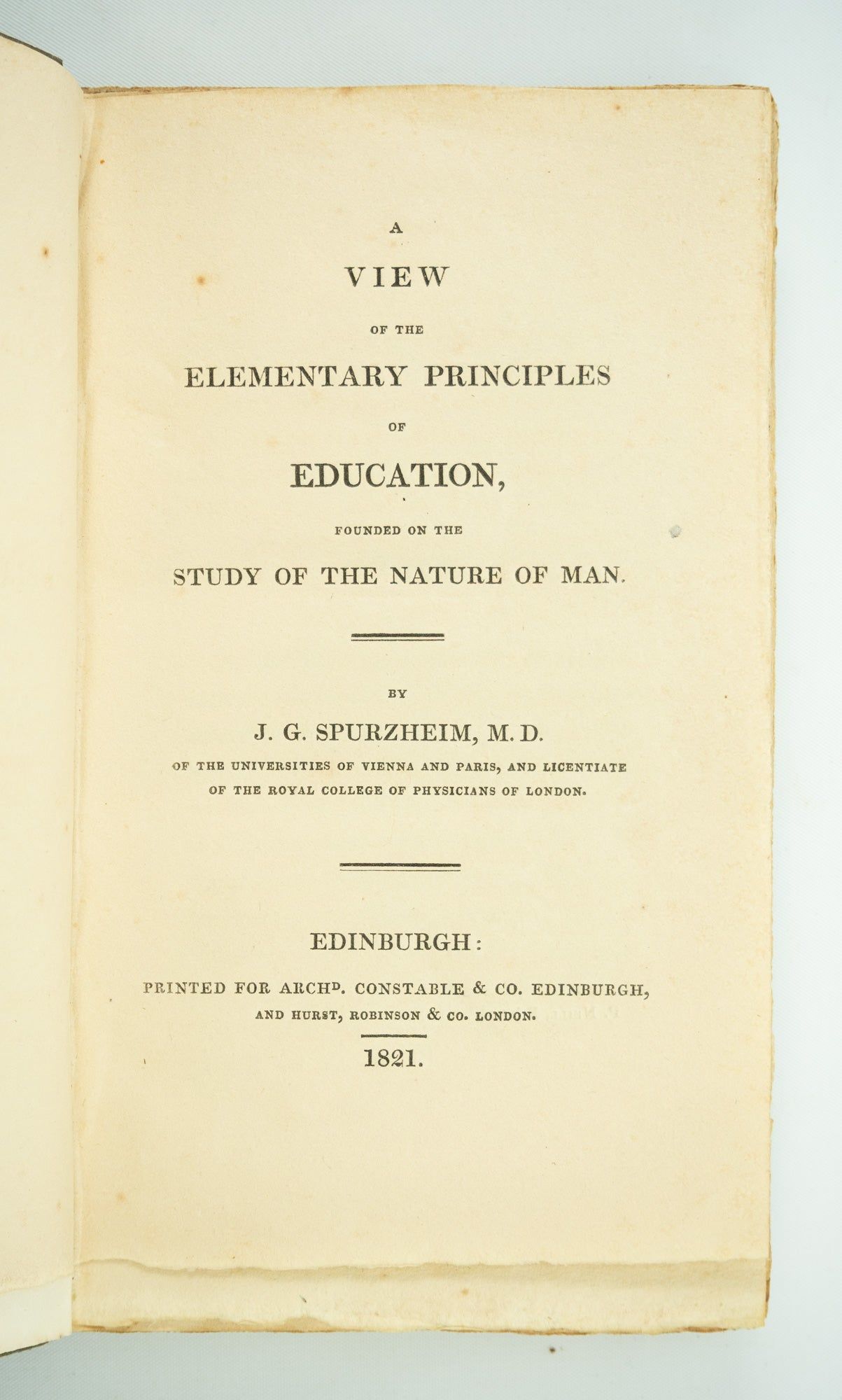
Edinburgh: Printed for Arch[ibal]d Constable & Co.; London: Hurst, Robinson & Co, 1821. FIRST EDITION. 192 x 103 mm. (7 1/2 x 4 1/2"). xv, [1], lvii, [1], 59-360 pp.
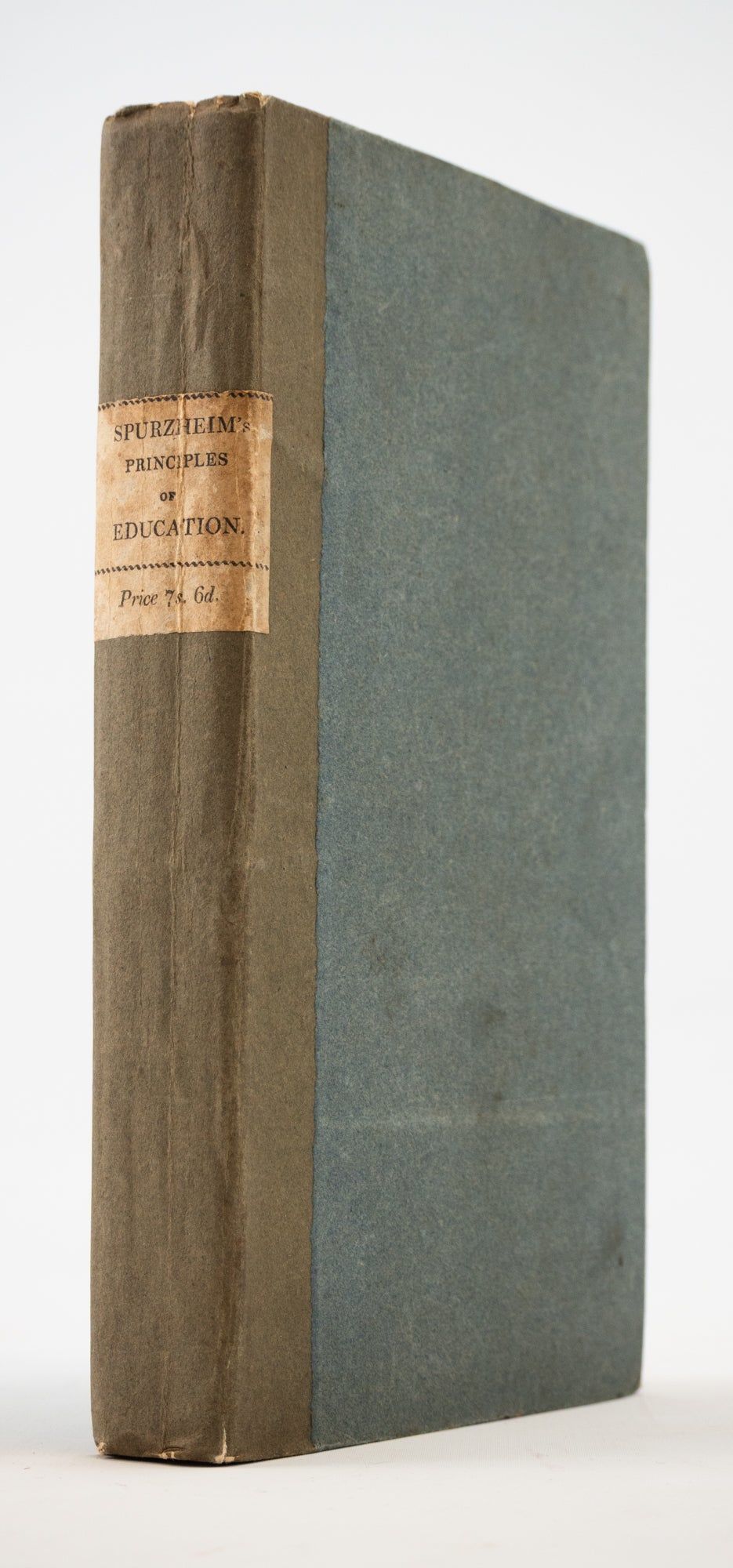
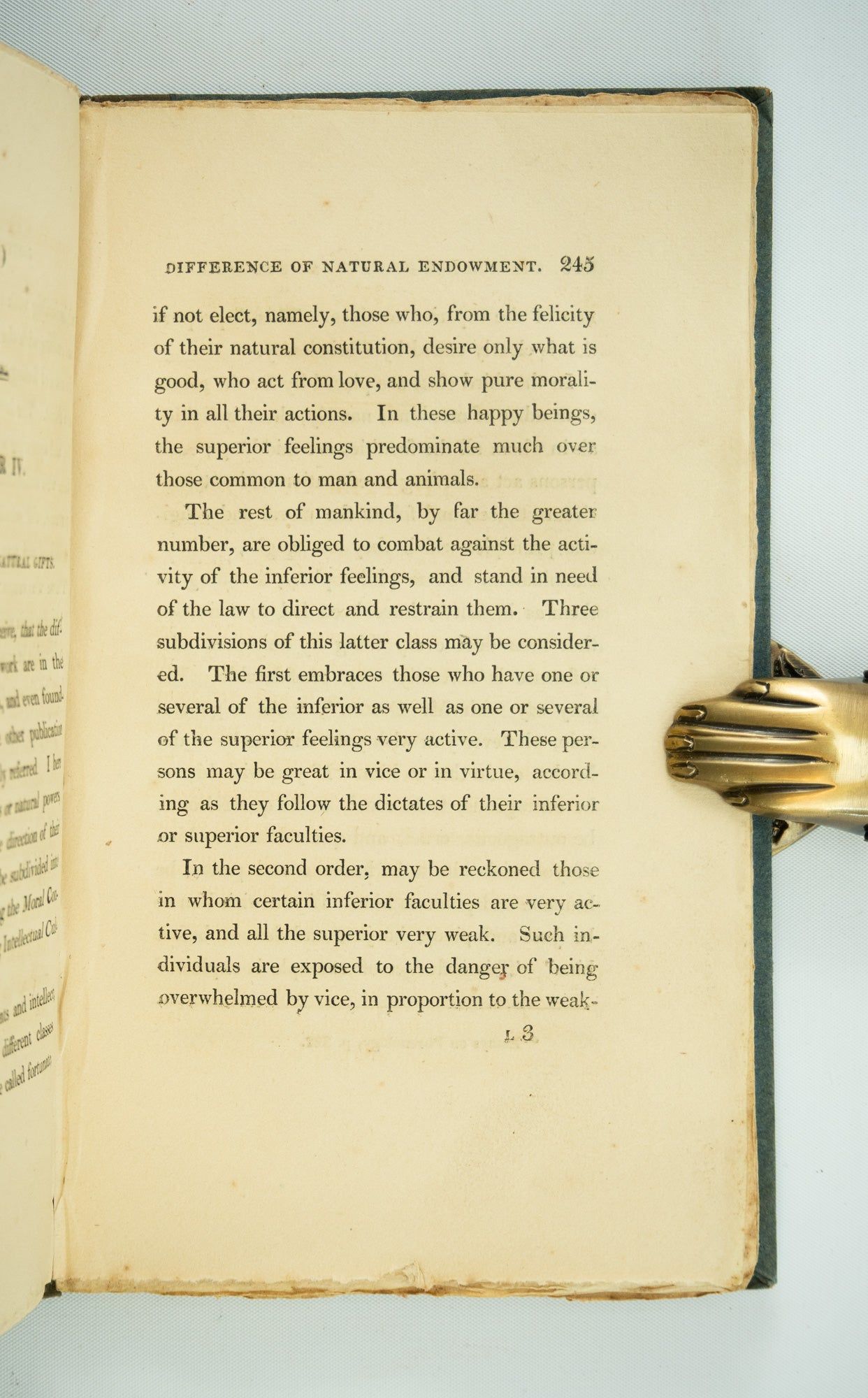
ORIGINAL PUBLISHER'S PAPER BOARDS, paper label on spine, edges untrimmed. Owner's signature of Robert Chichester, dated 1827, on front pastedown. Text a shade less than bright because of inferior paper stock, slight wear to the binding, but AS FINE A COPY IN THE ORIGINAL BOARDS AS ONE COULD HOPE TO FIND, the covers amazingly clean and smooth, and with only the most minor faults internally.
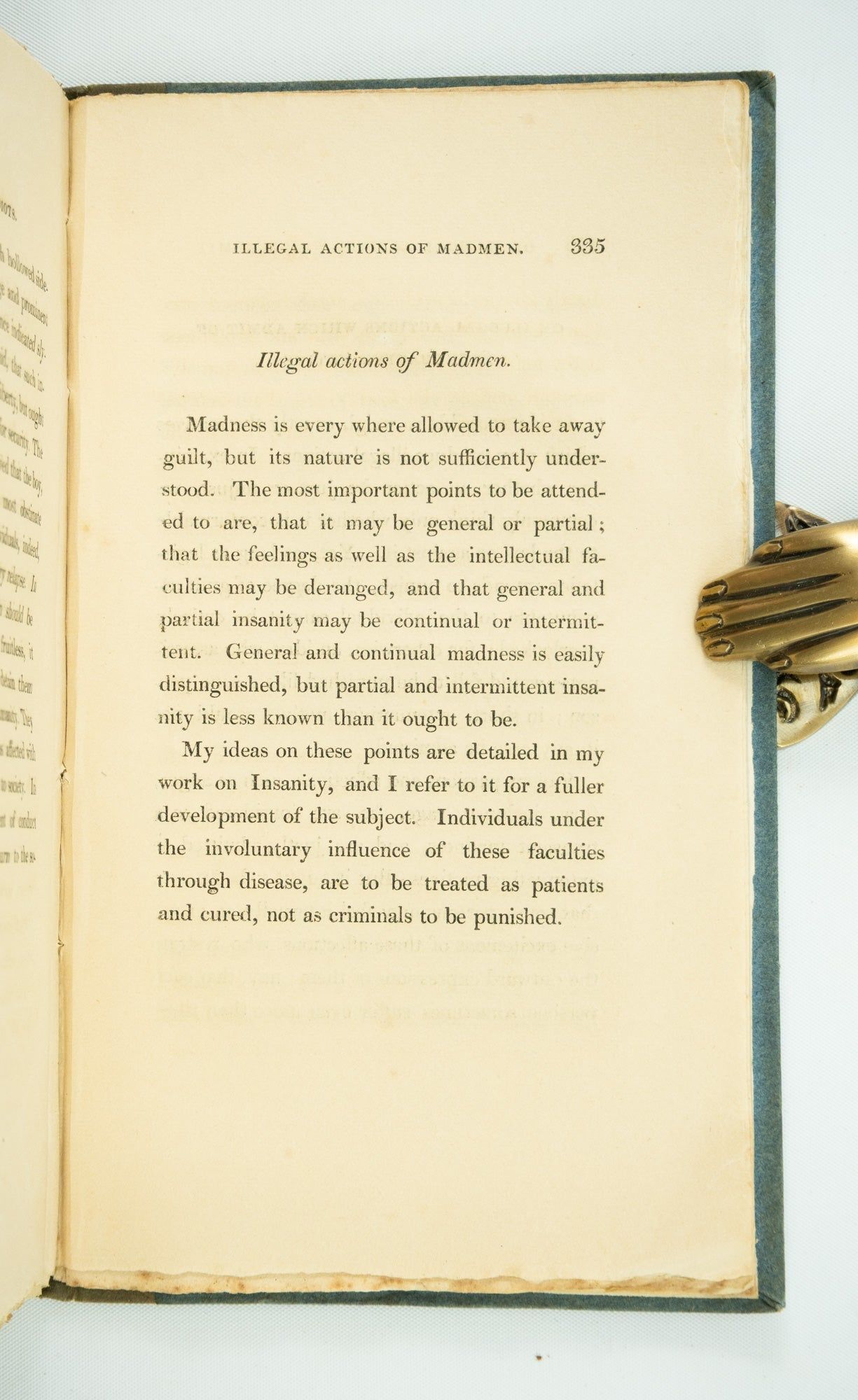
In its original remarkably well-preserved publisher's boards, this work on education captures the spirit of reform abundant in the early 19th century, including its warts. Although Spurzheim (1776-1832) was better known as an exponent of phrenology and an authority on mental illness than as an educational theorist, his "View of the Elementary Principles of Education" is an important work that, for the most part, is sensible and progressive. Especially significant are his assertion that all influences from birth onward contribute to the physical and mental development of the child, and the inference he draws from this that, in addition to the conventional education of the intellect, an optimal upbringing must include attention to such things as clean air, proper diet, and suitable exercise. He favors public education over private instruction because children will benefit by meeting a variety of people with "different manners of feeling and thinking." Spurzheim shows himself to be generally tolerant and forward thinking, as he maintains that good education can improve almost anybody (it would certainly reduce the number of criminals). But he sometimes disappoints, as in his belief that many limitations are hereditary and must be taken into account in designing the most fitting education for an individual. He states, for example, that the poor ought to be prevented from reproducing, as if poverty were in the genes. And, in answering the claims of Mary Wollstonecraft's "Vindication of the Rights of Women," he says, "I cannot perceive any arrangement of nature that can lead me to expect that women will cease to be considered as subordinate to men. Let them endeavor, if they please, to acquire the same degree of talent, but till they have acquired it, let them cherish order and exercise the virtues of their actual condition in society, rather than attempt to rise into a sphere for which they are not at present fitted." Also appended here is a section on the treatment and reform of criminals, in which the author calls for a better understanding of the causes of crime, for the requiring of prisoners to undertake useful work and courses of instruction while in prison, and for the study of the prison system instituted by William Penn at Philadelphia. While the sometimes disheartening contents approach a certain fascination, it's the binding here that competes for--and perhaps wins--our attention. That its fragile construction could hold up so beautifully through two centuries of use is extraordinary..
ORIGINAL PUBLISHER'S PAPER BOARDS, paper label on spine, edges untrimmed. Owner's signature of Robert Chichester, dated 1827, on front pastedown. Text a shade less than bright because of inferior paper stock, slight wear to the binding, but AS FINE A COPY IN THE ORIGINAL BOARDS AS ONE COULD HOPE TO FIND, the covers amazingly clean and smooth, and with only the most minor faults internally.
In its original remarkably well-preserved publisher's boards, this work on education captures the spirit of reform abundant in the early 19th century, including its warts. Although Spurzheim (1776-1832) was better known as an exponent of phrenology and an authority on mental illness than as an educational theorist, his "View of the Elementary Principles of Education" is an important work that, for the most part, is sensible and progressive. Especially significant are his assertion that all influences from birth onward contribute to the physical and mental development of the child, and the inference he draws from this that, in addition to the conventional education of the intellect, an optimal upbringing must include attention to such things as clean air, proper diet, and suitable exercise. He favors public education over private instruction because children will benefit by meeting a variety of people with "different manners of feeling and thinking." Spurzheim shows himself to be generally tolerant and forward thinking, as he maintains that good education can improve almost anybody (it would certainly reduce the number of criminals). But he sometimes disappoints, as in his belief that many limitations are hereditary and must be taken into account in designing the most fitting education for an individual. He states, for example, that the poor ought to be prevented from reproducing, as if poverty were in the genes. And, in answering the claims of Mary Wollstonecraft's "Vindication of the Rights of Women," he says, "I cannot perceive any arrangement of nature that can lead me to expect that women will cease to be considered as subordinate to men. Let them endeavor, if they please, to acquire the same degree of talent, but till they have acquired it, let them cherish order and exercise the virtues of their actual condition in society, rather than attempt to rise into a sphere for which they are not at present fitted." Also appended here is a section on the treatment and reform of criminals, in which the author calls for a better understanding of the causes of crime, for the requiring of prisoners to undertake useful work and courses of instruction while in prison, and for the study of the prison system instituted by William Penn at Philadelphia. While the sometimes disheartening contents approach a certain fascination, it's the binding here that competes for--and perhaps wins--our attention. That its fragile construction could hold up so beautifully through two centuries of use is extraordinary..
Details
Title
A VIEW OF THE ELEMENTARY PRINCIPLES OF EDUCATION, FOUNDED ON THE STUDY OF THE NATURE OF MAN
Author
(BINDINGS - PUBLISHER'S BOARDS). (EDUCATION). SPURZHEIM, JOHANN GASPAR
Condition
Unknown
Publisher
Printed for Arch[ibal]d Constable & Co.; London: Hurst, Robinson & Co: Edinburgh
Date
1821
Edition
FIRST EDITION