

Two Antiwar Underground Press Syndicate Dispatches from the Riotous Antiwar 1972 Miami Democratic National Convention
- 1972
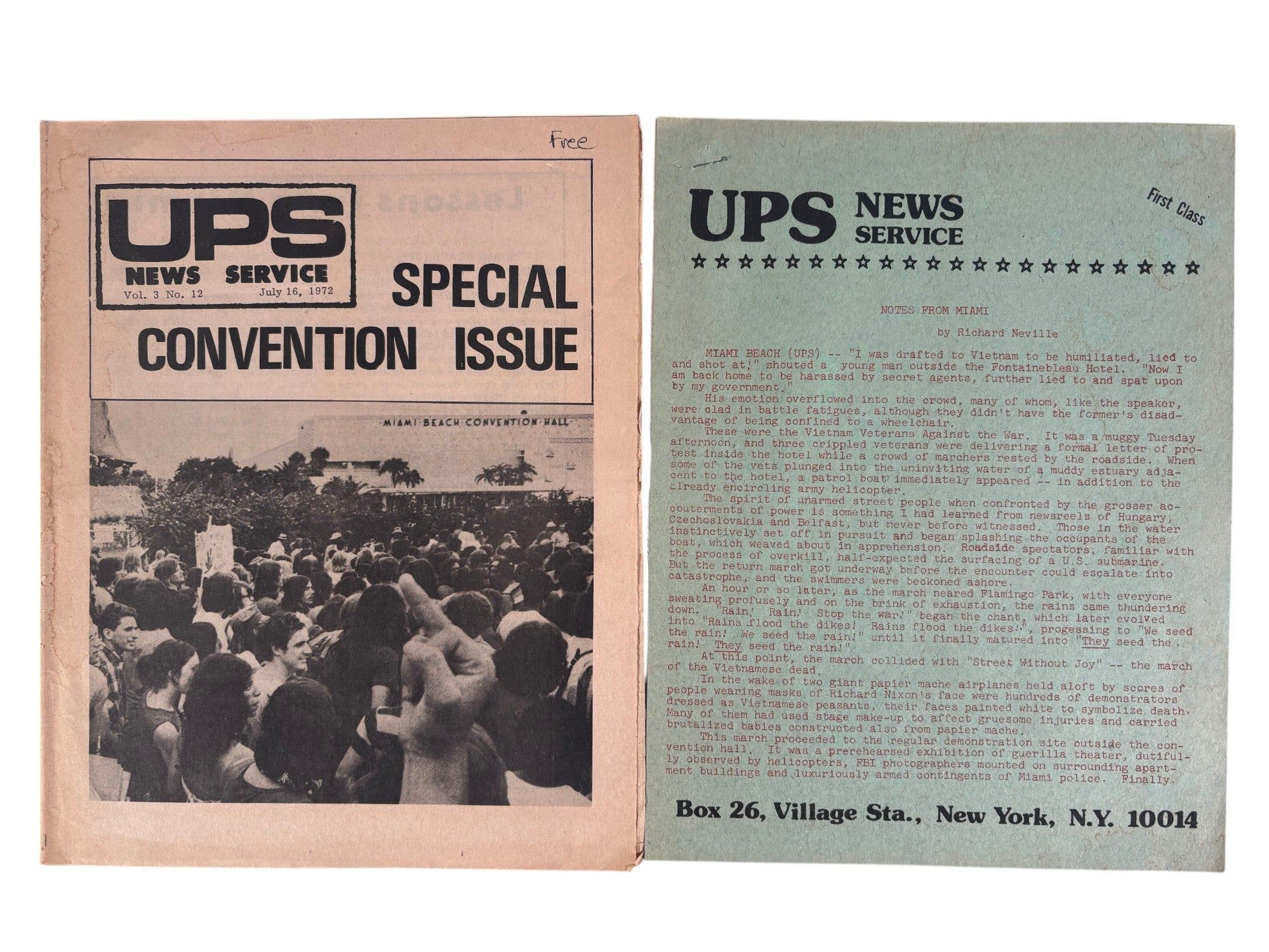
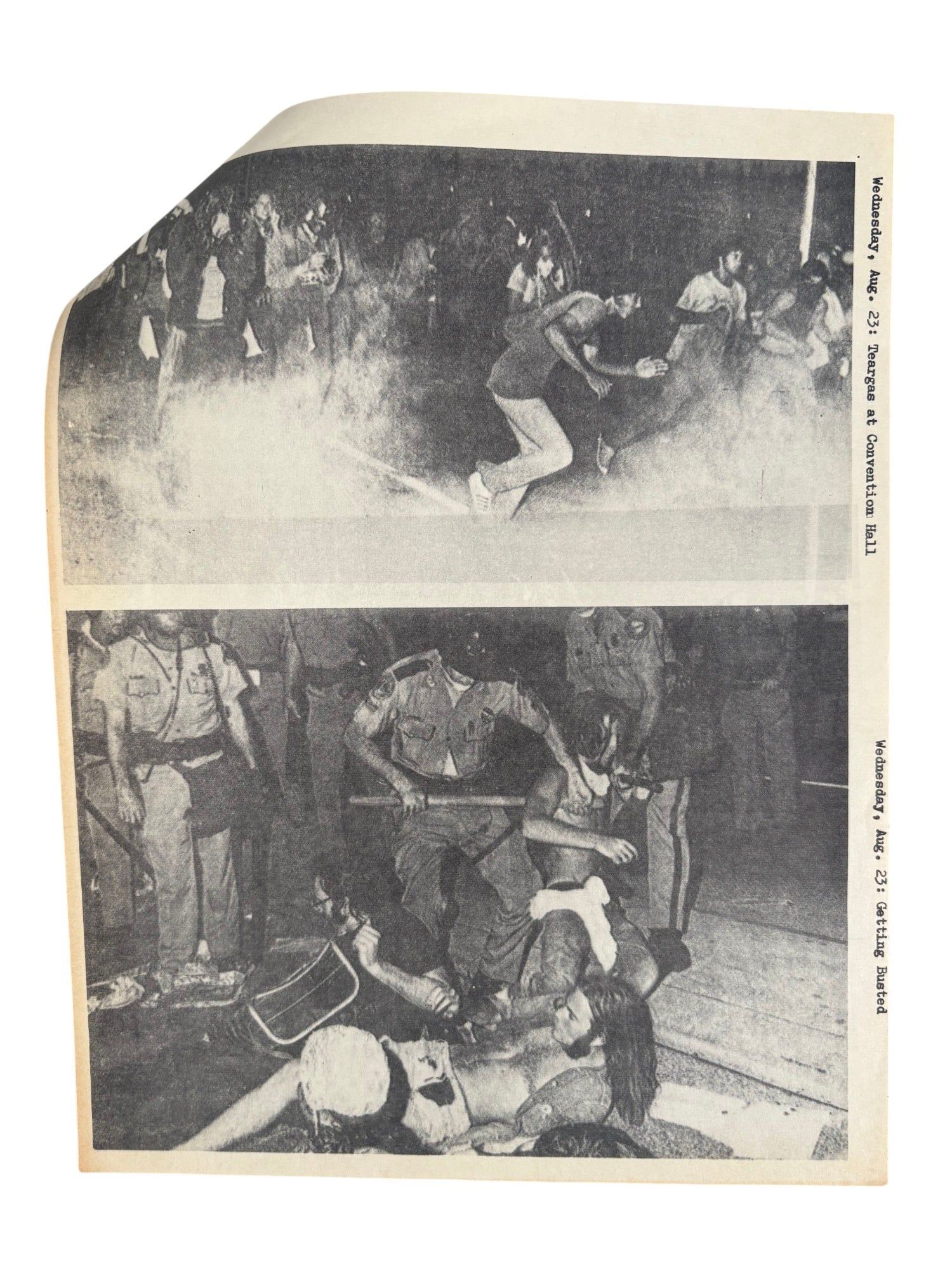
1972. [Counterculture] [Radical Activism] Rare and vivid primary documentation of the radical left's confrontation with the Democratic Party establishment during the 1972 Miami Democratic National Convention. New York: Underground Press Syndicate, July 16, 1972. Two items: [1] UPS News Service, Vol. 3, No. 12. "Special Convention Issue." July 16, 1972. 16 pages. [2] Neville, Richard. Notes from Miami. Typed newsletter on green paper. 8 typed pages and 2 pages of photographs of street protests at the 1972 Miami Democratic National Convention. Two Underground Press Syndicate Dispatches, as reported by UPS News Service-the house organ of the Underground Press Syndicate, a national network of underground newspapers. This "Special Convention Issue" and accompanying broadside chronicle the eruption of antiwar, countercultural, and Vietnam veteran-led protest in Miami Beach in July 1972, revealing the deep fissures between radical activists and the liberal center during the height of the Vietnam War and the Nixon era. The front page features a defiant middle finger raised above a crowd of protestors gathered outside the Miami Beach Convention Hall, a potent symbol of irreverence and rage. Inside, photojournalist Mark Diamond captures chaotic scenes of state repression, including one chilling spread labeled "Wednesday, Aug. 23: Parading at Convention Hall / Getting Busted." The upper photograph shows a group of young protestors fleeing from a cloud of tear gas, one in mid-sprint with a gas-soaked rag around his neck, while others shield their faces. Below, a more brutal confrontation: shirtless protestors, many bloodied, lie prone on the pavement as helmeted police with clubs stand over them.
The accompanying green newsletter titled Notes from Miami, authored by Richard Neville, provides a firsthand narrative of the protests. "I was drafted to Vietnam to be humiliated, lied to and shot at," proclaims one speaker outside the Fontainebleau Hotel. "Now I am back home to be harassed by secret agents. Further lied to and spat upon by my government." Neville recounts, "The emotion overflowed into the crowd, many of whom, like the speaker, were clad in battle fatigues, although they didn't have the former's disadvantage of being confined to a wheelchair." He describes a press conference led by Vietnam Veterans Against the War, noting, "It was a muggy Tuesday afternoon and three crippled veterans were delivering a formal letter of protest inside the hotel while the crowd of marchers nearby roared, riddled with paranoia and hope." The hotel windows were shuttered, "The sky was muddy cobalt. Jeeps coasted. Police milled and waited. Helicopters roared. The mood oscillated wildly."
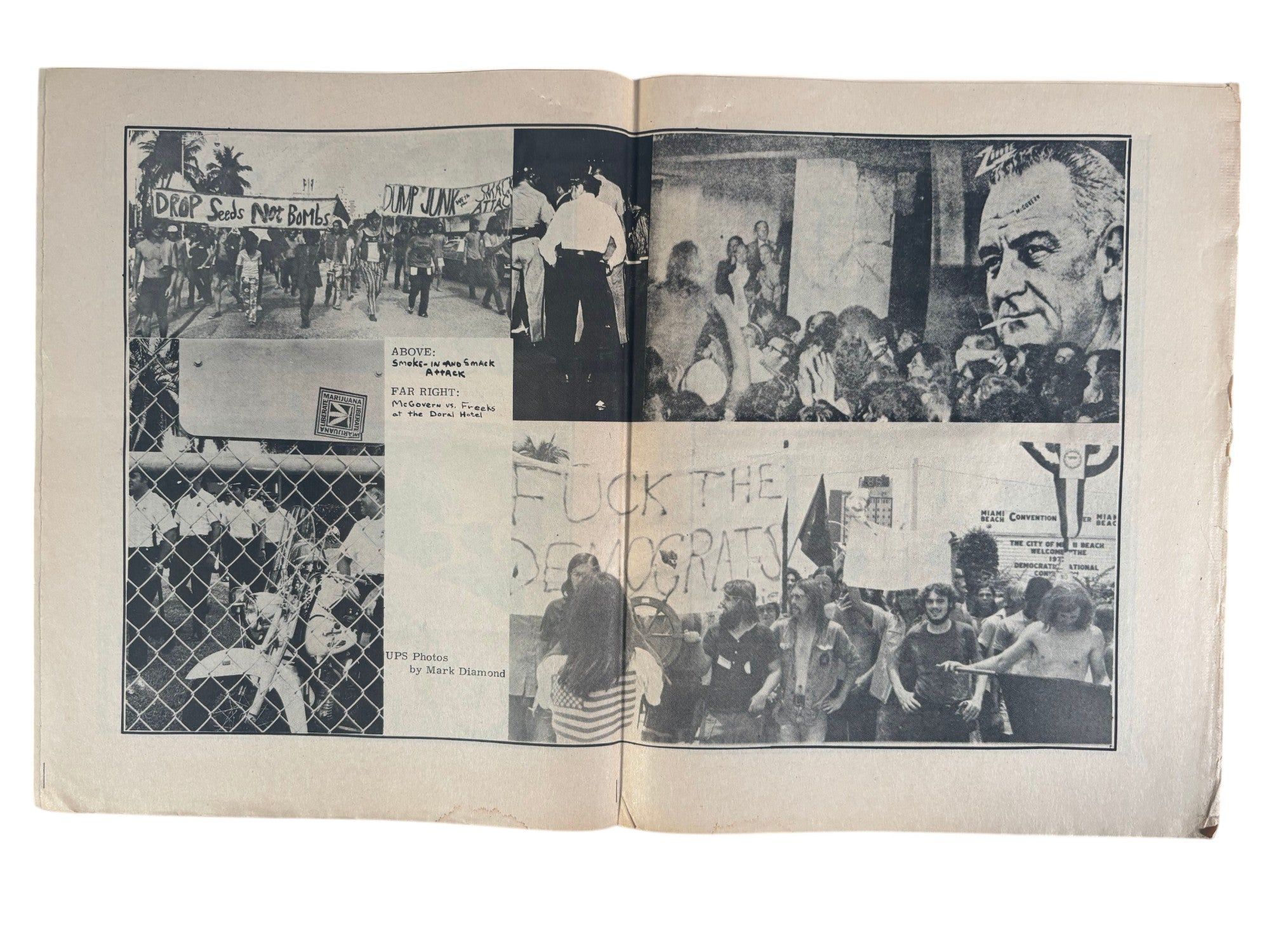
The center spread of the UPS broadsheet functions as a visual protest manifesto. In a collage of candid photos, demonstrators carry a long horizontal banner reading "DROP SEEDS NOT BOMBS," while in another we see "FUCK THE DEMOCRATS," spray-painted across a barricade. In one photograph, a topless protestor raises a clenched fist while others cheer, march, and chant outside the gates of the Democratic National Convention. These protest actions coincided with the nomination of George McGovern, whose antiwar platform initially drew support from the New Left but ultimately alienated many radical activists due to perceived compromises with the political center. The visual and textual content of UPS News Service captures the generational and ideological rift between New Left radicals, Vietnam veterans, Yippies, feminists, and others on one side, and the centrist Democrats they saw as complicit in war, racism, and political repression.
As the publishing arm of the Underground Press Syndicate, UPS News Service connected alternative press outlets across the country-from Berkeley Barb to Fifth Estate-and operated both as a wire service and an occasional print periodical. Its raw photography, firsthand reportage, and unapologetic political stance make issues like this essential primary sources in the history of post-1960s dissent. Exceptionally scarce in commerce and seldom retained in complete form by institutions, this pairing of broadsheet and newsletter offers an unfiltered, militant chronicle of resistance at one of the most volatile intersections of protest and electoral politics in modern U.S. history. Newsprint lightly toned, with minor edge wear; newsletter folded once horizontally, with mild handling. Very good overall.
The accompanying green newsletter titled Notes from Miami, authored by Richard Neville, provides a firsthand narrative of the protests. "I was drafted to Vietnam to be humiliated, lied to and shot at," proclaims one speaker outside the Fontainebleau Hotel. "Now I am back home to be harassed by secret agents. Further lied to and spat upon by my government." Neville recounts, "The emotion overflowed into the crowd, many of whom, like the speaker, were clad in battle fatigues, although they didn't have the former's disadvantage of being confined to a wheelchair." He describes a press conference led by Vietnam Veterans Against the War, noting, "It was a muggy Tuesday afternoon and three crippled veterans were delivering a formal letter of protest inside the hotel while the crowd of marchers nearby roared, riddled with paranoia and hope." The hotel windows were shuttered, "The sky was muddy cobalt. Jeeps coasted. Police milled and waited. Helicopters roared. The mood oscillated wildly."
The center spread of the UPS broadsheet functions as a visual protest manifesto. In a collage of candid photos, demonstrators carry a long horizontal banner reading "DROP SEEDS NOT BOMBS," while in another we see "FUCK THE DEMOCRATS," spray-painted across a barricade. In one photograph, a topless protestor raises a clenched fist while others cheer, march, and chant outside the gates of the Democratic National Convention. These protest actions coincided with the nomination of George McGovern, whose antiwar platform initially drew support from the New Left but ultimately alienated many radical activists due to perceived compromises with the political center. The visual and textual content of UPS News Service captures the generational and ideological rift between New Left radicals, Vietnam veterans, Yippies, feminists, and others on one side, and the centrist Democrats they saw as complicit in war, racism, and political repression.
As the publishing arm of the Underground Press Syndicate, UPS News Service connected alternative press outlets across the country-from Berkeley Barb to Fifth Estate-and operated both as a wire service and an occasional print periodical. Its raw photography, firsthand reportage, and unapologetic political stance make issues like this essential primary sources in the history of post-1960s dissent. Exceptionally scarce in commerce and seldom retained in complete form by institutions, this pairing of broadsheet and newsletter offers an unfiltered, militant chronicle of resistance at one of the most volatile intersections of protest and electoral politics in modern U.S. history. Newsprint lightly toned, with minor edge wear; newsletter folded once horizontally, with mild handling. Very good overall.
Details
Title
Two Antiwar Underground Press Syndicate Dispatches from the Riotous Antiwar 1972 Miami Democratic National Convention
Author
Miami Antiwar Underground Press
Condition
Unknown
Date
1972